
Aleenta Retreat Chiang Mai sits in the Suthep area, in the foothills of Doi Suthep near Wat Umong. The hotel itself describes the setting as quiet and residential, away from the busier parts of the city. That is the first thing to understand: this is not a Nimman or Old City hotel that happens to have a good spa downstairs. The location is part of the retreat mechanism. If you still want to walk out for coffee, dinner and spontaneous city time every day, compare Old City vs Nimman before treating wellness as the main booking criterion.
The real choice is structure versus modularity
AYURAH at Aleenta currently builds personalised retreats around consultation, with programs spanning multiple nights and combining practices such as yoga, meditation, breathwork, Qi Gong or Tai Chi with spa treatments and wellness cuisine. Current Yoga & Mindfulness itineraries, for example, are published in 3-, 5- and 7-night formats and include accommodation, three wellness meals per day, classes and specified treatments.
A central hotel plus outside spa sessions gives you modularity. You can keep the city as the default and add wellness when you feel like it. Aleenta reverses the relationship: the retreat becomes the default, and city time has to fit around it.
Stay planning
Find a place to stay
See available rooms around the property or neighborhood discussed here, with prices for your dates.
Do not compare “hotel + spa” with “hotel + spa”
That comparison hides the most important difference. Aleenta currently offers several levels of commitment. A normal hotel stay can still use the property and book individual AYURAH services. The resort also promotes a minimum-two-night Luxury All-Inclusive format with daily meals, non-alcoholic wellness drinks, a personalised spa treatment each day and selected wellness activities during the first two days. Above that sit structured retreat programs with consultation, repeated classes, treatments and wellness meals.
Central hotel + external wellness
Best when the city is the trip and wellness is one or two appointments. You retain walk-out dining, café choice and easier last-minute changes.
Aleenta stay + selected wellness
The middle ground. You get the quiet Suthep setting and AYURAH access without promising your whole trip to a formal retreat rhythm.
Aleenta structured retreat
Best when the point is repetition: movement, treatment, food and reflection are meant to reinforce each other across several days.
| Decision point | Aleenta Retreat Chiang Mai | Central hotel + separate spa/yoga | Who wins? |
|---|---|---|---|
| Wellness frequency | Designed for repeated sessions and multi-night programs | Easy to keep wellness occasional | Aleenta when you want several touchpoints, central hotel when you want one or two |
| Food | The Garden serves breakfast, lunch and dinner; wellness cuisine is integrated into retreat programs | Much wider restaurant and café choice outside the hotel | Aleenta for a deliberate food framework; city base for spontaneity |
| Evening freedom | Quiet foothill setting; leaving for dinner adds a transport decision | Walk-out options depend on the exact neighborhood but can be much easier | Central hotel if you expect to change plans after 6 p.m. |
| Transport | Official concierge can arrange private airport transfer | Airport and city rides depend on the chosen base | Neither automatically; compare your repeated rides, not one airport transfer |
| First-time wellness | Official AYURAH information says beginners are accepted and introductory programs are available | Lower commitment if you are unsure whether you enjoy structured wellness | Central hotel for experimentation; Aleenta if guidance is exactly what you want |
| Room choice | Current rooms range from 45 m² balcony rooms to pool residences and a 300 m² four-bedroom teak villa | Depends entirely on hotel | Do not let a bigger room distract from the location and schedule decision |
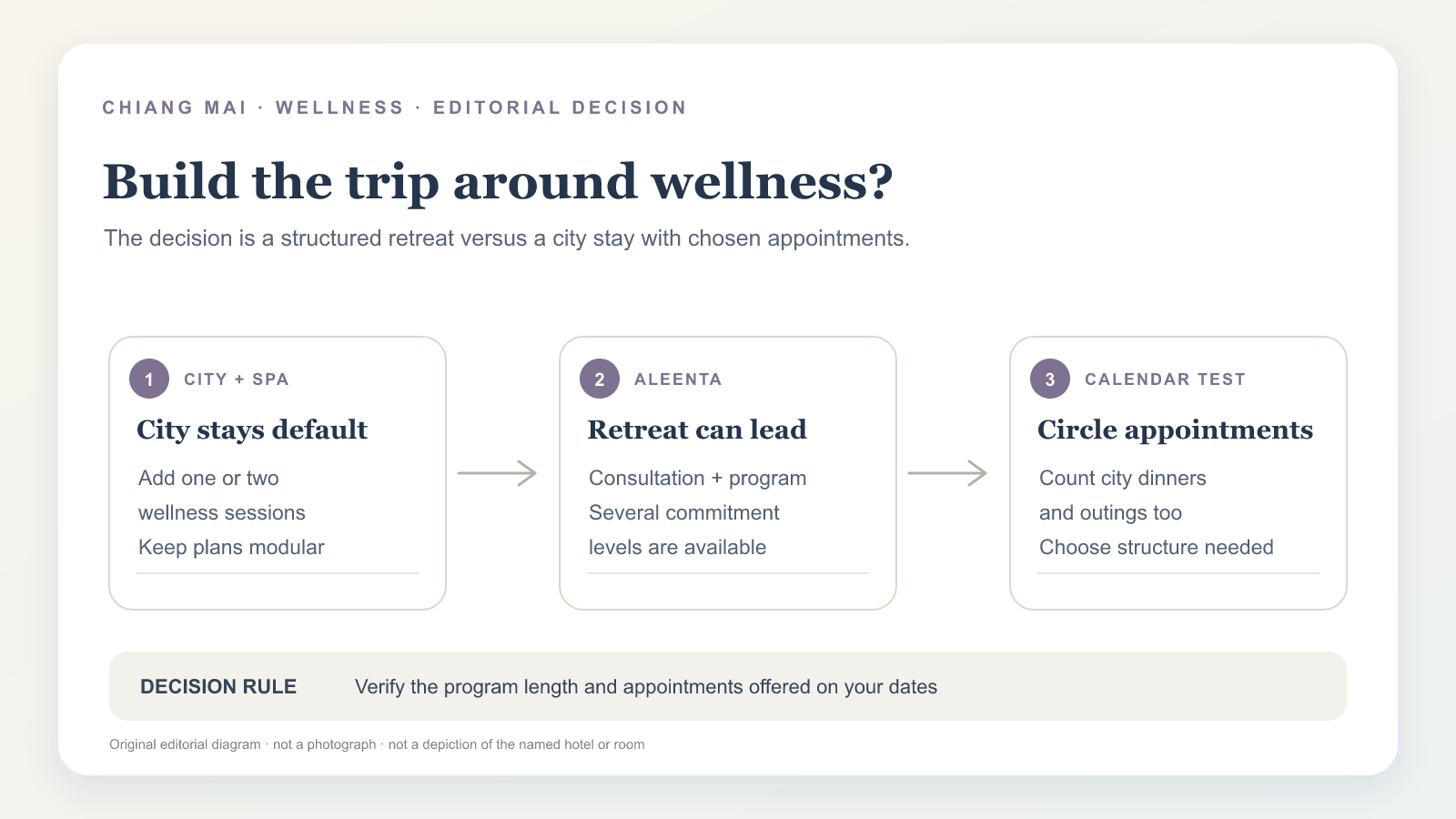
The decision diagram is not a property photograph
The image above is an original editorial diagram, not a depiction of Aleenta, a room, the spa or The Garden. The hotel’s current accommodation, wellness and dining details are supported by the official sources below; no property photographs are displayed in this article.
The calendar test: circle the wellness appointments before booking
Take your actual Chiang Mai plan and mark the wellness blocks you genuinely want. If a four-night trip contains one massage on day two, Aleenta is competing against every central hotel plus one spa booking. If the same trip contains morning yoga, a private treatment, an intentional lunch, afternoon recovery and another guided practice, Aleenta is competing against a chain of separate reservations, rides and decisions.
This is why a retreat can feel expensive and efficient at the same time. The retreat also sells coordination: fewer choices between sessions, fewer transfers, fewer “where should we eat now?” decisions and a setting that makes it easier to continue the plan. But that efficiency only exists if you wanted the plan in the first place.
When a central hotel is the stronger choice
Stay central when your Chiang Mai list is still dominant: Old City temples in the morning, Nimman cafés in the afternoon, Night Bazaar or Chang Khlan after dark, plus day trips. In that shape of trip, every retreat session competes with something outside the hotel. The same logic appears in our riverside resort vs central hotel guide and the shuttle vs walk-out base decision: a better property does not erase the cost of repeated departures and returns.
A central hotel is also better if your definition of wellness is flexible. Maybe you want one excellent massage, a café breakfast and then a late dinner. Maybe your friend wants yoga while you want to sleep. You do not need both travelers to consume the same wellness schedule to enjoy Chiang Mai. Two friends with different appetites for spa time often benefit from keeping the accommodation neutral and buying wellness separately.
When Aleenta becomes more logical
Aleenta becomes more convincing when you actively want the hotel to occupy the middle of the itinerary. Its official wellness program currently covers meditation, yoga, breathwork, Qi Gong, Tai Chi, spa therapies, sound treatments, walks and wellness cooking, with beginners explicitly welcomed. That breadth matters because you can build several different kinds of quiet day without leaving the property.
The resort also solves food continuity. The Garden serves breakfast, lunch and dinner, and wellness cuisine is integrated into retreat programs. If you choose a structured retreat because you want a food framework as much as a massage, comparing it with a central room plus one spa appointment misses half the product. Conversely, if Chiang Mai cafés are one of the reasons you are travelling, booking three hotel meals a day can become a feature you paid for and then repeatedly abandoned. The breakfast-included vs room-only decision is the smaller version of the same problem.
Do you need to move hotels for it?
Not necessarily. A split stay is cleaner when the phases are genuinely different: first use a central hotel for temples, restaurants and late evenings, then move to Aleenta and stop commuting back into town for every meal. If you intend to keep returning to the Old City or Nimman throughout the “retreat” half, you have created a resort commute rather than a retreat.
For a five- or six-night Chiang Mai trip, two or three city nights followed by a protected wellness phase can be rational. For a three-night first trip, moving hotels can easily cost more attention than it saves. Use our city + out-of-town split-stay test even though Aleenta is not in Hang Dong: the principle is the same — the second property should give the trip a distinct pace.
Solo traveler note: retreat comfort and city freedom are different kinds of ease
Aleenta's own FAQ positions the property as suitable for solo travelers seeking rest and reflection, and the structured environment can remove the awkwardness of figuring out every meal or wellness appointment alone. For a first solo retreat, that can be useful.
But do not confuse structured comfort with walk-out convenience. The foothill setting is deliberately quieter. If your version of solo confidence comes from stepping outside into a well-lit, busy neighborhood with cafés and dinner choices, a central base may feel easier. If your version of comfort is knowing where your next session and meal are happening without negotiating transport after dark, Aleenta may feel easier. Those are different needs.
Rain and airport days make the difference sharper
On wet days, an integrated property reduces handoffs between hotel, spa, yoga studio and meals. That is a real advantage if those are your planned activities. But if your itinerary still requires repeated city rides, the retreat location does not solve rain friction; it can add another pickup. Our rainy-season hotel guide is useful here: count how often you can move between covered spaces during the day.
For arrival, Aleenta says its concierge can arrange a private transfer from Chiang Mai International Airport. That makes the first handoff manageable, but one smooth airport transfer should not be used to justify a location for four days. If your flight lands late, settle the first-night problem separately with the Chiang Mai airport late-arrival guide; if your last flight is early, use the airport hotel vs city hotel test rather than moving automatically.
Five booking gates before you commit to Aleenta
Write down the actual program
Do not book “a wellness retreat” as a vague mood. Confirm which current program or stay package you are buying, its length, consultations, classes, meals and treatments.
Check whether both travelers want the same level of structure
For two friends especially, one person's retreat can become the other person's expensive waiting room. Compare the exact participation rules and what a non-participating companion would do.
Confirm the room category and retreat package
Current accommodation includes 45 m² Deluxe and Club Balcony rooms, 75 m² one-bedroom and 100 m² two-bedroom pool residences, plus the larger Golden Teak Villa. Match bedding, privacy and luggage space to the party.
Count the city exits you still plan to make
If you have three restaurant reservations and two evening markets saved, you probably have not built a retreat phase yet. Compare resort dining vs hotel near restaurants before paying for an integrated food routine you will keep leaving.
Protect enough time
A wellness property is poor value when it is treated like a place to sleep between day trips. If your four-day plan is still full, use the Chiang Mai 4-day itinerary to see what you would actually remove.
My pick
For a first Chiang Mai trip with only one or two wellness appointments, choose the central hotel and book those separately. You keep restaurant choice, easier spontaneous evenings and a cleaner sightseeing base.
Choose Aleenta Retreat Chiang Mai when the point of two or more days is to stop assembling the day yourself. Consultation, movement, treatment, food and quiet should be the itinerary. That is the product you are paying for.
If you want both Chiang Mai and the retreat, split the trip only when you can protect the Aleenta phase from repeated rides back into town. Otherwise, keep one central base and buy wellness à la carte.
For the broader destination graph, return to the Chiang Mai guide hub or browse all Chiang Mai stay decisions.
Sources checked
Stay planning
Find a place to stay
See available rooms around the property or neighborhood discussed here, with prices for your dates.