
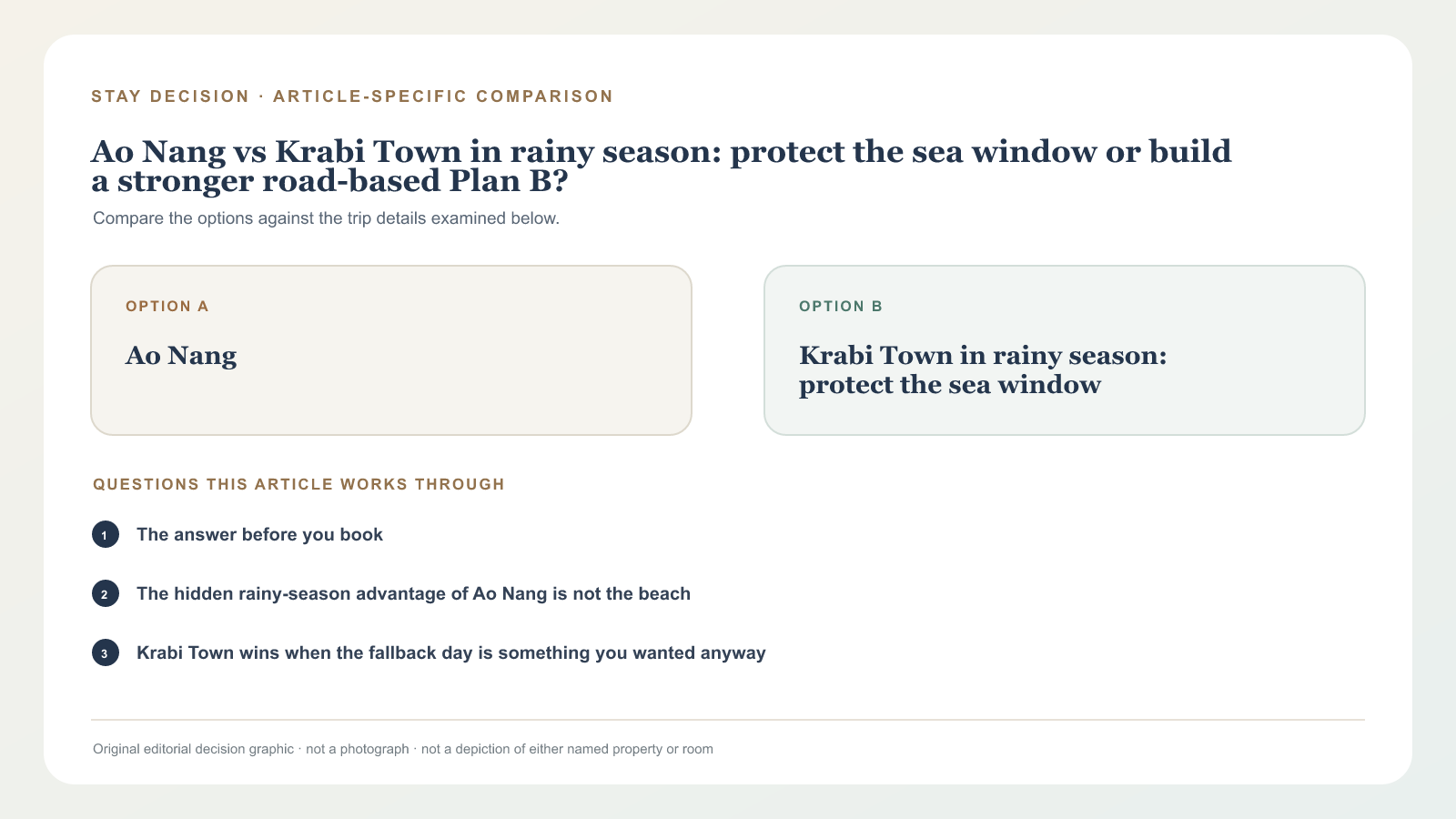
The ordinary Krabi Town vs Ao Nang decision asks whether you want a town-and-inland base or a beach-and-boat base. Rainy season adds a sharper question: when the original plan becomes uncertain at 7 a.m., which kind of day would you rather salvage?
That is not the same problem as Ao Nang vs Klong Muang in rainy season. Klong Muang can work as a resort-based weather refuge. Krabi Town is a different proposition: it is useful when you want to replace marine uncertainty with road-connected and town-based choices rather than retreat into the hotel.
The answer before you book
Pick Ao Nang for a short trip with one or more must-do island days, a first visit where Railay matters, or a schedule that needs to move boat days around as conditions change.
Pick Krabi Town if Emerald Pool, hot springs, Tiger Cave, markets, cafés and town evenings already occupy a meaningful share of the trip—and you will not resent skipping the coast when the marine forecast is poor.
Do not pick Krabi Town because you think it is “safer in rain,” and do not pick Ao Nang because you think rain means boats always stop. Current Krabi operator guidance distinguishes ordinary tropical rain from unsafe sea conditions. Wangsai Speedboat says trips can proceed in light rain, while strong winds or high waves can trigger cancellation; the captain and authorities make the safety decision.
Stay planning
Find a place to stay
See available rooms around the property or neighborhood discussed here, with prices for your dates.
The hidden rainy-season advantage of Ao Nang is not the beach
Tourism Authority of Thailand still describes Ao Nang as Krabi’s major launching point for nearby island trips, with hotels, restaurants, bars and shops concentrated along the seaside visitor strip. In changeable weather, that density gives you something more valuable than a prettier morning view: you can hold your coastal plan loosely without spending a road transfer every time you check whether it is back on.
Imagine you have Hong Islands tomorrow and Four Islands the day after. If tomorrow’s sea conditions are poor but the following day improves, staying in Ao Nang makes it easier to swap the marine day, fill the disrupted hours locally and try again without turning the whole holiday into transport choreography.
If your marine priority is specifically Hong Islands, use the Hong Islands longtail vs speedboat guide after the weather decision is made. Boat format and weather fitness are separate questions.
Krabi Town wins when the fallback day is something you wanted anyway
A good rainy-season Plan B should not feel like punishment. Krabi Town works when a road-based day, town food or riverfront evening was already attractive enough to make the itinerary. TAT’s current Krabi information lists Maharaj Walking Street on Friday to Sunday evenings, while its Krabi Town day route links the town with Khao Khanap Nam, Ko Klang and the surrounding river landscape.
That does not make every town activity rainproof. Khao Khanap Nam and Ko Klang still involve outdoor time and, in the former case, a boat across the river. The point is broader: a Krabi Town stay reduces your psychological dependence on the sea being the headline every day. You are less likely to spend the whole morning refreshing a marine forecast because the next-best version of the day is already nearby or road-based.
For a fully inland-heavy trip, the narrower comparison is Krabi Town vs Ao Nang for Emerald Pool and Tiger Cave. Use that page when the inland attractions—not weather resilience—are the main decision.
| When the plan changes | Ao Nang | Krabi Town |
|---|---|---|
| Boat day is postponed, but you still want to try tomorrow | Better fit. Stay inside the coast-and-tour ecosystem. | Works, but you have added a road journey back toward the coastal departure system. |
| You are happy replacing the sea with an inland road day | Possible, but the base is no longer doing much of the work. | Better fit. Town and inland intent align. |
| Rain clears for only a few usable evening hours | Better for beach-strip spontaneity. | Better for market/town spontaneity when the relevant market is operating. |
| Your trip is three nights and the islands are non-negotiable | Usually choose Ao Nang. | Too much of the stay may be spent commuting toward your actual priority. |
| You already planned two inland days and only one optional boat day | Coastal convenience may be underused. | Krabi Town becomes very defensible. |
Run the 7 a.m. test, not the sunshine-photo test
The operator says: wait for confirmation
Ao Nang is calmer operationally because you are already near the tourism infrastructure built around marine departures. In Krabi Town, do not start a road transfer until your exact pickup or meeting instruction is confirmed.
The boat is cancelled for safety
If you are in Ao Nang, rebuild the day locally or use our rainy-day island-vs-inland decision. In Krabi Town, a road-based pivot can feel more natural because you have not centered the morning on the beachfront in the first place.
The sky opens again after a dry spell
Ao Nang makes a spontaneous coastal walk, dinner or massage easy if your hotel is well positioned. Krabi Town gives you its own evening rhythm, especially around the town’s dining and market areas. Neither is “better”; the useful base is the one whose evening you wanted before it rained.
You are walking back in wet sandals
The exact hotel pin now matters more than the district label. A central-sounding hotel can still involve a dim side road, poor drainage or a longer-than-expected walk. Audit the last 300–500 metres rather than assuming a busy area guarantees an easy wet-weather return.
For solo women, check the return route after rain and after dark
Rain compresses evenings. You may leave dinner later than planned, take a taxi for a distance you would normally walk, or end up carrying a wet bag while looking for the correct hotel entrance. In either base, inspect lighting, road shoulders, covered frontage and the realistic route from dinner or your drop-off point.
Ao Nang usually offers more visitor-facing density, but a cliffside or inland property can still create an awkward final walk; Ao Nang without a scooter is the better micro-location check. In Krabi Town, compare the exact riverside or market-core position using our Krabi Town riverside vs market-core guide.
Low season can remove transport options before it removes your holiday
Rainy season is not simply a weather icon. Some marine routes have seasonal operating windows. Aonang Travel & Tour currently marks specific ferry services as unavailable for substantial parts of the 2026 low season and says travel time depends on weather. The exact route matters: do not generalize one ferry timetable to every boat in Krabi.
This makes an important distinction between the two bases. Ao Nang is better if you are trying to preserve the chance of doing marine days when a safe window appears. Krabi Town is better if you are willing to let the sea drop down the priority list rather than reorganize the trip around it.
If your trip includes Railay, read Ao Nang vs Railay separately. Railay adds a boat-access dependency that changes the rainy-season calculation again.
August and September: do not build the hotel decision around Maya Bay
The Thai Government’s 2026 national-park closure guidance asks travelers to verify site status because seasonal closures vary by park and weather. Maya Bay, Loh Samah Bay and Lo Ko Bay also have an established annual 1 August–30 September rehabilitation closure, linked to both ecological recovery and monsoon-season safety.
That means an August or September Phi Phi product may operate with a different stop pattern. Before choosing Ao Nang simply because a listing shows Maya Bay, verify the exact dated itinerary. If Phi Phi is the main reason for the trip, the Phi Phi early-bird vs standard tour guide handles tour timing once current access is confirmed.
Two trip shapes make the choice almost automatic
Four nights: Railay + Hong + one free day
Ao Nang. Your holiday is still marine-led. The free day is buffer. You want to move Hong or Railay around the safest usable sea window, not make the road-based fallback the center of the trip.
Five nights: Emerald Pool + Tiger Cave + town food + one optional island day
Krabi Town is credible. The coast is one option rather than the operating system. A cancelled boat day does not erase the trip you actually came to do.
What not to optimize
Do not choose by a tiny hotel-rate difference if the cheaper base forces repeated transfers toward your real priorities. Do not choose by the prettier pool if you know you hate staying in when weather changes. And do not choose by a generic statement that one area is “better in monsoon season.” The same storm affects the region; the decision is about how gracefully your itinerary fails.
If you are arriving late or leaving early, weather resilience may not be the dominant question at all. Use Krabi Town vs Ao Nang after a late flight or Krabi Town vs Ao Nang for the last night instead.
The one-line rule
Stay in Ao Nang when rainy season makes you want to preserve the next safe sea window; stay in Krabi Town when a town-and-road day is a real substitute you would enjoy even if the boat never goes.
Sources checked
Stay planning
Find a place to stay
See available rooms around the property or neighborhood discussed here, with prices for your dates.