
The recommendation
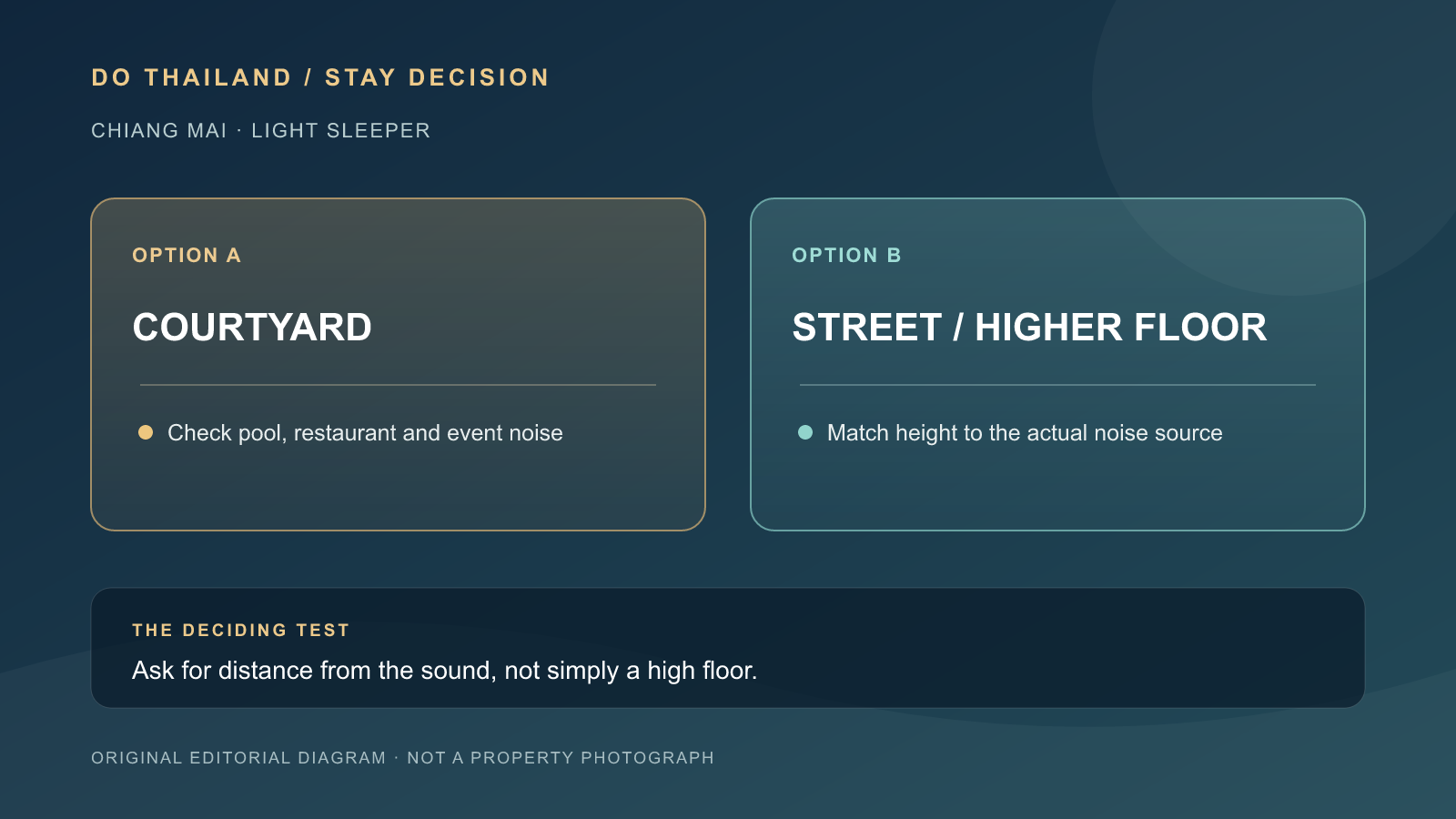
For a light sleeper in Chiang Mai, choose by noise source → distance → barrier → floor. Treat “courtyard,” “city view,” “mountain view” and “high floor” as room-position clues, not quietness guarantees.
If the hotel cannot confirm a specific orientation, make your request precise but modest: ask for a non-connecting room away from lifts and service areas, and—if the property layout allows—away from whichever late-night source worries you most. A request note is still a request, not a booked feature.
Stay planning
Find a place to stay
See available rooms around the property or neighborhood discussed here, with prices for your dates.
Name the noise before you choose the room
“Quiet” is too vague to be useful. Chiang Mai hotels can have several completely different sound environments inside the same property. A room can be away from a road but above an arrival driveway. Another can be deep inside the building but beside an elevator bank. A resort room can be far from traffic and still overlook a pool or restaurant that stays active after you want to sleep.
Road and nightlife
Think traffic, motorbikes, horns, music and people returning late. Distance from the facade and an inward orientation may matter more than one extra floor.
Hotel social spaces
Pools, bars, breakfast rooms, restaurants and event lawns can create their own schedule. An inward room is not automatically quieter if it faces the busiest shared space.
Internal circulation
Lifts, stair doors, housekeeping stores, ice or service areas and high-traffic corridors create short repeated sounds close to the bed. Floor height does little to solve these.
Building equipment
Rooftop or service equipment can make the top floor a poor automatic choice. “Highest possible floor” is therefore a weaker request than “quiet room away from known mechanical/service areas.”
This is why the pool-access vs upper-floor decision is not a universal noise ranking. Pool access may increase activity near the room; an upper floor can improve privacy, but the actual source and building layout still decide the sleep trade-off.
Courtyard, street-facing or higher floor? Use this matrix
| Room position | When it can help | Hidden trade-off | What to verify |
|---|---|---|---|
| Inner courtyard / garden-facing | The building mass may separate you from a busy road or arrival side. | The courtyard itself may contain a pool, restaurant, wedding/event space or morning circulation. | What occupies the courtyard, and its operating/event pattern. |
| Street-facing | The street may be minor, the building may be set back, or the room may have better isolation than a busy inward side. | Traffic and late returns can be closer to the facade. | Exact road, setback, floor and whether the room is directly above an entrance. |
| Higher floor | Can increase distance from ground-level traffic, driveway activity and pedestrians. | Does not solve corridor noise and may move you closer to rooftop venues or equipment. | What is above you, below you and on your corridor. |
| End-of-corridor | Usually reduces pass-by foot traffic. | Can be next to stairs, service doors or building equipment depending on the plan. | Nearest lift, stairs, service room and connecting door. |
| Non-connecting room | Removes one common weak point between adjacent guest rooms. | It is not proof of silence from outside or the corridor. | Whether the assigned room has a connecting door. |
Courtyard is not a synonym for quiet
Some of Chiang Mai’s most appealing heritage hotels are deliberately organised around courtyards. Tamarind Village’s current official accommodation page says its rooms sit around flower-filled courtyards, with Lanna Rooms offering first- and second-floor garden courtyard views. Rachamankha’s official site likewise describes a sequence of colonnaded courtyards and gardens, and its room inventory includes a Courtyard Superior category.
That tells you something useful about orientation and architecture. It does not certify a decibel level in a specific room on your dates. The correct booking question is therefore: what happens in the courtyard my room faces?
A high floor only solves noise that is actually below you
The phrase “high floor” feels reassuring because it sounds like distance. But distance only helps when it moves you away from the source. If your concern is a road, lobby driveway or street activity, height can be useful. If the concern is a lift, connecting door or corridor, moving from floor four to floor twelve changes almost nothing. If the hotel has a rooftop venue or equipment above the guest floors, very high can even point you toward a different source.
InterContinental Chiang Mai The Mae Ping’s current official gallery is a good reminder that room position can vary inside one hotel: it labels guest rooms with both city and mountain views across Classic and Premium categories. Those labels are useful orientation evidence. They still do not mean “city view = noisy” or “mountain view = quiet.” Use the exact room-facing information as the starting map, then ask what lies between the bed and the source you care about.
Street-facing can still be the smarter room
Do not reject a street-facing room on the label alone. A smaller side street, deep setback, enclosed arrival court or stronger facade can make one street side perfectly workable, while an inward room may overlook a social space. You cannot infer acoustics from a marketing photo.
Location still outranks room perfection. If moving to a theoretically quieter hotel leaves you with a long, uncomfortable final walk or repeated ride dependency, the trade can be poor—especially for a solo woman returning after dinner. Compare the room-position question with Old City vs Nimman, inside vs outside the Old City moat and our shuttle vs walk-out location guide before letting one room request determine the whole base.
What current first-party hotel pages can—and cannot—prove
- Tamarind Village: official accommodation information confirms courtyard-oriented room architecture and garden courtyard views for Lanna Rooms.
- Rachamankha: official hotel and room pages confirm its courtyard-led design and a Courtyard Superior category.
- InterContinental Chiang Mai The Mae Ping: the official gallery distinguishes city-view and mountain-view rooms across current inventory.
None of those first-party descriptions is a universal sound guarantee. Use those room-position descriptions as terms to verify. Noise depends on the assigned room and its location within the property, so the labels alone cannot tell you which side is quieter.
Separate a bookable fact from a request
A practical request is short enough for staff to use: “Light sleeper: quiet room away from lifts/service areas; if possible, away from street/pool/bar, and non-connecting.” If only one source matters, name that one rather than sending a long list that no room can satisfy.
Do a 60-second room-position audit before you book
Open the map, room photos and hotel layout clues together
- Pin the exact building and note which side faces each road or shared area. Which side faces a main road, small soi, river, car park or internal garden?
- Find the social spaces. Pool, restaurant, bar, event lawn, lobby and entrance can matter at different hours.
- Check vertical sources. Rooftop venue, gym, mechanical level and breakfast room can make “high floor” too simplistic.
- Inspect the room-category photos. View labels can reveal orientation even when the floor plan is not published.
- Decide your one hard sleep priority. Road noise, pool activity, corridor traffic or connecting doors?
- Put that priority in the request. Ask for the most relevant distance/barrier, not every possible preference.
Late arrival makes certainty more valuable
If you land late, you have less energy to negotiate a room move after midnight. This is one reason a light sleeper should send the request before arrival rather than relying on the front desk conversation. Pair the room plan with our Chiang Mai airport late-arrival guide and, if your flight lands well before standard check-in, the early check-in vs luggage-storage decision.
Rain adds a different kind of friction. A quieter building deep down an awkward uncovered soi may not be a win if you return wet every evening. In the rainy season, check the last 30 metres, drop-off and pickup setup as a separate decision.
Three Chiang Mai stay patterns, three different quiet-room requests
You value walking first. Keep the right micro-location, then ask which room side is furthest from the property’s main late-night source. Do not move outside your preferred area just to chase a generic high-floor label.
If you expect later dinners and active streets, identify whether the hotel has a calmer inward side. But verify what occupies that inward side before assuming it is better.
Traffic may matter less than pool, restaurant, event and service circulation. Your quiet-room request should reflect the resort plan rather than a city-hotel rule.
If the resort itself is the reason for staying, also read resort dining vs a hotel near restaurants. If two friends share the room, sleep position is only one layer: confirm the actual twin-bed setup and bathroom privacy separately. A “quiet” room that forces one person onto an unwanted sleep surface or exposes the shower is not the better room.
The final pick
Choose the room that puts the most credible distance and barrier between your bed and the specific noise source you care about.
For road noise, an inward orientation or higher floor may help. For a pool, bar or courtyard restaurant, a street side may actually be better. For lifts, service areas and connecting doors, floor height is largely the wrong variable. The order is simple: source → distance → barrier → floor → request wording.
Then keep the room decision in proportion. Your Chiang Mai Stay hub and Chiang Mai destination hub should still decide the base, transport pattern and resort logic before one sleep preference takes over the trip.
Sources checked
Stay planning
Find a place to stay
See available rooms around the property or neighborhood discussed here, with prices for your dates.