
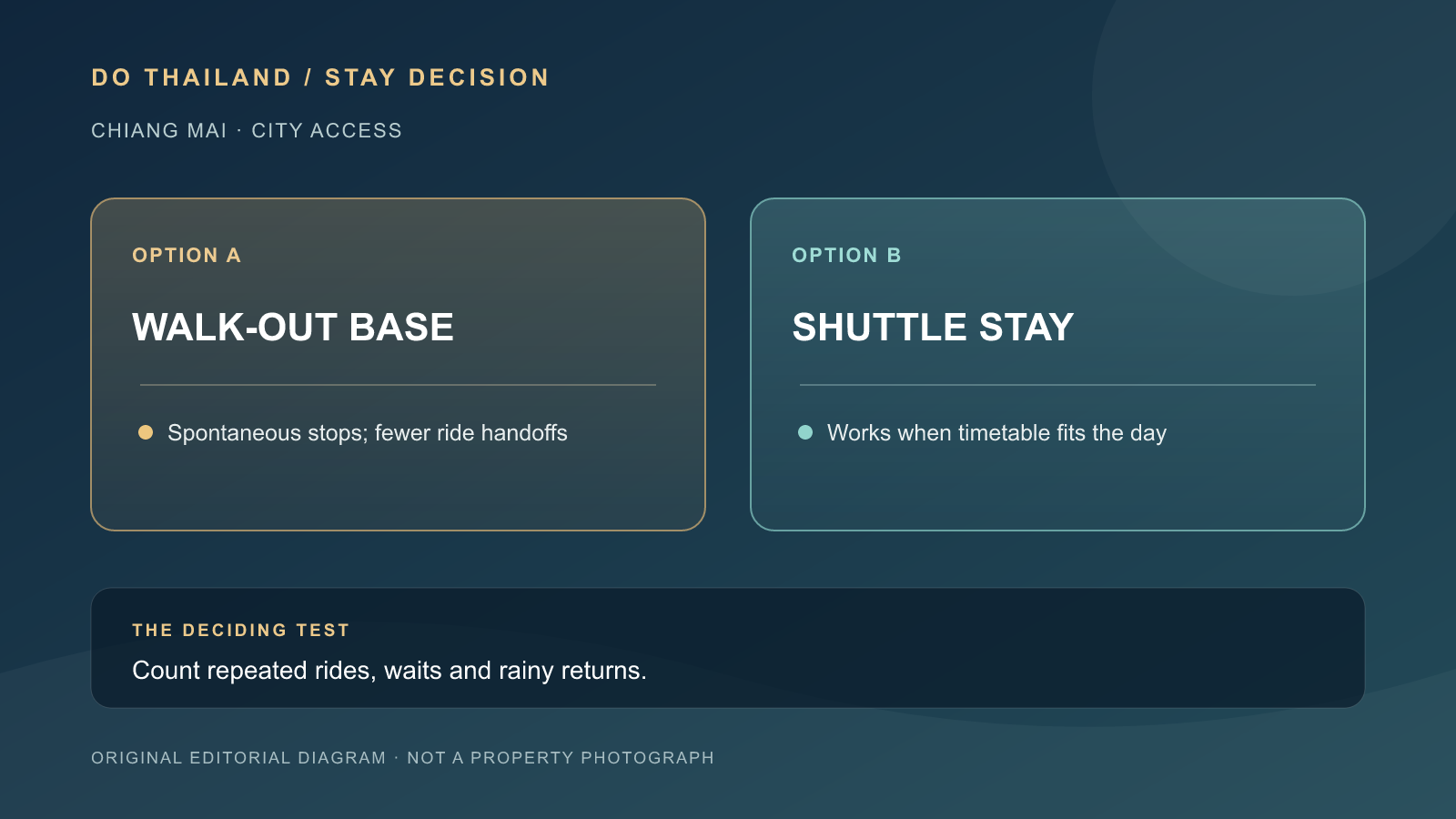
Chiang Mai does not have one single urban center that makes every journey equally easy. Tourism Authority of Thailand highlights the Old City/Tha Phae side and Nimmanhaemin Road as distinct visitor zones, while Chiang Mai International Airport currently publishes city-bus routing that connects the airport with Nimmanhaemin, Tha Phae Gate and the Night Bazaar corridor. In practical terms, you can move between these areas. Your accommodation choice decides how often that movement becomes a task.
This guide is deliberately not a hotel ranking. It is the step before that. If you still need to choose the side of town, start with Old City vs Nimman, Nimman vs Night Bazaar or Old City vs Night Bazaar. Once the area is roughly right, use the shuttle-versus-walk test on the exact hotel pin.
Use a friction ledger, not a feature list
Write down three numbers before comparing rooms.
Breakfast, sightseeing, lunch, a room reset and dinner can create three separate departures in one day.
A fixed shuttle helps less when you want to return at 2:30 p.m., go out again at 5 p.m. and come home after dinner.
The more real time you intend to spend at the pool, spa, restaurant or in a better room, the easier it is to justify transport dependence.
Stay planning
Find a place to stay
See available rooms around the property or neighborhood discussed here, with prices for your dates.
A walk-out location makes spontaneous stops easier
The strongest argument for a central pin is not that walking is free. It is that small decisions stop needing coordination. You can leave for coffee without checking a timetable, come back because the rain starts, change dinner plans, or split up for an hour without deciding who keeps the ride booking.
That matters most on a short first trip. If your days are built around the historic core, read the exact-pin logic in Inside Old City vs Outside the Moat. If your evenings keep ending east of the moat, Chang Moi vs Night Bazaar shows how a small map difference changes the final walk home.
A walk-out base is also easier for two friends who do not always want the same evening. One person can go back earlier without turning the hotel return into a shared transport decision. For a solo traveler, the benefit is different: the last part of the night is more predictable when the route from dinner to the hotel is short, familiar and visually straightforward. The exact street still matters, so inspect the entrance and the final approach rather than trusting the neighborhood label alone.
A hotel shuttle is valuable only when the timetable behaves like your itinerary
“Free shuttle” sounds like a solved transport problem, but it can be a scheduled service rather than an on-demand car. Before treating it as a hotel advantage, verify the current timetable, reservation requirement, pickup point, capacity rules, last return and whether luggage is accepted.
If the shuttle leaves at times you would naturally leave anyway, it can be excellent. If it forces a 9:00 departure when you want a slow morning or a 20:00 return when you want dinner at 20:30, the service has shifted the cost from money to flexibility.
The property has to repay the transport tax
A less central stay can still be the right choice when it gives you something you will repeatedly use. This is the same logic behind our riverside resort vs central hotel decision: more atmosphere, pool time, spa time or on-property dining can justify a ride-dependent location when those things are actually in the plan.
The cleanest test is to remove the hotel photos for a moment. Ask what the less-walkable property changes in your real day. A significantly better pool you will use every afternoon is a real change. A quiet garden you plan to read in is a real change. A larger room that lets two people work or unpack comfortably can be a real change. A dramatic lobby that you pass for forty seconds is not enough on its own.
Breakfast works the same way. If a remote or shuttle-based stay includes a breakfast you genuinely want, that can remove the first transport decision of the day. If Chiang Mai cafés are part of the plan, a central room-only rate may be more coherent; see breakfast included vs room-only.
Count repeated journeys by trip shape
| Your normal day | Better default | Why |
|---|---|---|
| Temple morning, lunch out, room reset, dinner out | Walk-out base | Four small movements are more important than one comfortable shuttle ride. |
| Full-day Doi Suthep / mountain outing, then hotel dinner | Either | You are already using arranged transport for the main day; the hotel location matters less if you stay in afterward. Compare transport separately in our Doi Suthep guide. |
| Pool, spa, lunch and dinner mostly on-property | Shuttle-dependent can win | The property is doing enough work that fewer city exits are not a sacrifice. |
| Cafés, shopping, late dinner, drinks, no fixed return time | Walk-out base | The value is keeping the evening editable without planning around a last shuttle. |
| One early airport departure on the final morning | Do not redesign the whole stay for it | Use the last-night airport hotel test only if that final handoff is genuinely fragile. |
Rain makes the hotel entrance more important than the map pin
In wet weather, a “central” hotel can still be irritating if the drop-off is exposed, the final path floods easily or a car cannot stop close to the lobby. A less central hotel can feel easier if it has a clear covered drop-off and reliable pickup procedure.
For rainy-season booking, inspect the actual entrance: covered curb or open pavement, stairs before shelter, how far luggage travels from a car, and whether ride-hailing pickup is obvious. This is also useful after a late flight; our Chiang Mai airport late-arrival guide separates the arrival handoff from the multi-day hotel decision.
Airport access does not automatically favor the shuttle hotel
Airports of Thailand currently lists multiple ground-transport options at Chiang Mai International Airport, and its published R3 city-bus route includes Nimmanhaemin, Tha Phae Gate and the Night Bazaar corridor as well as the airport. AOT also tells travelers to re-check current fare and route details before travel. The useful point is not that everyone should take the bus. It is that the airport is connected to several major visitor areas, so a one-time arrival should not outweigh the repeated movements of the rest of the trip.
If you arrive late or carry heavy luggage, solve the airport-to-hotel transfer well. Then choose the accommodation for the days that follow. For a four-day trip, our Chiang Mai four-day itinerary makes the repeated city and mountain blocks visible enough to count.
What two friends should check before paying for the “better” remote hotel
Two-friend trips expose a weakness in shuttle-dependent stays: independence. If one person wants a massage and the other wants coffee, or one wants bed at 10 p.m. while the other wants another drink, every return can become a coordination problem.
That does not mean two friends should always stay central. It means the room upgrade must solve something real. Check confirmed twin beds, bathroom privacy, mirrors and lighting outside the bathroom, whether two suitcases can remain open, and whether one person can move around while the other sleeps. A clearly better room can repay some location friction. A decorative upgrade usually cannot.
Solo travelers should test the last 300 metres
Neighborhood names are too broad for after-dark practicality. Open the exact hotel pin and trace the final approach from the place you are most likely to finish dinner. Look for the kind of route you would be comfortable repeating: visible entrances, active frontage where possible, simple crossings, a clear ride pickup point and minimal need to walk down an unfamiliar side street after the main road ends.
This is why “shuttle vs walk-out” is not a safety ranking of Chiang Mai areas. It is a planning test. A short predictable final route can be valuable; so can a reliable door-to-door pickup at a property where you intend to stay in. The right answer depends on which pattern you will repeat.
Run this five-question check on the booking page
Choose the walk-out base when…
- You expect two or more independent outings most days.
- Dinner and cafés are part of the destination, not hotel amenities.
- You want easy room resets between plans.
- You dislike scheduling the final return after dinner.
- The hotel quality difference is modest.
Choose the shuttle-dependent stay when…
- The property itself has planned pool, spa or dining time.
- The current shuttle timetable matches your actual departures and returns.
- You are comfortable using paid rides when the shuttle does not fit.
- The room or resort advantage is substantial and usable.
- You plan fewer independent city exits.
The recommendation
Start with walk-out convenience for a short, city-heavy Chiang Mai stay. Move to a shuttle-dependent hotel or resort only when you can name the property benefit that repays the repeated transport friction — and when the current shuttle schedule fits your real day rather than the day the hotel hopes you will have.
Once that access model is settled, browse the Chiang Mai destination guides or the full Stay hub to narrow the exact area or room decision.
Sources checked
Stay planning
Find a place to stay
See available rooms around the property or neighborhood discussed here, with prices for your dates.