
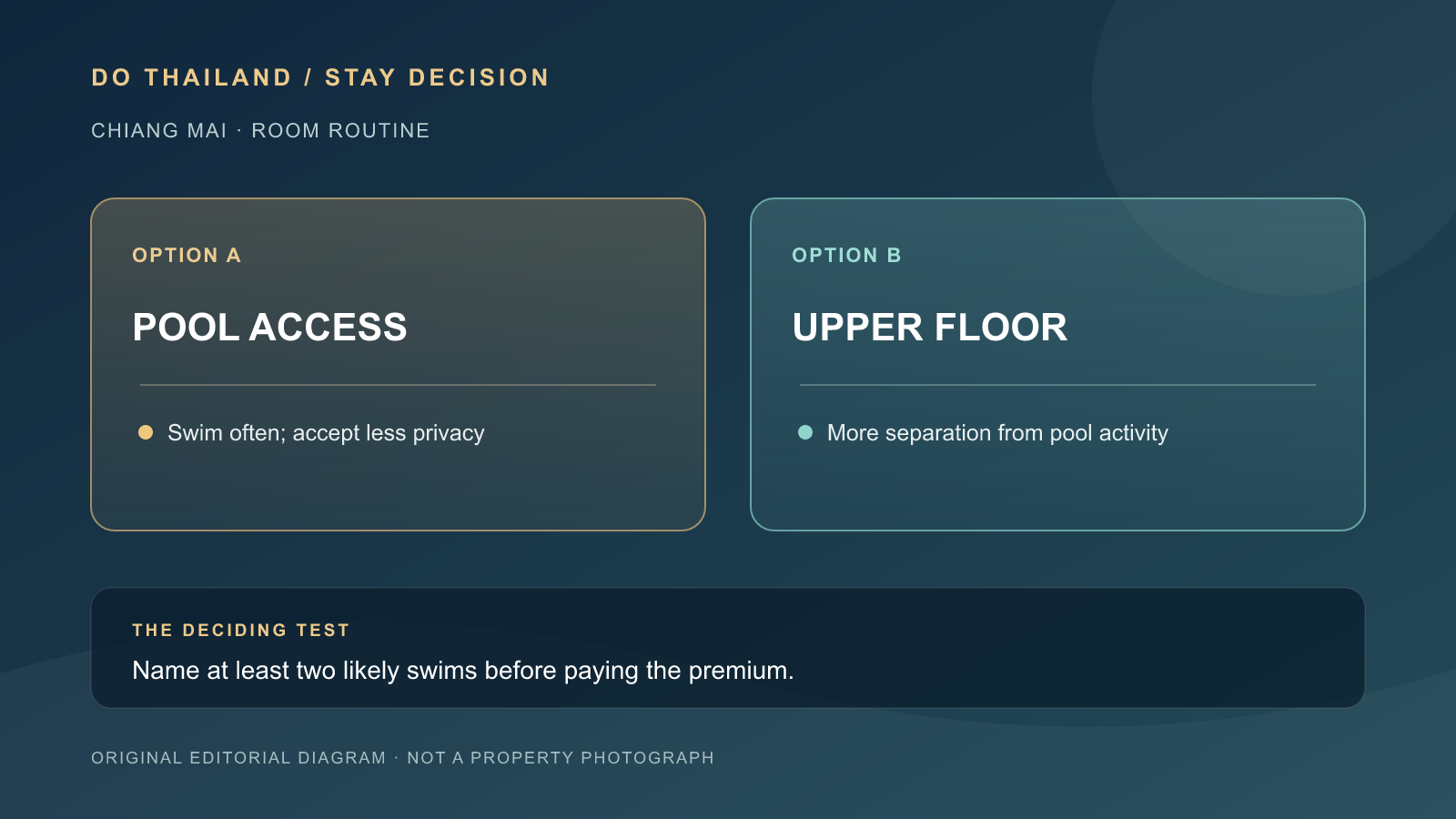
Start with the door, not the room name
A useful pool-access room changes one repeated action: you open your balcony or terrace door and get into the pool without walking through the hotel. That sounds minor until you are actually using it twice a day. It also sounds more luxurious than it is when you swim once, close the curtains, and spend the rest of the trip in the Old City or Nimman.
The booking test is simple: would direct water access change your morning, your late afternoon, or both? If the answer is “probably neither,” take the room with the better privacy, view, bed setup or rate instead.
This is a different decision from choosing a Chiang Mai neighborhood. If your hotel pin is not settled, decide Old City vs Nimman first. A perfect pool-access room in the wrong part of the city still leaves you paying for transport friction every day.
Stay planning
Find a place to stay
See available rooms around the property or neighborhood discussed here, with prices for your dates.
The three-swim rule
I use a deliberately strict threshold because pool-access upgrades are easy to romanticize at booking time. Count realistic swims, not imagined holiday versions of yourself.
Choose the non-pool-access room. You are paying for a door position, not a meaningful part of the stay.
Now compare the live rate gap, privacy and room specifications. The upgrade can make sense, but it is not automatic.
Pool access becomes a real convenience: quick morning dip, shower, breakfast; or return, swim, get ready, dinner.
The same “use it or skip it” logic applies to resort upgrades generally. If you are paying for more hotel time, the Four Seasons resort-time test is useful even if you are booking somewhere completely different.
Do not assume pool access means a bigger room
Current Chiang Mai hotel room inventories show why the label itself is not enough. Some properties publish a standard room and a pool-access version at the same headline floor area; others change the size, bed setup or terrace as well. In other words, the premium can be mostly about where the door opens.
That means the fair comparison is not “basic room versus luxury room.” Put the two live room descriptions side by side and subtract everything that is identical: floor area, bed, bathroom, breakfast, balcony, occupancy and public facilities. What remains is what you are actually paying to change.
| Check | Pool-access room | Upper-floor / non-pool-access room | Why it can decide the booking |
|---|---|---|---|
| Pool relationship | Direct door or terrace access | Walk through the hotel to the shared pool | Only valuable if you swim often enough to notice the saved friction. |
| Privacy | Room edge may face a shared pool route | Often easier to separate room life from pool circulation | Check real photos and the site plan; do not assume “access” also means seclusion. |
| Bed setup | May differ by category | May offer a different king/twin choice | For two friends, separate beds can matter more than direct water access. |
| Wet-room route | Shorter return from pool to shower | Longer route, but wet traffic stays outside the room edge | Think about towels, swimwear, bathroom floor and where you will dry things. |
| View / light | Usually pool-level outlook | May give a more open outlook depending on the building | Verify the exact category; do not pay for a view the room description does not promise. |
| Pool hours | Direct access does not automatically mean unrestricted use | Same shared-pool rules normally apply | Check current operating hours before treating the pool as a dawn-or-late-night feature. |
Privacy is a geometry problem
Pool access works better when…
The terrace has meaningful screening, the path into the water is obvious, the room interior is not fully exposed when curtains are open, and you are comfortable with the amount of shared-pool activity immediately outside.
An upper floor works better when…
You want to sit by the window or balcony without feeling connected to pool circulation, expect to get ready with curtains open, or simply value a stronger boundary between public hotel space and your room.
This matters more for a solo traveler than a generic “is the hotel safe?” label. I would inspect the room photos for sightlines: can someone at the pool see straight toward the bed? Is there planting, a screen or a setback? Does the terrace feel like a small private threshold or part of the pool deck? Those questions are more useful than assuming ground floor is bad or upper floor is automatically better.
Two friends should check the bed before the pool
For two friends, a room category can fail before privacy even becomes the issue. Some Chiang Mai pool-access categories are king-only while other categories at the same hotel may offer twins. If each person wants her own bed, that requirement outranks a pool door.
The same principle appears in our U Nimman room-choice guide: the larger or more premium-sounding category is not necessarily the more functional one for two people. Check the exact bedding attached to the exact rate you are booking.
Rain does not make pool access useless — it makes your real routine more important
Do not try to predict every shower months in advance. Instead, ask whether the room still works if one planned swim disappears. If your entire reason for upgrading is “we might jump in once,” bad weather can erase most of the value. If the pool is part of a slow two- or three-night hotel phase, you have more chances to use it.
This is where itinerary shape matters. A city-heavy four-day Chiang Mai plan leaves less hotel time than a deliberate resort phase. If you are considering moving out of town for slower days, read the city + Hang Dong split-stay decision before paying for a room feature that only earns its keep while you are actually at the property.
Pool access can also change the “getting ready” sequence
For women traveling together, the practical value is often less glamorous than the booking photo. A direct return from the pool can be excellent when one person wants to shower while the other dries hair, changes clothes or uses the mirror. It can also be irritating if wet swimsuits, towels and sandals have nowhere sensible to go.
Look for the bathroom entrance, towel hooks, drying space, hard flooring near the pool door and whether two suitcases can remain open without blocking the wet route. None of those details are guaranteed by the words “pool access.”
Do not let the room upgrade hide a worse hotel-location decision
If the pool-access premium pushes you toward a less useful property, compare the hotel itself again. A walk-out city hotel may give you more value every evening than a pool door you use twice. Our shuttle vs walk-out guide is the better test when the prettier property requires repeated rides.
Likewise, if you are choosing between a central hotel and a property where the grounds matter more, use the riverside resort vs central hotel decision. Room category comes after base choice, not before it.
Breakfast and pool access are separate purchases
A room can feel like a “resort upgrade bundle” even when the live rate plan does not include anything beyond the room itself. Check breakfast separately. If Chiang Mai cafés are central to your mornings, the breakfast-included vs room-only guide will stop you paying twice for two different versions of the same morning.
Five booking gates before you pay the pool-access premium
Verify what “pool access” means
Confirm that your exact room opens directly to a shared pool; a pool view, balcony or nearby building does not mean direct access.
Check the exact bed configuration
Do not assume king/twin choices carry across categories. For two friends, this can decide the room immediately.
Inspect privacy in current photos
Look for sightlines, screening, terrace depth and whether a public path runs directly beside the room.
Check current pool operating rules
Direct access does not override hotel pool hours, maintenance closures or property rules. Verify the current information close to booking.
Compare the live rate gap with expected swims
Do not use a generic “worth it” threshold. Divide the upgrade by the number of times you realistically expect the direct access to improve the day.
My pick
Choose the upper-floor or non-pool-access room by default on a first, city-led Chiang Mai trip. It keeps the booking focused on bed setup, privacy, location and the room itself.
Choose pool access when you are deliberately building hotel time into the trip and can see yourself using the water repeatedly. The upgrade is strongest for a slow stay, not a packed sightseeing schedule.
If an early flight is the next constraint rather than pool time, do not let a room upgrade distract from the bigger logistics decision: airport hotel vs keeping your city hotel.
For the rest of the accommodation graph, browse the Chiang Mai destination hub or all Thailand stay guides.
Sources checked
Research note. Current official Chiang Mai hotel room pages were checked on 11 August 2026 to verify that “pool access” is not a standardized product label: Away Chiang Mai Thapae currently describes a 31 m² Deluxe and 31 m² Deluxe Pool Access; U Chiang Mai lists direct-pool-access categories with category-specific bedding; Hotel Sensai Nimman describes a central-pool access room separated by planting; Siripanna explicitly places its current plunge-pool-access category on the ground floor; and Baan U Sabai publishes separate pool-view and pool-access categories plus current pool operating hours. These properties are research examples, not recommendations in this article. Sources: Away Chiang Mai official rooms, U Chiang Mai official accommodation, Hotel Sensai official rooms, Siripanna official site, Baan U Sabai official site.
Stay planning
Find a place to stay
See available rooms around the property or neighborhood discussed here, with prices for your dates.