
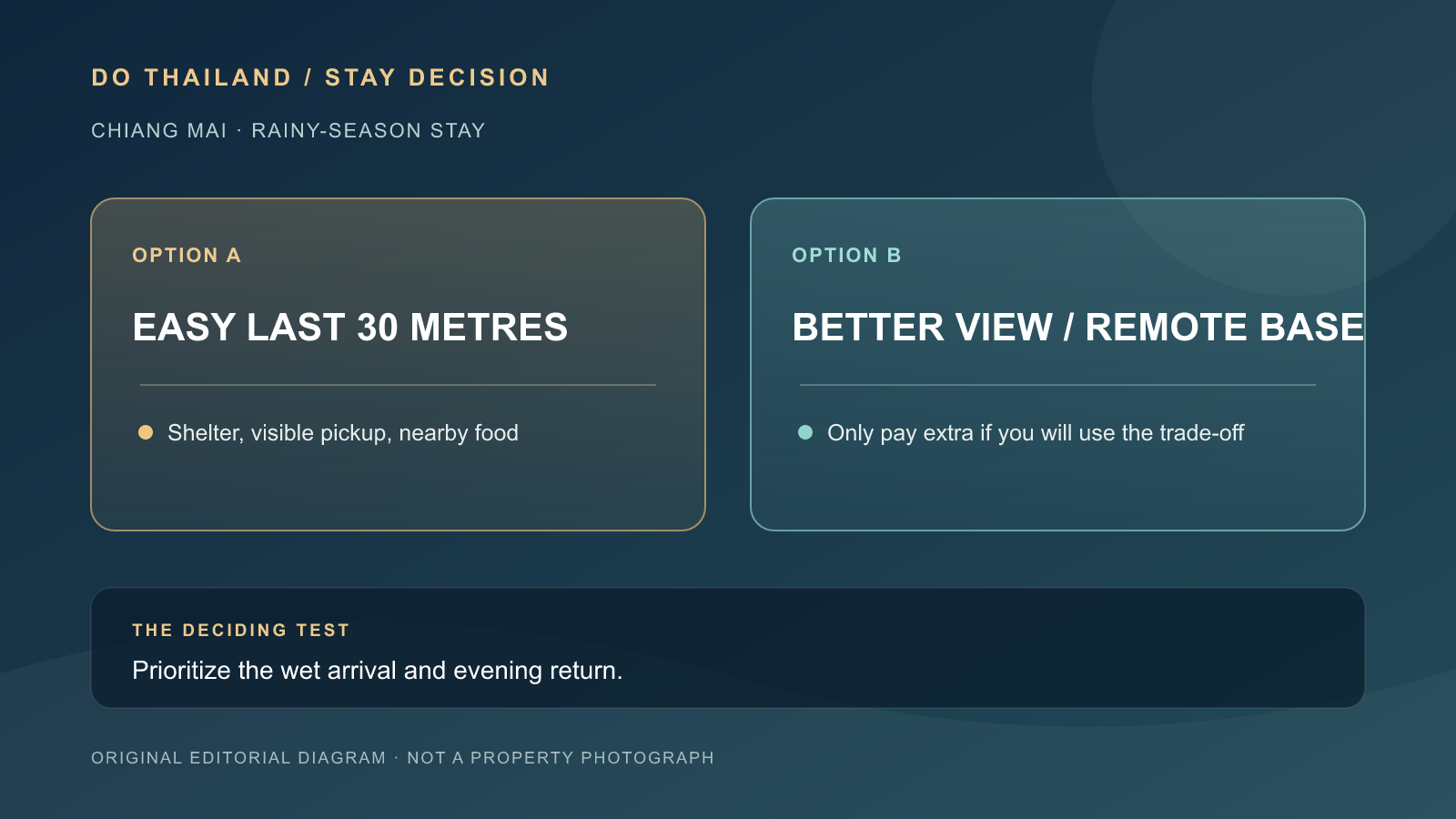
The booking rule: test the hotel at the worst five minutes of the day
Imagine it is 7:20 p.m. You are returning with a shoulder bag, a phone in one hand and shopping in the other. Rain starts just as the car reaches your hotel. Where does the driver stop? Can you step under cover, or are you crossing a wet lane, uneven paving or an open forecourt? Can you wait inside for the next ride?
If a hotel answers those questions well, it is rain-resilient even if the weather is unpredictable. If it answers them badly, the inconvenience repeats every time the timing is unlucky.
Thailand's official seasonal guidance places the rainy season broadly between mid-May and mid-October, while northern Thailand can see periods of heavier rain from mid-July into September. That does not mean six months of continuous all-day rain. It means wet-weather logistics deserve a place in your hotel decision, especially when your trip falls inside that window.
First settle the broad base. If you still have not chosen the side of the city, use Old City vs Nimman. If the question is whether a hotel pin sits on the convenient side of the moat for your plans, use inside the Old City vs outside the moat. This guide starts one level later: you already like the area, and now you are deciding which actual hotel building will be easier when the pavement is wet.
Stay planning
Find a place to stay
See available rooms around the property or neighborhood discussed here, with prices for your dates.
Rain exposes four hotel handoffs
A hotel can look perfectly located on a map and still make these four transitions awkward. I would audit them separately rather than relying on a vague “good location” label.
1. Airport arrival
You have luggage, may be tired, and do not want to discover that the car can only stop across a busy or uncovered stretch. The first arrival is the moment when a proper lobby approach earns its keep most clearly.
2. Morning departure
If breakfast or coffee is outside, can you reach it quickly under light rain? If you have a tour pickup, is there a clear place to wait without standing at the curb?
3. Afternoon reset
Chiang Mai days often involve returning before dinner. A sheltered car-to-lobby route makes that reset easier when clothes, shoes or shopping bags are already damp.
4. Evening dinner return
This is the handoff I would weight most heavily for a solo traveler: entrance visibility, indoor waiting space and a short final walk become more useful after dark.
The last 30 metres matter more than the map pin
A map can tell you that two hotels are 200 metres apart. It cannot tell you whether one entrance is directly visible from the road while the other sits down a narrow lane, whether a car can pull under a canopy, or whether the lobby starts after a flight of uncovered steps.
Before booking, look at the hotel's official exterior photos, current street imagery where available, and the exact entrance pin. Then ask the hotel if the answer is not obvious. You are not trying to find a completely rain-proof building. You are checking whether the unavoidable wet part is short and simple.
| Hotel detail | Stronger rainy-season setup | What to verify | Why it matters |
|---|---|---|---|
| Car arrival | Sheltered or very short curb-to-lobby route | Where cars can stop for a covered drop-off | Reduces the worst luggage-and-rain handoff. |
| Ride pickup | Clear, easy-to-name waiting point | Whether drivers routinely collect from the lobby entrance or another gate | Less time standing outside while matching car and passenger. |
| Entrance visibility | Obvious doorway with staffed or active lobby | Street-facing access versus a quiet lane or recessed gate | More practical for late returns, especially alone. |
| Nearby food | Several realistic options within a very short walk | Name a nearby restaurant you would use in heavy rain | Lets you abandon a longer dinner walk when rain is heavy. |
| Internal route | Lift and rooms reached without exposed courtyards or long outdoor walks | Property layout, especially at boutique and resort-style hotels | A covered lobby is less useful if the room is across an uncovered garden. |
| Room entry | Hard flooring or sensible wet-item zone near the door | Where shoes, umbrella and damp bags can go | Keeps the bathroom and luggage area from becoming the only wet zone. |
The five-minute food radius is your rainy-night insurance
On a dry evening, a fifteen-minute walk to dinner can be part of the pleasure of Chiang Mai. In heavy rain, that same walk can become a ride-hailing problem for a distance that feels too short to justify a car but too wet to enjoy on foot.
I would therefore give a rainy-season hotel one backup food test: can you eat reasonably well within about five minutes on foot, or comfortably stay in and eat on-property? You do not have to use that option every night. Its value is giving you a low-friction fallback when the weather changes at the same time as hunger.
This is one reason a more central hotel can beat a prettier resort on a city-heavy trip. Our riverside resort vs central hotel guide asks how many evenings you actually want to spend on-property. In rainy season, add a second question: how many evenings are you willing to depend on a car just to change your dinner plan?
A hotel shuttle does not automatically solve rain
A scheduled shuttle can remove some exposed walking, but it replaces weather friction with timetable friction. If you miss the return or decide to leave dinner early, you may still need a ride. Compare that trade-off in shuttle stay vs walk-out base.
For rainy season specifically, the best access model is the one that leaves you options: a ride can stop easily, you can wait under cover, and you can still walk to something useful if you do not want to coordinate a car.
Solo female traveler: judge the waiting place, not the neighborhood label
I would look closely at where you physically stand while waiting for a car after dark. A hotel can be in a popular area and still have an awkward recessed entrance or quiet side lane. Another can sit slightly farther from the main attraction but give you a bright, visible lobby entrance where you can wait indoors until the car arrives.
That is a more practical question than treating an entire Chiang Mai district as simply “safe” or “unsafe.” Check the exact doorway, the final stretch from the nearest restaurant cluster, and whether the lobby remains a useful waiting space during the hours you expect to return.
Two friends: wet-weather room function starts at the door
For two friends sharing, rain adds a small choreography problem. One person comes in with wet shoes and an umbrella while the other is using the bathroom or hairdryer. Two suitcases are open. Shopping bags need somewhere dry. If the room is tight at the entrance, the floor becomes the bottleneck.
Look for a sensible luggage zone, enough hard flooring near the door, bathroom privacy, usable mirrors outside the bathroom if possible, and a hairdryer setup that does not force both people into the same getting-ready space. These details can matter more than upgrading to a pool-access room. If you are weighing that feature, use the pool-access vs upper-floor decision and remember that rainy-season value comes from the room working even when you skip the swim.
Breakfast becomes a weather decision only if you were going outside anyway
Choose hotel breakfast when rainy mornings make nearby cafés harder to reach. If you love Chiang Mai cafés and have several nearby, you may still prefer room-only. If your preferred cafés require an exposed walk or ride every morning, breakfast on-property gains some convenience value — but it should still be priced against how many mornings you will actually use it. The detailed test is in breakfast included vs room-only.
Airport arrival: solve the pickup handoff, not the whole trip with an airport hotel
Airports of Thailand currently lists Grab among the ground-transport options at Chiang Mai International Airport and publishes designated pickup information. That makes app-based arrival coordination a practical option, but the hotel-side handoff is still property-specific. Before arrival, save the hotel name in Thai if the property provides it, keep the exact map pin, and know where the lobby entrance actually is.
If you land late, combine that with our Chiang Mai airport late-arrival guide. Do not move your whole stay to an airport-area hotel just because rain is possible. The airport hotel vs city hotel decision should still be driven by the departure handoff, not weather anxiety.
Rainy mountain day? Make the hotel easy for vehicle pickup
For Doi Suthep or other mountain days, the hotel choice cannot control the weather. It can make the pickup easier. A clear lobby meeting point, a driver-friendly entrance and somewhere dry to wait reduce the chance that a rainy morning begins with phone calls at the curb.
If Doi Suthep is central to the trip, our red songthaew vs private car guide already treats rain and return-time control as part of the transport decision. Keep that decision separate from the hotel: the hotel should make the handoff simple; the vehicle choice should fit the mountain day.
Do not overpay for “rain-proofing” you will not use
The rainy-season filter should break close ties, not erase every other reason to choose a hotel. If one property is much better for your daily sightseeing, do not reject it because its canopy is smaller. If you are on a slow resort stay with on-site dining, spa and long indoor downtime, a remote property may be perfectly sensible because you are not trying to leave four times a day.
This is also why a city + Hang Dong split stay can work when the resort phase is genuinely separate. A remote resort is most frustrating when you keep treating it like a city hotel and repeatedly commuting back for meals and nightlife.
For a short first trip, compare the hotel against your actual four-day Chiang Mai plan. The more often you leave and return, the more weight I would give the entrance, pickup point and five-minute food radius.
Seven checks to make before you book
Find the real entrance
Do not stop at the map pin. Match the official exterior with the road or lane where cars arrive.
Ask where ride-hailing cars collect guests
If the property has multiple gates or sits inside a larger complex, identify the practical pickup point in advance.
Count the exposed metres
Look at curb to lobby, lobby to lift, and lift or corridor to room. Resort-style layouts can add outdoor segments after check-in.
Build one bad-weather dinner backup
Identify a nearby restaurant, convenience store or on-site option you would genuinely use rather than a theoretical map pin.
Check the room entrance zone
For two people especially, make sure luggage, wet shoes and bathroom traffic will not all collide in the same narrow space.
Separate rain from breakfast and pool decisions
Do not buy every hotel add-on as insurance. Pay only for the features that still fit your real routine.
Recheck the weather close to the day
Seasonal patterns tell you what to prepare for; current forecasts and official warnings should guide the day itself.
Final answer
For most rainy-season Chiang Mai city trips, choose the hotel that makes repeated arrivals boring. You want a car to know where to stop, a dry or very short path into the lobby, an easy place to wait for the next ride, and at least one food option that does not require a long exposed walk.
If two hotels are otherwise close, I would take those practical advantages before paying for a room view, a pool door or a more atmospheric property that creates extra wet-weather transfers. Rain does not need to dominate the trip. The point is to stop it from dominating the last 30 metres.
Still deciding the bigger accommodation picture? Browse the Chiang Mai decision hub or all Thailand stay guides.
Sources checked
Stay planning
Find a place to stay
See available rooms around the property or neighborhood discussed here, with prices for your dates.