
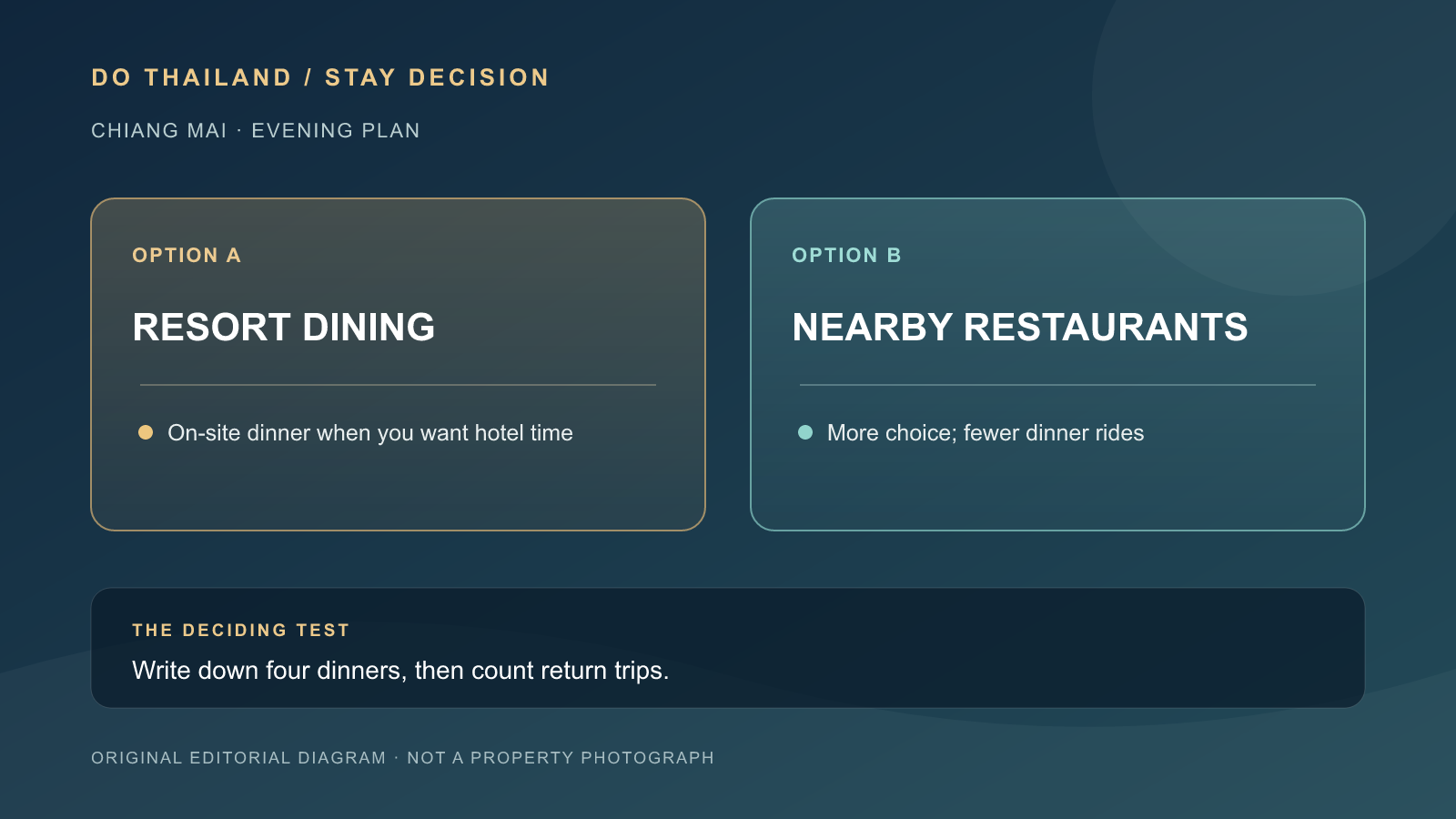
The fastest test: write down four dinners before you book
Do not start with the hotel photos. Start with the evenings. On a four-night stay, label each dinner hotel, planned restaurant, market / casual wander or unknown.
If two or three dinners are already marked hotel, a resort with credible on-site dining can remove real friction. If most are planned restaurants, markets or unknown, the more useful luxury may be a hotel door that opens into food choices.
Chiang Mai makes this distinction unusually important because the same trip can move between very different evening systems. Tourism Authority of Thailand currently highlights Nimmanhaemin Road for food, shops and contemporary city life, and Tha Phae Walking Street as a recurring evening attraction. The same official destination material also treats Mae Rim and Hang Dong as separate Chiang Mai districts alongside the city. The province is compact enough to combine these worlds, but they do not behave like the same hotel location after dinner.
This is one level deeper than riverside resort vs central hotel. That guide asks whether you want to spend evenings on-property. This one assumes the hotel finalists are already attractive and asks a narrower question: who is responsible for dinner every night—the property, your feet, or another car?
Arrival night
Usually the easiest night to keep on-property. You are carrying travel fatigue and may not want another transport decision after check-in.
Exploring night
If this is a Nimman, Old City, Night Bazaar or Tha Phae evening, a hotel near the action lets dinner emerge from the walk instead of becoming a separate transfer.
Resort night
This is where a full-service property earns its location: pool or spa, shower, dinner, then straight back to the room without reopening the transport app.
Unknown night
The unknown night favors optionality. A walk-out base gives you more ways to change your mind without turning a small appetite decision into a car journey.
Stay planning
Find a place to stay
See available rooms around the property or neighborhood discussed here, with prices for your dates.
On-site dining only counts if you would willingly use it
A restaurant inside the property is not automatically a benefit. It is a benefit when the menu, operating hours, atmosphere and price point fit the evening you actually want.
Before booking a quieter resort, check the current official dining page and ask five unglamorous questions: Is dinner served every night of your stay? Is there more than one practical dinner format, or only a special-occasion restaurant? Are vegetarian, allergy or other dietary needs clear enough for you? Does room service or in-room dining operate during the hours you would use it? If one restaurant is closed, is there a realistic backup without leaving the property?
This is similar to the logic behind breakfast included vs room-only. A meal benefit has value only when it replaces something you would otherwise spend time arranging. It is not valuable simply because the hotel can sell it to you.
The dinner-ride rule
Count a dinner ride every time the hotel location forces you to arrange transport purely to eat somewhere you wanted to reach on foot from a more central base.
One planned dinner ride in four nights is minor. Three or four is a hotel-location pattern. At that point you are choosing a different set of evening options.
That does not make the resort wrong. It means the resort has to give something back: a dinner you genuinely enjoy on-site, a spa-and-dinner evening, a pool-to-restaurant rhythm, or enough calm that staying in feels like the point rather than a compromise.
A hotel near restaurants gives you more choices for dinner
The strongest city-hotel advantage is not that every restaurant is physically close. It is that you can decide late.
You can have a drink, realize you are not hungry yet, browse a market, split a snack, change restaurants after seeing a queue, or choose a café-style dinner because lunch ran late. Tourism Authority of Thailand's current Chiang Mai destination page explicitly highlights local cuisine on Nimmanhaemin Road, while its Tha Phae material treats the Sunday walking street as an evening food-and-shopping environment. Those are examples of dinner becoming part of the neighborhood rather than a single reservation.
If that sounds like your trip, first choose the right side of town. Old City vs Nimman helps with the broad first-trip rhythm; Nimman vs Night Bazaar is more useful if your decision is specifically about where evenings end; and Chang Moi vs Night Bazaar narrows the east-side choice further.
| Evening pattern | Resort with on-site dining | Hotel near restaurants | What should decide it |
|---|---|---|---|
| You want two slow hotel evenings | Strong fit | Useful but not necessary | Verify the current dinner offering before paying for isolation. |
| You save restaurants on your map all day | Can become restrictive | Strong fit | Your dinner list is telling you that neighborhood access is part of the trip. |
| You dislike planning dinner | Good only if on-site options are flexible | Usually stronger | More nearby choices reduce the penalty for deciding at 8 p.m. |
| You have an early countryside day tomorrow | Can be excellent | Also workable | A simple on-property dinner can protect sleep and packing time. |
| You expect markets or bars after dinner | Creates an extra return leg | Usually stronger | Count the journey to dinner and the ride home. |
| Rain changes plans easily | Strong if dining is genuinely usable | Strong if food is within a very short covered or easy walk | Choose the option with the simplest fallback, not the prettier forecast. |
The return journey matters more than the outbound journey
It is easy to tell yourself that you can always get a car into town. The better booking question is what happens when you want to come back.
7:00 p.m. · Dry evening
A planned ride is barely a problem. If you already reserved a restaurant and know exactly when you want to leave, a remote hotel can be perfectly manageable.
9:45 p.m. · Plans changed
You stayed for dessert, your friend wants one more drink, or the market was better than expected. A walk-out hotel turns this into a stroll. A resort turns it into another pickup decision.
8:30 p.m. · Heavy rain
This is where both sides need scrutiny. A resort with usable dining can remove the journey entirely; a central hotel wins only if the final walk is genuinely short and the entrance is easy. Use the rainy-season hotel checklist to audit the last metres.
Airports of Thailand currently lists Grab as a ground-transport option at Chiang Mai International Airport, which is useful evidence that app-based rides are part of the city's transport mix. It is not evidence that a car will appear immediately at every remote resort pin after every dinner. Treat the exact hotel's own transfer options and the return pickup as a separate live check.
If a hotel solves this with a scheduled shuttle, compare the timetable rather than treating “free shuttle” as a synonym for freedom. The shuttle vs walk-out guide is the better tool when your problem is repeated departures and returns across the whole day.
Solo female traveler: choose where you want to wait after dinner
For a solo traveler, I would not turn this into a blanket claim that one Chiang Mai district is “safe” and another is not. The practical question is more specific: where will you physically stand while waiting for the ride back, and where will the car drop you at the hotel?
A resort can be very comfortable if you intend to eat on-property and the lobby is the beginning and end of the evening. It can feel less convenient if every dinner requires waiting outside a restaurant for a pickup and then arriving at a quiet approach road. A central hotel can be easier if the entrance is visible and the final walk is active and short, but the exact doorway still matters more than the district label.
If your arrival is late enough that dinner and check-in blur into one problem, read the Chiang Mai airport late-arrival guide before choosing a remote first night. The first evening is the worst time to discover that the property restaurant has stopped serving and you still need another ride for food.
Two friends: dinner flexibility can be worth more than a room upgrade
Two friends do not always get hungry at the same time. One may want a proper restaurant; the other may want a light meal after a cooking class. One may want to shower first; the other may want to go straight back out. A hotel with easy nearby food lets those small differences stay small.
At a resort, the shared plan matters more. If the on-site restaurant is the only low-friction dinner, you are effectively agreeing on the same evening system before the trip. That is completely fine when both of you want the resort rhythm. It is less attractive when your saved maps are full of different places to try.
Before paying extra for a larger room to make a friends' trip feel more comfortable, compare whether a better location would solve more daily friction. The U Nimman room-choice guide is one example of why usable bedding and actual city routine can matter more than square metres alone.
Mae Rim and Hang Dong need a stricter dinner test
The farther your stay moves from your evening plans, the more important on-site dining becomes. This does not mean every Mae Rim or Hang Dong resort is isolated, and it does not mean city restaurants are always inconvenient from those districts. It means you should stop using district names as proxies and inspect the exact pin and the exact dinner plan.
If you are considering a countryside phase, read Mae Rim resort vs Chiang Mai city hotel and city + Hang Dong split stay first. Those guides decide whether moving out belongs in the itinerary at all. This page handles the next step: once you are willing to move out, is the property's dinner system good enough that you will not keep undoing the move every evening?
A resort dinner is strongest when it joins another hotel activity
The most convincing on-site dinner is not “we are stuck here, so we may as well eat here.” It is an evening that flows naturally: late swim, shower, spa, drink, dinner, room. The meal saves a transport leg because you already wanted to spend that block at the property.
If the resort is only where you sleep after a full city day, on-site dining may be less meaningful. You may arrive too late to enjoy the restaurant, or keep eating in town because you are already there. That is the same reason a premium property can disappoint when it is used only as a bedroom. Protect resort time first; then let the restaurant complete it.
Run this six-point dinner-independence check before booking
- Count hotel dinners. Can you name at least two evenings when you genuinely want to stay on-property?
- Open the current dinner menu and hours. Would you choose it even if transport were free?
- Check the backup. If the main restaurant is closed or you want something lighter, what is option B?
- Map the final food radius. From the exact hotel entrance, what can you realistically reach without a car?
- Audit the return. After a city dinner, where do you wait for the ride and where does it drop you?
- Subtract nights already committed elsewhere. A cooking class, market night, late tour or special restaurant reservation cannot also be counted as a resort-dining evening.
The last point is easy to miss. If you already booked a Chiang Mai cooking class, the evening format may replace or delay dinner. If one day is a long mountain trip, the next dinner may be the night you most want simplicity. Your hotel should fit those actual evening blocks, not an imaginary week where every night is open.
My booking rule
Choose the resort with on-site dining when you want the hotel to be part of the evening, can identify at least two nights you will genuinely eat there, and the current dining operation gives you a credible backup without leaving the property.
Choose the hotel near restaurants when dinner is exploratory, spontaneous or different every night; when markets and bars keep you out late; or when you know you will resent arranging a car just to eat.
The better room is not always the better stay. In Chiang Mai, the more useful upgrade can be removing one small transport decision every evening.
Continue with the Chiang Mai decision hub for area, transport and experience choices, or browse all Thailand stay guides.
Sources checked
Stay planning
Find a place to stay
See available rooms around the property or neighborhood discussed here, with prices for your dates.