
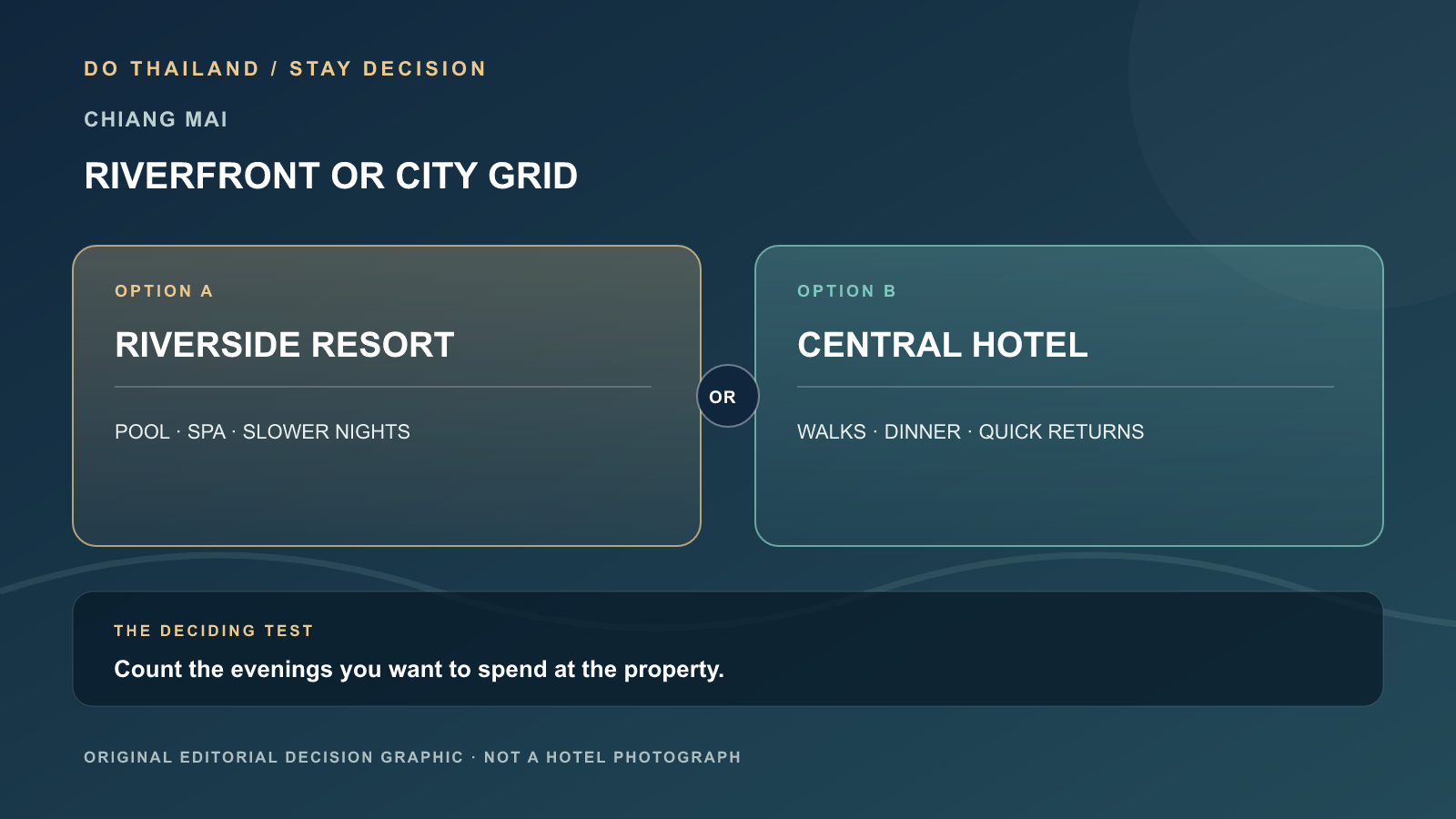
This is a different decision from Old City vs Nimman. That comparison asks which urban rhythm you want outside the hotel. Riverside resort versus central hotel asks whether you want the property itself to absorb a meaningful part of the day.
Chiang Mai can support both versions of the trip. Tourism Authority of Thailand still frames the Old City, Tha Phae Walking Street and Nimmanhaemin Road as major visitor experiences, while Wat Ket is an established community on the eastern side of the city. Airport transport also gives arriving travelers several ride-based options, including airport taxi, metered taxi and Grab. In practice, that means a riverside stay is not impossible without a car. It simply makes you accept more deliberate departures and returns.
The 30-second rule: pay for the resort only if you will use the resort
Central hotel wins when your days are already full and your evenings remain open-ended: temple walks, cafés, markets, dinner somewhere different, a drink after dinner, then a short final walk or simple ride home.
Riverside resort wins when you deliberately want a slower middle or end to the day: swim, shower, spa, sunset drink, dinner on-property, early night, long breakfast, repeat.
Do not choose by “riverside” alone. The Ping River corridor covers different micro-locations. A hotel that is technically by the river but awkward for your preferred restaurants can create more friction than a map thumbnail suggests. A central hotel can also be surprisingly inconvenient if it sits deep down a quiet soi or behind a difficult pickup point.
Stay planning
Find a place to stay
See available rooms around the property or neighborhood discussed here, with prices for your dates.
Count evenings, not attractions
Most travelers compare Chiang Mai hotels by asking which one is closer to the Old City, Doi Suthep or a favorite café. That is useful, but it misses the repeated decision that separates a resort stay from a city stay: what happens between 5 p.m. and bedtime?
A central hotel is usually stronger when the answer changes every night. One evening might be Tha Phae Walking Street, another a restaurant near Chang Moi, another Nimman, another an early return after a mountain day. A hotel that makes leaving again easy gives you flexibility without forcing the whole group to agree on “resort night.”
A riverside resort becomes more compelling when at least two evenings already have an on-property shape. You are not “giving up the city” if you intended to spend those hours at the pool, spa, restaurant or lounge anyway. In that case, the quieter location is not a transport penalty; it is part of what you bought.
Use this three-evening ledger before you compare rates
Stay central
If every night already has a market, dinner reservation, bar, café or neighborhood walk attached to it, a resort can turn every plan into an out-and-back ride.
Central still leads
One pool afternoon or spa appointment rarely justifies moving your whole base unless the resort itself is the reason for the trip.
Riverside becomes rational
Once multiple evenings are designed around the property, the room, pool, dining and slower river setting stop being decorative upgrades and start becoming usable itinerary time.
A central hotel protects spontaneous nights
Tourism Authority of Thailand's current Chiang Mai destination material highlights Tha Phae Walking Street and Nimmanhaemin Road, and its night-market coverage places the Sunday market along Ratchadamnoen Road from Tha Phae Gate into the Old City. These are exactly the kinds of plans that benefit from a central base because the night can expand or contract without a separate transport decision every time.
That flexibility matters more than it first appears for solo travelers and two friends. A dinner plan can change. Someone may want dessert after everyone else is done. A market may be hotter or more crowded than expected. Rain can clear. A bar you intended to visit may not feel worth the extra ride. Centrality keeps those decisions small.
For a first trip of only two or three nights, this is usually the safer choice. You have fewer evenings to “spend” on the hotel, so a property that asks you to return early should deliver something you genuinely value in exchange.
A riverside resort protects downtime you might otherwise never take
The counterargument is not scenery. It is behavior. Some travelers choose a central hotel, then spend every day outside until they are exhausted because there is no strong reason to return early. A good resort can create a different rhythm: leave in the morning, return after lunch or mid-afternoon, then let the hotel carry the rest of the day.
That can be especially useful on a four- or five-night Chiang Mai stay. Our four-day Chiang Mai itinerary already separates Old City, Nimman and mountain time. If one of those days is intentionally light, a riverside resort gives the empty hours somewhere pleasant to go instead of encouraging another round of cross-town sightseeing.
For couples, this can be the point of paying more for the property. The decision is not “romantic river view versus practical city hotel.” It is whether both of you actually want to spend a substantial block of time together at the hotel. If one person wants resort time and the other keeps planning dinners, markets and late cafés, the quieter location can become a recurring negotiation.
| Your real priority | Central hotel | Riverside resort | Better lean |
|---|---|---|---|
| First trip, two nights | Protects scarce city time | Property time competes with sightseeing | Central |
| Four to five nights with one slow day | Easy to keep adding plans | Gives the slow day a clear home | Riverside if you want downtime |
| Dinner somewhere different every night | More flexible | More ride-dependent | Central |
| Pool + spa + on-property dinner matter | May require separate bookings and rides | Concentrates the experience | Riverside |
| Solo traveler who dislikes late ride coordination | Can reduce the final transport step if the exact pin is good | May require a deliberate ride back | Central |
| Couple who wants early nights and long breakfasts | Convenient but possibly more urban than needed | Better aligned with the pace | Riverside |
Do not use the airport as the deciding argument
Chiang Mai International Airport currently publishes airport taxi, metered taxi and Grab information, including designated Grab pickup arrangements. That makes the first hotel transfer a solvable handoff for both central and riverside stays. Our late-arrival guide for Chiang Mai Airport covers the arrival decision in more detail.
The airport's current RTC city-bus information also lists routes through Night Bazaar, Tha Phae Gate and Nimmanhaemin. That is useful evidence that central urban zones have multiple transport touchpoints, but it should not be read as a promise that a riverside resort will be difficult. The exact resort entrance and the exact hour of travel matter more than the neighborhood label.
Before booking any riverside resort, check these six exact-pin questions
- Where does a Grab or taxi actually stop? A beautiful riverfront address is less useful if every pickup requires a long walk through a property drive or side road.
- Can you walk to one dinner you would genuinely choose? Name one restaurant you would genuinely choose and reach without a vehicle.
- What happens after dark? Check lighting, pavement, road crossings and whether the final approach still feels practical when you are tired.
- Is the pool or spa actually part of your plan? If you cannot name the day you will use it, do not automatically pay for it.
- Does the hotel solve dinner, or merely offer dinner? If you know you will leave for food every night, the restaurant is not reducing transport friction.
- How many times will you cross town? If Old City, Nimman and night plans are all on separate days, count the repeated rides rather than one airport transfer.
Rain makes the hotel entrance more important than the river view
Chiang Mai rain changes the cost of a bad micro-location quickly. A 10-minute walk that feels pleasant in dry weather can become a ride request, a wet curb wait and a luggage problem. For either hotel type, inspect the covered drop-off, the distance from vehicle to lobby, and whether food is reachable without an exposed walk.
If rain is a major concern, a central hotel is not automatically safer and a resort is not automatically easier. A central property on a narrow or inconvenient soi can be more annoying than a riverside resort with a strong porte-cochère and reliable pickup point. Judge the entrance, not the marketing category.
Your mountain day does not justify moving the whole stay
If Doi Suthep is part of the trip, you are already accepting a road block. Use our Doi Suthep songthaew vs private-car comparison to solve that day. Do not choose a hotel mainly because it appears marginally closer to one mountain route.
The same applies if you continue to Chiang Rai. Our Chiang Mai to Chiang Rai guide deals with that transfer. And if you are still deciding how to arrive from Bangkok, compare the sleeper train with flying separately. A single transport day should not dictate where you sleep for four nights.
Should you split the stay?
Do not split a two- or three-night trip
Moving hotels consumes one of the short trip's most valuable resources: a clean middle day without packing, checkout, luggage storage or another check-in. Pick the stronger overall rhythm and keep it.
Consider a split only when the second stay has a job
On a five-night or longer trip, a central-first, resort-last structure can work if the final one or two nights are intentionally slower. Do not move just to “experience two areas.” Move because the second hotel changes how you use the day.
For solo travelers, the last 300 metres matters more than “riverside” or “central”
Solo female travelers often benefit from reducing late-night coordination, but that does not translate into a blanket rule that central is safer or riverside is less practical. Look at the exact route from your likely dinner area, where a car can stop, whether the hotel entrance is obvious, and whether you would be comfortable repeating the final approach alone after dark.
If you expect to dine alone often, a central location can make spontaneous solo meals easier because you do not have to turn every dinner into a round-trip ride. If you prefer to finish the evening at the hotel and value a staffed lobby, lounge or on-site restaurant, a resort can remove the need to go back out at all. The better fit depends on the behavior you actually want.
The booking-page test: remove the river photo
Before you book, mentally hide the hero image. Compare the room, bed setup, bathroom, breakfast rules, covered arrival, restaurant hours, pool you would really use, and the exact pin. If the resort still wins without the river-facing photo, it probably fits the trip. If the decision collapses once the photo disappears, you may be paying for atmosphere you will barely use.
For couples and friends comparing actual properties, start from our Stay hub and return to the Chiang Mai destination page as this accommodation cluster expands. If you decide the hotel should be a launchpad rather than part of the itinerary, the earlier Old City vs Nimman guide becomes the next useful fork.
Final rule: count the nights you want the hotel to become the plan
Choose central if your room is mainly for sleep, showering and resetting between city plans. Choose riverside if two or more evenings, breakfasts or slow daytime blocks are intentionally built around the property. The resort premium is easiest to justify when staying in feels like the choice — not the compromise.
Sources checked
Sources checked 10 August 2026: Tourism Authority of Thailand — Chiang Mai; Tourism Authority of Thailand — Wat Ket Community; TAT — Chiang Mai moat and Tha Phae Gate; Chiang Mai International Airport / AOT — Grab pickup; Chiang Mai International Airport / AOT — RTC city bus. Transport details can change; recheck close to travel.
Image gate: this page compares accommodation types and micro-location behavior without selecting, naming or evaluating an individual hotel or resort. No exact property is being represented, so no property image is shown and no generic hotel or AI substitute is used. When this cluster moves into named properties, the exact-property exterior plus three-image interior gallery rule applies.
Stay planning
Find a place to stay
See available rooms around the property or neighborhood discussed here, with prices for your dates.