
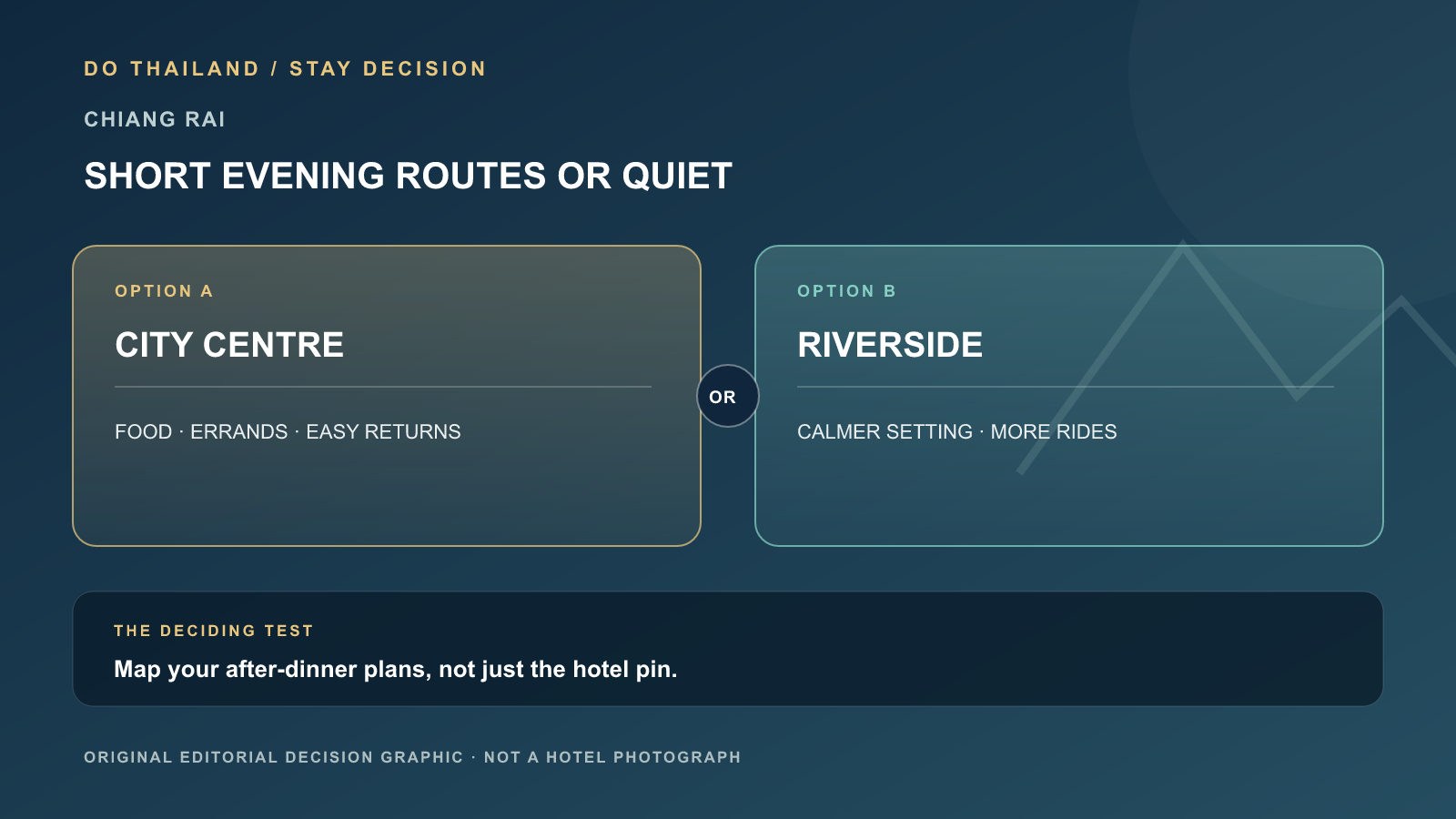
Tourism Authority of Thailand material makes this comparison less binary than it looks. Its Chiang Rai city material identifies the Clock Tower streets as part of the modern commercial core, while separate TAT material describes Kok River accommodation that can still sit close to downtown. A generic “riverside is far, centre is convenient” rule is therefore too crude.
For this guide, city centre means the hotel orbit around the Clock Tower, Night Bazaar and central commercial streets—not every address inside Mueang Chiang Rai. Riverside means urban Kok River hotels where the river setting and property time are part of the booking decision, not any accommodation somewhere along the river.
City centre: buy repeated walk-out freedom
Use the centre when ordinary evenings matter: dinner without arranging a car, a market visit, dessert, massage or simply changing your mind after you have already showered and changed.
The centre earns money by removing small decisions you would otherwise repeat.
Stay planning
Find a place to stay
See available rooms around the property or neighborhood discussed here, with prices for your dates.
Riverside: buy a quieter second half of the day
Use the Kok River side when you plan to spend time at the hotel. River-facing downtime, pool time and a deliberately slow hotel dinner can replace another city outing.
Riverside earns money only when staying in is part of the plan.
Four moments choose the base better than an attractions list
Do not confuse “city centre” with one exact hotel pin
Even inside the central orbit, a hotel can be on a quiet side street or deep enough that the walk stops feeling attractive in rain. Before booking, pin the hotel door, the Clock Tower area and the Night Bazaar on one map. Then add the restaurant or evening stop you are most likely to use twice.
TAT describes Suksathit Road by the Clock Tower as an important modern commercial street. Its Chiang Rai walking-street material also places the Saturday market on Thanalai Road in the city centre. Market operations can change, so verify your dates. The structural point is more durable: central Chiang Rai has multiple evening anchors, not one landmark you visit once.
Riverside has to earn a second door
A city-centre hotel often has one economic job: make leaving easy. A riverside hotel needs two. It must be a good private base and make staying in attractive enough that you do not resent the extra ride when you later want the centre.
That means a river label alone is not enough. Check the exact room outlook, whether common areas genuinely face the river, pool hours, dinner availability and how guests normally return from the centre after dark. If the room is inward-facing and you plan to eat outside every night, the river may be doing more work in the marketing than in your itinerary.
The airport does not settle the argument
Mae Fah Luang–Chiang Rai International Airport currently lists taxi, limousine and app-based ride-hailing among arrival transport options. The airport also publishes a 150 THB airport-taxi rate for rides within Chiang Rai city, while metered taxis have their own published operating hours. These are airport-side services with published hours; arrange the onward ride around your hotel and arrival time.
The airport trip happens once. Your dinner and hotel-return pattern can happen every night. Do not let a one-off arrival ride choose the whole stay.
The weak-weather test can reverse the winner
Imagine a late-afternoon shower removes the easy “walk around and see” plan. In the centre, your fallback may be a short hop between food, cafés, massage and the room. Riverside becomes more valuable when the property has enough indoor or covered space to make a slow afternoon feel intentional rather than stranded.
The opposite matters too: a beautiful riverside booking with a mediocre room and no useful on-property dinner can become more annoying in rain because every fallback still requires a ride.
Solo women should price the last ride, not the first one
For a solo traveler, the central default is partly about preserving optionality after dark. You can finish dinner earlier than planned or change venues without coordinating a driver every time. That does not make every central lane automatically comfortable; inspect the final few hundred metres to the exact hotel, lighting and entrance.
Riverside can still be excellent solo when the hotel has a staffed entrance, a clear pickup point, dinner you are happy to use and a predictable way back from the centre. The question is not simply whether a ride-hailing app operates in the city. It is whether your specific return plan has enough redundancy that one failed ride request does not become the evening.
Two friends should check bedding before paying for scenery
For two friends sharing, a twin room in the centre can be more useful than a prettier river room sold only with a king bed at the rate you found. Compare the full room name and bed configuration for the room you found. Also check bathroom privacy, mirror space and where two open suitcases will go. A scenic upgrade that makes the private half of the stay awkward is not an upgrade.
Two nights, temple-and-food first trip
City centre. You have too few evenings to make extra hotel-to-centre rides a recurring feature.
Three nights, one slow afternoon
Riverside can win. The hotel has enough protected time to become part of the itinerary.
Day trips north, back after dark
Usually centre. The hotel is mostly a recovery and dinner base, so walk-out usefulness matters more than daytime river scenery.
Couple trip with pool and quiet nights
Riverside. You are actually buying the conditions the river setting is designed to improve.
One upstream decision changes the first-night value
If you are coming overland, read our Chiang Mai to Chiang Rai bus vs private transfer guide before paying for a more isolated hotel pin. A private door-to-door car can make a riverside or resort-style location easier on arrival; a scheduled bus plus final local ride makes the exact last-mile distance more relevant.
If Chiang Rai is one stop in a longer northern trip, keep this base decision separate from your Chiang Mai accommodation choice. The same traveler can rationally choose a walk-out Chiang Mai neighbourhood and a quiet Chiang Rai river hotel because the two cities are doing different jobs.
Seven checks before the cheaper rate is allowed to win
- Exact pin: measure the hotel door to your real evening anchors, not the destination label.
- Return after dark: decide whether you will walk, use a hotel car, taxi or app-based ride.
- Room bedding: confirm king or twin configuration for the exact category.
- Rain fallback: identify what you can do for three hours without leaving the property.
- Riverside proof: if paying for the river, confirm which room or common spaces actually deliver it.
- Airport or terminal handoff: price the real arrival and departure, but do not let a one-off transfer outweigh every evening.
- Same-rate comparison: align dates, occupancy, breakfast, taxes, cancellation and payment terms.
The booking rule
For a short first trip, book the city centre unless you can name the hotel hours that justify the river. Riverside is not the “luxury” answer and centre is not the “budget” answer. Centre buys optionality. Riverside buys concentration. Choose the one you will use repeatedly.
Chiang Rai city centre · Walk-out base
Compare hotels around the central evening orbit
Match the same dates and room terms, then pin the hotel against the Clock Tower, Night Bazaar and your likely dinner route.
Kok River · Quieter hotel-led base
Compare the exact riverside hotel radius
Check the real room outlook, evening transport and on-property dining before paying for a river label you may not actually use.
Sources checked
Chiang Rai Stay Decisions · Chiang Rai destination hub · All Stay Guides · All Destinations · All Guides