
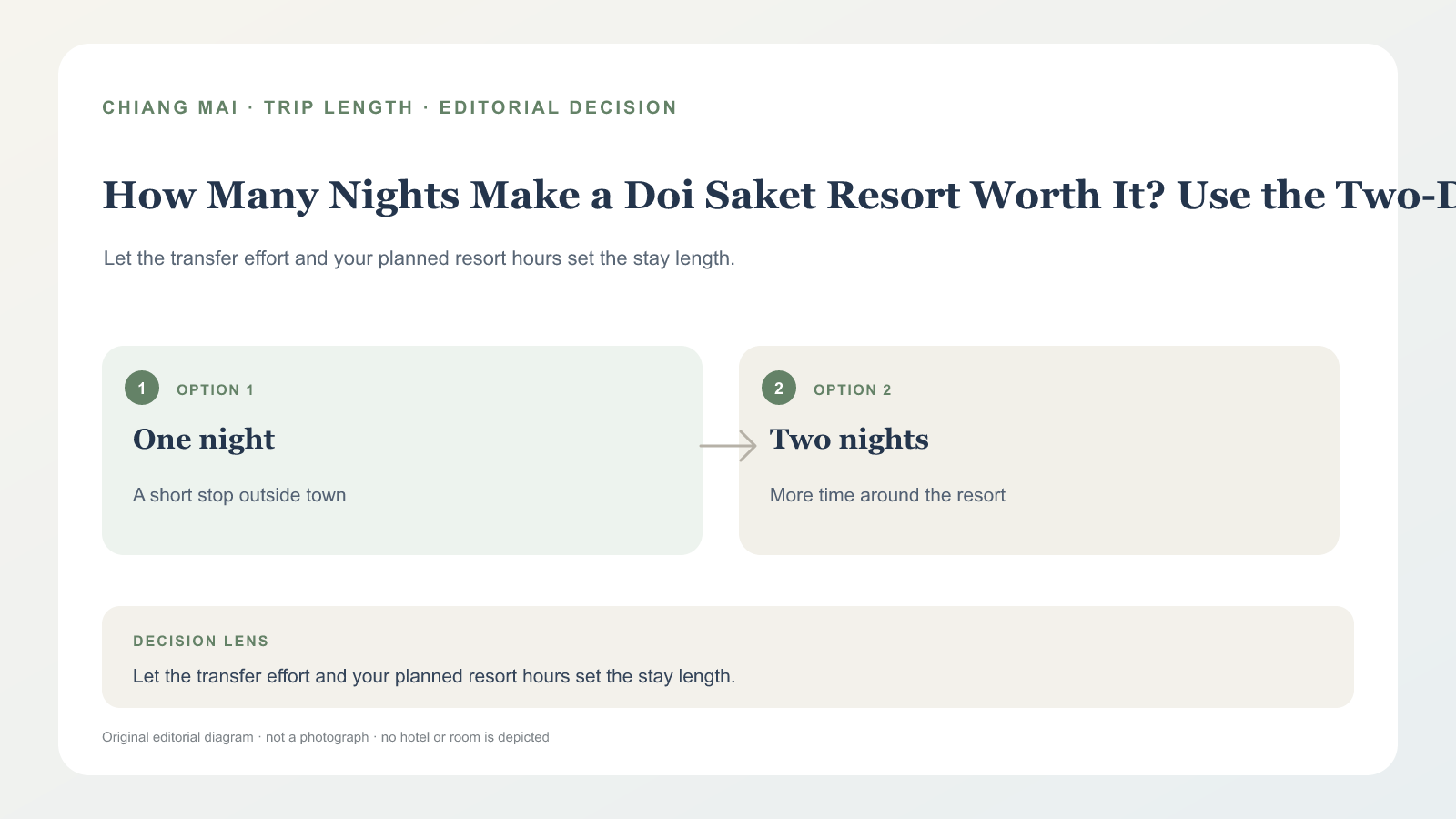
This is a different calculation from choosing a first-trip base such as Old City or Nimman. Those choices are about what you want outside the door every day. Doi Saket is better treated as a specialist block: you deliberately move there because the countryside or the resort itself is going to replace part of your city schedule.
Official Thai tourism material highlights community activities in Doi Saket, including the Tai Lue community at Ban Luang Nuea, where half-day and full-day visits can include cycling, temples, rice fields, agricultural gardens, crafts and local food. That is exactly why a Doi Saket stay works best when you give the east side real calendar space rather than squeezing it between central-city nights.
The two-day rule: count days, not hotel nights
Before looking at a room, draw the next 72 hours. A resort move is doing useful work only when it clusters plans that belong together.
The distinction matters because checking out, arranging a ride, waiting with luggage, checking in and learning a new dinner routine all consume attention. None of those steps is disastrous. The problem is paying that cost and then spending the next day trying to get back to the city you just left.
| Your Doi Saket block | What it feels like | Default decision |
|---|---|---|
| 1 night | Arrival, unpack, dinner, sleep, breakfast, check-out. There may be very little unstructured resort time. | Usually stay in Chiang Mai city unless the single night is the event itself. |
| 2 nights | Arrival afternoon, one complete slow day, one final morning. The transfer begins to buy a different rhythm. | Best general starting point for a split stay. |
| 3+ nights | The resort becomes a genuine base rather than a side excursion. | Works when the property and east-side plans are core to the trip. |
What actually counts as a “Doi Saket day”?
A day counts if most of it would still make sense even if you never crossed back into central Chiang Mai. That might mean a community visit, a countryside activity, long spa or pool time, reading on the terrace, a slow lunch and dinner on the eastern side, or simply choosing the resort as the main experience.
A day does not really count if breakfast is followed by a ride to Tha Phae, lunch around the Old City, shopping in Nimman and a city dinner. Tourism Authority of Thailand material shows how many of Chiang Mai's high-frequency visitor activities are concentrated around the city rhythm: Tha Phae Walking Street, Nimmanhaemin Road, temples and food. If those are still the spine of your day, a central hotel is usually doing more logistical work for you.
For a short first trip, compare the idea with our riverside resort vs central hotel decision. The same principle applies: atmosphere is valuable, but repeated transport can quietly consume the benefit.
Use a 72-hour movement budget
Instead of asking “How far is Doi Saket?”, count how many separate movements your plan creates. Exact road times vary with the property, traffic, weather and pickup point, so a fixed minute estimate is less useful than a movement ledger.
City check-out → Doi Saket resort → two days mostly nearby/on-property → onward trip or airport transfer.
City check-out → Doi Saket → city dinner → Doi Saket → city sightseeing → Doi Saket → city/airport.
If the second version looks like your itinerary, you have not created a countryside stay. You have created a distant sleeping location.
This is also where a hotel shuttle vs walk-out location becomes relevant. A published shuttle can help, but a timetable is not the same thing as spontaneous access. Verify the actual current schedule for your dates rather than assuming that “shuttle available” solves every departure.
Dinner is the hidden test
Remote-feeling stays become inconvenient most often after the sightseeing is over. If you come back tired at 7:30 p.m., what happens next?
A Doi Saket resort earns its location more easily when dinner is simple: there is a restaurant you genuinely want to use, room service or another clearly published food option, and operating hours that fit your schedule. If dinner requires another ride every night, you are paying a transport tax for being hungry.
Our broader resort dining vs hotel-near-restaurants guide uses the same test. For Doi Saket, apply it more strictly because walk-out restaurant density cannot be assumed from the district name alone. Check the exact pin around your property.
Breakfast deserves the same scrutiny. If an early activity matters, confirm when breakfast actually begins. If you are happier with a café morning, a central room-only plan may still be the better product; see breakfast included vs room-only.
Solo women: judge the pickup sequence, not the postcard
A quiet countryside setting is not automatically impractical for a solo woman, and a city street is not automatically comfortable. The useful check is operational.
- Can a driver identify the entrance without a long phone exchange?
- Is there a staffed or visible place to wait if a ride is delayed?
- Will you need to walk an unlit or unsheltered stretch after dinner?
- Can reception help arrange a transfer if app pickup is inconvenient?
- What happens if you return later than planned?
Do not infer remote-resort ride availability from Chiang Mai airport transport. Airports of Thailand publishes ground-transport arrangements for CNX, including app-based pickup information, but that says nothing about how quickly a car will reach a specific countryside resort. Ask the property about its current transfer options and treat app availability as something to verify on the day.
If late arrival is already part of the trip, read the airport hotel vs city hotel decision before adding another hotel move.
Two friends: the room can veto the resort
Two friends can love the idea of a quiet resort and still dislike the room. Before getting emotionally attached to the pool or landscape, verify the exact live room category:
- Is twin bedding actually offered on the rate you are booking?
- Is the bathroom sufficiently private for two unrelated adults?
- Can two suitcases stay open without blocking circulation?
- Are there two usable mirror/light positions when both of you are getting ready?
- Is a hairdryer provided, and can one person use it without taking over the bathroom?
Those details are more consequential than a vague promise of “extra space.” The same principle appears in our pool-access vs upper-floor room guide: a feature is an upgrade only if it improves the way you will actually use the room.
Rain makes the resort decision more binary
In wet weather, a well-designed resort can be wonderful because you have somewhere pleasant to remain without improvising. But rain also magnifies every weak handoff: exposed pickup areas, muddy luggage routes, a restaurant that closes before you need it, or repeated trips back to the city.
For rainy-season dates, prioritize a sheltered arrival, an obvious driver pickup point, usable on-property food and enough indoor or covered space to enjoy a slow day. Our Chiang Mai rainy-season hotel checklist explains why the final metres between car and lobby can matter more than one extra amenity.
One night, two nights or three? Three realistic trip shapes
Scenario 1: four nights in Chiang Mai, first visit
You want Old City temples, Nimman, a night market and one countryside day. Stay in the city. One Doi Saket night would probably turn your only countryside day into a hotel-change day. Put the energy into a good outing instead.
Scenario 2: five or six nights, with a deliberate slow chapter
You have already protected two east-side/on-property days. Two Doi Saket nights can work well. Arrive in the afternoon, keep the middle day local and leave after the second breakfast. This is the cleanest version of the split.
Scenario 3: resort trip with Chiang Mai attached
Spa, pool, reading, countryside and long meals are the main reason for booking. Three or more nights can make sense. At this point, the city is the add-on rather than the resort being the add-on.
If you are considering a split but have not decided whether the second hotel really changes the trip, compare the logic with Chiang Mai city + Hang Dong split stay. Different direction, same standard: the move should create a distinct phase, not simply relocate the same itinerary.
The airport-day trap
A final countryside night can look elegant on a map and still create an awkward departure morning. Do not assume a transfer time. Ask the exact property how airport transfers currently work, whether they must be reserved, what happens for an early flight and whether luggage can be held if you leave later in the day.
If you are arriving late rather than departing early, reduce the number of handoffs. A tired first night is rarely the best moment to make a multi-stage resort transfer. Keep the first night simple, then move when you can actually enjoy the destination.
A decision tree you can use before booking
Question 1: Do you have two consecutive days that would still feel complete without returning to central Chiang Mai?
If no, stay central. If yes, continue.
Question 2: Is the resort itself part of your itinerary? Which on-property features will you use during the stay?
If no, a day trip or city base is usually simpler. If yes, continue.
Question 3: Can dinner, breakfast and pickups work without improvisation?
If no, fix those logistics before paying for the location. If yes, two nights is a strong starting point.
Question 4: Will a third night replace a city day you genuinely want?
If yes, stop at two. If no because you actively want another resort day, three nights may be the better stay.
What to verify on the live rate before paying
- Exact address and pin: “Doi Saket” covers more than one micro-location; judge the property, not the district label.
- Transfer policy: airport/city pickup availability, reservation requirement and current fee if any.
- Dining: restaurant days, last order, room-service or backup options.
- Breakfast: start time and whether your rate includes it.
- Check-in/check-out: especially if the two-night block depends on a long first afternoon or final morning.
- Luggage storage: useful when your onward travel is later than check-out.
- Room setup: king/twin configuration, bathroom privacy and usable luggage space.
- Pickup shelter: particularly for rainy-season dates.
The recommendation comes before the booking step for a reason: do not book Doi Saket first and invent a Doi Saket itinerary later. Protect two local/resort days first. Then choose the property that makes those days easiest.
For the rest of the accommodation graph, continue with the Chiang Mai destination guide or browse all Do Thailand stay decisions.