
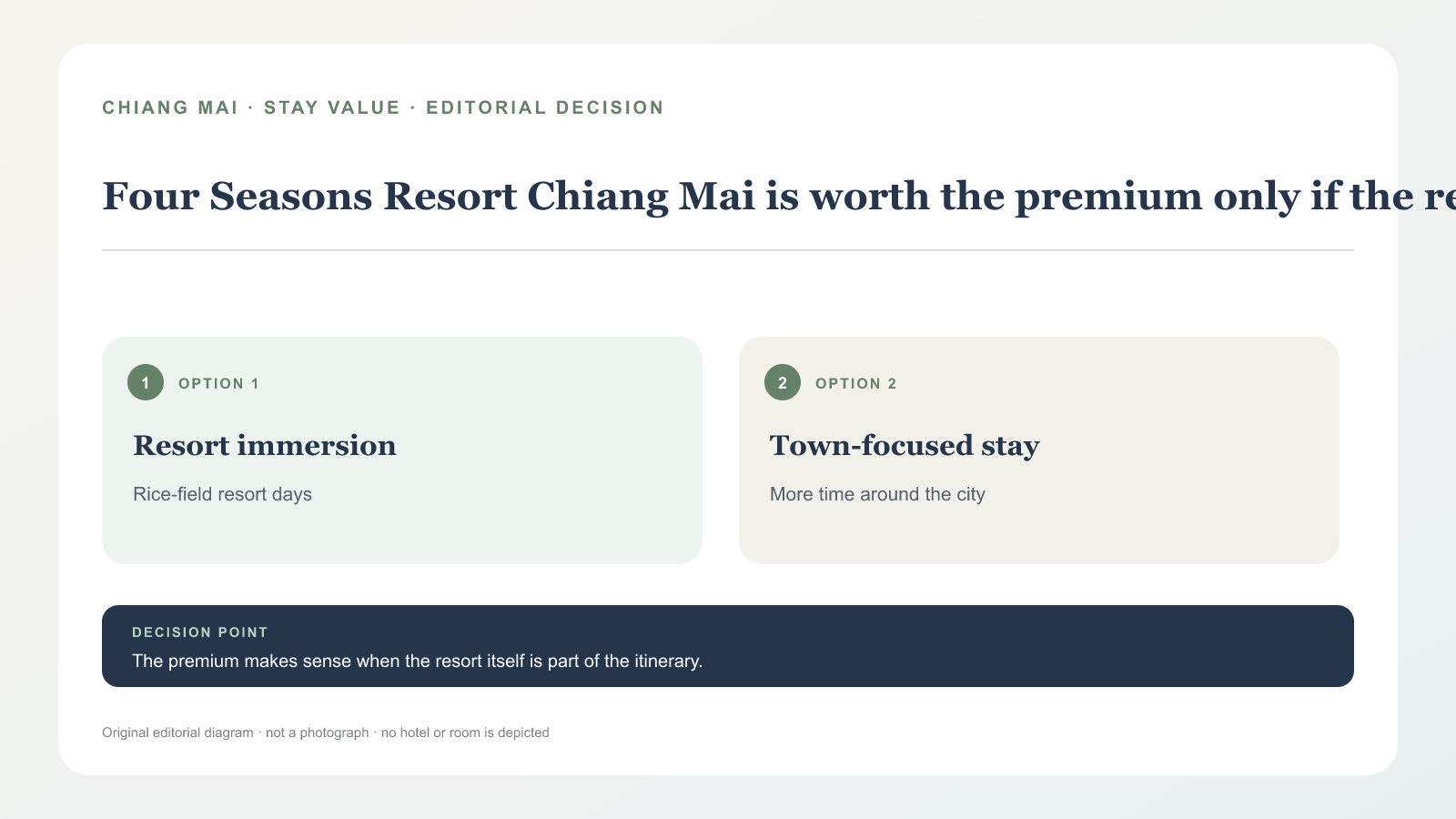
The important thing to understand is that this is a Mae Rim resort decision before it is a Four Seasons decision. Four Seasons currently describes the property as a 13-hectare resort in Mae Rim Valley with working rice terraces, two small lakes, gardens and its own water buffalo. Its official resort facts place it about a 30-minute drive from Chiang Mai International Airport. That is a very different daily rhythm from opening the hotel door and walking into the Old City or Nimman.
If you are still deciding whether Mae Rim belongs in the trip at all, start with our Mae Rim resort vs Chiang Mai city hotel guide. If your priority is a first-trip urban base, Old City vs Nimman is the more useful decision. This page assumes you are already attracted to Four Seasons and need to know whether the property itself gives you enough usable trip value to justify choosing a resort-led stay.
The shortest answer: count the hours you will be at the resort while you are awake
Worth it: you want slow breakfasts, pool time, spa or yoga, an on-property dinner, a cooking or cultural activity, and you are comfortable treating Mae Rim as part of the destination rather than a place you commute from.
Harder to justify: you leave after breakfast for Doi Suthep, the Old City, Nimman or a day trip, then return after dinner. In that version of Chiang Mai, you are paying for a resort environment you mainly see while getting ready for bed.
My practical floor: one night can work as a deliberately timed splurge, but two nights is the point where the resort has a much better chance of becoming part of the holiday rather than an expensive sleeping address.
Stay planning
Find a place to stay
See available rooms around the property or neighborhood discussed here, with prices for your dates.
What the premium is actually buying
The strongest argument for Four Seasons is not one single facility. It is the ability to build a full day without needing another destination. The current resort amenities include two infinity-edge pools overlooking the rice terraces, a full-service spa, a cooking academy at Rim Tai Kitchen, yoga and fitness options, walking and cycling trails, and daily resort experiences. Four Seasons also currently lists complimentary options including nature trails, buffalo bathing and Thai-language lessons, while its broader experience programme includes rice planting, pottery, tie-dye, Muay Thai, meditation and spa programmes.
That concentration matters if you are the kind of traveler who normally over-plans Chiang Mai. A central hotel makes it easy to keep adding another café, another market and another dinner reservation. Four Seasons becomes rational when the point is to stop adding things and let the property absorb part of the day.
Use a time budget, not a star rating
Possible, but timing-sensitive
It works when you can arrive early enough to use the afternoon and do not have an early checkout or day trip the next morning. Arriving after dinner and leaving after breakfast is the weakest-value pattern.
The practical sweet spot
You can have one arrival or transition day plus one full resort-centred day. That gives the pool, spa, dining and cultural programme enough space to compete fairly with the extra transfer friction.
Only if you like resort rhythm
Longer can be excellent for couples, families or wellness-led trips, but first-time visitors with a long city list may start resenting the repeated rides back toward central Chiang Mai.
If your wider trip is four days, compare this against our four-day Chiang Mai itinerary. A city-heavy four-day plan leaves surprisingly little empty resort time. A split stay can work much better than forcing every sightseeing day to begin and end in Mae Rim.
The hotel looks best when you actually stay put
The rooms are not tiny city-hotel rooms you tolerate for location. The current Four Seasons pavilion categories start with substantial indoor-outdoor space, and our separate Four Seasons pavilion room-choice guide explains why the four main pavilions all currently publish the same 70 m² headline size. The upgrade ladder is largely about view and level rather than simply buying more floor area.
For two friends, the official pavilion pages currently list king or twin bedding in the main pavilion categories, which is useful, but still confirm the exact bedding attached to the live rate before paying. For couples, the bigger question is whether you will use the outdoor sala and the resort landscape in daylight. A gorgeous view has limited value if both days are spent off-property.
The absence test: if these plans own your daylight, the resort loses value fast
A Doi Suthep day, a long intercity movement such as Chiang Mai to Chiang Rai, a city café day, night markets and a separate full-day cooking class can each remove a large chunk of the resort time you are paying for.
If two consecutive days already have full external schedules, I would keep the city hotel for those nights and move to Four Seasons only when the itinerary genuinely slows down.
Mae Rim is not inconvenient in the same way as a bad city-hotel location
This is an important distinction. A deep city soi can feel annoying because you keep paying a small transport tax every time you want coffee, dinner or the train. A Mae Rim resort is more binary. You accept that going into central Chiang Mai is a deliberate outing, then the property tries to remove the need to leave for smaller things.
That can be comfortable for a solo traveler who does not want to keep planning late returns, provided she actually likes eating and spending evenings on-property. It can be less satisfying for someone who chose Chiang Mai specifically for spontaneous cafés, bars, markets and walking. If you are comparing a quieter property with a more flexible urban base rather than this specific resort, our riverside resort vs central hotel guide gives the broader framework.
Rain also changes the equation. A self-contained resort can make a wet afternoon easier because there is somewhere pleasant to retreat to, but rain does not magically remove transfer time when you still insist on a dinner across town. The location works best when your plan is designed around it, not when you keep fighting it.
The strongest trip patterns are surprisingly simple
First trip: city first, resort second
Spend the sightseeing-heavy nights in the Old City, Nimman or another central base, then move to Mae Rim for two slower nights. This protects both versions of Chiang Mai instead of asking one hotel to do two opposite jobs.
Couple: two-night reset
Choose one proper resort day with pool, spa or yoga, then use the second day for a lighter Mae Rim experience. Dinner on-property makes the whole stay feel more coherent.
City-maximizer: skip the resort
If your saved map is almost entirely temples, cafés, markets and restaurants in town, spend the money on a better-located city hotel and a separate spa or dining experience instead.
If breakfast is part of the rate decision, do not assume an expensive hotel automatically makes breakfast-inclusive the smarter buy. Our Chiang Mai breakfast-included vs room-only guide explains how to count mornings you will actually use. The logic is particularly relevant here because a pre-dawn or full-day excursion can erase one of the resort rituals you paid to have.
Before booking, answer these five questions
Which afternoon will you stay at the resort?
Name it. If there is no answer, the premium is already on shaky ground.
How many dinners do you want outside Mae Rim?
One deliberate city dinner is fine. Leaving for dinner every night is a sign that a central hotel probably fits your trip better.
Are you paying for a view you will see in daylight?
If yes, choose the pavilion deliberately. If no, the baseline category may be enough.
Is one night creating checkout pressure?
Late arrival plus early departure turns a resort stay into a lobby-room-breakfast sequence. Two nights usually creates a much cleaner rhythm.
What is your next transfer?
If Four Seasons is your final stop before an early flight, compare the move against our last-night airport-hotel decision rather than assuming the resort should automatically hold the final night.
My pick
Book Four Seasons Resort Chiang Mai when you want the property to remove decisions from the trip. Two infinity pools, spa and wellness, dining, cooking and cultural activities make the resort capable of carrying substantial pieces of a day. That is what justifies Mae Rim.
Skip it for a city-maximizing first trip. If every day is already assigned to the Old City, Nimman, temples, cafés and off-property dinners, a central hotel gives you a better trip even if it gives you a less impressive resort.
Once you have decided the resort is the right base, move to the pavilion room-choice guide rather than automatically upgrading by price ladder. Then compare current availability for your actual dates through the site's hotel booking options.
For the wider Chiang Mai accommodation graph, return to the Chiang Mai destination hub or the Thailand Stay hub.
Sources checked
Stay planning
Find a place to stay
See available rooms around the property or neighborhood discussed here, with prices for your dates.