
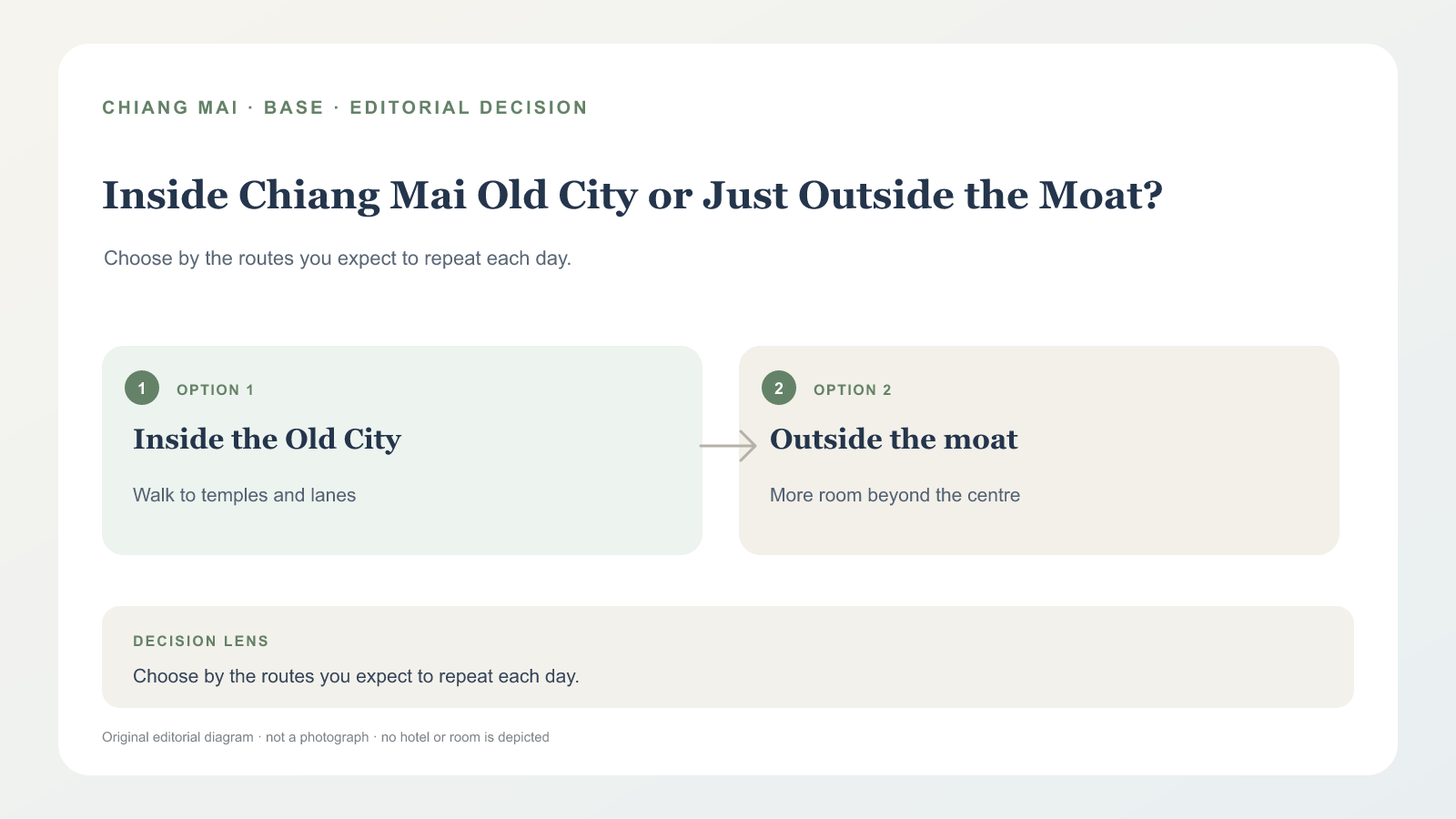
Search maps make this look like a tiny distinction. Two hotels can sit a few hundred metres apart, one technically inside Chiang Mai Old City and one just beyond the moat. Their room photos may look equally good. Their labels may even both say “Old City”.
Yet the better booking can change depending on which side of that boundary your day keeps using. Chiang Mai Province describes the historic center as a moat-encircled old city with surviving walls and gates. Tourism Authority of Thailand similarly identifies Tha Phae on the eastern wall as an entrance to the old walled city. Those gates are useful orientation points, but they do not make every hotel on either side equally convenient.
This guide is for the traveler who has already decided against a completely different base such as Nimman or Night Bazaar. If you are still making that bigger choice, start with Old City vs Nimman or Old City vs Night Bazaar. Here, the question is much smaller and more useful: which side of the moat should your actual hotel entrance be on?
The quick answer: count crossings, not metres
Imagine tomorrow without using the phrase “Old City”. Where will you eat breakfast? Where will you spend the first two hours? Where will dinner end? Where will a tour, Grab or airport ride need to meet you?
If most of those points are inside the moat, book inside. If two or three of them are outside in the same direction, an outside-the-moat hotel can be more practical even when the pin looks marginally farther from the center.
One easy 600-metre walk on the correct side can be more useful than a shorter straight-line distance that repeatedly makes you cross a major road or reposition for a pickup.
Stay planning
Find a place to stay
See available rooms around the property or neighborhood discussed here, with prices for your dates.
“Inside the Old City” buys you continuity
The strongest reason to sleep inside the moat is not romance. It is continuity. A temple morning can turn into coffee, lunch, a room break and another walk without the day feeling like a series of separate transfers.
TAT’s current Chiang Mai material describes the Sunday Walking Street beginning at Tha Phae and continuing along Ratchadamnoen into the Old City. That is one visible example of how activity can run through the historic core rather than sit at one isolated attraction. If your trip is built around old-city temples, lanes, cafés and short resets at the hotel, being inside lets the accommodation become part of the same pedestrian block.
This is especially valuable on a short first visit. You are not paying for proximity to one landmark; you are paying to keep several small decisions in the same zone. If the afternoon turns hot or wet, a nearby room can be a reset rather than the end of the sightseeing day.
But “inside” is not automatically better. An Old City hotel can still sit on a lane you do not enjoy returning through, or on the opposite side of the core from the places you actually repeat. If your map keeps sending you through the same gate every morning and every evening, the boundary has started costing you rather than helping you.
“Just outside the moat” can be the more connected choice
Outside the moat does not mean outside central Chiang Mai. Around several gates, the city continues immediately into other useful neighborhoods and transport corridors. The current Chiang Mai International Airport R3 city-bus information lists Chiang Mai Gate, Tha Phae Gate and Chang Phuak Gate among its city stops, alongside areas such as Night Bazaar and Nimmanhaemin. That is a useful reminder that the moat is a historic boundary, not the edge of the modern visitor city.
An outside hotel becomes attractive when the direction beyond your nearest gate is where you keep going anyway. East-side plans may repeatedly pull you toward Chang Moi, Warorot, Night Bazaar or the river; our Chang Moi vs Night Bazaar guide explains that handoff in more detail. South-side plans can make a hotel near Chiang Mai Gate work differently from one near Tha Phae; see Chiang Mai Gate vs Tha Phae Gate.
The practical gain can be small but repeatable: one fewer road crossing with luggage, a simpler place to meet a car, or a dinner route that stays on the same side as the hotel. None of those advantages can be guaranteed by the phrase “outside the moat”. They come from the exact pin.
| Your actual trip pattern | Lean inside the moat | Lean just outside |
|---|---|---|
| Two or three temple-heavy mornings | Strong. Keeping the historic core continuous is usually worth more than optimizing one transfer. | Only if the hotel sits directly beside the gate you would use anyway and the entrance is materially easier. |
| Night Bazaar / Chang Moi / river evenings repeat | Works if you value walking the Old City more during the day. | Strong on the east side when the hotel removes a repeated evening crossing or ride. |
| Several tours or car pickups | Good if the hotel gives clear curb access and the operator can collect there. | Can be better when the exact frontage makes pickup simpler. Verify with the operator rather than assuming. |
| Sunday Walking Street is a fixed plan | Strong if you want to walk home within the pedestrianized core. | Can still work near Tha Phae, but inspect how the hotel is approached when surrounding streets are busy or restricted. |
| You dislike crossing busy roads after dark | Choose the side containing your most repeated dinner / evening route. | Same rule. The correct side matters more than the “inside” label. |
The hotel entrance matters more than the map pin
A map pin can sit on the moat edge while the actual hotel entrance faces a different lane or road. That changes the trip. A front desk reached from a quiet side lane behaves differently from an entrance where a car cannot easily pause. A hotel that looks “one minute from the gate” may still require a longer pedestrian approach than another pin slightly farther away.
Before paying, switch from neighborhood research to entrance research. Look at the building frontage, rather than the map’s center point. Trace the final approach from the direction you expect to return after dinner. Then trace it again from the direction a car would approach with luggage.
Morning test
Pin the place you genuinely expect to start at least two mornings. If the hotel sits on the same side of the moat and the route is simple, that is real value.
Evening test
Pin the dinner or market area you are most likely to repeat. The route home matters more than a hypothetical attraction you may visit once.
Car test
Check where a Grab, airport ride or tour vehicle can actually stop. Do not infer pickup convenience from the neighborhood name.
Luggage test
Imagine the route with a suitcase in rain or heat. A slightly less central hotel can win if the final handoff is obvious and short.
Sunday is the day the boundary becomes most visible
TAT currently describes Tha Phae Walking Street as a Sunday event running from the gate along Ratchadamnoen into the Old City. If that market is central to your trip, an inside-the-moat hotel on a sensible walking route can be genuinely convenient because you can finish the evening without arranging another vehicle.
But that does not mean “book inside” for every Sunday stay. Events that pedestrianize streets can also change where cars can approach. If you arrive on Sunday with luggage, or expect to leave for dinner by car during market hours, ask the hotel how its entrance is normally reached during the walking street rather than assuming the usual curb route will behave the same way.
If your decision is specifically about which Old City anchor fits you, not which side of the moat, use Tha Phae vs Wat Phra Singh. That article compares east-gate flexibility with living deeper in the heritage core.
Airport arrival should break a tie, not choose the whole stay
Chiang Mai International Airport currently publishes an R3 city-bus route that includes several moat-side gates and central-city stops. It also advises travelers to verify routes and fares again before travel. That is enough to show that both inside-adjacent and outside-adjacent locations can sit within the airport-city transport network; it is not enough to promise one universal fastest side.
For a late flight, the better question is whether reception is open, where your ride can stop and whether you can identify the entrance immediately. Use our Chiang Mai airport late-arrival guide for that handoff. If you are considering changing hotels for an early departure, read airport hotel vs city hotel for the last night instead.
For women traveling solo, audit the final 200 metres in both directions
The practical issue is not whether the Old City or its outer edge has a better reputation. It is whether your exact return route feels simple enough that you will happily use it every night.
Five details worth checking before you book
- After-dark route: trace the final stretch from your likely dinner area and note whether you are relying on a lane, crossing or landmark that becomes less obvious at night.
- Ride-hailing pickup: look for a clear frontage or nearby meeting point. A beautiful courtyard hidden from the road can be lovely once you are inside and annoying when a driver is trying to find you.
- Rain reality: a moat-edge shortcut that feels trivial on a dry map can be less appealing with wet shoes, shopping bags and a phone in one hand.
- Reception timing: if you expect a late return, verify the property’s actual access procedure rather than assuming the front door works the same all night.
- Two-person room practicality: if you are traveling with a friend, let real twin beds, bathroom privacy, mirror placement and luggage space break a location tie before paying for a supposedly better side of the moat.
Three trip shapes make the choice much easier
Stay inside
If temples and Old City walking dominate, protect the small number of usable hours. The historic core should feel like one continuous day rather than a place you commute into.
Choose your dominant gate
Map your repeated east, south or north exits. An outside hotel can win when two or more days naturally leave the Old City in the same direction.
Let the property break the tie
Once both pins work, room quality, breakfast routine and how often you return during the day matter more than being technically inside the boundary.
If you are planning a longer city stay, the Chiang Mai four-day itinerary is useful because it separates Old City, mountain and modern-city time rather than pretending one base is closest to everything. A day at a Chiang Mai cooking class also changes the calculation: once a large part of the day is pickup- or transfer-led, shaving a few hundred metres from a temple walk matters less.
The same principle applies to Doi Suthep. Your mountain day already has its own transport decision, so solve it with our songthaew vs private-car guide rather than trying to make the hotel perfect for one excursion.
The booking rule
Choose inside the Old City when the hotel lets you stay inside your day. If your mornings, coffee stops, temple blocks and easy evenings all happen within the moat, crossing the boundary less often is the point.
Choose just outside when the hotel removes a crossing you would otherwise repeat. The best outside pin is not “cheaper Old City”; it is a better handoff to the direction your trip actually uses.
Open the exact hotel entrance, mark one repeated morning and one repeated evening, then count how many times you would cross the moat in a normal day. That number is more useful than the neighborhood label.
Continue with the Chiang Mai destination hub for the rest of the city decisions, or browse the full Thailand stay guide library.
Sources checked
- Chiang Mai Provincial Government — official Chiang Mai overview, for the moat-encircled Old City and historic gate context.
- Tourism Authority of Thailand — attractions near Chiang Mai Moat, for Tha Phae Gate and Sunday Walking Street orientation.
- Chiang Mai International Airport / Airports of Thailand — RTC Chiang Mai City Bus, for the current published R3 gate and city-stop routing and the airport’s instruction to recheck route information before travel.
Transport routes, operating conditions and hotel access can change. Recheck your exact hotel pin and current transport information before travel.
Stay planning
Find a place to stay
See available rooms around the property or neighborhood discussed here, with prices for your dates.