
This page starts two decisions downstream. If you have not decided whether to sleep in the province at all, begin with Kanchanaburi day trip vs overnight. If the night has won but you are still choosing between the town and the western nature side, use Kanchanaburi Town vs Sai Yok.
Once Town wins, the booking map still matters. Tourism Authority of Thailand currently lists both the Bridge over the River Kwai and Kanchanaburi War Cemetery among the city's major historical attractions, while State Railway of Thailand publishes Kanchanaburi Station on the Thonburi–Kanchanaburi–Nam Tok line. Those anchors are close enough to belong to one town trip, but not so interchangeable that your hotel pin stops mattering—especially with one night, luggage and a fixed train.
Think in two walking-and-ride radii, not official neighbourhood names
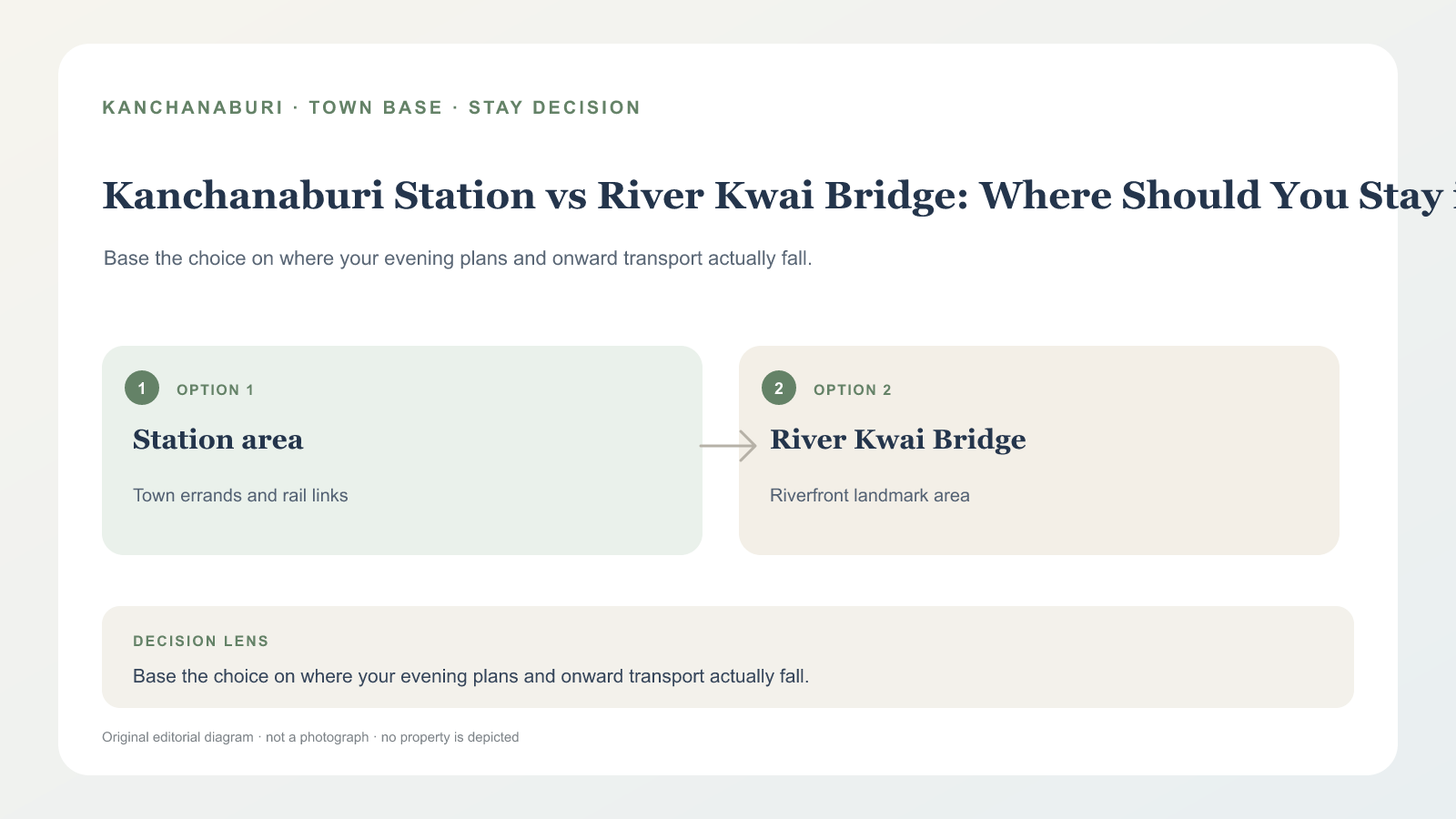
“Station side” and “Bridge side” are editorial shorthand here, not administrative districts. Use them to test the hotel pin you are actually considering.
Station-side radius
This is the practical core around Kanchanaburi Station and the War Cemetery/history side of town. Its job is to compress arrival, departure and a compact historical itinerary. It suits a room that functions mainly as a handoff: arrive, drop bags, walk or take a short ride to the next anchor, sleep, then move again.
It is especially strong when rail is part of either end of the stay. SRT currently publishes ordinary trains on the Thonburi–Kanchanaburi–Nam Tok route; exact times can change, but the structural advantage is stable: choosing a hotel near the station reduces one important luggage transfer when your trip is built around that rail line.
River Kwai Bridge-side radius
This side works when the bridge and river are not one photo stop but part of the texture you want to repeat: an early walk, a slower dusk, a riverside dinner or simply returning to the landmark without treating it as another cross-town outing.
The premium is not “closer to everything.” It is closer to one high-priority cluster. If most of your other tasks are station/history/transport-led, paying more to sit beside the bridge can create extra rides rather than remove them.
Stay planning
Find a place to stay
See available rooms around the property or neighborhood discussed here, with prices for your dates.
The first-and-last 40-minute test
For one night, do not evaluate the hotel using the middle of the day. Look at the two moments when friction is most expensive:
- The first 40 minutes after arrival: where do you put your luggage, how many handoffs happen before you can start the trip, and can you recover easily if it is hot or raining?
- The last 40 minutes before departure: can you leave the hotel without building a fragile taxi/train connection or carrying bags through a sightseeing stop?
If both edges of the stay point toward the station, choose station-side even if you plan to visit the bridge. One bridge visit does not outweigh two luggage-sensitive handoffs.
If the transport edges are already solved and the bridge/riverside owns the evening and morning, choose bridge-side. Then the room protects free time on the river side.
What each side removes from your trip
This is why I would not use “walkable to the Bridge” as a universal booking badge. A hotel location creates value only when it deletes a trip you would otherwise make. If you visit the bridge once for an hour and spend the rest of the stay around the station/history side, the Bridge location is mostly a view premium attached to the wrong repeated route.
Rain and heat make the return direction more important
Kanchanaburi is not a place where I would plan a one-night stay around heroic walking. In strong sun or a sudden shower, the important question becomes: where do you want the easy return to be?
For a solo woman arriving near dusk, I prefer a hotel pin that makes the final ride obvious and short rather than one that looks scenic on a wide map. For two friends, independence matters too: if one person wants to return early, can she do it without taking the other's transport plan with her?
The same logic applies to wet clothes and luggage. A bridge-side property can be lovely, but if your train, cemetery/history block and dinner all pull you back toward the station side, you have bought atmosphere while repeatedly paying to leave it. If your day naturally ends by the bridge, the equation flips.
A train trip makes station-side stronger—but not automatically
SRT's current railway-tourism page shows Kanchanaburi Station on the westbound Thonburi–Kanchanaburi–Nam Tok route and currently publishes ordinary-train examples in both directions. Treat the timetable as live information to recheck, not a permanent promise. What matters for this hotel decision is the structure: a rail-based traveler has a real fixed point in town.
Still, do not choose station-side just because you arrived by train if you immediately become a river-first traveler. If you arrive early, store luggage easily, then spend both sunset and the next morning around the Bridge, the repeat-use value can move west. The transport mode sets one anchor; it does not have to own the entire stay.
If your Kanchanaburi trip is attached to a complicated Bangkok arrival, settle that upstream first. Our red-eye arrival guide explains why a fragile first day is a poor place to stack extra hotel transfers, while BKK vs DMK helps if the airport handoff is still part of the plan.
Three real trip shapes
Train in, history, train out
Station side. The hotel is a logistics tool. Protect the bag drop, the departure margin and the compact history block; visit the Bridge as a deliberate outing instead of making every other task orbit it.
Bridge at dusk, river dinner, bridge again early
Bridge side. You are using the same landscape twice. Proximity now has repeat value, and the quieter morning can be part of why you paid for the night.
One night before moving west
Usually station side until the exact onward transfer proves otherwise. If the next day is really about Sai Yok or farther west, revisit Town vs Sai Yok; you may be solving the wrong micro-area inside Town.
Do not let a Bangkok room hide the real cost
If Kanchanaburi is a side trip, check whether this room replaces a Bangkok hotel night or duplicates one. The difference can matter more than a small Station-vs-Bridge rate gap. Use Where to Stay in Bangkok if your Bangkok base is not settled, or Bangkok Riverside vs Sukhumvit if your Bangkok hotel itself is still a location decision.
Keeping the Bangkok room can be reasonable when you want to leave most luggage behind. But then your Kanchanaburi hotel should work harder: it should make your stay easier through its location or facilities.
Seven exact-pin checks before you pay
- Open the hotel entrance, not the neighbourhood label. Measure from the actual driveway or door.
- Mark Kanchanaburi Station. If rail is involved, trace the bag-carrying route rather than a sightseeing walk.
- Mark the Bridge over the River Kwai. Count how many times you genuinely expect to return to that cluster.
- Name the evening plan. A scenic pin is valuable only if the evening uses it.
- Name the departure handoff. One night has no spare morning for a poorly planned ride.
- Check the last 300–500 metres. Lighting, road width, rain cover and ease of pickup matter more than the area's reputation.
- Compare like for like. Same date, occupancy, room type and cancellation terms before judging the location premium.
After the micro-base wins, compare accommodation around that anchor
The editorial verdict comes first: Station side for a compressed transport/history-led overnight; Bridge side when the bridge and river will be used repeatedly. Use the area links below to compare current availability, total price and cancellation terms for the same dates.
Station side · Compare stays
Shortlist around the rail-and-history handoff
Keep the exact station route, evening plan and departure margin visible while comparing the same dates and cancellation terms.
Bridge side · Compare stays
Shortlist where repeated river time is easy
Compare exact pins, then confirm how check station transfers, late returns and your next-morning plan alongside distance to the Bridge.
My final rule
Book near the anchor you will touch twice. If the station is part of both arrival and departure, let it win. If the Bridge owns sunset and the next morning, let the Bridge win. One-night location value comes from repeated doorstep use, not from the landmark that looks most romantic on the map.
Sources checked
Sources checked 12 August 2026: Tourism Authority of Thailand's current Kanchanaburi destination page for the current town/base context and the Bridge and War Cemetery as major historical anchors; TAT's current Kanchanaburi–Ratchaburi trip planner for the Bridge within the wider province itinerary; and State Railway of Thailand's current Thonburi–Kanchanaburi–Nam Tok railway-tourism page for the published Kanchanaburi Station rail structure. Railway times and hotel transport arrangements change; recheck the exact date and hotel pin before paying.