
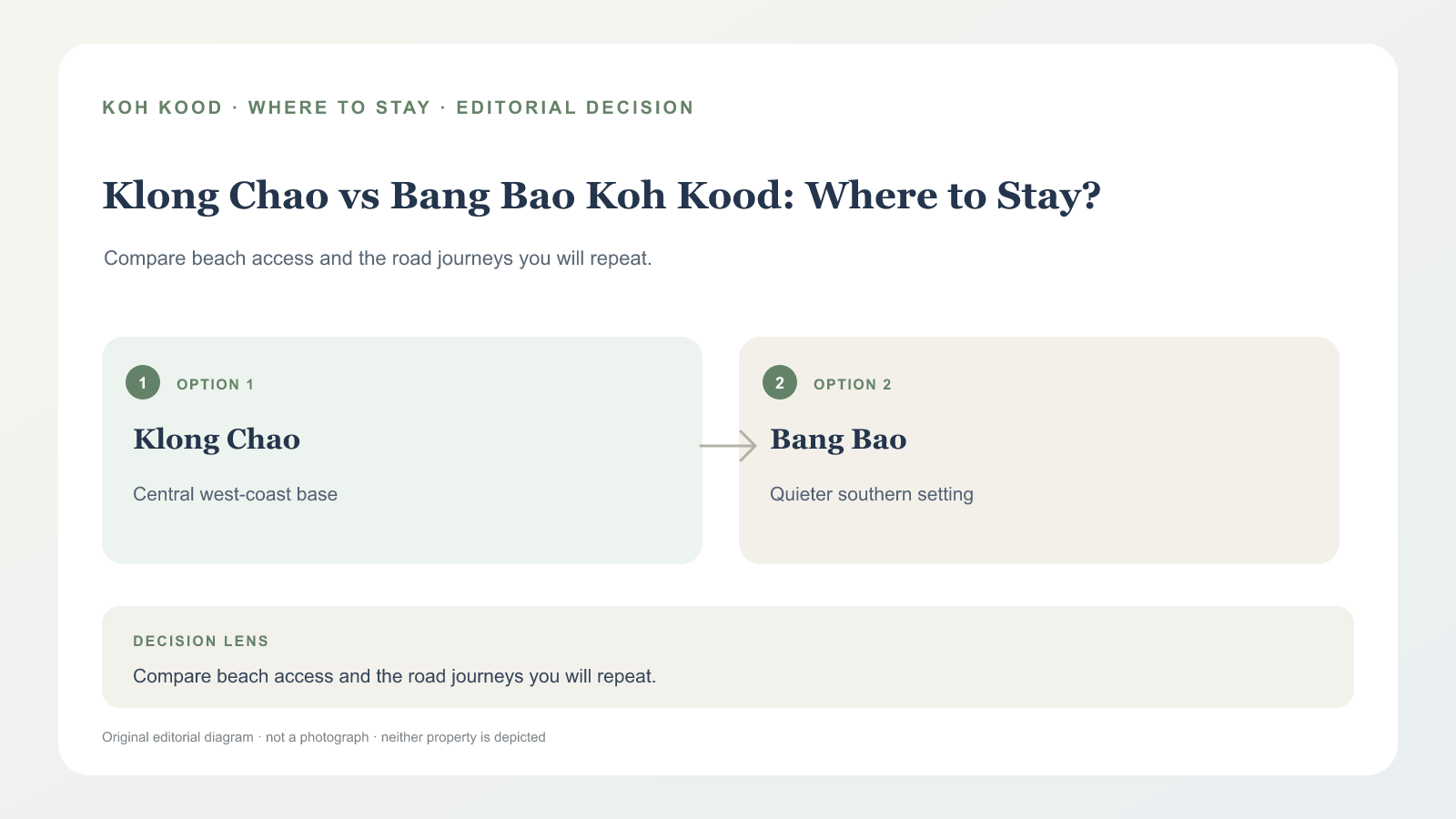
Koh Kood rewards a different booking instinct from Phuket or Koh Samui. Tourism Authority of Thailand currently describes it as a quiet resort destination with relatively little infrastructure, and its island guidance still warns that local transport is limited. That makes a hotel pin unusually powerful: a beautiful room in the wrong operating radius can quietly turn every meal, waterfall visit and change of plan into another ride.
Klong Chao: buy optionality
Choose Klong Chao when you want beach time without handing the whole day to one resort. The waterfall sits behind the bay, kayaking is part of the local river-and-mangrove experience, and current local guides show a broader spread of restaurants, cafés and smaller stays around the beach, road and waterfall junction.
Stay planning
Find a place to stay
See available rooms around the property or neighborhood discussed here, with prices for your dates.
Bang Bao: buy concentration
Choose Bang Bao when the point is to settle into a quieter bay and let the exact property do more work. Current accommodation inventory is strongly beachfront-resort led. That can be excellent value when your hotel supplies the beach, meals, kayaks or snorkelling rhythm you actually want; it is weaker value if you expect to roam independently several times a day.
Ask for three receipts from the area premium
Do not pay more for a location because it sounds central or secluded. Make the area earn its rate in three ordinary moments. These are more useful than a list of nearby attractions because they repeat on every hotel night.
Can you start the kind of day you want without first negotiating a ride?
Can you shower, change and choose food or another activity without turning the reset into a transfer?
Do you want another walk-out option, or are you genuinely happy to let the resort own the rest of the evening?
Klong Chao works better when your itinerary is still slightly undecided
TAT identifies Khlong Chao Waterfall as one of Koh Kood's headline natural attractions, and the official tourism directory places it behind Khlong Chao Bay on the island's west side. TAT also specifically mentions kayaking along the Khlong Chao waterway and mangrove area. Those details matter because they give the Klong Chao base more than one job: beach base, river/waterfall access point and a comparatively practical place to improvise a half-day.
Current 2026 local dining and beach guides also show more independent food choices around Klong Chao than the phrase “quiet island” might suggest. Do not translate that into “walkable town”. Koh Kood is still spread out, roads can be dark and hilly, and the exact hotel pin matters. The advantage is simply that Klong Chao gives you more ways to construct a normal day without asking one resort to provide every answer.
This is especially useful for two friends with different energy levels. One person can stay at the beach while the other goes for coffee, a massage or a short waterfall outing. For a solo traveller, the same optionality can reduce the number of times a small change of plan requires arranging another vehicle.
Bang Bao is stronger when the resort is supposed to be the itinerary
Bang Bao Bay is not empty. Current accommodation and local-area guides show several established beachfront resorts plus a smaller set of restaurants along and above the bay. The area works best as a contained south-west coast beach stay; daily cross-island outings make this base less practical.
If your ideal day is breakfast, swim, read, lunch, snorkel or kayak, shower, sunset and dinner—mostly without leaving the bay—Bang Bao's concentration is an advantage. The fewer movements you make, the less you pay for Koh Kood's limited transport in time and attention. A resort that includes or conveniently provides the things you were going to buy anyway can make the apparently less flexible base the more rational one.
The trap is booking Bang Bao for the beach photo while mentally planning Klong Chao-style days. If you expect to visit the waterfall, try several independent restaurants, change beaches and add island outings spontaneously, count those rides before you decide that the quieter bay is automatically more relaxing.
The no-plan afternoon test
Imagine it is 4:30 p.m. You have no booking, your swim is finished and nobody wants to research another activity. In Klong Chao, would you enjoy choosing among the beach, river area, a nearby restaurant or a short reset at the hotel? In Bang Bao, would you enjoy staying in the bay and letting the property carry the next five hours?
Whichever answer sounds like relief rather than compromise is the better base. This test is useful because it removes the once-per-trip highlights and exposes the ordinary hours that decide whether a three-night stay feels easy.
Do not let one waterfall or one snorkelling trip choose all three nights
Klong Chao Waterfall is a reason to visit the area, but one waterfall outing is not enough to justify every hotel night there. Likewise, a snorkelling-friendly bay does not mean Bang Bao is automatically the right base if the rest of your plans are elsewhere. A one-off activity should influence one block of the itinerary; a hotel base should be chosen by movements that repeat.
If you already know the exact tour operator, meeting point and transfer arrangement, use those facts. If you do not, keep the area decision broad and let the Thailand Experience guides handle the purchase decision later rather than inventing a pickup assumption now.
Rain makes the fallback more important than the headline beach
TAT currently says Koh Kood can be visited year-round but identifies June to October as the rainy season, while another current destination page warns that boat service is more limited in the low season. That does not mean “avoid Koh Kood in rain”. It means the weak-weather version of your hotel matters more.
Klong Chao generally gives you more independent fallback choices around the central west-side area. Bang Bao can still win if the exact resort has covered common space, food you would happily eat twice, a room you enjoy during a shower, and a sensible road/transfer plan. Rain does not automatically favour the more central base; it simply makes a property-first booking contract more visible.
If you do not ride a scooter, make the transport dependency explicit
TAT's Koh Kood guidance states that the island does not have conventional public transport and that travellers use rental motorcycles, bicycles or chartered songthaews. Current conditions and services can change, so verify your actual property transfer rather than assuming an island-wide taxi system works like Bangkok or Phuket.
For a solo woman returning after dinner, the useful question is not whether an area is “safe” in the abstract. It is whether the exact final route is lit, whether the hotel can reliably arrange a ride, what happens after its reception desk slows down for the night, and whether you are comfortable repeating that plan. For two friends, the same audit matters because one person may want to leave dinner earlier than the other.
Three-night trip shapes
Mixed first trip: Klong Chao is the cleaner default. It preserves the waterfall/river option, several eating choices and an easier base for changing your mind.
Resort-first beach break: Bang Bao is more compelling. Choose the exact beachfront property carefully and make sure its food, beach access and included facilities are things you will genuinely use.
One active day plus two slow days: either can work. Put the active day on paper. If it repeatedly pulls you north or back through Klong Chao, stay there. If it is one contained excursion with hotel pickup and the other days belong to the bay, Bang Bao can still be the better purchase.
Nine checks before you book the hotel pin
- The exact beach or bay—not simply “Koh Kood” in the OTA address.
- How the ferry operator or hotel handles the island-side transfer for your arrival.
- The route from the room to a restaurant you would genuinely use after dark.
- Whether you will rent a scooter, use hotel transport or need pre-arranged songthaews.
- Your planned Khlong Chao Waterfall or river day, if any.
- Whether the Bang Bao property provides meals, kayaks, snorkel gear or transfers—and whether those are actually included in your rate.
- Your weak-weather fallback inside and outside the property.
- Low-season ferry operation for your exact dates.
- The same dates, occupancy, room category, breakfast and cancellation terms when comparing prices.
My booking order
First decide how much of Koh Kood you want outside the hotel. Then verify the exact pin and transport plan. Only after that should the room rate break the tie. For a first three-night mixed stay, I would begin with Klong Chao. I would switch to Bang Bao when I can name the resort, bay and slow hotel time as deliberate parts of the trip rather than things I am merely willing to tolerate.
Klong Chao · Keep the island usable
Compare Klong Chao hotel pins
Use the same dates and occupancy, then inspect the actual route to the beach, food, waterfall junction and your ferry transfer.
Bang Bao · Let the bay carry more of the stay
Compare Bang Bao Bay hotel pins
Match dates and occupancy, then verify beach access, meal options, included facilities and the exact transfer before paying.
Where this decision goes next
Keep the accommodation chain in the Koh Kood Stay hub and the whole destination in the Koh Kood destination hub. If you are comparing another Trat island, use White Sand Beach vs Kai Bae on Koh Chang and the Koh Chang hub as a separate decision rather than assuming the islands work alike. For another Gulf island with a very different transfer pattern, see Sai Kaew vs Ao Phrao on Koh Samet. Verify changing boats and road handoffs in Thailand Transport, keep activity purchases in Thailand Experiences, and keep transfer messages available with Thailand eSIM vs Airport SIM. You can also return to all stay guides, all destinations or all guides.
The rule to remember
Klong Chao keeps more of Koh Kood outside the hotel. Bang Bao makes the hotel and bay a larger share of Koh Kood. Book the version of island life you actually want to repeat after the headline beach moment is over.