
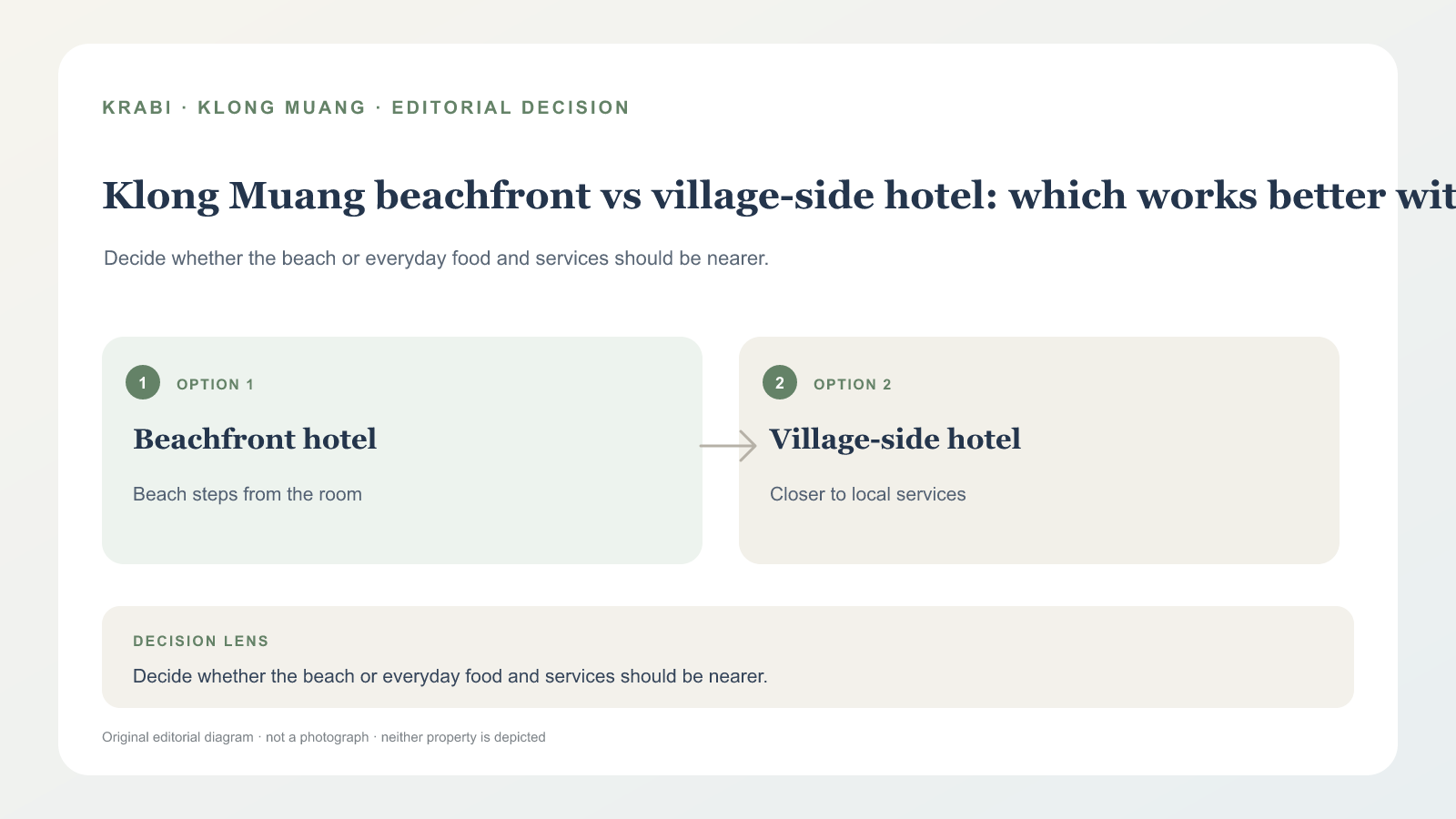
If you are still deciding whether Klong Muang itself is the right Krabi base, start with Klong Muang vs Ao Nang. This page begins one decision later: Klong Muang already fits the quieter, resort-first trip you want, but the hotel map still shows properties scattered between the sand, the main road and small service clusters.
That micro-location matters more when you are not renting a scooter. In a dense resort town, a slightly inconvenient hotel pin can be a minor annoyance. In a quieter beach area, it can decide whether every dinner is a pleasant walk, a resort meal or another car ride.
Count how often you will actually swim, walk the sand or return for sunset. Direct access gets valuable very quickly when the beach is a twice-daily habit.
Audit the real walking route after dark, not the straight-line map distance. Restaurants that look close can still involve an awkward road edge or an unappealing last stretch.
Island tours, airport transfers and prebooked cars can reduce the penalty of a quieter pin. They do not solve the small spontaneous trips you make between scheduled outings.
The useful rule: one exact pin beats the word “beachfront”
Klong Muang is not a simple two-zone map where every beachfront hotel is isolated and every inland hotel is convenient. Current official resort location information proves why the label alone is too crude: at least one current beachfront resort publishes a position only 200 metres from Klong Muang Plaza, while other beachfront properties explicitly sell a more secluded setting and rely more heavily on resort dining, transfers and taxis.
So the right comparison is not sand versus road. It is your exact hotel entrance to the places you will repeat.
Stay planning
Find a place to stay
See available rooms around the property or neighborhood discussed here, with prices for your dates.
Choose beachfront if you plan to use the beach every day
Beachfront earns its premium through repeated friction removal. If your ideal day begins with a barefoot walk, includes a midday swim and ends with sunset on the sand, crossing a road or walking several minutes each time becomes surprisingly annoying. The advantage gets larger in rain, in strong heat and when you are carrying wet sandals, a towel, a cover-up and a phone you do not want to expose to another roadside walk.
This is also where Klong Muang differs from an active Ao Nang itinerary. If your day is built around hotel time, the hotel can reasonably own a larger share of breakfast, lunch, pool hours and sunset. That is why the broader Tubkaek vs Klong Muang decision asks how much isolation you actually want, rather than treating quietness as automatically better.
Beachfront is especially convincing when your stay includes a deliberately slow day between boat trips. After a Hong Islands day, the difference between walking directly back to your room in wet clothes and waiting for another short ride can feel larger than it looked during booking.
Choose village-side when your independence starts after sunset
A village-side or service-cluster hotel is not necessarily the more romantic choice, but it can be the more usable one. If you like deciding at 7 pm whether dinner is noodles, seafood, a café stop or something from a shop, the ability to walk out without negotiating another transfer has real value.
The important word is usable. A hotel that is technically five or ten minutes from restaurants is only convenient if the route feels fine when it is dark, humid or raining. Check the entrance, the road shoulder, major crossings and the final few hundred metres. Do not assume a short map distance equals a pleasant walk.
This is the same logic behind our Ao Nang without a scooter guide, but the threshold is stricter in Klong Muang because you have fewer fallback options immediately outside the hotel. The correct pin can preserve the quiet beach-base feeling without turning every small errand into transport planning.
The twice-daily beach test
If you expect two or more voluntary beach returns most days—morning walk, swim, sunset, post-lunch reset—give direct sand access a high weight. You are buying back several tiny decisions every day.
The after-dinner test
If you expect to leave the property most evenings, give the entrance-to-dinner route equal or greater weight than the sea view. One comfortable walk you repeat nightly can be more valuable than a beach gate you use once.
Do not let one Hong Islands pickup choose the whole hotel
Klong Muang can be attractive for Hong Islands access, but a single tour day should not decide a three- or four-night hotel. Use the dedicated Klong Muang vs Ao Nang for Hong Islands guide if that boat trip is driving the base decision. Once Klong Muang is fixed, ask what happens on the other evenings.
A structured pickup can neutralise hotel-location friction for that one morning. It does not make dinner, laundry, pharmacy stops or a spontaneous café visit equally easy. The hotel should be chosen around the unstructured hours as well as the organised ones.
Airport transfer convenience does not require a beachfront hotel
Road access is the more important variable for arrival and departure. If you are landing late, carrying several bags or simply dislike finding a ride after a flight, compare Grab vs a prebooked transfer from Krabi Airport to Klong Muang. A confirmed door-to-door car largely removes the arrival advantage of choosing a hotel simply because it sits on a more obvious road.
Current official Klong Muang resort pages place the coast roughly a 40-minute drive from Krabi International Airport in their own location guidance, but treat that as a property-specific planning anchor rather than a guaranteed travel time for every hotel or traffic condition.
The after-dark audit matters more than the daytime map
For women travelling independently, the useful question is not whether Klong Muang is labelled “safe” or “quiet.” Those labels are too broad to choose a hotel. Look at the route you would actually walk alone after dinner: is there lighting near the entrance, a usable shoulder or pavement, an awkward crossing, an isolated final stretch, and a simple place for a driver to stop if you decide not to walk?
Also run the same route in rain in your head. A five-minute dry walk can become a very different proposition with a long dress, wet sandals, a tote bag and traffic spray. If the route fails that test, price the occasional car into the hotel decision rather than pretending you will always walk.
| Your actual trip pattern | Lean beachfront | Lean village-side / service-cluster |
|---|---|---|
| You plan morning beach + sunset most days | Yes. Repeated direct access is the product. | Only if the inland rate difference is large enough to matter. |
| You want a different off-property dinner most nights | Only when the exact beachfront pin is also an easy walk to services. | Usually. Evening independence matters more. |
| You have several organised tour pickups | Either can work; pickup reduces the location penalty. | Either can work; do not choose by tour morning alone. |
| You are happy eating at the resort frequently | Strong fit. The beach and property can own more of the day. | Less important unless the rate or room is materially better. |
| You dislike arranging short car rides | Choose only if restaurants and essentials are genuinely walkable from the exact entrance. | Strong fit when the service cluster is truly close. |
| You arrive late with luggage | Choose the better confirmed transfer and reception handoff; beachfront status is secondary. | |
Meal plan becomes part of the location decision
If the property is intentionally secluded, a half-board rate can solve a problem the location itself creates. If you choose a pin with easy off-property dining, prepaying dinner every night can remove the flexibility you paid for through that location. Use Klong Muang half board vs breakfast-only after you settle the hotel pin, not before.
The same principle applies to a split stay. If you want several activity-heavy evenings plus a couple of truly slow resort days, an Ao Nang + quiet-coast split may solve the conflict more cleanly than forcing one Klong Muang hotel to behave like both an activity hub and a retreat.
What to check on the map before you book
Open the exact hotel pin rather than the broad Klong Muang search result. Trace the entrance—not the centre of the resort—to the beach gate, two realistic dinner options, one convenience stop and the place a car can actually collect you. Then repeat the exercise for the return journey after dark.
If another quiet coast is still in contention, compare Nopparat Thara vs Klong Muang for a less resort-dependent alternative, or Railay vs Tubkaek if the bigger question is walk-out peninsula life versus a road-connected resort coast.
Finally, if Hong Island itself is the centrepiece, do not overbook the rest of the day around the hotel. Our Hong Island viewpoint vs beach-time guide is a better place to decide how much energy to spend once you are there.
The simple booking rule
Book beachfront when direct sand access is a repeated behaviour. Book closer to the village/service cluster when your repeated behaviour is walking out for dinner and small errands. If one hotel gives you both, that overlap is more valuable than either label by itself.
For a no-scooter Klong Muang stay, the winner is usually the property with the lowest total daily friction—not automatically the room nearest the sea.
Sources checked
Stay planning
Find a place to stay
See available rooms around the property or neighborhood discussed here, with prices for your dates.