
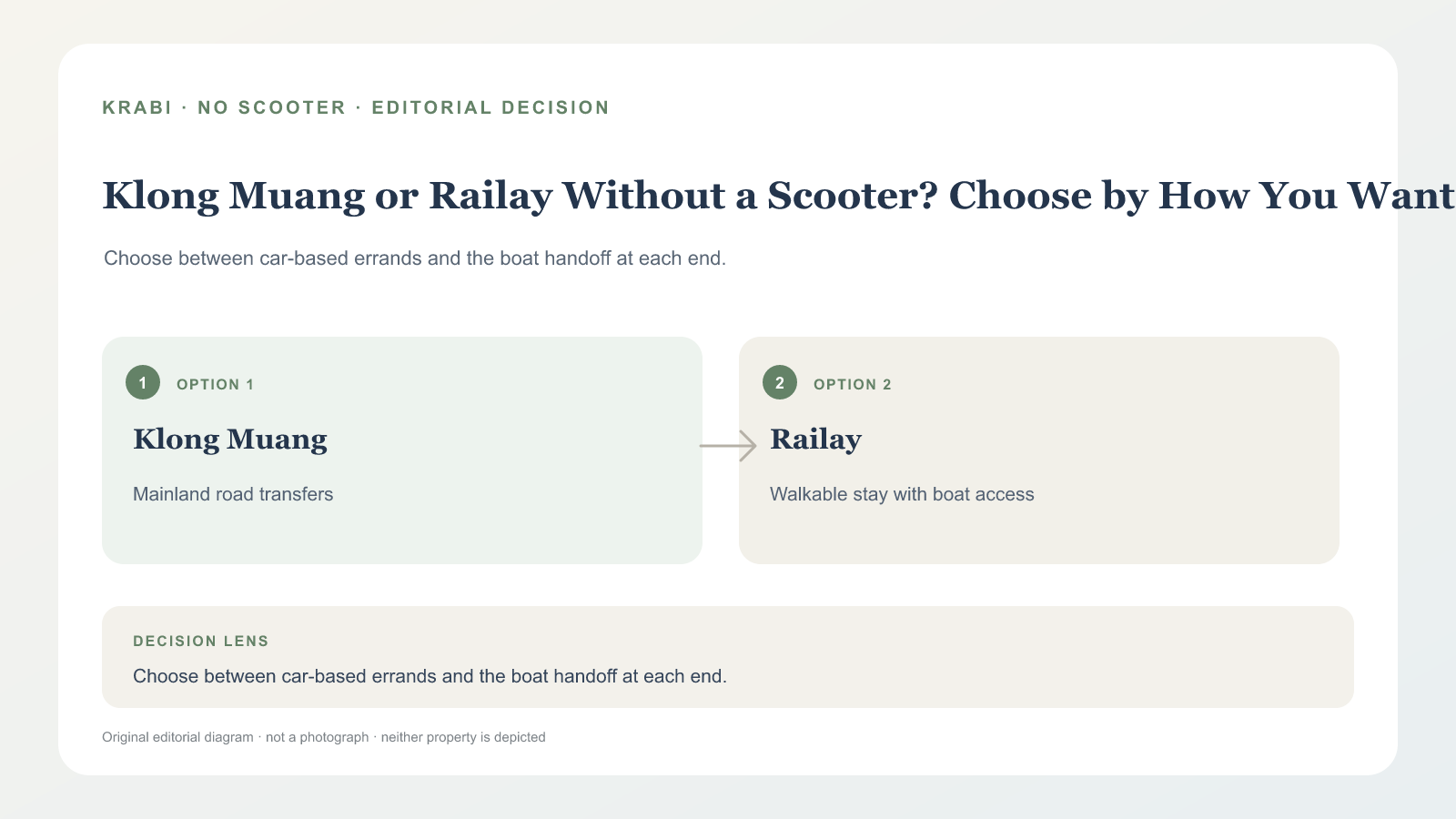
Klong Muang and Railay can both look like calmer alternatives to Ao Nang. That similarity disappears the moment you ask a more useful question: what happens when you want to go somewhere at 8:45 p.m.?
Railay is a boat-access peninsula. Tourism Authority of Thailand still describes Railay Beach as reachable only by boat, and current ferry-operator pages require Railay passengers on several onward routes to walk to the Railay East Floating Pier rather than expect hotel pickup. Klong Muang stays on the mainland road network. Current official Klong Muang resort information publishes road transfer times to Krabi International Airport and Ao Nang, while current ferry-operator pages list Klong Muang hotel pickup on some mainland routes.
None of that means one base is universally easier. It means they remove different kinds of friction.
The recommendation in one sentence
Railay is the stronger no-scooter base when you want to walk for most daily decisions; Klong Muang is the stronger no-scooter base when you want road-connected transfers and are willing to plan the rides you will still need. If your shortlist is really Klong Muang versus a more service-dense mainland hub, compare Klong Muang vs Ao Nang instead. If your shortlist is really Railay versus Ao Nang, the broader Ao Nang vs Railay guide solves that first.
Stay planning
Find a place to stay
See available rooms around the property or neighborhood discussed here, with prices for your dates.
Do not confuse car-free-feeling with transfer-free
Railay can feel wonderfully simple after check-in. You can move between the main Railay areas on foot, walk out for dinner, reach climbing meeting points and spend a beach day without ordering a vehicle every time your plan changes. This is the kind of independence that matters more than a scooter when the peninsula itself is the destination.
The trade-off is concentrated at arrival, departure and some excursion handoffs. Current Ao Nang Travel & Tour pages for Railay routes tell passengers to check in at Railay East Floating Pier at least 30 minutes before departure, note that Railay hotel pickup is not provided on those routes, and warn that travel time depends on weather. Those details are route-specific snapshots rather than a permanent timetable, but they illustrate the structural point: your luggage and your clock still have to respect the boat.
If your hotel-side choice is already Railay, read Railay East vs West. East can reduce pier friction; West gives you the classic beach-at-the-door feeling. If you are unsure whether moving onto the peninsula is worth it at all, the Railay one-night vs two-night guide is the more important decision.
Klong Muang keeps the road — but that does not make every hotel walkable
Klong Muang is easier at the edges of the trip because a driver can reach the coast by road. Current official Klong Muang property information publishes roughly 40 minutes from Krabi International Airport and about 15 minutes to Ao Nang for one beachfront location. The mainland location removes the island boat transfer; check journey time from your exact hotel pin.
The mistake is turning “road-connected” into “I will never need a ride.” Klong Muang is spread out enough that the exact hotel entrance matters. A beachfront room can be excellent for repeated sand-and-pool days and still leave you wanting a car for a late dinner somewhere else. Another hotel can sit close enough to a small service cluster that your evening is easier on foot.
That is why the next page after choosing Klong Muang should often be Klong Muang beachfront vs village-side without a scooter. It audits the route you will repeat rather than treating the whole coast as one pin.
The three-friction budget
A no-scooter trip becomes much easier when you decide which kind of friction you are willing to carry. You usually cannot remove all three.
Boat handoffs
Railay spends more of its friction here. You gain a compact peninsula after arrival, but the start and end of the stay need more choreography.
Vehicle dependence
Klong Muang spends more here. The road is available, yet off-property movement can still require a taxi, ride-hail vehicle where available or a pre-arranged transfer.
Hotel-pin risk
Klong Muang punishes a casual map decision more. Two properties carrying the same area label can create very different dinner walks and pickup routines.
For women travelling solo or with one friend, audit the last return — not the first departure
The morning is usually the easy part. You are awake, shops are open and you can solve a missed pickup. The more revealing test is the final journey home after dinner, in rain, with a wet tote bag or when you simply do not want another logistics problem.
On Railay, ask whether you are comfortable walking your actual route after dark and whether your chosen side of the peninsula matches the evenings you want. “Walkable” is not the same as step-free, brightly lit or effortless with luggage.
On Klong Muang, zoom into the real hotel entrance and the road you would use to reach dinner. If the answer to “How do I get back at 10 p.m.?” is “I will find a car then,” make that a deliberate plan rather than an assumption. The Krabi Airport to Klong Muang: Grab vs prebooked transfer guide is useful for thinking through the same reliability trade-off on arrival day.
Run this 9 p.m. test before you book
- Open the exact hotel pin. Do not judge from the area name alone.
- Pick one realistic dinner or evening stop. Not the hotel's own restaurant — somewhere you would actually want as an alternative.
- Trace the return in the dark. Note road shoulders, pier timing, wet-weather exposure and whether the route depends on a vehicle or boat still operating.
- Add one awkward object. A suitcase, shopping bag, wet swimsuit, beach towel or climbing gear changes what “easy” feels like.
- Repeat for departure morning. The best leisure base can still be the wrong last-night base if your onward transport is unforgiving.
Tour days expose the difference even more clearly
Do not assume every Krabi tour collects from every hotel. Current operator pages show why: some mainland services explicitly include Klong Muang pickup, while current Railay ferry pages can require passengers to reach Railay East Floating Pier themselves. The exact product, season, weather and meeting point still need to be checked for your date.
If Hong Islands is the anchor experience, compare Klong Muang vs Ao Nang for Hong Islands and then choose the boat style with Hong Islands longtail vs speedboat. Klong Muang can make sense when north-coast access and hotel pickup line up with the exact operator.
If Railay climbing is the anchor, sleeping on the peninsula changes the equation. You avoid a same-day mainland-to-Railay arrival before the activity and keep the rest of the day local. The next decision is Railay half-day vs full-day climbing, not whether Klong Muang has a nicer pool.
The luggage question matters more than it sounds
A rolling suitcase does not make Railay a bad choice, but it should make the arrival plan more explicit. You are not checking into a normal curbside mainland hotel zone. Confirm the transfer sequence and how the final handoff reaches your property before travel day.
Klong Muang is simpler for a large suitcase because the coast is road-accessible. That advantage grows if Krabi is one stop inside a longer Thailand trip and you are carrying more than a light beach bag. If Railay is still the emotional winner, a split stay can isolate the boat-and-luggage move to a meaningful block rather than one token night; see Ao Nang + Railay: one base or two.
Two realistic three-night trips
One climbing day, one loose beach day, dinners on foot
You land in daylight, accept the boat transfer once, spend the middle of the trip almost entirely on the peninsula and do not need a mainland errand. The transfer buys you three days of reduced road dependence. Railay makes sense.
One Hong day, one resort day, one airport-sensitive departure
You want a quieter coast but still value a normal car transfer, a hotel pickup where your chosen operator offers it and a simple final drive toward the airport. You are happy to pre-plan dinner transport when needed. Klong Muang makes sense.
When neither is right
If you are reading this and thinking, “I want Railay-level walkability but Klong Muang-level road access,” your answer may simply be Ao Nang. That is not a compromise to apologise for. It can be the correct operational base when restaurant density, boat departures and on-demand flexibility matter more than quiet.
Use where to stay in Ao Nang without a scooter to choose the useful radius rather than defaulting to the cheapest inland room. If you want quiet but are deciding how quiet, Tubkaek vs Klong Muang separates a more resort-contained coast from Klong Muang's somewhat more practical middle ground.
And if Railay is winning only because you want one sunset, do not move hotels yet. A day or evening visit may solve the desire without the luggage transfer. The split-stay guide explains when the move starts earning its friction.
Final pick
Pick Railay when “no scooter” means you want most daily choices to happen on foot inside one small peninsula. Pick Klong Muang when “no scooter” means you would rather retain normal road access and deliberately outsource the rides you need. Railay is more self-contained after arrival; Klong Muang is easier to connect back to the mainland. The better base is the one whose unavoidable friction happens less often in your actual itinerary.
Sources checked
Stay planning
Find a place to stay
See available rooms around the property or neighborhood discussed here, with prices for your dates.