
Use the three must-do routes test
Resort photos make outdoor paths look romantic because they are usually photographed dry, empty and in soft light. That is not the test.
Write down the routes you cannot simply skip: room → breakfast, room → lobby or pickup point, room → dinner, room → pool or beach, room → spa, room → reception. If at least three of those routes repeatedly expose you to rain, strong sun or slippery outdoor surfaces, circulation deserves real weight in the booking decision.
If only one optional route is exposed — perhaps the walk to a distant beach bar — I would choose the better hotel overall and carry an umbrella.
Stay planning
Find a place to stay
See available rooms around the property or neighborhood discussed here, with prices for your dates.
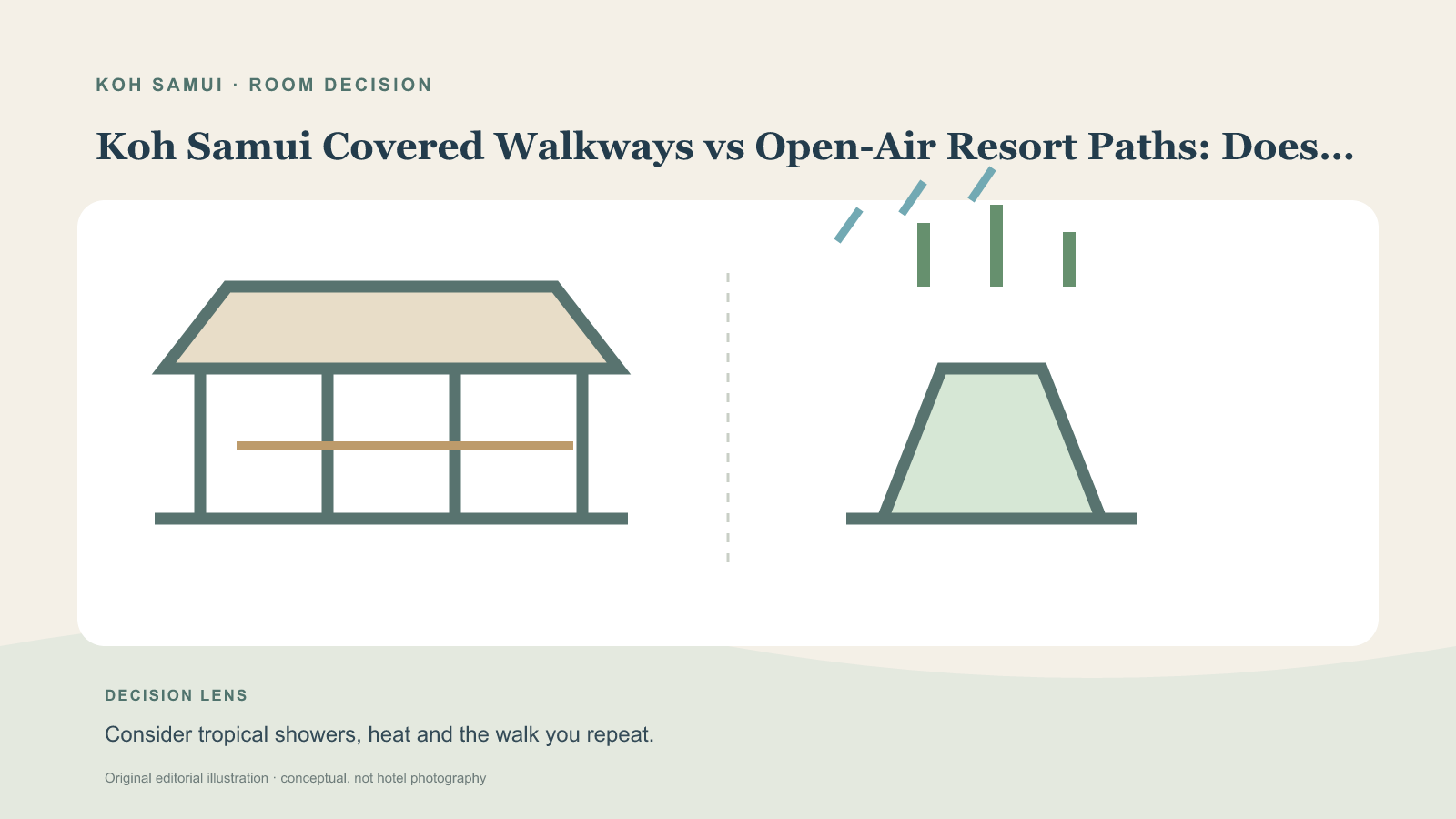
“Open-air resort” can mean four very different things
Most guest-room, lobby and dining movement is sheltered. Only leisure edges — garden, pool or beach — are outdoors. Weather is mostly optional.
The main route is partly sheltered, but one or two repeated transitions are open. This is usually manageable if distances are short and surfaces are simple.
Rooms sit in separate buildings or villas, pathways cross gardens or slopes, and the property relies on outdoor walking or buggies. Weather becomes part of the circulation system.
Current Samui properties show why the exact route matters more than the resort label
Hyatt Regency Koh Samui currently describes one landscaped circulation feature, “The Valley”, as a sheltered path. Kimpton Kitalay Samui’s current accessibility information confirms flat terrain between parking and the entrance plus ramp access to several resort facilities, which is useful route information but does not claim that every guest path is covered.
At the other end of the circulation spectrum, Four Seasons Resort Koh Samui currently describes several villas as secluded or hillside accommodations and lists buggy service among accommodation amenities. That does not make the resort inconvenient; it simply means room location, vertical distance and internal transport are part of the stay design.
The booking lesson is simple: do not ask whether a resort is “walkable” in the abstract. Ask which parts of your exact room-category route are covered, level, outdoors, stair-based or buggy-supported.
Map exposure by obligation, not by metres
A 120-metre garden walk to a beach you may visit once is less important than a 35-metre uncovered crossing between your room and breakfast that you repeat every morning.
- Must-do routes: lobby, breakfast, tour pickup, departure, reception when you need help.
- Likely routes: dinner, pool, gym, spa, beach.
- Optional routes: sunset bar, second pool, distant garden pavilion.
Put weather protection around the first group before you worry about the third.
Four ordinary moments expose the real trade-off
You are leaving for a boat pickup. A five-minute outdoor walk matters more when you are carrying a tote, phone, dry clothes and breakfast box. If early starts are central to the trip, also check where your hotel sits in the tour-pickup system.
You return from the pool in wet sandals. The question is less “Is the path covered?” and more “Can I reach my room without crossing slippery steps, a long lobby route or another transport stage?”
You are dressed for dinner and it starts raining. This is the route that turns a charming garden resort into either a pleasant tropical walk or an annoying outfit-and-hair reset.
You return after dinner. Darkness, wet paving and route legibility matter more than daytime aesthetics. Solo travelers should run the same after-dark route audit used in the private-entrance villa vs hotel-room guide.
When I would actively prefer more sheltered circulation
You have early pickups on more than one day
Early boat, diving or airport days make lobby access a repeated operational route. If your room is far from reception, add the internal walking or buggy time to the pickup time. The same logic appears in the buggy-supported vs walkable resort decision.
You dress up and go out most evenings
A tropical shower matters differently when you are heading to a pool than when you are wearing a dress, carrying a small bag and trying to keep hair or makeup intact. Shelter is not glamorous, but repeated low-level friction is exactly what hotel layout should remove.
You travel with luggage, a child, mobility limitations or lots of gear
Coverage is only one part of the problem. Level surfaces, ramps, stairs and staff help can matter more. On arrival day, pair the route question with early check-in vs luggage drop so you know where bags actually go if the room is not ready.
You are booking because the resort itself is the holiday
Resort-heavy stays multiply internal movement. Breakfast, beach, pool, spa, room, sunset drink and dinner may all happen on-property. That makes circulation more important, not less. Compare beach-first vs pool-first resort design and one central pool vs multiple pool zones before assuming more facilities automatically mean a better stay.
When open-air paths are completely fine
The exposed sections are short and simple
A 30-second garden crossing is not the same as a long hillside transfer. Do not overcorrect and choose a worse room or worse location just because another property has more roofing.
You leave the resort after breakfast and return for dinner
If you only make two internal journeys a day, route protection has less value. Prioritise the area, room and after-dark return instead. The resort dining vs nearby restaurants guide helps identify whether evenings will actually keep you on-property.
The open-air route is the experience you want
Some travelers actively enjoy walking through gardens, hearing rain under trees or moving between low-rise buildings. If the path is short, well lit and not physically awkward, the outdoor design may be a positive rather than a compromise.
Your room sits close to the facilities you use most
A partially open-air resort can still feel effortless when your exact room is well placed. Room position may solve more than roof coverage. See lobby-side vs beach-side rooms and main-pool vs quiet-wing rooms.
Current weather context: treat exposure as a real variable, not a seasonal stereotype
At publication in August 2026, the Thai Meteorological Department’s monthly outlook for Thailand’s southern east coast lists daytime highs around 33–35°C and thunderstorms affecting roughly 40–60% of the area, with some heavy-rain days. That dated forecast shows why covered paths can matter outside the usual rainy season; check the forecast for your dates.
Do not confuse shelter with convenience
A covered corridor can still be inconvenient if it is long, noisy or far from the lobby. An open garden path can be easier if it takes 45 seconds and is flat. I would rank the decision like this:
- Area and off-property access. Can you reach the places you actually want without constant transport friction?
- Property circulation. How many steps, slopes, buggy stages and exposed transitions sit between your room and the facilities you repeat?
- Room placement. Is your exact category usually near the lobby, pool, beach or a remote wing?
- Weather protection. Which repeated parts of the route are sheltered?
- Room upgrades. View, terrace, bath and extra space come after the route works.
If sleep is the bigger concern, do not use “inward” or “covered” as a proxy for quiet. Use the separate quiet-room request vs best-view decision. If the outdoor route is attached to a terrace or garden entrance, the balcony vs ground-floor terrace guide handles that trade-off directly.
| Your stay pattern | What I would favour | Why |
|---|---|---|
| Two early boat-tour mornings | More sheltered, simpler lobby route | The same exposed journey repeats when timing and gear already add friction. |
| Four-night pool-and-beach resort stay | Depends on exact room position | Internal movement is frequent; a short exposed path may be fine, a long multi-zone route may not. |
| Couple out exploring all day | Better hotel overall | You may only cross the property a few times. |
| Solo traveler returning after dinner | Clear, well-lit, easy route first | Route legibility matters more than whether every metre has a roof. |
| Family with stroller or lots of bags | Level circulation + shelter | Rain protection helps, but slopes, stairs and transfers may matter even more. |
| Hillside villa booked for privacy | Accept exposure if the villa is the point | You are deliberately buying separation; confirm buggy response and exact route. |
| Split stay with one resort-heavy half | Shelter matters most on resort-heavy half | The number of internal journeys changes by stay design. See one resort vs split stay. |
| Late arrival | Simple reception-to-room route | The first trip through an unfamiliar property should be boring. Also check front-desk hours. |
Nine questions to send before booking
- For my exact room category, is the normal route from lobby to room indoors, covered outdoors or fully outdoors?
- About how many minutes is that walk at a normal pace?
- Are there uncovered stairs, slopes or stepping surfaces on the route?
- Is buggy service normally used for this room category, or only available on request?
- Can I reach breakfast and the main restaurant without crossing an uncovered area?
- Can I reach the tour pickup / main entrance without a buggy transfer?
- Is the path fully lit after dark?
- When it rains heavily, does the resort provide umbrellas or an alternative covered/vehicle route?
- Can luggage be delivered directly to and collected from the room?
Ask about the exact room category. Large Samui resorts can contain several circulation patterns inside one property.
The shortest rule
Choose shelter for the routes you cannot avoid; accept open air for the routes you can choose.
If breakfast, lobby, dinner and pickup all require meaningful outdoor exposure, circulation belongs in the hotel decision. If only the garden, beach edge or optional bar is exposed, choose the better room, area and resort fit instead.
For the wider hotel graph, start at the Koh Samui destination guide.
Sources checked
Stay planning
Find a place to stay
See available rooms around the property or neighborhood discussed here, with prices for your dates.