
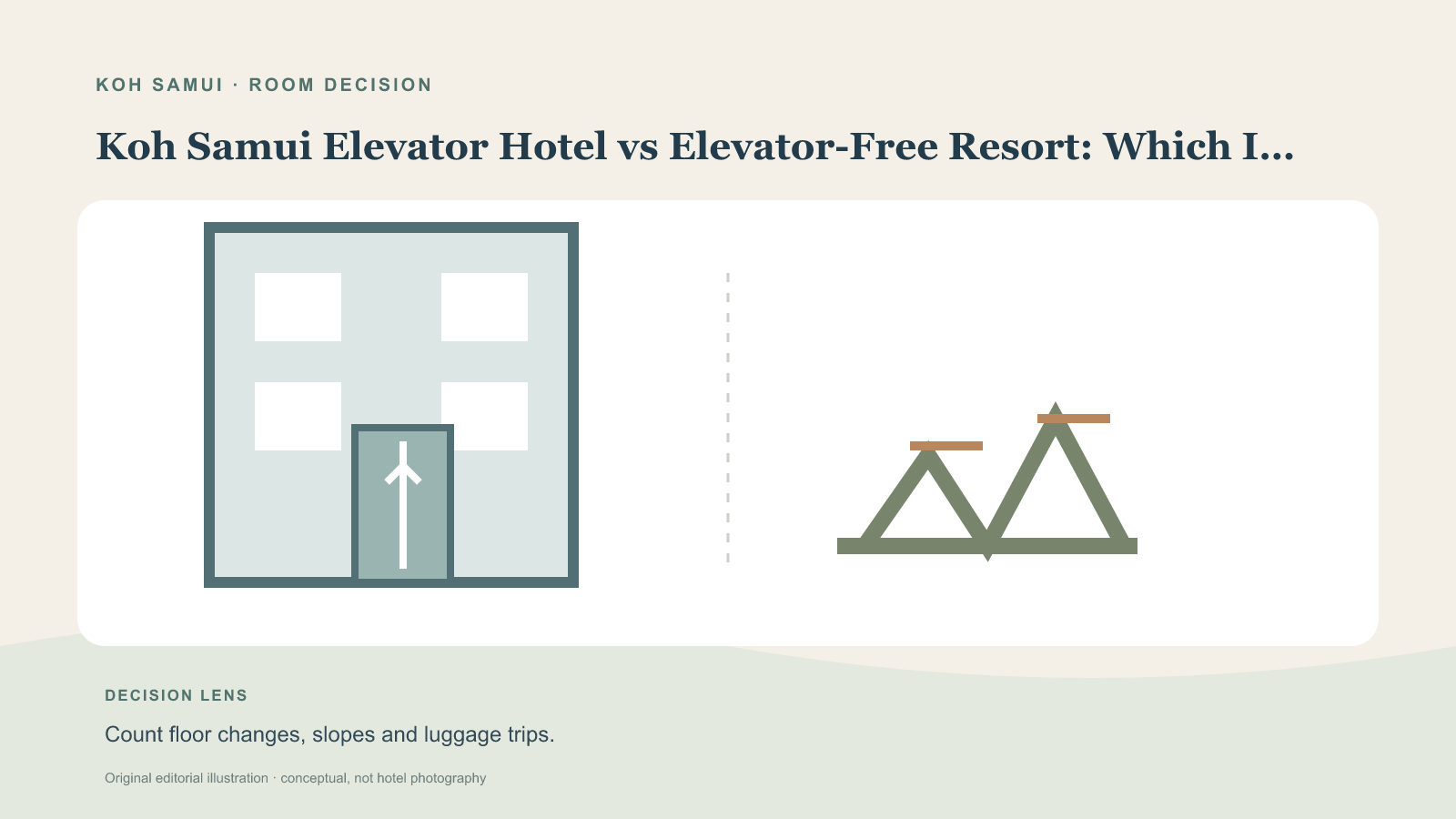
Use the two-unavoidable-vertical-trips rule
The useful question is not “Does the hotel have an elevator?” It is “How many times will I have to change level when I do not want to?” A lift can be irrelevant if your room, breakfast, pool and lobby are already on an easy route. An elevator-free resort can feel effortless if staff handle luggage and your room sits close to the facilities you use. The opposite can also be true.
Before booking, draw one ordinary day. Count only the vertical transitions you cannot realistically skip: room to breakfast, room to lobby for a boat pickup, pool back to the room, room to dinner, and the final return after dark. If two or more of those journeys require stairs or a meaningful slope every day, vertical circulation becomes a real hotel feature rather than background architecture.
If your concern is only whether the room sits beside a noisy lift lobby, that is a different problem; use our room near the lift vs end of corridor guide. If the real issue is floor level rather than the property’s circulation system, compare ground-floor vs upper-floor rooms.
Stay planning
Find a place to stay
See available rooms around the property or neighborhood discussed here, with prices for your dates.
There are four very different versions of “no elevator”
Few level changes, short paths and a room that may be reached almost entirely at grade. No elevator can be functionally irrelevant.
One short flight to the room or restaurant. Fine for many travellers, but worth confirming if you are carrying your own bags or returning several times a day.
Multiple buildings, terraces, stairs or slopes between facilities. The question becomes repeated circulation, not simply room-floor access.
You need a step-free route, reliable lift, ramp or staff-assisted alternative. In this case, “we have elevators somewhere” is not enough; confirm the exact continuous route.
Current Koh Samui hotel information shows why property labels are not enough
Vana Belle, a Luxury Collection Resort, Koh Samui currently describes its accommodation environment as elevator-free. That is useful, unusually explicit first-party information — but it still does not tell you the exact number of steps between a specific suite and breakfast, the beach or the lobby.
Kimpton Kitalay Samui publishes the opposite kind of detail on its current accessibility page: it states there is elevator access to all levels, along with ramp access to several public facilities and flat terrain between parking and the entrance. W Koh Samui’s current Marriott property information also states that the property has elevators.
Hyatt Regency Koh Samui currently publishes accessible-route information for guest rooms and several public areas. The important lesson is that accessibility is a route, not a single amenity icon. A lift can solve one level change while the route to a pool, beach, restaurant or villa still includes distance, slope or outdoor exposure.
These hotels are examples of current circulation information, not ranked recommendations. If vertical access matters to you, ask the hotel to describe the exact route for the room category you intend to book.
Replay the journeys that make stairs feel different
You have a day bag, water bottle and perhaps a wet-weather layer. You are moving on someone else’s timetable. Extra stairs matter more here than on a slow pool day because there is no buffer for forgotten items. Pair this check with our tour-pickup hotel location guide.
You are warm, damp and carrying sandals, phone, sunscreen and a cover-up. A short staircase may be nothing. A long uphill return that you repeat every day can change how often you go back to the room.
The question is no longer “Can I climb these stairs?” It is “Do I still want this route after a long evening?” Lighting, rain, outdoor paths and staff proximity matter as much as the lift itself. Our covered walkways vs open-air paths guide covers that weather-exposure layer.
The luggage problem happens twice, not once
It is easy to dismiss stairs because staff may carry your suitcase at check-in. That solves the first five minutes. It does not automatically solve checkout morning, a split stay, a room change, repeated shopping bags, a stroller, a dive bag, or the small things you carry up and down during the stay.
If you are arriving before the room is ready, the more useful question may be whether you can leave everything securely and start the day rather than whether you can personally move the suitcase upstairs. See our early check-in vs luggage-drop guide. If you are moving hotels mid-trip, the cumulative friction belongs in the decision too; our one resort vs split-stay guide helps test whether the move is worth it.
Score the route, not the architecture
When an elevator-accessible hotel should win
You have a genuine mobility constraint
Knee pain, ankle problems, pregnancy, reduced stamina or a wheelchair requirement should not be downgraded to a “preference.” The correct comparison is not whether stairs are technically possible; it is whether the hotel lets you move through the holiday without repeatedly negotiating a physical obstacle.
You travel with awkward luggage
A large suitcase is one thing. A stroller, multiple bags, dive equipment or shopping can make a small level change annoying many times. If staff assistance is central to making the route work, confirm when it is available rather than assuming someone will always appear.
You keep returning to the room
Some trips naturally create frequent room resets: beach, shower, change, lunch, rest, dinner. When that is your pattern, even a modest vertical route gets multiplied. The same repetition logic appears in our balcony vs ground-floor terrace guide: repeated behaviour matters more than an amenity label.
You need predictable movement at odd hours
Early tours and late returns reduce your tolerance for friction. A straightforward indoor route can be especially reassuring when travelling solo. That does not make every elevator hotel safer; it simply removes one variable. For after-hours service, separately check 24-hour front desk vs limited reception.
When an elevator-free resort can still be the better choice
Your exact room route is easy
A resort can be elevator-free and still place your room, pool, restaurant and beach on a pleasantly simple route. If there is one short staircase that you barely notice, choosing a weaker hotel purely for a lift is over-optimising the wrong detail.
The resort itself is the destination
Some low-rise or hillside properties use terraces, gardens and separate buildings as part of the atmosphere. If that environment is why you are booking the hotel, you may happily accept more vertical movement — provided you understand the route before arrival. Compare that broader trade-off in our buggy-supported vs walkable resort guide.
You value direct outdoor access more than indoor circulation
A villa or garden-level room can remove lifts and corridors entirely while adding outdoor walking instead. For solo travellers especially, that is a separate privacy-and-route decision; use our private-entrance villa vs hotel-room guide.
The better room is simply better
Do not sacrifice sleep, bathroom practicality, beach fit or an excellent room just to gain elevator access you may use twice. If you are already deciding between a quieter position and a stronger view, our quiet-room request vs best-view guide keeps those priorities separate.
Do not confuse “has elevators” with “step-free holiday”
An elevator may connect guest floors but not every resort zone. A beachfront restaurant may sit down a slope. A pool might require a ramp or outdoor path. A villa may be in a separate building. A buggy might cover distance but still leave a short staircase at the end. If step-free access matters, you need the whole route described — entrance, room, breakfast, pool, beach, spa, lobby and pickup point.
The reverse misunderstanding happens too. “Elevator-free” sounds severe, but an at-grade room near the lobby may involve less vertical movement than an elevator hotel with long corridors and several building transitions. Hotel geometry beats amenity checkboxes.
| Your trip pattern | Give elevator access this much weight | Why |
|---|---|---|
| Carry-on only, active couple, simple pool-and-beach stay | Low | One or two easy level changes are unlikely to affect the holiday. |
| Two friends with large suitcases and frequent room returns | Medium | Repeated movement makes small circulation friction accumulate. |
| Solo traveller with early tours and late dinners | Medium | Predictable routes matter more when you repeatedly move at the edges of the day. |
| Parent with stroller | High | Every staircase creates a carry, fold, detour or request for help. |
| Knee or ankle limitation | High | The issue is repeated comfort, not whether stairs are technically possible once. |
| Wheelchair or strict step-free requirement | Non-negotiable | Confirm a continuous accessible route to the exact room and facilities in writing. |
| Elevator-free resort with an at-grade room close to everything | Low | The property label matters less than the actual route. |
| Hillside property with buggy service and several split levels | Context-dependent | Check how much walking remains before and after each buggy journey. |
Ask these questions before booking if vertical access matters
- Is my exact room category reachable from reception without stairs?
- If there is an elevator, does it reach my room floor and the main facilities I will use?
- How many steps remain between the elevator or buggy drop-off and the room door?
- Is breakfast reachable by a step-free route?
- Is the pool or beach reachable without stairs, or is there an alternate ramped route?
- Will staff handle luggage both at arrival and departure?
- Is assistance available early in the morning or late at night?
- Are any ramps steep, uncovered or unusually long?
- Which room categories offer the shortest route to reception and the facilities you will use?
Keep the hotel hierarchy in the right order
For most travellers without mobility constraints, elevator access belongs below the big stay decisions: area, room quality, sleep, beach or pool fit, bathroom practicality and the routes you repeat most. It should not beat a materially better hotel on its own.
But for travellers who need step-free movement — or who know repeated stairs will drain energy — circulation jumps close to the top of the hierarchy. That is not being fussy. It is matching the hotel’s physical layout to the way you will actually move through the stay.
If your concern is broader internal distance rather than vertical movement, use the lobby-side vs beach-side room guide. For the full island picture, return to the Koh Samui destination hub.
The final rule
Choose the hotel by the route you will repeat, not by whether an elevator icon appears on the amenities list. If two or more unavoidable daily journeys involve stairs or level changes you would rather not make, elevator-accessible circulation deserves real weight. If the actual room-to-resort route is easy, an elevator-free property can still be the more comfortable stay.
Current first-party sources checked
- Vana Belle, a Luxury Collection Resort, Koh Samui — accommodations
- Kimpton Kitalay Samui — accessibility
- W Koh Samui — property information
- Hyatt Regency Koh Samui — hotel accessibility information
Operational and accessibility details can change. Reconfirm the exact route and room category directly with the property if access is important to your stay.
Stay planning
Find a place to stay
See available rooms around the property or neighborhood discussed here, with prices for your dates.