
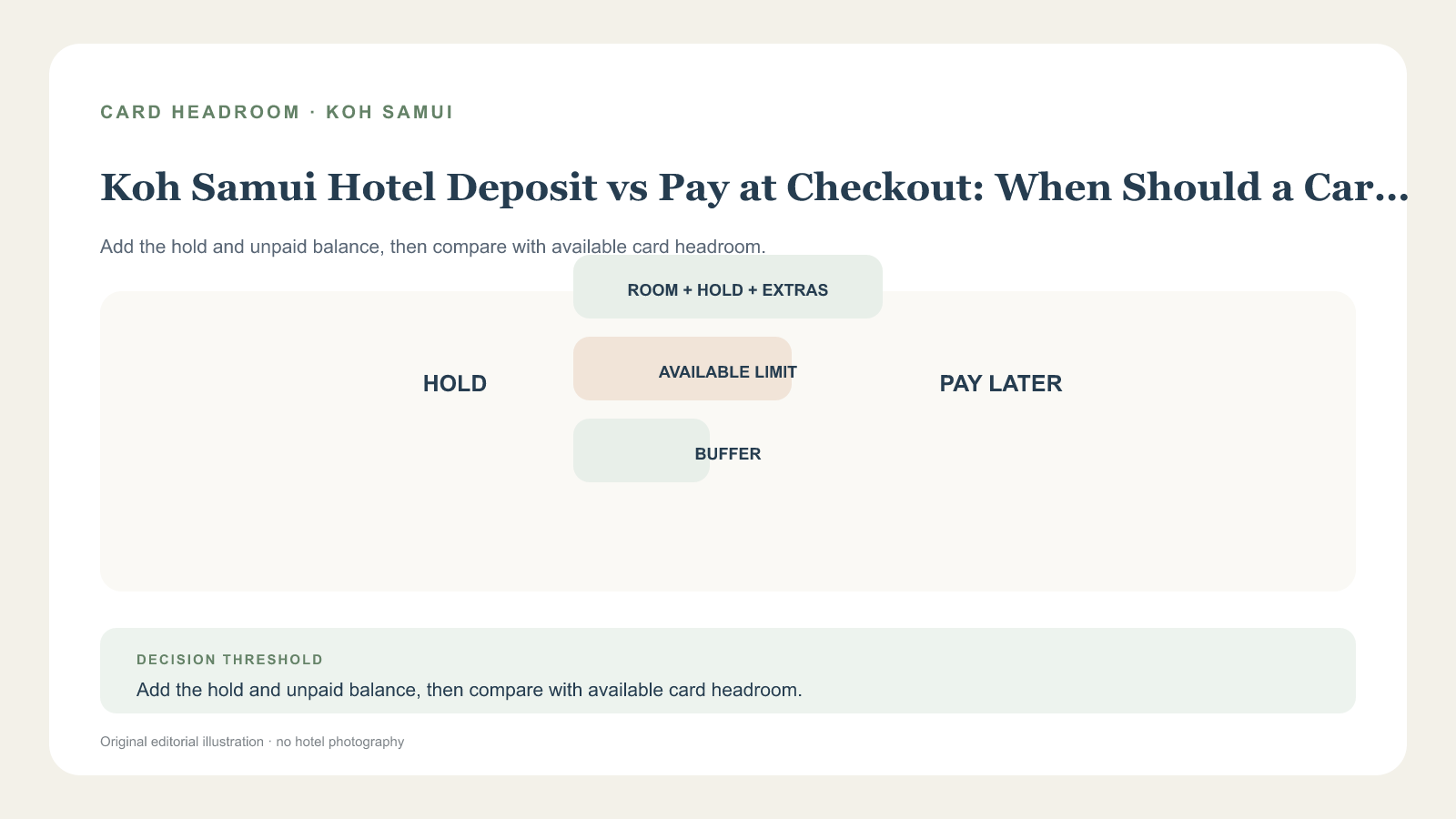
Use the card-headroom test, not the “no deposit” test
A deposit becomes a hotel-selection issue when it changes what you can comfortably do after check-in. Imagine the card you planned to use for a private transfer, two dinners, a boat-day backup, the next hotel and an emergency flight change. If a hotel hold would make that card feel tight, the policy matters. If you still have ample available credit or another sensible payment method, the hold is usually administrative friction rather than a reason to book an inferior room or location.
A room balance can be due at checkout while the hotel still places an incidental pre-authorisation at check-in. Prepaid rates can also require a separate hold for meals, minibar or damage.
Compare the amount temporarily unavailable, how long the hold lasts and whether it affects the rest of your travel funds.
Stay planning
Find a place to stay
See available rooms around the property or neighborhood discussed here, with prices for your dates.
Koh Samui hotel deposit vs pay at checkout: separate these three money buckets first
Room payment
The accommodation cost itself. Depending on the rate, it may be prepaid, charged shortly before arrival, settled at check-in or charged at checkout.
Incidental hold
A temporary authorization or deposit intended to cover things such as dining, minibar, room charges or damage. It can reduce available credit even when it is not yet a final charge.
Actual extras
The restaurant, spa, laundry or other charges you genuinely incur. These eventually replace part of the hold or are settled separately, depending on the property's process.
Travelers often combine the three into one vague question — “Do they take a deposit?” — and then get surprised at reception. The cleaner question is to ask exactly what happens to the room balance, exactly what is held for incidentals, and how each amount is released or settled.
Current Samui policies show why this is a cash-flow decision
Hyatt Regency Koh Samui currently states that, at check-in, it authorizes a THB 2,000 deposit hold per room, per night for incidentals, in addition to room and tax for the reserved stay. Its policy says most authorizations are released immediately on departure, but some can take up to 30 days depending on the issuing bank.
Anantara's current accommodation terms explain the mechanism from another angle: a hotel may place a pre-authorization deposit for incidentals or damage; the pre-authorization affects available funds or spending limit; and release timing is controlled by the bank. For Asian properties, a deposit may be required and is to be communicated during booking or at check-in.
Anantara Bophut Koh Samui Resort's current Best Flexible Offer also shows why room-payment timing must be kept separate from a security hold. Its current terms say the confirmed hotel-currency rate is charged at checkout while a full non-refundable deposit becomes due two days before arrival under that specific flexible offer. That is a rate-plan payment rule, not the same thing as the hotel's general incidental pre-authorization language.
The practical conclusion is simple: read “deposit” in context. A booking deposit, an incidental hold and a damage deposit solve different problems and can hit your card at different times.
Under Hyatt Regency Koh Samui's current THB 2,000-per-room-per-night incidental-hold policy, seven nights equals THB 14,000 of incidental authorization before considering the room-and-tax authorization described in the same policy.
That amount may be completely unimportant on a high-limit travel card. On a tighter card — especially one you also need for your next hotel — it can be meaningful. The hotel has not suddenly become “bad value”; your payment setup has simply become part of the accommodation decision.
The four places a hold can create real friction
This is one reason a one-resort vs split-stay decision can change the importance of deposit policy. One seven-night hotel produces one check-in payment event. Two hotels can create overlapping authorization windows even when both stays are perfectly affordable on paper.
When the security deposit should genuinely influence your hotel choice
Your card limit is deliberately modest
Some travelers keep a low-limit travel card for security. That is sensible until a long hotel hold consumes a large share of the available limit. If the card is also your main emergency backup, ask for the exact hold formula before booking.
You are moving hotels
A pending authorization from Hotel A plus a new authorization at Hotel B can create a temporary double squeeze. This matters more on a last-night hotel switch than on a single-base stay.
You rely on one physical card
If the same card funds your hotel, transport and day-to-day spend, available headroom matters more than it does for someone who has a second independent payment method.
You arrive when solving a card problem would be annoying
A late arrival is the wrong moment to discover that the expected hold exceeds the available limit. If your arrival is already tight, combine this check with the 24-hour front desk vs limited reception decision.
When deposit policy is usually not important enough to downgrade the hotel
If the hold is comfortably within your available credit, the release process is clear, and you have another way to pay for the rest of the trip, do not over-optimise this. A better beach, safer return route, more practical room or easier pickup location will affect you repeatedly. The temporary hold may affect you only twice: at arrival and while waiting for the bank to restore the limit.
That hierarchy matters. A deposit should rarely outrank the physical hotel decisions already shaping your stay: whether the resort is easy to move around, whether you can reach dinner without an awkward ride, or whether an early tour pickup works from the location. If you are still choosing those basics, use our buggy-supported vs walkable resort, resort dining vs nearby restaurants and tour-pickup hotel location guides before letting payment administration dominate the shortlist.
Pay at checkout can still require a card with real headroom
This is the most important misconception to remove. “Pay at checkout” describes when the final room account is settled. It does not automatically promise that the hotel will leave your credit line untouched until then.
Anantara's current terms explicitly say a pre-authorization can affect your available funds or spending limit. Hyatt Regency Koh Samui's current property policy explicitly describes an incidental hold plus room-and-tax authorization. Those are exactly the kinds of mechanics that disappear when a booking screen is reduced to one comforting phrase such as “pay later.”
If you are booking a flexible rate because you want planning freedom, read our flexible vs non-refundable rate guide as a separate decision. Cancellation flexibility tells you whether you can change the booking. Deposit and authorization policy tells you what happens to your money and credit while the booking is being used.
Prepaid does not mean “nothing else needed at check-in” either
The reverse assumption causes just as much trouble. Paying the room in advance can remove the accommodation balance, but the hotel may still need a card or other deposit method for incidentals. If you deliberately booked a prepaid rate to make the holiday feel “already paid for,” keep a small mental distinction between room paid and arrival payment requirements completed.
This is especially useful on a longer stay where your room setup changes how much you spend inside the hotel. A residence-style unit may reduce restaurant or laundry charges, while a full-service resort can make room charging more convenient. Our resort vs residence-style suite guide helps decide the accommodation model; the deposit policy then tells you how the hotel handles the money around that model.
The solo-traveler version of this decision is mostly about backup capacity
For a solo woman, I would not choose a worse-located hotel just to avoid a normal, clearly disclosed hold. I would, however, protect enough independent payment capacity that a pending authorization cannot strand the rest of the itinerary.
That means keeping the card or cash needed for airport transport, a replacement ride, a medical expense or an unexpected extra night separate from the amount a hotel can temporarily absorb. If a morning arrival means you will be carrying your bags before the room is ready, the early check-in vs luggage drop decision is more important than the deposit itself. If you need room access late on departure day, compare late checkout vs an extra night before deciding how much card capacity you need across the final 24 hours.
| Your setup | How much deposit policy should matter | Practical move |
|---|---|---|
| One hotel, high available card limit | Low | Confirm the hold, then choose the better hotel on location, room and trip fit. |
| Seven-night stay, modest available limit | Medium to high | Ask for the exact per-night or per-stay authorization formula before locking the booking. |
| Two hotels back to back | High if limits are tight | Assume the first hold may still be pending when the second hotel checks you in. |
| Room prepaid in full | Still relevant | Confirm whether a separate incidental or damage hold remains due at arrival. |
| Rate says pay at checkout | Still relevant | Ask whether room-and-tax or incidental amounts are pre-authorized at check-in. |
| Solo traveler with one main card | Higher | Protect enough card or cash backup for transport and emergencies after the hold is placed. |
| Hotel is materially better and hold is easy to absorb | Low | Do not downgrade the accommodation just to avoid temporary authorization friction. |
| Bank is known to restore authorizations slowly | Higher on a multi-stop trip | Plan the next check-in as if the old hold could overlap. |
Ask these eight questions before a deposit-sensitive booking
- Is there a security or incidental deposit at check-in?
- Is it a credit-card pre-authorization, an actual charge, cash deposit or another payment method?
- Is the amount per room, per night or per stay?
- Is room and tax also authorized at check-in if the rate says payment is due later?
- If the room is prepaid, what amount is still required at arrival?
- When does the hotel release the authorization after checkout?
- Can the hotel provide written confirmation of the current amount for my exact stay?
- If I am using a different card at check-in from the one used to book, is that accepted under the property's current policy?
Save the answer with the reservation. Deposit rules can be rate- or property-specific, and release timing can depend on the issuing bank. The useful information is the policy for your exact booking, not an old forum post about somebody else's stay.
Do not confuse a payment problem with a hotel-quality problem
A large temporary hold can be inconvenient without saying anything about whether the hotel is right for you. Likewise, a hotel with a small or no obvious hold is not automatically easier if it has a poor location, limited reception, awkward transport or a room that does not fit the group.
Use payment policy after the bigger decisions. If you work from the room, decide whether hotel workspace vs coworking changes the base. If you prefer privacy over frequent service visits, check daily housekeeping vs reduced service. Once the actual stay fits, the deposit question becomes a clean operational check rather than a reason to restart the entire hotel search.
The shortest rule
Choose the hotel first; stress-test the payment flow second.
If the property's maximum realistic hold plus any outstanding room balance still leaves you comfortable capacity for the rest of the trip, the deposit should not drive the booking. If it meaningfully compresses your travel card or cash buffer — especially across a split stay — treat payment policy as a genuine constraint and compare another property or payment setup before you arrive.
For the wider accommodation plan, return to the Koh Samui destination guide and keep the money mechanics in their proper place: important when they affect your freedom, secondary when they do not.
Sources checked
Stay planning
Find a place to stay
See available rooms around the property or neighborhood discussed here, with prices for your dates.