
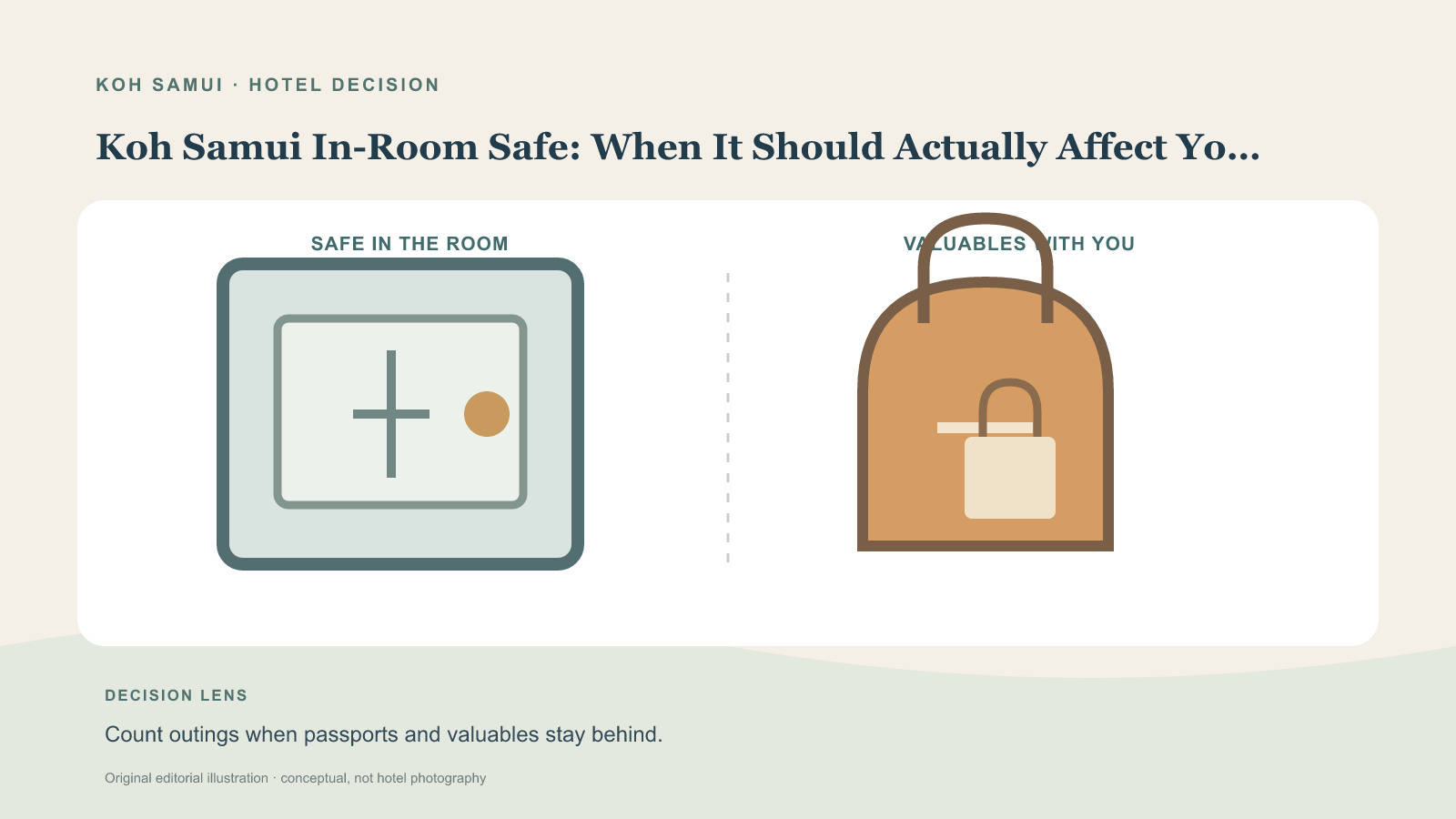
The recommendation: count the times valuables stay behind
A hotel safe is easy to overvalue because the amenity sounds serious. In practice, the useful question is much more ordinary: how many times during this trip will you close the room door while something important stays inside?
For a three-night island stay where you carry your phone and wallet everywhere, the answer may be once. For a five-night stay with beach days, a boat trip, spa time and a work laptop, the answer can be daily. That difference is what turns a safe from an amenity icon into a room-practicality feature.
This is also separate from choosing a better wardrobe and luggage layout. A tidy place for your suitcase does not answer where you will put passports, backup cards or small electronics when you leave the room.
Stay planning
Find a place to stay
See available rooms around the property or neighborhood discussed here, with prices for your dates.
Use the three-outing test
You are carrying almost everything. Do not trade away a better room just to get a published safe.
Worth confirming if two otherwise similar hotels are competing, but not a top filter.
Repeated beach, pool, spa or tour days make convenient in-room storage materially more useful.
Workcation gear, backup payment methods or valuables left behind most days justify exact verification.
The threshold is deliberately about repeated behaviour, not the monetary value of what you own. A tiny passport wallet can create more daily handling friction than a large suitcase. If you are doing a work-and-holiday stay, pair this check with the hotel workspace vs coworking decision, because laptop routines change what stays in the room.
Current Samui hotel pages show why the wording matters
Current official room inventory explicitly lists an in-room safe across multiple room categories. That is a useful room-level disclosure: it tells you the storage is inside the accommodation rather than forcing you to infer it from a generic hotel-facilities list.
The current IHG rooms page also lists an in-room safe. Again, the value here is the location wording: the hotel is not simply saying that some type of safe-deposit facility exists somewhere on the property.
Anantara's current property factsheet lists an electronic in-room safe. That is more specific than a generic “safe” icon and is the kind of disclosure worth looking for if this amenity genuinely matters to you.
The current room inventory lists a digital safe, while the services page separately lists a safe deposit box. The useful lesson is not to assume those labels are interchangeable: room-level storage and a property-level safe service can be two different things.
Picture three ordinary room exits, not a dramatic security scenario
Boat-day departure
You take your phone, some cash and one card. Passport, backup card, jewellery and laptop stay behind. This is exactly the kind of repeated departure where a verified in-room safe reduces decision-making before an early pickup.
Pool or spa hour
You want to leave the room carrying as little as possible. If valuables have one consistent storage place, the “what do I do with this?” question disappears every afternoon.
Dinner outside
You switch bags and take only what you need. For two friends, a small shared routine matters: both people should know what is stored, what travels and who has the backup card.
A room safe gives you a consistent place for valuables; check that it locks and keep passports, cash and electronics secured when you leave. What you can assess before booking is whether the hotel publishes the storage feature you expect and whether using it fits your trip.
When an in-room safe deserves more weight
Give it real weight on a longer stay, when you plan several water-based days, when you carry a work laptop, or when you deliberately travel with a backup payment method that should not be in the same wallet as your primary card. It can also matter more for two friends sharing a room because separate bags, wallets and devices create more small items to manage.
If you are choosing a private villa with a longer outdoor route, do not confuse privacy with storage logistics. Our private-entrance villa vs hotel-room guide looks at the route to the door; this page is about what remains behind after the door closes.
Likewise, a 24-hour front desk can help with access and problem resolution, but it does not tell you whether the exact room has its own safe. Check both when late arrivals or unusual schedules make staff availability important.
When it should stay a minor detail
Do not reject a better-located hotel simply because its public room page does not publish a safe if you are unlikely to use one. A hotel can still be the better choice because it gives you a quieter room, easier walk-out access, a better bathroom or fewer daily transport steps.
For example, if you keep most belongings in your day bag and your main concern is evening convenience, the hotel near shops vs self-contained resort decision probably matters more. If sleep is fragile, the quiet room vs best view trade-off should outrank the safe.
And if your stay involves moving hotels, the one resort vs split stay decision changes the handling problem entirely: every move creates another pack, unpack and valuables check.
Use this priority order before you let the safe decide
- Area and repeated routes. Choose where you want to spend the trip.
- Sleep and room layout. A safe will not rescue a noisy or awkward room.
- Bathroom and sharing practicality. Repeated morning friction is usually bigger than valuables-storage friction.
- Operational fit. Arrival hours, housekeeping rhythm and staff access should work for your schedule.
- Then verify the safe. If two hotels still fit equally well, the published in-room safe can be the clean tie-breaker.
If arrival handling matters, see early check-in vs luggage drop. If you dislike frequent room entry while you are away, compare daily housekeeping vs reduced service. Those are separate operational decisions.
A practical decision table
| Trip pattern | How much the safe should matter | Why |
|---|---|---|
| 3 nights, carry-on, mostly restaurant and beach walks | Low | Very few valuables are repeatedly left behind. |
| 5 nights with Ang Thong or Koh Tao day trip | Medium | Early departures make a consistent leave-behind routine useful. |
| 7-night workcation with laptop | High | Small tech and backup payment items may stay in the room daily. |
| Two friends sharing one room | Medium to high | Two sets of cards, watches and devices create more handling decisions. |
| Luxury resort stay, almost never leaving property | Low to medium | You may still use it, but there are fewer long absences from the room. |
| Split stay across two hotels | Medium | Repeated packing and room changes make a clear valuables routine more useful. |
Eight questions to ask if an in-room safe is important
- Is the safe in the exact room category I am booking?
- Is it described as in-room, digital or electronic, rather than only as a hotel service?
- Is the safe large enough for the specific items I plan to leave behind?
- Can the hotel confirm whether a laptop fits, if that is essential?
- Is access self-service inside the room, or does any alternative safe-deposit service involve staff?
- If the safe fails to open, what reception hours apply?
- For two guests, will both know the code and the leave-behind routine?
- Does the hotel publish any separate policy for valuables or liability that I should read before arrival?
Do not guess laptop fit from a generic safe icon. Just as with hotel deposits and card holds, the useful detail is the exact operating rule, not the existence of a symbol.
One final rule for solo travelers
For a solo traveler, the best setup is the one that reduces unnecessary handling. You should not need to carry every backup item to the pool simply because you never decided where it lives. But the safe should still sit inside a hotel choice that works after dark, on arrival and on ordinary evenings.
That is why we would still rank room route, front-desk availability and location above a safe icon. The broader chain hotel vs boutique resort guide also explains why published systems can be useful without making the brand label itself the decision.
The final rule: count outings, then verify the exact room
If valuables will stay behind on three or more outings, verify an in-room safe before booking. If not, treat it as a bonus. Either way, do not let one storage feature overrule a hotel that better fits your sleep, location and daily movement.
For the wider island decision graph, continue with the Koh Samui destination guide.
Sources checked
- Hyatt Regency Koh Samui — current room inventory
- Kimpton Kitalay Samui — current rooms page
- Anantara Bophut Koh Samui Resort — current factsheet
- NH Collection Samui Peace Resort — current rooms
- NH Collection Samui Peace Resort — current services
Checked 14 August 2026. Public hotel descriptions can change; verify the exact room category when the safe is a genuine requirement.
Stay planning
Find a place to stay
See available rooms around the property or neighborhood discussed here, with prices for your dates.