
Extra space only becomes useful when it lets two things happen at once
A hotel can call a room spacious, a suite, a villa or a residence and still give you one large open space where the bed, sofa, television and coffee table all share the same light and sound. That can feel luxurious at 3 pm and surprisingly limiting at 11 pm.
The useful upgrade is not necessarily more square metres. It is independent use: can one person close a door and sleep while the other watches something, works, orders food or dries hair without turning the whole room into one shared schedule?
Stay planning
Find a place to stay
See available rooms around the property or neighborhood discussed here, with prices for your dates.
The closed-door test takes about one minute
You normally wake, shower, relax and sleep at roughly the same time. A lounge area is enough.
One early boat day or one work call is likely. Solve the specific moment before paying for a suite all week.
Different bedtimes, naps, calls or getting-ready routines will happen on two or more days. A separate living room starts earning its price.
Current Samui room descriptions show why “living area” and “living room” are not interchangeable
Hyatt Regency Koh Samui currently describes its 48-square-metre Garden View rooms as having a lounge area. Its 70-square-metre One Bedroom Regency Suite, by contrast, explicitly lists a separate living room; the 96-square-metre Executive Ocean View Suite adds a separate living room, dining area and two bathrooms. That is a meaningful layout change, not simply a bigger sofa.
Anantara Bophut Koh Samui Resort currently describes its 64-square-metre Garden View Suite as open-plan living with a lounge area opening onto the balcony. It is more spacious than the resort’s standard rooms, but “suite” does not automatically mean a bedroom door separates the sleeping and living zones.
Sheraton Samui Resort currently highlights its two-bedroom suites as having separate living and sleeping areas, showing the other end of the spectrum: a suite can be structured around true zone separation rather than one expanded room.
Anantara Lawana Koh Samui Resort currently describes its Pool Villa and Sea View Pool Villa as having a separate living room. Again, the useful fact is the physical separation — not the prestige of the room label.
These examples are evidence of current room-layout language, not hotel recommendations. Always verify the exact category you plan to book because “lounge”, “living area”, “studio”, “suite” and “villa” do not guarantee the same floor plan.
Think in zones, not room categories
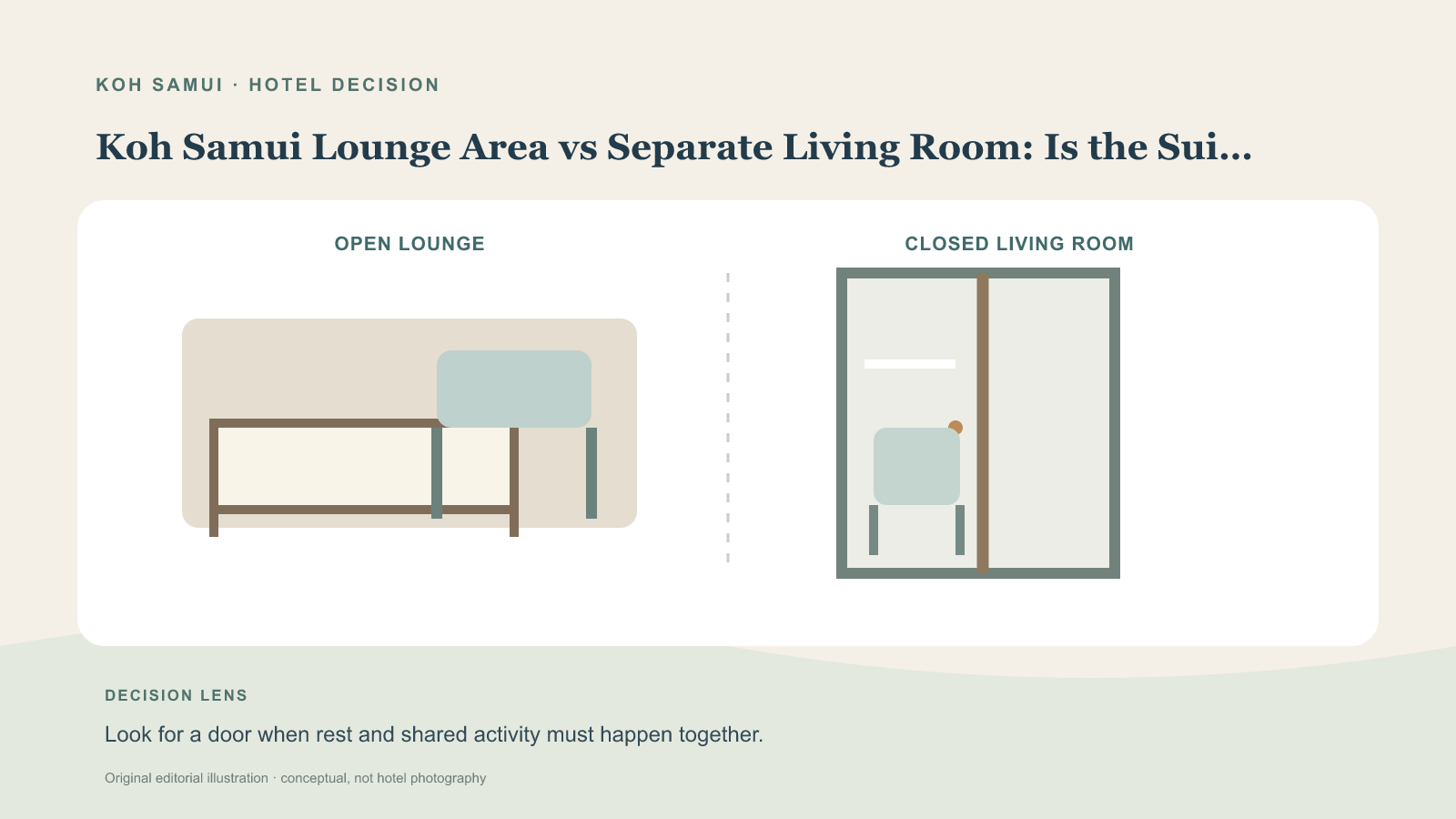
Open lounge area
The sofa, desk or chairs sit within the same acoustic and lighting zone as the bed. You gain comfort and floor space, but one person’s television, lamp, phone call or hairdryer still affects the sleeper.
This is usually enough for couples who use the room together, spend most days outside, and mainly want a better place for coffee, room service or a glass of wine before dinner.
Separate living room
A door, wall or genuinely enclosed sleeping zone creates two usable schedules. One person can sleep while the other reads, watches television, works, eats or gets ready.
This matters more for different bedtimes, jet lag, children sleeping early, friends sharing a suite, long work calls or anyone who needs quiet alone time without leaving the room.
Replay one ordinary five-night stay
One person wakes for an early boat pickup. In an open room, bathroom light, packing and phone alarms affect everyone. A separate living zone can become the staging area.
Someone wants a nap after the beach while the other wants to answer messages. A sofa six metres from the bed does not create real separation.
Hair, makeup, clothes and room-service decisions overlap. Sometimes a second bathroom matters more than a second room; check the one vs two bathrooms guide before paying for living space that does not solve the actual queue.
One person is exhausted; the other is not. This is the moment that separates “nice seating” from a room layout that genuinely gives you two independent evenings.
When the lounge area is the smarter choice
You will spend most waking hours outside the room
If the trip is built around beaches, boat days, restaurants and short resort breaks, a separate living room can become expensive empty space. In that case, prioritise the hotel’s location and daily movement first. The tour-pickup hotel location guide and buggy resort vs walkable resort guide often affect more hours of the trip than the internal room layout.
You and your partner genuinely keep the same schedule
Some couples do not need two zones. They wake together, go out together and are both ready to sleep when they return. For them, a lounge chair, sofa and balcony can deliver almost all the useful comfort of a larger suite without paying for separation they will rarely use.
The “suite” upgrade improves space but downgrades the rest of the stay
A larger open-plan suite can sit farther from the beach, have a weaker view, require more internal transport or cost enough to reduce the budget for experiences. Do not trade the entire hotel for a floor plan. If room position is the real issue, compare main-pool vs quiet-wing rooms or lobby-side vs beach-side rooms separately.
When a separate living room earns the upgrade
Your trip contains real work, not imaginary laptop time
A separate living room is valuable when a call has to happen while another person is sleeping or getting ready. If work is substantial enough to shape multiple days, cross-check the hotel workspace vs coworking guide. A suite does not fix a bad chair, weak privacy for calls or a poor location for repeated work sessions.
You have different sleep clocks
This is the strongest adult-couple case. One person wakes early; the other sleeps late. One wants to watch a show at midnight; the other is done by ten. On a five-night trip, repeated sleep compromise becomes more important than one spectacular view.
You are sharing with a friend and need soft privacy
Friends may be perfectly comfortable sharing a room while still wanting moments when they are not sitting on each other’s beds. A separate living room creates a neutral zone for food, planning and waiting while someone showers. If sleeping configuration is the bigger issue, use the king vs twin beds for friends guide first.
One person rests more than the other
Heat, long flights, migraines, pregnancy, recovery after diving or simply different energy levels can create extra room time. In those cases the second zone is not decorative. It lets one traveler rest without forcing the other into the lobby or pool every time.
Four upgrade traps that look better on a booking page than in real life
“Lounge area” beside the bed
A sofa can improve comfort without creating privacy. Ask whether a solid door separates the zones.
Open-plan suite with a bigger footprint
More space is pleasant, but light and sound still travel across one room. Do not pay a separation premium for floor area alone.
Separate room, wrong furniture
A living room with only decorative chairs may be poor for working, eating or a third adult. Match the furniture to the job you need it to do.
Better layout, worse daily route
A suite can sit far from breakfast, beach or lobby. Use the room-position guides before assuming a higher category is automatically more convenient.
The layout can expose other priorities you should solve first
If you mainly want a second room because one person needs to prepare food, the real decision may be mini fridge vs kitchenette. If the issue is seven-night practicality, compare full-service resort vs residence-style suite. If you are trying to reduce interruptions around cleaning, the daily housekeeping vs reduced-service guide is more relevant than room size.
And if the only reason for a living room is “we might relax there”, ask where you actually relax on a Samui trip. If the answer is balcony, pool, beach or restaurant, you may get more repeated value from a better outdoor space. The balcony vs ground-floor terrace guide can be a better tie-breaker.
| Your real pattern | Better default | Why |
|---|---|---|
| Couple, same bedtime, four active days | Lounge area | You are buying comfort, not independent schedules. |
| Couple, one works early mornings | Separate living room | Calls and light can happen without waking the sleeper. |
| Friends, confirmed twin beds, similar routine | Lounge area may be enough | Bed separation may solve more friction than room separation. |
| Friends, different bedtimes | Separate living room | A neutral second zone prevents the bedroom becoming the only social space. |
| One nap day after an excursion | Do not upgrade for this alone | One conflict is cheaper to manage than five nights of unused space. |
| Child sleeps at 8 pm, adults stay awake | Separate living room | The second zone changes the evening every night. |
| Suite is farther from everything you use | Re-score the whole hotel | Room layout should not erase repeated location friction. |
Ask these eight questions before paying for the suite
- Is the living room physically separated from the bedroom by a solid door, or is it one open-plan space?
- Can the living room be used with its lights on while the bedroom stays genuinely dark?
- Is there a second television, or will sound still come from the bedroom zone?
- Does the living room have a desk or dining table if work or room service is part of the plan?
- Is the bathroom accessed from the bedroom only, or can someone use it without crossing the sleeping zone?
- Does the upgraded category change the room’s floor, view, distance to beach, lift, lobby or buggy dependency?
- Are the exact room photos and floor plan for the category you are booking, rather than generic suite imagery?
- What repeated moment on your itinerary will use the second room at least twice?
For a five-night Samui stay, repeated independence matters more than prestige
Five nights is long enough for layout friction to repeat, but not long enough to justify every residential-style feature. If you need a kitchen, laundry and separate rooms, you are moving into the territory covered by the resort vs residence-style suite decision. If you only need somewhere better to sit, a lounge area can be completely adequate.
The tie-breaker is simple: imagine the most inconvenient ordinary moment, not the prettiest check-in photo. If one person is asleep at 10:30 pm, can the other still have a normal evening without leaving the room or disturbing them?
Final rule: pay for a second schedule, not a second sofa
Choose the separate living room when it lets two people live differently inside the same booking on at least two days. Choose the lounge area when you mainly want comfort while doing the same things together.
Then return to the bigger hotel decision: location, beach or pool fit, sleep quality, bathroom practicality and daily movement usually matter before the room label. If you are still choosing between radically different properties, the one resort vs split stay guide and the Koh Samui destination hub will help you keep the upgrade in context.
Sources checked
Stay planning
Find a place to stay
See available rooms around the property or neighborhood discussed here, with prices for your dates.