
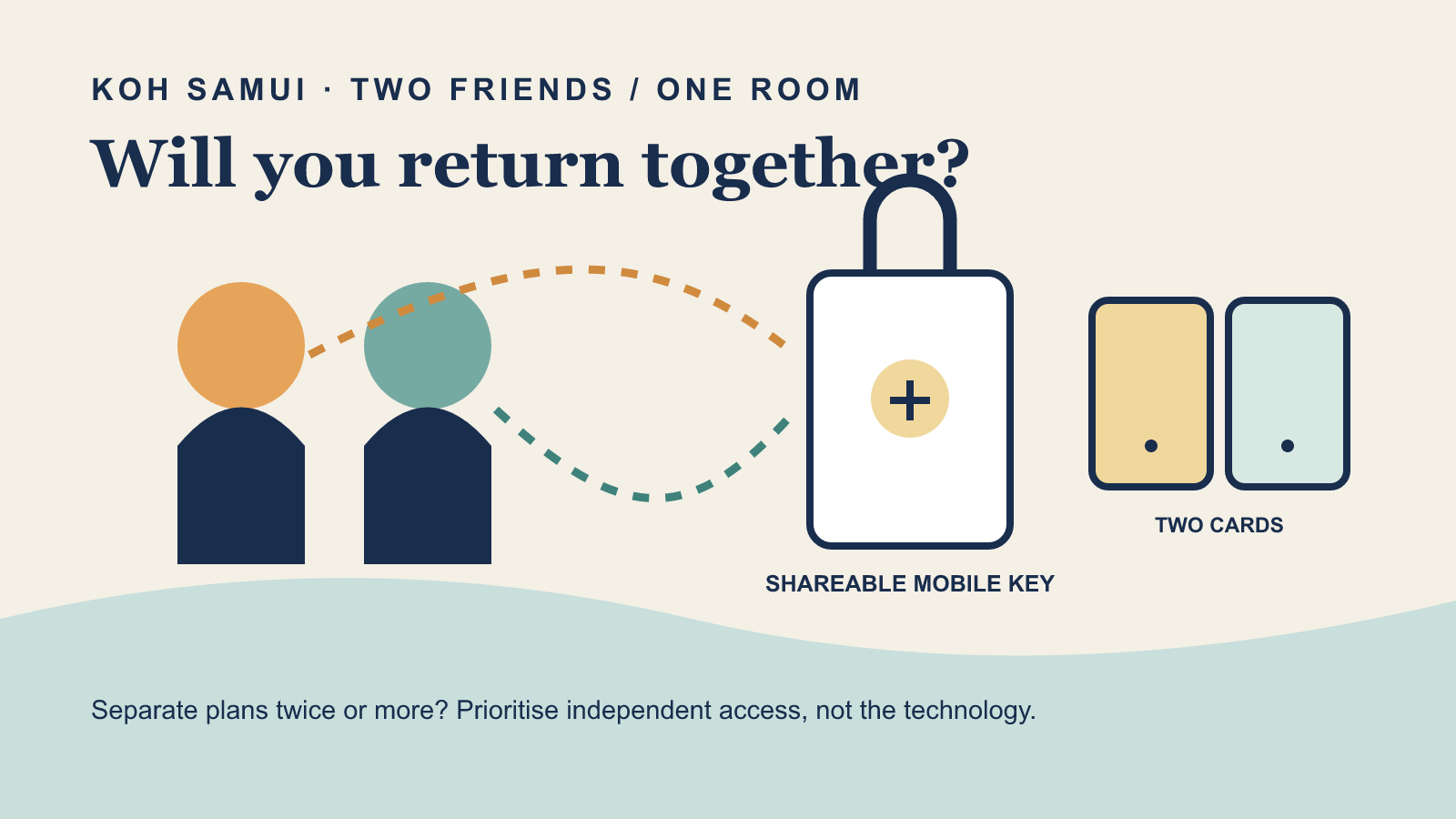
The recommendation: solve access independence, not “digital convenience”
Two friends sharing one room do not need identical schedules. One person may go to the gym before breakfast while the other sleeps. One may book a spa treatment while the other goes out for coffee. After dinner, one may want to return early while the other stays out.
The friction appears when a perfectly ordinary sentence—“Who has the key?”—starts controlling the evening.
So the useful hotel requirement is not Mobile Key by itself. It is independent room access for each registered adult. A pair of reliable physical cards can solve the problem just as well. A shareable digital key can solve it elegantly. One shared credential of any kind is the setup to avoid when your schedules repeatedly split.
Stay planning
Find a place to stay
See available rooms around the property or neighborhood discussed here, with prices for your dates.
There are three different access setups
One shared physical card
Fine when you move together. Annoying the moment one person leaves the room while the other wants to sleep, shower or stay behind. It creates message-checking and handoff logistics that have nothing to do with the holiday.
Two physical key cards
Usually the simplest friend-room solution when the hotel can issue independent cards to registered guests. No app setup, no phone battery dependency and no Bluetooth/NFC learning curve.
Shareable Mobile Key
Useful when the property supports it and both travelers meet the app requirements. It can remove the “did you take the key?” problem, but it still depends on registration, device setup and a working phone.
Current Samui disclosure check: Mobile Key is real, but sharing has conditions
Current Marriott property pages for Vana Belle, a Luxury Collection Resort, Koh Samui, W Koh Samui and Renaissance Koh Samui Resort & Spa all list Mobile Key among their current amenities. Vana Belle and Renaissance also publish 24-hour front-desk service and electronic room-key details. These are operating examples only—not hotel recommendations.
Marriott's current Mobile Key help page says sharing is available to registered guests at select properties. Receiving guests must be adults, Marriott Bonvoy members, use the Bonvoy app and be registered on the reservation. It also says traditional physical key cards remain available from the front desk. The same help page currently contains inconsistent wording about the exact number of additional recipients versus total active devices, so a three- or four-person group should verify the live app or front desk rather than plan around a quoted maximum.
Do not infer Mobile Key from brand alone, and do not infer that a hotel without a published Mobile Key feature will issue only one physical card. Verify the exact stay if independent access matters.
The two-independent-return-times test
One friend goes to the gym
The other is asleep. If the early riser takes the only key, the person inside may have to coordinate later access. If the sleeper keeps it, the gym-goer may need a handoff to get back in. Independent credentials turn this into a non-event.
One stays for a spa treatment
The other heads back to shower before going out again. This is where a shared-key system starts dictating who can move first. If fitness is a recurring part of the stay, our resort fitness vs specialist studio guide is the bigger decision; access independence is the small coordination layer underneath it.
One wants an early night
The other wants one more drink. Independent access means neither person has to become the other person's doorman. For friends, that can be more useful than a small room-feature upgrade.
The later friend returns alone
The practical goal is a direct, predictable return: transport to hotel, lit route, working credential, door. If late solo returns are likely, 24-hour front desk vs limited reception and private-entrance villa vs hotel-room circulation matter more than whether the key lives in a phone.
For two friends, independence usually matters before “smart hotel” features
Shared-room friction tends to stack. First it is the bed setup. Then bathroom access. Then storage. Then room entry. None of these needs to be luxurious; they need to reduce negotiation.
If you are still choosing the sleep setup, solve king vs twin beds for friends first. For three adults, the one vs two bathrooms guide and sofa bed vs extra bed guide have much more impact on comfort.
After those fundamentals, independent access is one of those boring features that quietly makes a shared room feel more adult: nobody needs permission to come back, nap, change clothes or leave early.
When Mobile Key is genuinely useful
Your schedules split repeatedly
Two or more separate returns is enough to make independent access useful. A shareable Mobile Key is particularly tidy when you both already use the relevant hotel app and keep your phones charged.
If one person plans to work from the room while the other goes out, the access issue sits naturally beside the hotel workspace vs coworking decision.
You use multiple resort facilities separately
Some digital keys can also unlock hotel-managed common areas at participating properties. That can matter when one friend goes to the gym, pool or lounge without the other. But access scope varies, so treat “opens the room” and “opens every guest facility” as separate questions.
You hate carrying another card
For travelers already using the phone for boarding passes, maps, taxi apps and messages, one fewer object can feel pleasant. Treat mobile entry as a small convenience after choosing for location and sleep quality.
You want a physical fallback anyway
Mobile access is easiest to value when it complements, rather than replaces, a physical option. A phone can run flat. An app can sign out. Bluetooth/NFC can misbehave. Marriott's current help page explicitly says physical cards remain available from the front desk.
When two physical cards are the better answer
If both friends can simply receive their own working physical card at check-in, the digital question may disappear. You do not need Bonvoy accounts, app permissions, push notifications or a charged phone to unlock a door.
This is especially attractive if one traveler is not interested in installing another hotel app, if your phones are already doing heavy duty for maps and photography, or if you want the least technical failure mode possible.
The same principle shows up elsewhere in a Samui stay: bedside power vs desk-only charging matters only when nightly device friction repeats. If you are constantly managing low batteries, making your phone the only route into the room may be the opposite of convenience.
Do not let room access outrank the hotel
Independent access is a coordination feature, not a destination feature. A hotel with perfect Mobile Key support can still be wrong for your trip if it has the wrong location, room layout or resort circulation.
If you expect to split up frequently because one person explores while the other stays at the resort, compare buggy-dependent vs walkable resorts. If both of you carry laptops, cameras or spare cards, the in-room safe guide and room storage vs suitcase living may save more repeated friction.
And if your biggest coordination problem is not the room at all but an early pickup, see where to stay for tour pickups. A key system cannot fix a hotel that makes every boat morning awkward.
Decision table
| Trip pattern | Independent access value | Best default |
|---|---|---|
| Couple moving together | Low | One working credential may be fine; ask for a second card only if useful. |
| Two friends, same daily plans | Low to medium | Do not choose a hotel for Mobile Key alone. |
| Two friends with separate gym/spa plans | High | Verify two independent physical cards or shareable Mobile Key. |
| One friend works from the room | High | Independent access prevents every return becoming a message or door handoff. |
| Different nightlife habits | High | Each adult should be able to return without waking or waiting for the other. |
| Phone battery often runs low | Medium | Prefer physical cards or keep one as backup. |
| Split stay | Medium | Reconfirm access at each property; see our one resort vs split-stay guide. |
| Morning arrival before room readiness | Low at first | Luggage drop vs early check-in matters more until the room is assigned. |
Ask these questions if independent access matters
- Can each registered adult receive an independent physical room key card?
- Does this exact property currently support Mobile Key for my stay?
- If Mobile Key is available, can the primary guest share it with another registered guest?
- Does the receiving guest need a loyalty account, the hotel app or multi-factor authentication?
- Will the digital or physical key also operate lifts, gates, pool areas or the gym where required?
- If one person's phone is flat, can the front desk immediately issue a physical card?
- Is the front desk staffed when the later-returning guest expects to come back?
- Do all registered names need to be added before additional keys can be issued?
- If the room changes during the stay, will both credentials update automatically or need re-issuing?
The final rule
Count independent returns, not app features. If two friends will separate and come back at different times at least twice, make independent room access part of the booking checklist. The ideal outcome is simple: both adults can enter without waking, waiting for or locating the other person.
If you will move together almost all the time, choose the better hotel and treat Mobile Key as a nice extra. Start with the wider Koh Samui decision hub if the hotel area itself is still undecided.
Sources checked
- Vana Belle, a Luxury Collection Resort, Koh Samui — current Marriott property overview, checked 14 August 2026 for Mobile Key, 24-hour front desk and electronic-room-key disclosure.
- W Koh Samui — current Marriott property overview, checked 14 August 2026 for current Mobile Key disclosure.
- Renaissance Koh Samui Resort & Spa — current Marriott property overview, checked 14 August 2026 for Mobile Key, 24-hour front desk and electronic-room-key disclosure.
- Marriott Bonvoy — current “How Do I Share My Mobile Key?” help page, checked 14 August 2026 for registration, app/member requirements, shared-key workflow, physical-key fallback and current device-limit wording.
Operational access can vary by property, reservation, device and live system availability. When independent access is important, confirm the exact stay rather than assuming a brand-level feature applies identically everywhere.
Stay planning
Find a place to stay
See available rooms around the property or neighborhood discussed here, with prices for your dates.