
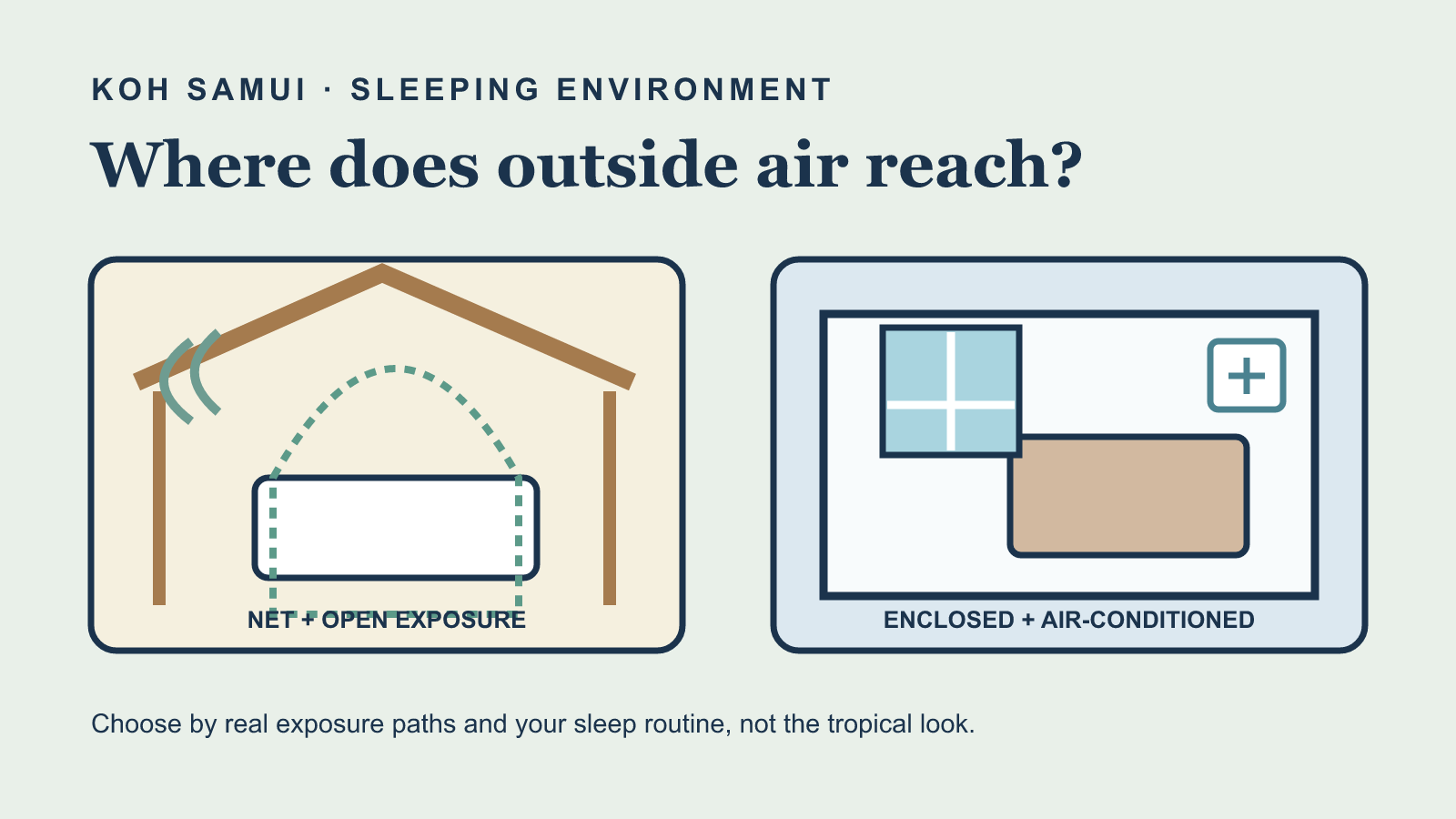
Use the one-exposure-route test
Start with the room architecture, not the amenity list. If you can identify one unavoidable, repeated route that keeps the sleeping zone meaningfully connected to outdoors at night, a mosquito net becomes a sensible feature to verify. If the bedroom is conventionally enclosed, climate-controlled and used with doors and windows closed while sleeping, the net should sit much lower in your hotel hierarchy.
This is deliberately different from our ceiling-fan vs AC-only room guide. A fan changes airflow. A net changes the immediate bed boundary. Neither tells you whether the room is actually open, sealed, quiet or comfortable.
Stay planning
Find a place to stay
See available rooms around the property or neighborhood discussed here, with prices for your dates.
“Mosquito net” and “open-air room” are not the same thing
Nature-forward room
Think exposed roof structure, strong indoor-outdoor design, detached sala, outdoor shower or a terrace that is part of the everyday living space. In this type of room, a net may be one layer of the room concept rather than decorative styling.
If the bathroom is part of that exposure, compare the trade-off separately in our outdoor vs enclosed bathroom guide.
Enclosed AC room
Think conventional walls and ceiling, a closable entrance or balcony door, individually controlled air-conditioning and a sleeping zone designed to be shut at night. Here, the most useful habit is often simply keeping the room closed when you want it closed.
If climate control itself is what you are worried about, do not let insect-related anxiety distract you from the actual sleep question.
Current Koh Samui room pages show why architecture matters more than the icon
Trace the four moments when “outside” can enter your room routine
For a room where the route from your door to bed is itself outdoors or garden-facing, our private-entrance villa vs conventional hotel-room guide is the better upstream decision. And if rain or heat exposure on repeated resort routes is the real concern, compare covered walkways with open-air resort paths.
When a mosquito net deserves real weight
The room is intentionally porous
An open roof concept, outdoor bathroom or strong indoor-outdoor sleeping setup makes the net part of the architecture rather than a styling detail. Verify that the net is actually fitted for the bed you are booking.
You will use the terrace at night
If you repeatedly move between balcony, terrace and bed after dark, you are choosing an open-door routine. The more useful next question may be whether the outdoor space is genuinely usable; see our balcony vs ground-floor terrace guide.
You sleep better with a visible barrier
Comfort is partly behavioural. If a properly arranged net lets you stop thinking about the room boundary and actually sleep, that value is real — even if another traveller would barely notice it.
When the enclosed AC room is the easier default
You want predictable sleep more than tropical theatre. If the point of your room is cold, dark and quiet sleep after long days outside, start with an enclosed room, good climate control and the right location. Our soundproofing vs quiet-location guide explains why removing a repeatable noise source often matters more than adding another room feature.
You are a light sleeper who already dislikes visual clutter around the bed. A canopy or net can feel cosy to one person and fussy to another. Do not pay for a romantic room concept you will spend every night rearranging.
You share the room with a friend. One person may love sleeping with doors open and another may want the room sealed and cool. That disagreement is more important than whether a net exists. A good shared-room decision reduces negotiation, just as a clear bathroom layout or independent bed setup does.
You are mostly out all day. If the room is a shower-and-sleep base, choose the property for location, sleep and transport friction. One visually dramatic tropical room does not automatically beat a simpler room that behaves exactly how you need at midnight.
Keep the hotel hierarchy intact
A net does not fix a room you dislike
There are three easy ways to overvalue it. First, assuming a romantic four-poster photo means the room has the kind of enclosed climate control you want. Second, assuming “air-conditioned” means every part of the villa is sealed from outdoors. Third, assuming a net tells you anything about noise, humidity, bathroom privacy or the route from reception to the room.
If your real priority is a better indoor-outdoor balance, compare our private-pool villa vs beachfront room guide. If you mainly want to wake without early light, the relevant room filter is blackout curtains vs sunrise-facing room, not a net.
Which setup fits your trip?
| Your room/trip pattern | Better default | Why |
|---|---|---|
| Standard enclosed hotel room, doors closed at night | Enclosed AC room | The net is unlikely to change the basic sleep setup enough to outrank core room quality. |
| Open thatched-roof or strongly nature-forward room | Verify mosquito net | The sleeping zone is intentionally more connected to outdoors, so the bed boundary becomes more relevant. |
| Outdoor shower but enclosed bedroom | Choose by bathroom separation first | The key question is whether the outdoor zone remains separated from the place you sleep. |
| Terrace-heavy evenings with doors frequently open | Net gains value | Your own routine repeatedly reconnects the room to outdoors. |
| Tour-heavy trip, room mainly for sleep | Enclosed AC room | Predictability beats paying for a tropical room concept you barely use. |
| Nature-forward resort is itself the experience | Choose the architecture you actually want | If living close to the garden is part of the stay, do not erase that experience just to make the room behave like a city hotel. |
| Two travellers with opposite door/temperature habits | Enclosed room unless both agree otherwise | Shared-room friction repeats every night. |
Solo women: focus on control, not a vague “safer room” label
A mosquito net is not a security feature, and an enclosed room is not automatically a safer hotel. For a solo stay, the useful questions are more specific: Can you close and lock the bedroom easily? Is the nighttime route from lobby or drop-off to your door straightforward? Does the bathroom require you to step into an outdoor zone? Can you control the AC, curtains and doors without awkward workarounds?
Those questions reduce uncertainty without pretending one architectural style is universally safer. If the nighttime approach to the room matters more than the room shell itself, revisit the private-entrance villa vs hotel-room route decision.
Eight questions to ask before booking a nature-forward room
- Is the bedroom itself fully enclosed, or is any roof, wall or eave intentionally open?
- Does the exact room category include a mosquito net fitted around the bed, or is it only visible in some photos?
- Is the bedroom air-conditioned, fan-cooled, or both?
- Is the bathroom fully indoors, partly outdoors, or detached from the sleeping area?
- Can the terrace/balcony door close completely and remain closed while the AC is running?
- Does the net cover the exact bed configuration you are reserving, including an extra bed if relevant?
- Are the room photos for the exact category, or are they property-level examples?
- If your room requirement is non-negotiable, will the hotel confirm it in writing for your booked category?
If you are splitting hotels, resist the urge to use the nature-forward room as a one-night novelty unless packing and transfers are already part of the plan. Our one-resort vs split-stay guide helps decide whether the second hotel is worth another move. And if you have not yet chosen your Samui base at all, start from the Koh Samui destination hub before filtering for tiny room amenities.
The shortest rule
Choose the room architecture first; value the mosquito net second. If the room has one unavoidable, repeated open-air exposure route, verify the net and how the bedroom closes. If the exact bedroom is conventionally enclosed and air-conditioned, do not downgrade a better hotel just to get a net.
Sources checked
- Jungle Club Samui — Jungle Thai Villa, current room architecture and amenity disclosure, checked 15 August 2026.
- Jungle Club Samui — Jungle House 2 Bedrooms, current closed-ceiling and amenity disclosure, checked 15 August 2026.
- Jungle Club Samui — Jungle Deluxe Lodge, current AC/fan/net/outdoor-shower disclosure, checked 15 August 2026.
- Hyatt Regency Koh Samui — Rooms & Suites, current standard-room climate-control disclosure, checked 15 August 2026.
Stay planning
Find a place to stay
See available rooms around the property or neighborhood discussed here, with prices for your dates.