
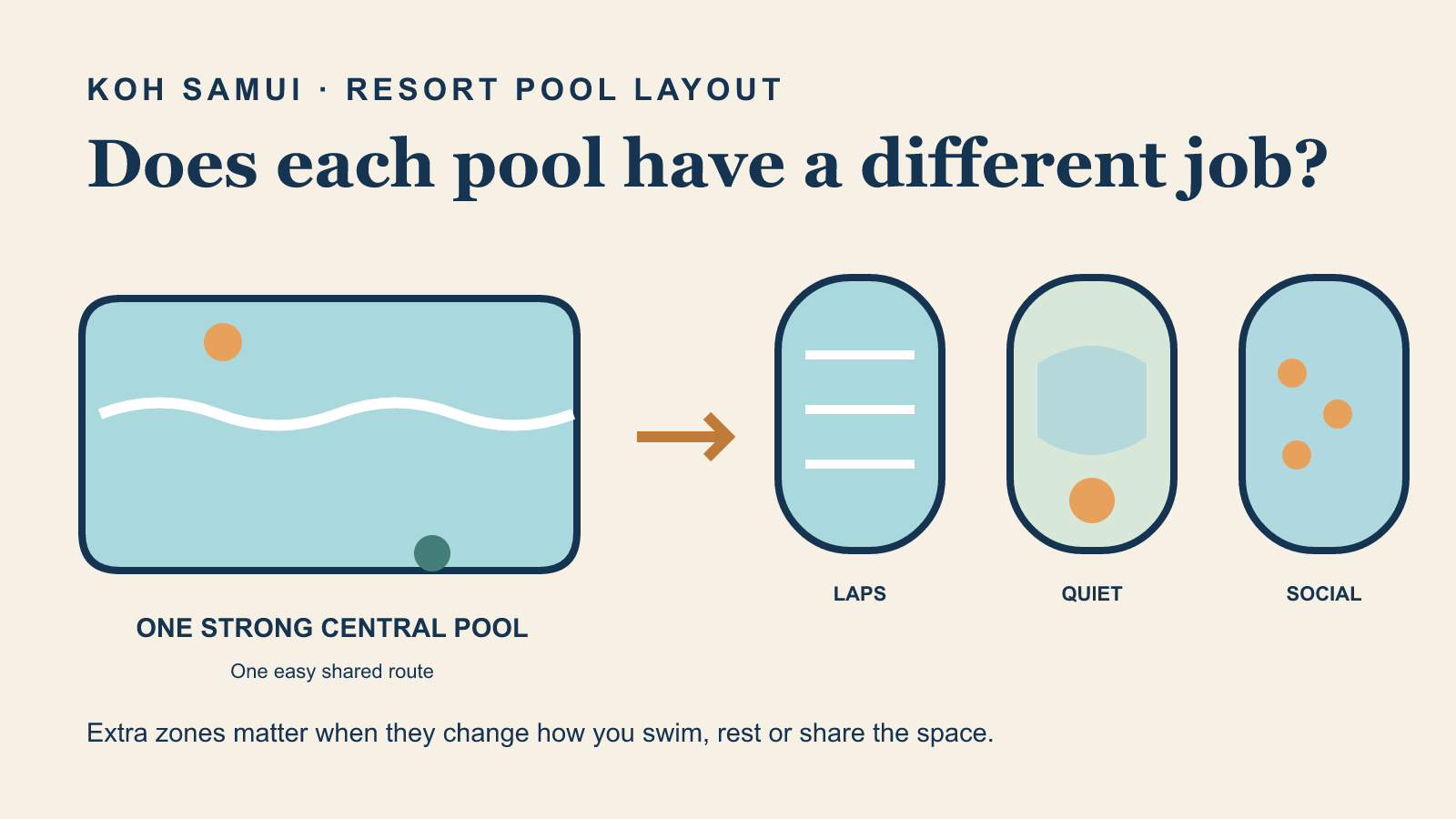
Do not count pools. Count pool jobs.
The useful question is not “How many pools does the resort have?” It is “How many different pool jobs will I actually use?”
If your ideal Samui pool day is a lounger, shade, a swim and an easy route to lunch, one well-designed central pool can be enough. If you want laps before breakfast, a quieter afternoon swim and a more social sunset zone, multiple pools can materially change the stay. The number only matters when the functions are different.
This decision is narrower than choosing a private-pool villa versus a beachfront room. That is about having water attached to your own accommodation. Here, the question is how the shared resort pool system affects the way you spend ordinary resort days.
Stay planning
Find a place to stay
See available rooms around the property or neighborhood discussed here, with prices for your dates.
Give your pool day a job description
Float and read
You need a comfortable lounger, usable shade and a pool that does not require you to keep relocating. A second or third pool adds little if the first already does this well.
Swim proper laps
A decorative freeform pool and a lap-friendly pool are not interchangeable. If swimming is exercise rather than a dip, shape and length matter more than pool count.
Find a quieter zone
A physically separate adults-only or calm pool can be useful when the main pool becomes more social or family-oriented. “Another pool” is not enough; the separation has to change the atmosphere.
Stay close to the beach
A beach-side pool can work as a low-friction base between sea swims, showers and lunch. It has value when it keeps your beach day in one compact orbit.
Meet friends easily
For two or four friends, one obvious central pool is sometimes better precisely because nobody needs a chat thread to decide where to regroup after breakfast.
Separate family needs
A shallow kids’ pool or slide pool can make a genuine difference for families. If you are traveling without children, the same separation may be useful because it leaves another pool with a different rhythm.
If only one of those jobs sounds like your holiday, pool variety should sit below room quality, location and the parts of the resort you will use every day. If three or four jobs matter, a multi-zone pool design becomes a meaningful resort feature rather than brochure decoration.
Current Samui resorts show why “multiple pools” can mean very different things
Read the first-party descriptions, then translate them into functions
- Hyatt Regency Koh Samui currently markets a “Five Freeform Pools” concept and names different formats including lap, plunge, sunken, party and kids’ pools, while also mentioning a pool by the beach. The useful editorial point is not the arithmetic; it is that the official description assigns different functions to different water zones.
- InterContinental Koh Samui Resort currently describes a main outdoor infinity pool, a second infinity pool overlooking the beach and a separate shallow kids’ pool. Again, those are distinct positions and uses rather than simply three copies of the same pool.
- SALA Samui Choengmon Beach Resort currently describes a Main Pool overlooking the beach and a separate Adults-Only Pool among palms, with the restaurant and Beach Bar close to the beach/pool area. That is a good example of how “two pools” can really mean a social/main option plus a quieter alternative.
- Centara Reserve Samui currently lists a Deluxe Pool Access room whose terrace accesses a resort pool, while other current suite and villa categories have private pools. That is a reminder to separate shared pool access from private room/villa pools when an OTA filter or room name makes the total pool offering look more impressive.
These hotels are not being ranked or selected here. They are current first-party examples showing why pool count is an imprecise comparison metric. If a particular pool function matters to you, confirm that exact shared pool, its location and its current operating rules before booking.
The same principle applies to room labels. A pool-access room versus a sea-view room is a room-category decision, not proof that the resort’s shared pool system will suit you. A pool can be physically near your terrace and still be the wrong atmosphere for the way you want to spend the day.
The one-central-pool case is stronger than it sounds
A single strong central pool can remove a surprising amount of low-level friction. You learn where the shade falls. You know which lounger area you like. Your friend can find you without messaging. You can leave the room with one bag rather than treating every move between pool zones as a miniature relocation.
That simplicity matters even more when the pool is integrated with the restaurant, bar or beach. You are not “giving up variety” if the one pool sits at the center of the exact day you wanted anyway.
It can also reduce room-position anxiety. If almost everyone is ultimately using the same central pool, the main remaining question is how far your room is from it. That is exactly what the room near the main pool versus quiet wing decision solves.
Multiple pool zones win when they let you change the mood without leaving the resort
The best multi-pool resorts are not interesting because you can photograph more pools. They are useful because the pools divide the day into different modes.
You might swim laps before breakfast, move to a beach-side pool for a long afternoon, then spend an hour at a quieter pool after families leave for dinner. In that case, the resort is effectively giving you several micro-environments without requiring a taxi, beach club reservation or day pass elsewhere.
This is particularly valuable on a resort-heavy trip. If you are staying mostly on property, variety inside the resort can be the activity. If you are out on Ang Thong, Koh Tao, food tours and dinners most days, you may never use enough of those zones to justify choosing the hotel around them. For tour-heavy stays, the practicalities in our Koh Samui tour-pickup hotel location guide will usually matter more.
Run the three-switch test
Would you really move pools three times in one day?
Imagine your towel, sunscreen, book, sunglasses, room key, phone and drink are already beside one pool. A different pool is a five- to ten-minute walk away.
Would you move because the other pool gives you something clearly better? If the answer is yes—proper laps, real quiet, sunset, a better beach connection—multiple zones have value. If the answer is “probably not, because this pool is fine,” the additional pools are mostly optional inventory.
This test is deliberately ordinary. Hotel marketing shows every pool empty and ready for you. Real resort days involve wet bags, forgotten chargers, lunch reservations and the fact that once you are comfortable, you often stay put.
Replay a realistic pool day
Post-breakfast swim
You want 25 minutes in the water before the day heats up. A dedicated lap-friendly pool is useful if swimming is part of your routine. Otherwise, walking past two other pools to reach it may be pointless.
If breakfast convenience is already a major priority, compare this with the trade-offs in our breakfast-side versus garden-block room guide.
Long afternoon base
This is where the central-pool argument is strongest. You are settled for two hours, perhaps ordering lunch and going between water and lounger. Pool quality, shade and nearby facilities matter more than having four alternatives on the map.
If you keep returning to your room for sunscreen, clothes or a shower, resort layout begins to matter too. Use the broader buggy-supported versus walkable resort test.
One last swim
Now a second pool can earn its keep. If it is quieter, faces sunset or sits beside the beach you want before dinner, changing zones creates a genuinely different end to the day. If it is simply another pool, you will probably remain where your towel already is.
Room access can also change this calculation; compare a balcony with a ground-floor terrace if outdoor movement from the room matters.
Solo, couples and friends use pool variety differently
Solo travelers: one reliable central pool can feel pleasantly easy because you can settle without repeatedly repacking your things. Multiple zones are worthwhile if one offers a noticeably quieter atmosphere or the type of swim you actually want. The useful question is not whether moving alone is difficult; it is whether the move gives you enough benefit to interrupt a comfortable base.
Couples: multiple zones can be excellent when preferences differ. One person can want laps while the other wants shade, or both can prefer a quieter adults-only pool later in the day. But if you always plan to sit together by the same pool, extra zones may not influence the stay at all.
Friends: a single central pool is operationally brilliant for regrouping. Multiple pools can work equally well if your group deliberately splits—some swimming, some reading, some at the beach—but decide in advance how much coordination you are willing to add. The same “shared convenience versus personal preference” logic appears in our one resort versus split-stay guide.
Pool variety should never outrank the room you actually sleep in
It is easy to let resort facilities dominate the booking comparison because they are more photogenic than corridor position, bathroom privacy or bed configuration. But the room is used every night; the third pool may be used once.
If the multi-pool resort forces you into a room zone you dislike, check the hierarchy again. A better room location may beat a more elaborate pool network. The lobby-side versus beach-side room decision and ground-floor versus upper-floor room decision are often more consequential than the raw facility count.
Likewise, do not confuse shared pool choice with private water access. If the real fantasy is stepping directly into water from your room, return to the pool-access versus sea-view room comparison instead of choosing a hotel because the resort map has more blue shapes on it.
Use this matrix before you let pool count break a tie
| Your actual stay pattern | One strong central pool | Multiple distinct pool zones | What should break the tie? |
|---|---|---|---|
| Couple, four nights, two excursion days | Usually enough | Nice but likely underused | Room quality and location |
| Solo, five nights, plans to read poolside most afternoons | Strong choice if shade and service are good | Useful only if one zone is materially quieter | Shade, atmosphere and room route |
| Swimmer who wants exercise every morning | Works only if shape suits laps | Better if a genuine lap-friendly option exists | Pool dimensions/function, not count |
| Friends who want an obvious meeting point | Excellent | Can create unnecessary coordination | How often the group separates |
| Resort-heavy honeymoon with few off-property plans | Can still be ideal | Potentially valuable if zones change mood | Whether you will switch pools repeatedly |
| Family needing a shallow kids’ area | Only if family facilities are built into it | Useful when children’s and adult/general areas are genuinely separated | Exact child-pool design and supervision rules |
| Traveler choosing mainly for beach time | Often enough when pool sits beside beach | Useful if one zone improves the beach orbit | Beach–pool–room walking route |
Do not book from an OTA “pool” icon alone
Pool information is unusually easy to flatten. An OTA may tell you a hotel has a pool without telling you whether that means one shared infinity pool, several shared zones, a kids’ pool, room-category pool access or private villa pools.
That distinction matters because the booking decision is behavioral. A private plunge pool belongs to the room product. A children’s pool may solve a family need. A lap pool may solve an exercise need. A second decorative pool may solve nothing for you at all.
If your choice depends on a specific pool, confirm the exact current setup rather than extrapolating from an amenity icon or a gallery caption.
Seven questions worth sending the resort before you book for the pools
- Which pools are shared guest pools, and which are private room or villa pools?
- Does each shared pool have a distinct purpose or guest policy? Ask specifically about adults-only, children’s, lap or activity areas if those matter.
- What are the current pool operating hours?
- Which pool is closest to the room category or zone I am considering?
- Is the beach, restaurant or bar directly beside the pool I expect to use most?
- Are any pools seasonally closed, under maintenance or subject to event restrictions during my dates?
- If a room is sold as “pool access,” which exact pool does it access?
You do not need all seven answers for every booking. Use the questions that correspond to the pool job you care about. The point is to turn a facility count into a usable day plan.
One more filter: how much of Samui will you actually leave the resort to see?
If you are building a trip around boat days, restaurants and beaches elsewhere on the island, the hotel pool system will have fewer chances to matter. A simpler resort with the right room and easy departure logistics can be the better booking.
If the resort itself is a major part of the holiday, multiple genuinely different pool zones can become part of the experience rather than just amenities. That is when the extra water starts to justify extra walking.
For the final night, the same principle of actual usage over theoretical amenity applies to time as well as pools: our late checkout versus extra night guide helps decide whether paying for more hotel time changes the trip enough to matter.
The rule I would use
Choose the resort whose pool system solves your two most repeated pool jobs with the least friction.
If one central pool gives you shade, swimming, food and an easy room route, extra pools are not automatically an upgrade. If separate zones give you lap swimming, genuine quiet, family separation or a beach-side second mood you will use repeatedly, multiple pools can absolutely justify choosing one resort over another.
Then put the pool decision back into the whole stay. Check the Koh Samui destination hub and make sure the resort still works for the parts of the island you want outside the water.
Sources checked
Sources checked
- Hyatt Regency Koh Samui — current official Veriō Spa & Recreations page, checked 12 August 2026, for the currently published “Five Freeform Pools” concept, named pool formats and 7:00 AM–7:00 PM hours.
- InterContinental Koh Samui Resort — current official amenities page, checked 12 August 2026, for its main infinity pool, second beach-overlooking infinity pool, shallow kids’ pool and published pool hours.
- SALA Samui Choengmon Beach Resort — current official amenities and services, checked 12 August 2026, for the Main Pool, Adults-Only Pool, beach relationship and current pool operating hours.
- Centara Reserve Samui — current official accommodation inventory, checked 12 August 2026, for the distinction between Deluxe Pool Access to a resort pool and room/villa categories with private pools.
Pool hours, access rules, room allocations and maintenance schedules can change. If a particular pool is a booking requirement, confirm the current setup for your dates directly with the resort before paying.
Stay planning
Find a place to stay
See available rooms around the property or neighborhood discussed here, with prices for your dates.