
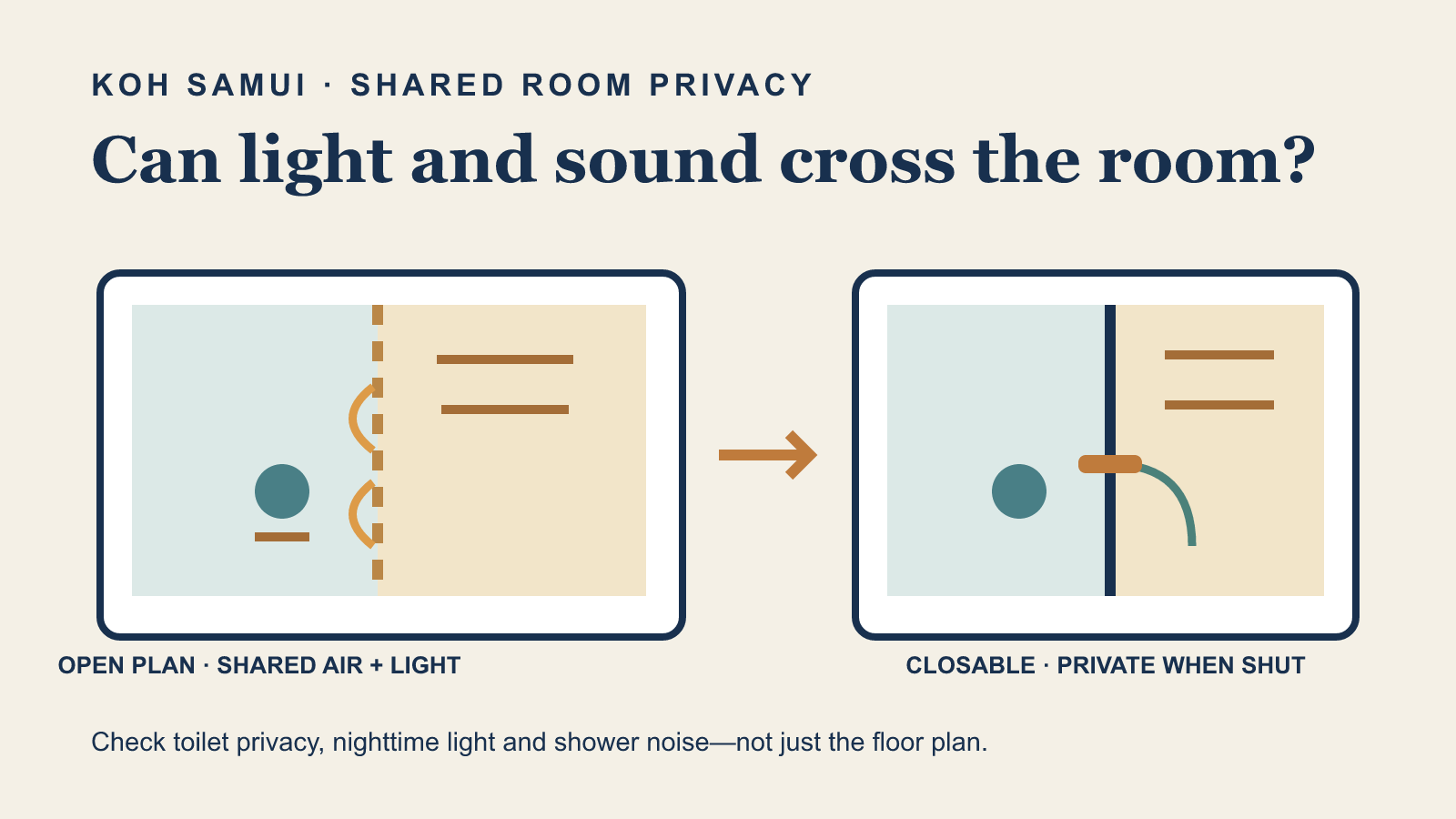
The recommendation in one line: count closures, not square metres
A beautiful bathroom can still be awkward to share. A smaller bathroom can work perfectly if the toilet closes, the shower is screened and the vanity does not flood the sleeping area with light.
Before paying for a bigger room, look for three kinds of separation: a closable toilet zone, a shower screen or door that contains water, and a way to isolate bathroom light from the bed. If the room has all three, an open vanity or freestanding tub is usually a design choice rather than a privacy problem. If the toilet is exposed to the bedroom, the layout should be treated as a major sharing trade-off.
Stay planning
Find a place to stay
See available rooms around the property or neighborhood discussed here, with prices for your dates.
“Open-plan bathroom” can describe several completely different rooms
The phrase sounds precise, but hotel room descriptions use it for very different layouts. It can mean a bathtub visually connected to the bedroom while the toilet remains enclosed. It can mean a vanity that sits in the dressing zone outside a smaller wet room. It can also mean a bathroom separated by glass, a sliding partition or no substantial visual barrier at all.
Kimpton Kitalay Samui currently describes both its Essential Garden View Room and Essential Resort View Room as having a freestanding tub in an open-plan bathroom, while also listing separate bath and shower. That tells you the tub-and-shower format, but it still does not answer every sharing question a booking photo raises. The property’s official room information does not, on those category descriptions, specify exactly how the toilet is screened from the bed. That missing detail is precisely why the decision should be based on the exact floor plan or a direct hotel confirmation rather than a marketing label.
This is a different problem from choosing an outdoor versus enclosed bathroom in Koh Samui. That guide is about exposure to weather, humidity and outdoor bathing. This one stays indoors and asks whether two people can use the room without making each other feel watched, woken up or rushed.
Map the bathroom into four privacy zones
Toilet
This is the non-negotiable privacy zone for many friends and a meaningful one for couples. Ask whether the toilet has a solid or opaque door that closes; a “separate WC” label does not confirm privacy.
Shower
Check whether the shower has a door or screen, how transparent it is, and whether stepping out of it puts you directly in the bedroom sightline.
Vanity
An open vanity can actually improve sharing because one person can do skincare or makeup while the other uses the shower. The downside is light and hair-dryer noise near the bed.
Tub
A freestanding tub can be intentionally open to the bedroom or view. That may feel romantic for a couple, but it should not be mistaken for proof that the whole bathroom lacks privacy.
If the room has two adults who get ready at the same time, this four-zone map is often more useful than bathroom size. It also explains why the bathtub versus shower-only decision is separate: a tub changes how you bathe; privacy zoning changes whether you can comfortably share the room.
The fastest deal-breaker test: can one person use the toilet while the other stays in the room?
Imagine a completely ordinary situation, not a honeymoon photo: one person is packing at the desk while the other needs the toilet. Would both of you be comfortable? If you would need the other person to step onto the balcony, turn up the television or leave the room, the layout is not functionally private enough for your travel style.
For friends, this question should be asked before view, tub, terrace and even a small room-size upgrade. For couples, the answer is more personal, but it is still worth deciding before arrival rather than discovering the boundary at midnight.
Current Samui room descriptions show why partitions matter
The current Essential Garden View and Essential Resort View descriptions explicitly use “open-plan bathroom” for rooms with a freestanding tub and separate bath and shower. This is a useful example of openness being part of the room design, not a synonym for “everything is exposed”.
The current Garden View Suite describes a terrazzo tub for two with a partition that can be opened to take in garden views. The current Luxury Beach Front View Suite similarly describes a partition that can be slid open to reveal the sea. In other words, visual openness can be adjustable rather than permanent.
The current Junior Garden Suite describes a standalone tub in a spacious bathroom and separately highlights a tub and rain shower. Again, fixture descriptions tell you only part of the layout. A traveler who cares about toilet privacy still needs the exact plan.
These properties are evidence examples, not recommendations in this article. Room categories can change, and room layouts can differ between categories at the same resort; check the photos and exact description for the bathroom partition.
For couples, open-plan can work — but only if your privacy boundaries already match
Open-plan is often fine when…
You are comfortable getting ready in the same visual space, one person using the vanity does not bother the sleeper, the toilet closes properly, and the open tub or vanity is actually a feature you both like. In that case, the room can feel larger and less segmented without creating daily friction.
Choose the closed bathroom when…
One person wakes much earlier, either of you needs real toilet privacy, one takes long showers while the other rests, or you prefer being able to shut a door after a beach day and contain steam, light, wet towels and hair-dryer noise.
If you are also debating a private-pool villa versus beachfront room, do not let a dramatic bathroom photo decide the larger accommodation choice. Privacy, resort movement and how much time you spend in the room usually matter more.
For two friends, the closed door is usually worth more than the open tub
A friends’ trip creates different bathroom economics. You may be comfortable sharing a bedroom but still want a clear privacy boundary for changing clothes, using the toilet and showering. This becomes more important when you are both getting ready for dinner, when one person comes back later than the other, or when morning schedules diverge.
If you are already stretching one room to three adults, start with the sofa-bed versus extra-bed guide, then check the one-versus-two-bathrooms decision for three friends. Bathroom openness is a secondary problem if the room does not have enough sleep surfaces or bathroom capacity in the first place.
Nighttime light is the hidden reason some open bathrooms become annoying
At 2 a.m., the problem is rarely the bathtub. It is the light. A vanity mirror or bathroom ceiling light that shines directly toward the bed can wake a light sleeper even if the toilet is technically screened. Frosted glass can also glow brightly when one person switches on the bathroom light.
Ask whether the toilet has its own low-level light, whether the bathroom can be closed from the bedroom, and whether there is a night light that does not illuminate the entire vanity. If one person regularly sleeps earlier, a closable bathroom is often a higher-value feature than extra floor area.
This same “repeat the route at night” logic also matters in the ground-floor versus upper-floor room choice and the balcony versus ground-floor terrace decision: hotel design matters most during everyday use, including mornings and evenings.
Shower noise and steam matter if one person treats the room as a retreat
An open bathroom can make the entire room feel like one large space. That is attractive when both guests are awake and moving. It is less attractive when one person is reading, sleeping or taking a call while the other is showering, using a hair dryer or running a bath.
If your Koh Samui trip has several early departures, this gets more practical. One person may be showering before a boat pickup while the other is trying to sleep another 20 minutes. In that kind of schedule, the hotel-location guide for early tour pickups may be your first decision, but a closable bathroom can make the room itself work much better once you have chosen the right base.
Use a privacy budget instead of a luxury checklist
| Sharing pattern | Open-plan risk | What should decide the room |
|---|---|---|
| Couple with matching sleep and getting-ready times | Low to medium | Confirm toilet closure, then choose by the better overall room category. |
| Couple with very different sleep schedules | Medium to high | Prioritise a door or partition that blocks vanity light and shower noise. |
| Two friends sharing one room | High if toilet/changing zones are exposed | Default to a fully closable bathroom unless the exact layout clearly protects privacy. |
| Three friends in one room | Very high during morning and pre-dinner peaks | Check bathroom count and third-bed plan before debating aesthetics. |
| Solo traveler | Usually low | Choose by room quality, but check glass sightlines if staff, pool or terrace circulation is close. |
| Resort-heavy stay with frequent showers | Higher because the bathroom is used more often | Prioritise ventilation, easy wet-zone containment and a layout that lets two people reset at once. |
| Tour-heavy stay with little room time | Lower, unless schedules differ | Do not sacrifice the better hotel location just to gain a prettier bathroom layout. |
A better room layout can beat a larger room
Suppose one option is 58 square metres with an open bathroom and the other is 45 square metres with a proper bathroom door. If two friends are sharing, the smaller room may feel more usable because each person can create temporary privacy. The same can be true for a couple with different schedules.
Conversely, an open-plan room with a closed toilet cubicle, screened shower and vanity positioned away from the bed may function beautifully. Do not pay for a suite merely to solve a problem the standard room does not actually have. If you are comparing separate sleeping spaces too, use the connecting versus separate rooms guide before treating a bathroom partition as the main issue.
Ask the hotel these seven exact questions
- Does the toilet have its own solid or opaque door that closes completely?
- Can the bathroom be closed off from the bedroom, or is the vanity/tub permanently open to the sleeping area?
- Is the shower glass clear, frosted or opaque, and is it visible from the bed?
- Can the vanity be used while someone else is using the toilet or shower?
- Does bathroom lighting spill directly into the bed area at night?
- Does this exact room category have the same layout shown in the photos, or are there multiple configurations?
- Can the hotel confirm the layout in writing for the room category you are booking?
A floor plan is more valuable than another wide-angle bathroom photograph. A direct written answer is more valuable than assuming that “separate bath and shower” means “separate bathroom”.
Do not let this micro-decision override the whole trip
Bathroom privacy can matter every day, but it still sits inside a bigger accommodation choice. A perfectly enclosed bathroom is not enough reason to choose an isolated resort if you want to walk out for dinner, and an open-plan tub is not enough reason to choose a resort that adds long taxi rides to every plan.
If you are still deciding the shape of the stay itself, compare one resort versus a split stay in Koh Samui. The Koh Samui destination hub also connects the accommodation decision to beaches, transport and experiences.
The final rule: protect the one moment you would hate to negotiate
If sharing a room means either person would ever need to say, “Can you go outside for a minute?”, choose the bathroom with the proper door. If your toilet privacy is already protected and both of you genuinely like the open tub or vanity, the open-plan layout can be a pleasure rather than a compromise.
Choose the room by the most private task, not the most photogenic fixture.
Sources checked
- Kimpton Kitalay Samui — current official resort rooms, checked 12 August 2026: Essential Garden View and Essential Resort View descriptions use “open-plan bathroom” and list separate bath and shower.
- IHG / Kimpton Kitalay Samui — current official room inventory, checked 12 August 2026: current room/suite categories and bathroom/accessibility information.
- Anantara Bophut Koh Samui Resort — current Garden View Suite, checked 12 August 2026: open-plan living and a terrazzo tub with an opening partition toward garden views.
- Anantara Bophut — current Luxury Beach Front View Suite, checked 12 August 2026: soaking tub with a sliding partition that can open to the sea view.
- Anantara Bophut — current Junior Garden Suite, checked 12 August 2026: standalone tub, rain shower and current room details.
Stay planning
Find a place to stay
See available rooms around the property or neighborhood discussed here, with prices for your dates.