
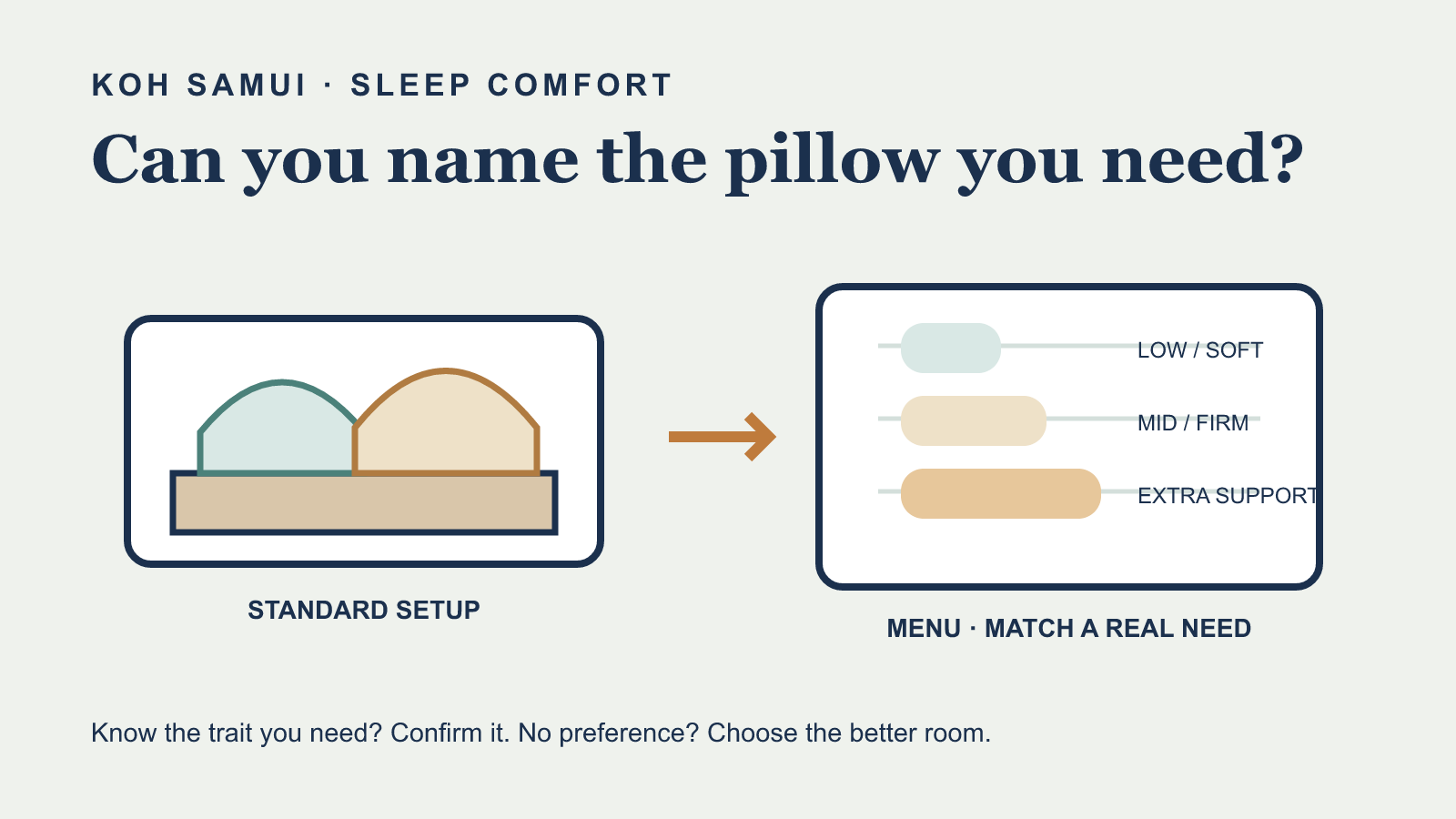
The recommendation: one specific need makes pillow choice real
A pillow menu sounds luxurious because it suggests custom sleep. But customization only matters when you know what you are trying to change. If you are usually fine with whatever a good hotel places on the bed, the menu is a pleasant service extra. If you already know that a very high pillow, very soft pillow or feather filling does not work for you, the ability to request an alternative becomes practical rather than decorative.
That distinction matters in Koh Samui because room decisions already compete with stronger variables: noise, blackout control, air-conditioning, bed configuration, bathroom privacy and the route back to the room at night. Our quiet-room request vs best-view guide and blackout-curtains vs sunrise-facing-room guide deal with two of those larger sleep levers. Pillow flexibility comes after them unless you have a known preference.
Stay planning
Find a place to stay
See available rooms around the property or neighborhood discussed here, with prices for your dates.
Four pillow traits are more useful than the words “pillow menu”
Often the first thing you notice. A menu is useful when it gives you a real alternative rather than another pillow that feels almost identical.
Firmness is subjective. If this matters to you, ask how the hotel describes its actual options instead of assuming “menu” means every firmness level.
For travelers who avoid a particular filling, this can be the most important question. Do not infer a feather-free option unless the hotel confirms it.
Sometimes the useful request is simply an extra pillow, not a specialist menu. A hotel that handles requests well can solve the problem without a long list of named pillows.
Current Samui hotel pages show several different versions of “pillow choice”
The current official IHG room page lists a pillow menu under amenities available by request. That wording matters: it is a request service, not something you should assume is already staged in every room.
The current official Marriott accommodation page describes W pillow-top beds, goose-down comforters and a W pillow menu. It is a clear first-party statement that pillow choice is part of the sleep product, but the public page does not enumerate every current pillow option.
The current IHG room inventory also lists a pillow menu available by request. Again, the useful operational detail is the request mechanism; the public page should not be stretched into a guarantee of a specific fill or height.
Current official room pages such as Luxury Ocean, Deluxe Pool Access and The Reserve Suite explicitly list Pillow Menu among the room amenities. Check the pillow menu for your exact hotel and room; listed amenities can differ across properties.
The current official services page includes pillow menu among complimentary services. The same page positions it as one service among many, which is exactly how most travelers should value it unless pillow choice is already a known sleep requirement.
These are operating examples, not rankings. Pillow stock, exact fillings and request availability can change. If one particular option matters to your sleep, verify that exact option for your stay rather than relying on the icon or phrase alone.
A pillow menu solves a known preference; it does not rescue a bad sleep setup
When the pillow menu deserves real weight
You already know the hotel-standard high pillow makes you uncomfortable; you prefer a lower profile; you avoid feather filling; or you routinely sleep with an extra support pillow. In those cases the menu can remove a predictable problem before Night 1.
If you are sharing, a pillow menu can also stop a small negotiation becoming nightly friction. Two friends may want completely different pillow heights even when the king-vs-twin bed decision is already solved.
When standard pillows are enough
You sleep well on most hotel beds, you rarely adjust pillows at home, and the hotel can provide an extra pillow on request. In that case, choose the room with better noise control, blackout, temperature and layout. If airflow matters more than bedding customization, our ceiling-fan vs AC-only room guide is a more useful filter.
For a short stay with long beach and boat days, I would not trade a better location or a calmer room merely to gain a pillow-menu badge.
Night 1 is where vague preferences become obvious
Imagine a very ordinary arrival. You check in at 4:30 p.m., shower, go out for dinner, come back at 10:45 and finally notice the pillow. This is the worst time to discover that “pillow menu” meant a request that needed advance notice, or that the specific option you had in mind is not currently available.
That is why I would make the request before arrival if the trait is genuinely non-negotiable. A 24-hour front desk can help with late-night problem solving, but prevention is still easier than negotiating sleep setup when you are already tired.
If the issue is not the pillow but the whole room environment — bright bathroom light, open-plan privacy, people getting ready at different times — use our open-plan vs closed-bathroom guide instead. A perfect pillow does not fix a room that keeps waking you for other reasons.
My hotel sleep-priority stack
- Can I sleep here? Noise, blackout, temperature and bed setup.
- Can I move through the room comfortably? Bathroom privacy, storage and nighttime route.
- Can the hotel solve the one sleep detail I already know about? This is where pillow choice belongs.
- Only then: decorative or low-use bedroom extras.
If you are comparing a suite because you want more separation rather than better bedding, the lounge area vs separate living room guide is the better decision tool. For a longer stay, resort vs residence-style suite looks at the bigger home-like trade-off.
Do not confuse a pillow menu with a pillow guarantee
The phrase can describe very different service levels. One hotel may have a printed menu with several named fills. Another may simply offer a few alternative pillows when requested. A third may have a brand standard but limited stock on a busy night.
If your requirement is casual, that uncertainty is fine. If it is specific, ask a specific question. “Do you have a pillow menu?” is weaker than “Can you confirm a low, non-feather pillow can be placed in my room before arrival?” The second question turns a marketing label into an operational answer.
This is similar to how we treat other small hotel amenities. A “hair dryer” icon does not tell you power or attachments, which is why our hotel hair dryer vs own styling tool guide focuses on the routine you actually need. A pillow menu should be judged the same way.
Decision matrix: how much should pillow choice influence the booking?
| Your pattern | How much pillow choice matters | What I would do |
|---|---|---|
| You sleep well on almost anything | Low | Ignore the pillow-menu badge and choose the better hotel. |
| You always ask for one extra pillow | Low to medium | Confirm an extra pillow is available; a formal menu is unnecessary. |
| You need a low or firm pillow | Medium to high | Verify the exact alternative before booking if two hotels are otherwise close. |
| You avoid feather filling | High if it is a firm preference | Ask for explicit non-feather confirmation; do not infer it from “pillow menu.” |
| Two friends want very different setups | Medium | Request separate pillow preferences in advance rather than solving it at bedtime. |
| You are moving hotels every two nights | Lower | Do not optimize every property around pillows. Read one resort vs split stay first. |
| You are staying seven nights and know your sleep setup | Higher | Repeated nightly value can justify choosing a property with confirmed flexibility. |
| You care mostly about brand service consistency | Medium | Use pillow handling as one service clue, but compare it within the larger chain hotel vs boutique resort decision. |
For two women sharing a room, the useful part is reducing bedtime negotiation
A shared room becomes easier when each person can set up the bed without borrowing the other person's pillow or stacking everything in the middle. This is not a glamorous upgrade, but it is the sort of tiny friction that repeats every night.
I would still rank bathroom privacy and sleep separation above pillow customization. If you are already negotiating mirrors, showers or toilet access, those issues have more effect on the room than pillow choice. The point is not to collect more amenities. It is to remove the repeated friction that actually belongs to your trip.
Housekeeping can matter too: if an alternative pillow is requested, ask whether it will stay assigned to the room for the full stay rather than being reset accidentally. Our daily housekeeping vs reduced-service guide covers the broader room-reset rhythm.
Eight questions to ask when the pillow really matters
- Does my exact room category have access to the pillow menu?
- Is the menu in the room, or is it only available by request?
- What pillow heights or firmness descriptions are currently available?
- Do you have a non-feather or synthetic option if needed?
- Can the requested pillow be placed in the room before arrival?
- Is availability guaranteed or subject to stock on the day?
- Can each guest in a twin or shared room request a different option?
- Will the requested pillow remain assigned to the room throughout the stay?
The hotel should still win the whole-trip test
A pillow menu should rarely rescue a hotel that loses on the things you use all day. If one property has a much better beach, easier dinner access, safer-feeling nighttime route or quieter room position, I would usually take that advantage and solve the pillow separately where possible.
Conversely, if two hotels are nearly tied and one can confirm the exact pillow setup you know works for you, that is a legitimate tie-breaker — especially on a longer stay. The same logic applies to choosing a private-entrance villa vs conventional hotel room: the small detail matters only after the core route and room fit are sound.
The final rule: name the trait before you value the menu
If you cannot name a pillow trait you need, choose the better Koh Samui hotel and treat the pillow menu as a nice extra. If you can name one — low, high, firm, soft, non-feather, or simply one extra pillow — ask the hotel to confirm that exact option before arrival.
That is the useful difference between “this hotel has a pillow menu” and “this hotel can support the way I actually sleep.” For the rest of the island decision, start at our Koh Samui guide hub.
Sources checked
- Kimpton Kitalay Samui — official IHG room page, checked 14 August 2026: pillow menu listed as available by request.
- W Koh Samui — official Marriott rooms overview, checked 14 August 2026: W pillow menu listed as part of the villa sleep setup.
- InterContinental Koh Samui Resort — official IHG room page, checked 14 August 2026: pillow menu listed under amenities available by request.
- Centara Reserve Samui — official Luxury Ocean room page, checked 14 August 2026: Pillow Menu listed in current room amenities; other current Centara Reserve room pages show the same amenity in selected categories.
- Four Seasons Resort Koh Samui — official services and amenities page, checked 14 August 2026: pillow menu listed among complimentary services.
Operational details can change. Reconfirm any specific pillow requirement directly with the hotel for your stay dates.
Stay planning
Find a place to stay
See available rooms around the property or neighborhood discussed here, with prices for your dates.