
Use the 11 pm route test
Ignore the pool, the terrace and the room size for one minute. Imagine returning alone after dinner at 11 pm. It has rained. Your sandals are wet. Your phone is at 8%. You want to be behind your own door within five minutes.
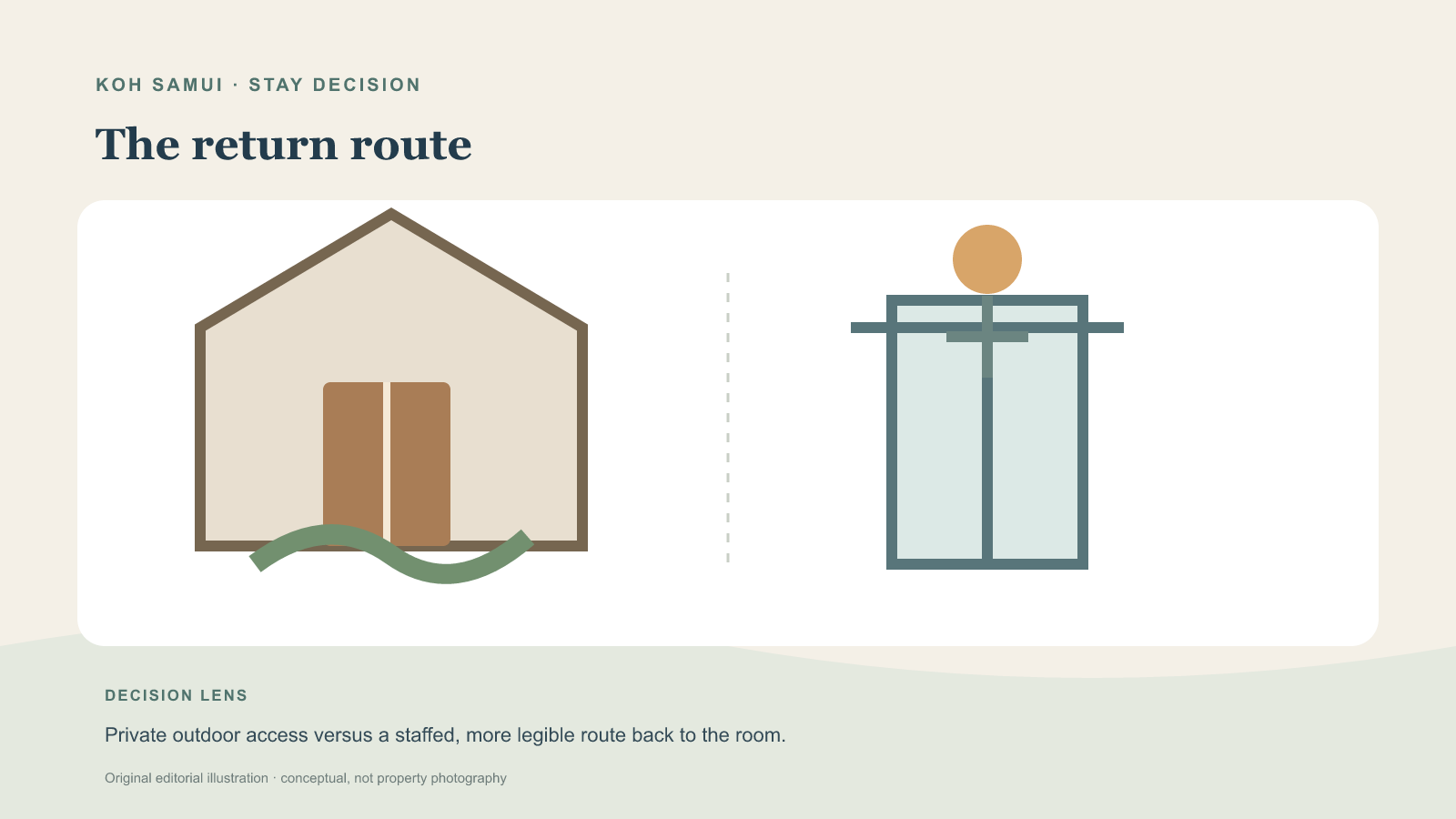
Which route would you rather repeat: lobby → lift or internal walkway → room, or reception/drop-off → outdoor path → garden gate or villa door?
My rule: choose the private-entrance layout only when you can picture the entire after-dark route and it still feels easier than the privacy is worth. If the route is vague, long or transport-dependent, the conventional hotel-room system is the safer default decision for a solo stay.
Stay planning
Find a place to stay
See available rooms around the property or neighborhood discussed here, with prices for your dates.
This is not really a room-type decision
It is a circulation decision. Two accommodations can offer the same bed, bathroom, terrace and service level while feeling completely different because of what happens between the property entrance and your door.
Private outdoor-access route
The room or villa opens to a garden, terrace, pool zone or dedicated outdoor approach. The upside is separation: fewer people pass your door, indoor circulation can feel calmer and you may step straight into tropical outdoor space.
The trade-off is that the last part of your route may involve weather, garden paths, stairs, darker landscaping or more distance from the lobby.
Conventional hotel-room route
You move through a staffed lobby and then a lift, staircase or shared internal circulation to your room. It can feel less secluded, but the route is usually easier to understand on the first night and easier to repeat when tired.
The trade-off is more shared movement: doors, lifts, housekeeping and other guests may sit closer to your room.
Current Samui room inventories show why you should verify the route, not guess it from “villa” or “suite”
Current official Samui accommodation pages show several different access patterns inside the same destination. One resort sells second- and third-floor balcony rooms alongside a Junior Garden Suite with direct garden access and an entrance through a garden archway. Another sells a 47 sqm Deluxe Balcony room alongside a much larger ground-floor Garden Pool Villa with a covered terrace, private pool and landscaped outdoor setting. A third describes a mix of rooms, suites and villas, many with direct swimming-pool access.
Those labels tell you something about the physical experience, but they do not tell you the whole route from reception to the door. “Garden access”, “pool villa” and “private terrace” are not substitutes for asking where you actually walk after dark. The useful booking question is: from the main arrival point, what is the exact route to this room category?
Run four ordinary moments before you upgrade for privacy
You have just checked in with luggage. A private path feels romantic until you are dragging a suitcase over uneven or wet surfaces. If arrival is the hardest part, compare early check-in vs luggage drop and confirm whether staff escort luggage to the exact room.
You are dressed for dinner and it starts raining. A short covered internal route may suddenly feel more luxurious than an extra 40 square metres of private outdoor space.
You return alone. This is the key test. Do you cross a quiet garden, wait for a buggy, walk beside a pool, climb exterior steps or enter through a staffed building?
You have an early pickup. Can a driver or tour host find the lobby easily, and can you move from room to meeting point without adding ten minutes of internal travel? Use the tour-pickup hotel location guide if early starts are central to the trip.
When the private entrance is genuinely worth choosing
You spend real daytime hours in the room
If your stay includes slow mornings, remote work, private-pool time, reading or afternoon rests, separation is not decorative. You are buying a calmer mini-base. The trade becomes especially sensible when the villa is still close to the main hotel facilities rather than hidden at the far edge of a spread-out resort.
The outdoor route is short, legible and well used
Privacy does not require isolation. A compact resort can give you a garden gate or villa entrance a minute from the lobby. That is very different from a hillside layout where every dinner or forgotten charger becomes another internal transfer. Cross-check the buggy-supported vs walkable-resort guide.
You strongly dislike corridor traffic
Some travelers care more about people passing their door than about seeing staff on the way back. If that is you, a private approach can feel materially calmer. But solve the actual noise source too: the quiet-room request vs best-view guide is more useful if sleep, rather than entrance privacy, is the main goal.
You want direct access to a garden or pool for a repeated routine
Direct outdoor access can change the day if you genuinely use it: morning swim, wet-swimsuit return, reading on the terrace, quick shower before lunch. If you only like the idea of it in photos, do not pay for the route change. Compare the separate balcony vs ground-floor terrace decision before assuming “closer to outside” is automatically better.
When I would choose the conventional hotel-room route instead
You arrive late or alone for the first time
The first ten minutes matter more than the hundredth. A straightforward reception-to-room route reduces the number of things you need to work out when tired. If your flight or ferry timing is uncertain, also read 24-hour front desk vs limited reception.
You go out every evening
If the room is mainly for showering and sleeping, choose the system that makes leaving and returning boring. A beautiful secluded villa loses some value if you repeatedly walk past dark landscaping, wait for internal transport or carry an umbrella across the property just to get back to bed.
You prefer visible staff proximity
Some solo travelers simply relax more when the route passes a staffed lobby or reception. That preference is valid even if the property’s private-villa route is perfectly functional. Hotel choice is partly about removing mental load; you do not need to justify wanting a simpler arrival path.
You are already compromising on location
Do not stack friction. If the resort is isolated enough that dinner already requires a car, avoid adding an awkward internal route unless the villa itself is a major purpose of the stay. The resort dining vs nearby restaurants guide helps separate on-property convenience from walk-out freedom.
The solo route audit: eight questions to send before booking
- Is this exact room category in a main building, a separate villa, a garden block or a pool-access wing?
- From reception, roughly how long is the normal walk to this category?
- Is the route indoors, covered outdoors or fully outdoors?
- Are there exterior stairs, steep slopes or buggy transfers on the normal route?
- Is the route lit after dark all the way to the room entrance?
- Does reception or security operate overnight, and how do I contact them from the room?
- Can luggage be delivered directly to the room on arrival and collected at departure?
- If I return late, do I use the same entrance and route as during the day?
Ask about the exact booked category, not the resort in general. Large Samui properties can contain several circulation models at once.
What matters more than the entrance type
A private entrance should not rescue the wrong hotel. My order for a solo stay is usually:
- Area and after-dark return logic. Can you get back from the places you actually want to visit without turning every evening into a transport project?
- Property circulation. Is the room-to-lobby, room-to-breakfast and room-to-pickup route easy? For large resorts, compare lobby-side vs beach-side rooms.
- Room-door environment. Private path, internal corridor, lift proximity and neighbouring activity.
- Room features. Pool, view, terrace, bath, workspace and other upgrades.
If internal circulation is the worry, the more specific near-lift vs corridor-end guide handles that trade-off. If vertical position is the issue, use ground-floor vs upper-floor room. If the private layout also creates a more exposed bathroom, check open-plan vs closed bathroom separately.
Eight common solo-stay patterns
| Trip pattern | Better default | Reason |
|---|---|---|
| First solo Samui trip + late arrival | Hotel-room route | Fewer access decisions on Night 1. |
| Resort-heavy 4-night reset | Private outdoor access | The room and its private zone are part of the trip. |
| Two early boat/tour mornings | Whichever has the shorter lobby route | Pickup friction repeats before breakfast. |
| Out for dinner every night | Hotel-room route | Return simplicity beats daytime seclusion. |
| Remote work + afternoon room time | Private outdoor access | Privacy is used for hours, not minutes. |
| Hillside resort with buggy dependence | Hotel-room route or closer villa | Do not buy privacy by adding repeated transport. |
| Light sleeper worried about corridor doors | Depends on exact noise source | Request distance from the disturbance rather than guessing from room type. |
| Seven-night stay with mixed plans | Simpler route unless villa is a core experience | Small circulation costs compound across a week. |
Do not confuse privacy with security — or visibility with safety
A quiet garden path is not automatically unsafe, and a busy internal corridor is not automatically safer. The point is not to rank architectural styles. It is to understand which route gives you lower mental load at the times you will actually use it.
For a solo traveler, useful evidence is concrete: lighting, route length, staff availability, locked access, weather exposure, steps and whether help is easy to contact. Marketing words such as “secluded”, “sanctuary”, “private” or “exclusive” do not answer those questions.
The same principle applies if you are changing hotels mid-trip. A second property means another arrival system to learn, so read one resort vs split stay before multiplying the number of access routines.
Final decision
Choose the private-entrance villa when privacy is something you will use for hours and the after-dark route is short, clear and easy to confirm. Choose the conventional hotel-room route when the room is mainly a base and you value a predictable staffed return more than architectural seclusion.
The best tie-breaker is deliberately unglamorous: which door would you rather reach alone at 11 pm in the rain? Pick that room, then spend your upgrade budget on the feature you will notice while you are actually awake.
Continue planning from the Koh Samui destination guide, or cross-check service rhythm with daily housekeeping vs reduced service if you are building a longer, more private stay.
Sources checked
Stay planning
Find a place to stay
See available rooms around the property or neighborhood discussed here, with prices for your dates.