
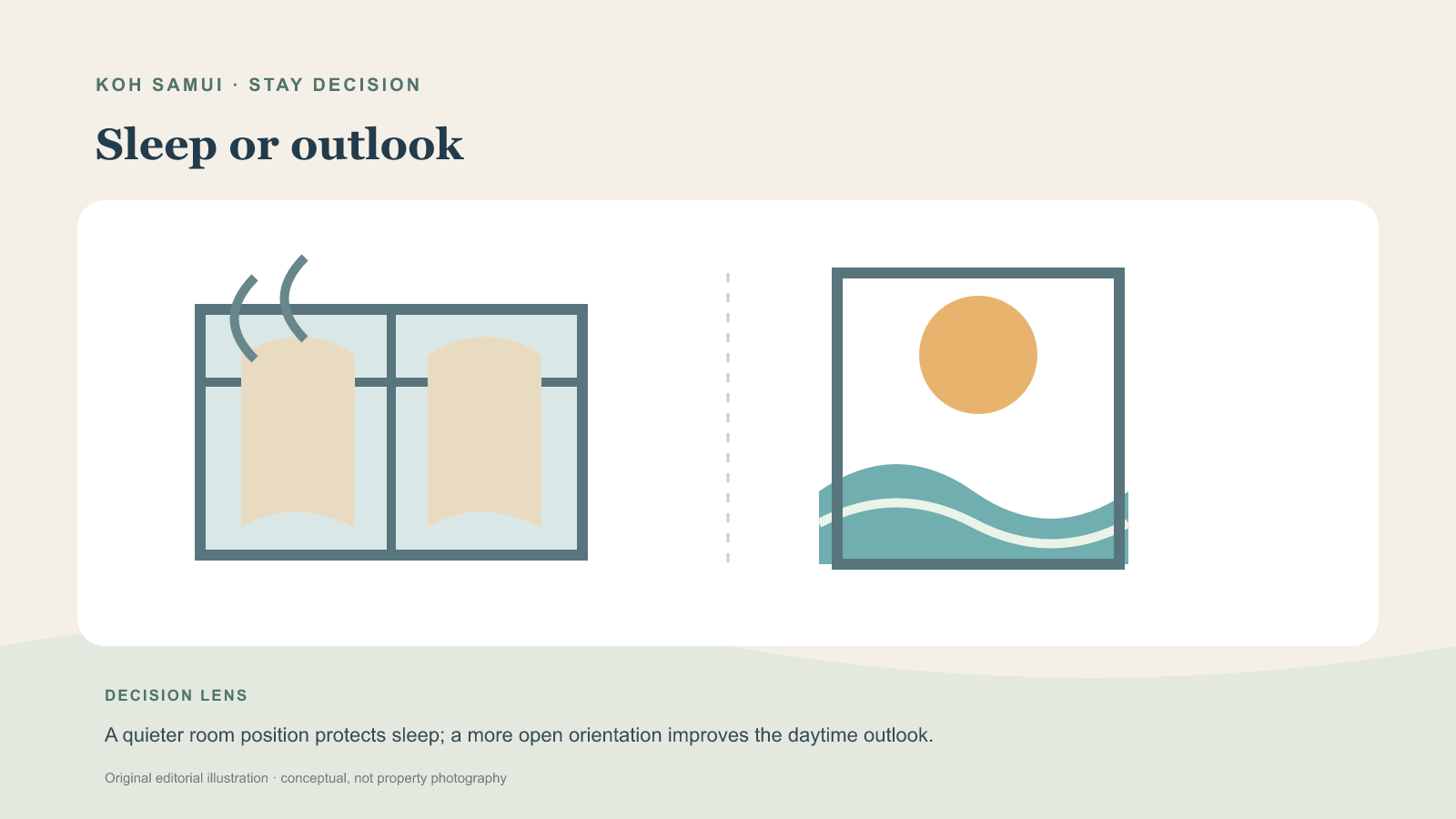
Use the sleep-tax test, not the prettiest room photo
Imagine the room with the curtains closed at 11:45 pm. If the view disappeared, would the room still be worth the upgrade? Now imagine two nights of fragmented sleep before a boat day, early flight or long beach day. Which loss would bother you more?
That is the useful comparison. A view is an amenity you consume when you are awake and in the room. A quiet position protects the hours when you cannot simply move somewhere else.
Rule: if you can already name two nights when poor sleep would materially hurt the next day, treat room position as a booking request rather than a nice-to-have note.
Stay planning
Find a place to stay
See available rooms around the property or neighborhood discussed here, with prices for your dates.
First decide how sensitive your trip is to sleep
You sleep through normal hotel activity, stay out late and rarely nap. Prioritise the room or view you will actually enjoy.
You notice doors, corridor chatter or music but recover easily. Request a quieter position without sacrificing a meaningful upgrade.
You wake easily and have early starts. A quieter placement deserves priority over a marginally better view.
Migraines, jet lag, pregnancy, recovery, children or work make sleep unusually important. Ask the hotel to describe the exact room surroundings before arrival.
Current Samui room inventories show what a room label can — and cannot — tell you
Anantara Bophut Koh Samui Resort currently separates room categories by outlook and floor: Premier Garden View is listed on the third floor, Deluxe Garden View on the second floor, while Deluxe Sea View is sold for its Gulf outlook. The official descriptions tell you where the view points and, in some cases, the floor. They do not promise a particular acoustic condition.
Holiday Inn Resort Samui Bophut Beach currently spreads more than 200 rooms and suites across nine low-rise buildings. Its official gallery distinguishes Ocean View, Pool Access, Playground View and other room contexts, while the resort itself is marketed as being in the heart of Fisherman’s Village, within easy walking distance of restaurants, cafés, shops and the Walking Street night market.
That distinction matters. “Sea view” describes what you see. “Pool access” describes access. “Playground view” describes orientation. None of those words is a certified noise measurement. A quieter-room request therefore needs to name the source you want distance from, not simply ask for “a quiet room”.
Map the four noise sources that matter before you request anything
Public-facing edge
Roads, walking streets, bars, restaurants and evening entertainment can make a wonderfully convenient base. If walk-out dining is the reason you chose Bophut, keep the location and ask whether a room can face inward rather than abandoning the area purely for silence.
Resort activity zone
Main pools, kids’ spaces, event lawns and busy breakfast routes are useful in the daytime. If you are choosing between convenience and separation, compare the dedicated main-pool vs quiet-wing room guide.
Internal hotel movement
Lifts, stair doors, housekeeping stores, service corridors and connecting doors can matter even in a resort far from nightlife. The near-lift vs corridor-end guide isolates that trade-off.
Your own room geometry
A dramatic open bathroom, connecting door or balcony near shared circulation may affect sleep more than the view category. Cross-check open-plan vs closed bathrooms if nighttime light and sound are the real issue.
A lively base can still be the right decision
Quiet is not automatically the highest-value hotel feature. In Bophut, Fisherman’s Village is currently promoted by both Tourism Authority of Thailand material and local hotel guides as a walkable area of restaurants, shops and evening-market activity. Holiday Inn Resort Samui Bophut Beach explicitly sells the ability to walk to that scene as part of the location benefit.
For a solo woman, that can be a meaningful trade. A room that is slightly less acoustically isolated but sits inside a hotel with an easy, well-used return route can feel more practical than a very quiet property that turns every dinner into a ride home. Decide the area first using Bophut vs Choeng Mon or Bangrak vs Bophut; then solve room position inside the base you actually want.
The same logic applies to food. If your evenings are built around leaving the resort, read resort dining vs nearby restaurants. If you expect very late returns, 24-hour room service vs late-night walk-out food may matter more than the view.
Calculate the “sleep tax” in three steps
- Count vulnerable nights. Early boat pickup, airport departure, diving day, work call, long drive or simply a day you care about feeling good.
- Count view-use windows. Will you actually sit on the balcony for breakfast, sunset or an afternoon break — or will you mostly see the view while walking past the window?
- Compare repeat value. If quiet protects five nights and the view gets used twice for twenty minutes, quiet wins. If you sleep deeply and spend two hours on the balcony every day, the view can be the better upgrade.
When I would prioritise the quiet-room request
You have two or more early starts
One 05:45 alarm is manageable. Multiple early pickups make cumulative sleep more important. Hotel location for tours still comes first — use the tour-pickup hotel location guide — but once the location works, request distance from the hotel’s busiest night-time or early-morning circulation.
You are staying five to seven nights
A view premium is easier to justify on a short romantic stay where the room itself is part of the experience. On a longer trip, repeated sleep quality usually compounds faster than novelty. If the trip is long enough that room routines matter, also compare whether one resort or a split stay better fits the week.
You are sharing with someone on a different schedule
The problem may not be external noise at all. A friend returning later, a partner waking earlier or someone taking calls can create more disturbance than the street. Solve bed configuration and internal layout first; a quiet wing cannot compensate for a room that does not fit how you share space.
You already know you are a light sleeper
This is not the trip to experiment with whether a pool-facing room will suddenly stop bothering you. Use your normal sleep pattern as evidence. Ask for distance from the specific source that usually wakes you: lifts, bar, pool, playground, event area, service corridor or connecting door.
When the best view deserves priority
The room is one of the main experiences
If the plan includes slow mornings, room-service breakfasts, afternoon rests and sunset drinks, the outlook is not decorative. You are buying hours of use. In that case, a sea-facing or elevated room can deliver more repeat value than an inward room you chose purely out of caution.
You sleep easily and return late anyway
A traveler who reliably sleeps through ordinary hotel sounds should not pay an invisible premium for silence she will not notice. Spend the preference on the balcony, floor, view or water access you will enjoy instead. The balcony vs terrace guide and ground-floor vs upper-floor guide separate those choices.
The “quiet” alternative damages the whole stay
Do not move to an inconvenient area, accept a room far from everything or give up the hotel you actually want just to chase theoretical silence. A specific room-position request is usually a better first move than changing the destination logic of the trip.
Eight common situations, one priority
| Situation | Priority | Why |
|---|---|---|
| Light sleeper + two early boat days | Quiet request | Sleep protects two high-effort mornings. |
| Four-night couple trip + balcony sunset ritual | Best view | The view has planned daily use. |
| Solo stay in Bophut + dinner out nightly | Location first, then quiet request | Easy evening return beats chasing an isolated room. |
| Family + pool/playground priority | Convenience first | Short daytime routes may matter more than theoretical silence. |
| Jet lag + work calls | Quiet request | Recovery and concentration repeat across the stay. |
| Deep sleeper + two-night resort escape | Best view | Short stay raises the value of the room experience. |
| Friends with different bedtimes | Internal layout first | Your roommate may be the main sound source, not the hotel. |
| View upgrade forces worse location | Better hotel/location | Never optimise one window at the expense of the whole trip. |
The booking-page mistake: turning a preference into a guarantee
A room category can guarantee features the hotel explicitly sells — for example, a specified sea view or room size — but softer requests are different. Even when a hotel accepts “quiet room”, “high floor” or “away from lift” preferences, the exact placement can depend on the room category and what is available when rooms are allocated.
That is why the useful request contains priority order. If a sea-view category matters more, say the sea-view category must be preserved and quiet position is secondary. If sleep matters more, say you would prefer the quietest available placement within the booked category even if the view is less central or the walk is slightly longer.
If you are deciding between garden view and sea view, separate view from position
Anantara Bophut is a useful current example because its official inventory clearly distinguishes Premier Garden View, Deluxe Garden View and Deluxe Sea View. That makes the view decision legible, but still does not tell you that one category will always be acoustically quieter than another. If that exact property is on your shortlist, the existing Anantara Bophut Deluxe Garden vs Deluxe Sea View guide handles the room-category trade-off; use this page only for the additional sleep-position request.
Final rule: choose the hotel for your waking hours, then request the room for your sleeping hours
If the hotel’s location, beach, pool, restaurants and logistics are wrong, a quiet room will not save the trip. Choose the right base first. Then decide whether your room preference should protect sleep or maximise the view.
For light sleepers, two vulnerable nights are enough to put quiet placement ahead of a marginal view upgrade. For easy sleepers who will genuinely use the balcony or outlook every day, take the view and make quietness a secondary request.
Keep the wider island decision connected through the Koh Samui destination hub.
Sources checked
Stay planning
Find a place to stay
See available rooms around the property or neighborhood discussed here, with prices for your dates.