
It is easy to overvalue an activity list when booking Koh Samui. “Morning yoga” sounds wholesome. Complimentary kayaks sound useful. Muay Thai, Pilates, cooking classes and a social hour can make a resort feel unusually complete. Then the trip starts: your marine-tour pickup is early, you sleep in after dinner, the sea is rough on the one free afternoon, and the class you liked runs on a day you are somewhere else.
The booking mistake is counting how many things the resort offers instead of whether those things fit the hours you actually control. This decision sits one level above our beach-first vs pool-first resort guide. That page asks which water you will repeatedly use. Here, the question is whether your hotel should actively structure the day for you at all.
The three-activity rule
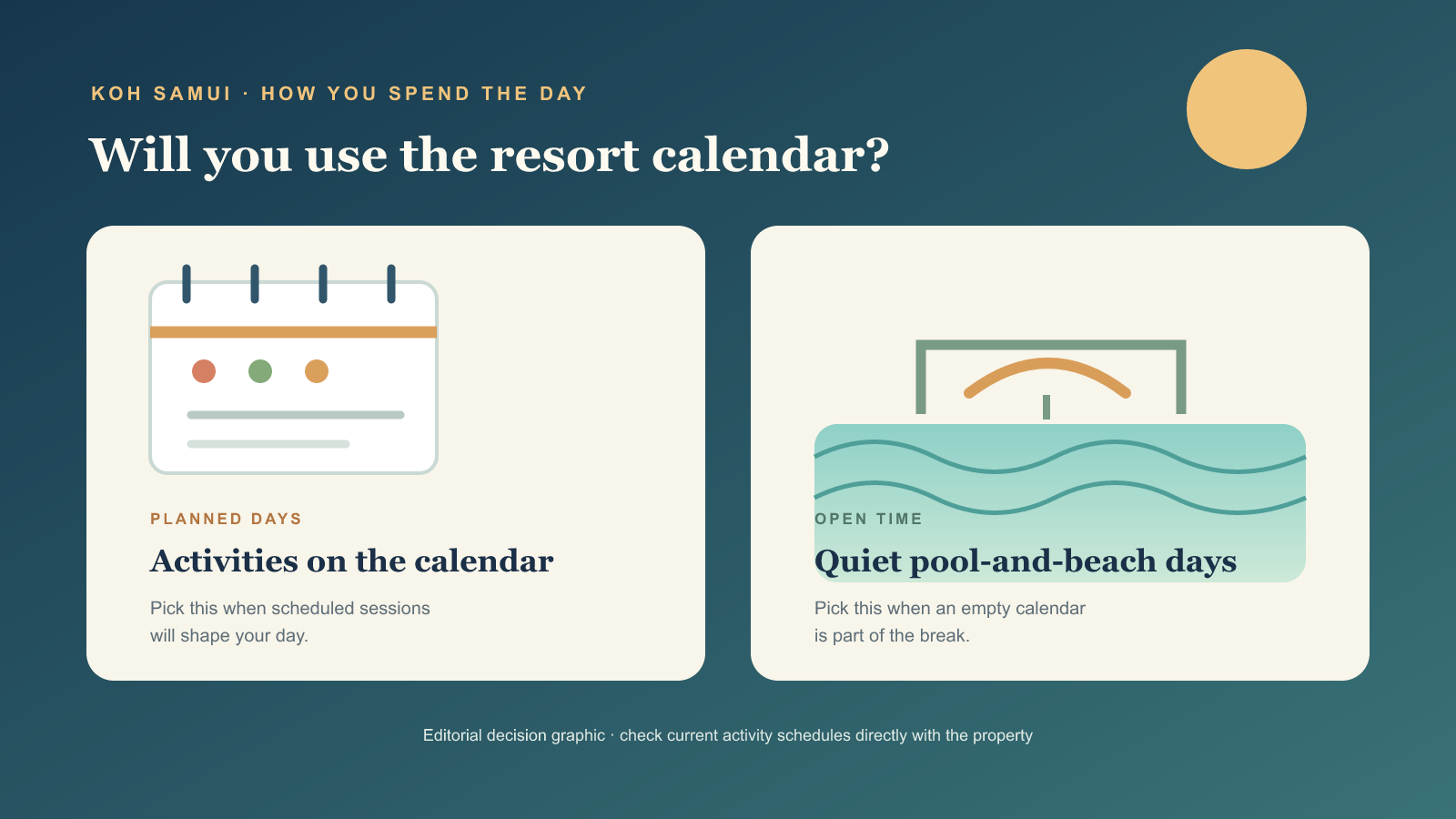
Before letting a resort activity programme influence the booking, write down the three specific things you would put into your own trip calendar today.
Choose the better quiet resort. You are buying optionality you probably will not use.
Tie-breaker only. Let room quality, beach, pool, dinner logistics and location decide first.
The programme can genuinely matter. Now verify days, times, booking rules, fees and weather dependence.
Stay planning
Find a place to stay
See available rooms around the property or neighborhood discussed here, with prices for your dates.
“Activity-rich” can mean four very different things
Do not compare resorts by a single activities icon. The useful distinction is how much commitment each activity asks from you.
Equipment you can use now
Kayaks, paddleboards, a gym or a games room are flexible. They create value when you can decide at 3:20 p.m. rather than reserve at 9 a.m.
Classes with a clock
Yoga, Pilates, aqua aerobics or a group Muay Thai class can be excellent, but only when the published time survives contact with breakfast, tours and sleep.
Activities needing a slot
Private training, cooking classes, wellness sessions and guided activities may need advance booking, minimum numbers or a cancellation window.
Excursions sold by the resort
Boat trips, diving and island tours are not really “hotel activities” in the same sense. Judge them against independent or organised alternatives rather than treating them as a reason to choose the room.
Current first-party resort menus prove why the timetable matters
Current official Koh Samui resort pages show that the word “activities” can cover completely different levels of commitment. Four Seasons currently lists complimentary kayaking, paddleboarding and snorkelling equipment alongside morning yoga and Pilates, Muay Thai facilities, beach sports, cooking classes and separately arranged excursions. Vana Belle's current Marriott experience information describes a weekly schedule including yoga, meditation, Pilates, Thai kickboxing and aqua aerobics, while also providing a 24-hour fitness centre. Six Senses Samui currently lists experiences ranging from Thai cooking and Muay Thai to island hopping and diving, with dedicated yoga and meditation facilities in its wellness offering.
Those examples are evidence about programme design, not hotel recommendations. None of those properties is selected or ranked in this guide. The useful lesson is that a gym works on your clock, a group class works on the resort's clock, and an excursion can occupy most of a day. A long activities page therefore tells you almost nothing until you separate those three things.
Official activity menus can also change. A class visible when you research may move days, require advance reservation, carry a fee or disappear during your stay. Treat any timetable as something to re-check with the hotel, not a permanent amenity like a bed or bathroom.
The hidden cost is the calendar tax
A scheduled class can take more than its listed 45 or 60 minutes once you allow for a “do we still have time?” buffer before the class, a shower-and-change block afterwards, and a decision not to wander farther from the hotel because you need to be back.
That tax is worth paying when the activity is something you genuinely want. It is irritating when you joined only because it was included.
Put your real Samui week beside the resort timetable
If you are leaving early for a marine trip, a morning yoga class has almost no value that day. This is why tour-pickup logistics matter more than a long activity list on excursion-heavy trips.
This is where an activity-rich property can earn its keep. You can paddle before lunch, do nothing for two hours, then join a class without arranging another transfer.
Outdoor programming is not automatically a rainy-day plan. A cooking class, covered wellness session or spa is more resilient than a beach activity. Compare the actual backups with our rainy-day cooking class vs spa guide.
If you want dinner and an independent evening away from the resort, a late-afternoon class can compress the exact hours you wanted free. The programme is not adding value to that day.
A quiet resort is not “a resort with nothing to do”
For this decision, “quiet low-programming resort” means a property where the stay works even if nobody tells you what happens at 8:00, 10:30 or 16:00. The beach, pool, room, spa, restaurant and setting are enough. You can wake up and decide.
That freedom is especially valuable when your holiday already contains structured experiences. If you have a cooking class, a boat tour, a spa appointment and a dinner reservation elsewhere, adding hotel programming may simply turn the rest of the week into more appointments.
If your ideal Samui afternoon is pool → shower → nap → beach → “shall we get dinner?”, look first at how the resort's pool system works, whether getting around the property needs a buggy, and how much dinner choice exists on and off property. Those repeated frictions can matter every day. A class you attend once cannot compensate for them.
For solo travelers, programming can be more valuable than the activity itself
A group yoga class, social hour, cooking session or guided resort activity can give a solo traveler a low-pressure reason to be around other people without manufacturing a social plan. That can be genuinely useful—especially in an isolated resort where you might otherwise spend every meal and evening alone.
But do not confuse “social opportunity” with “I must join things.” If you chose Samui specifically because you want to read, swim and be left alone, a full calendar may create the opposite feeling: subtle pressure to optimise your holiday.
Run the night-route test too. A social activity is less valuable if the room is far from the lobby or shared spaces and you dislike walking dark, quiet resort paths alone. In that case, practical room position can outweigh the programme.
Couples and friends should measure coordination, not variety
Two people rarely want every activity equally. One wants sunrise yoga; the other wants to sleep. One wants Muay Thai; the other wants an hour at the pool. An activity-rich resort works beautifully when it increases independent choice: each person can do one thing, then meet again without leaving the property. It works badly when the calendar becomes a negotiation before every meal.
For friends, flexible drop-in facilities can be more useful than formal programming. A kayak you can borrow when both of you feel like it creates less coordination than a class that needs two people ready at 08:30.
The 10-minute sign-up test
Open the current resort activity page and imagine you have already checked in. Give yourself ten minutes. Which activities would you actually reserve?
If you immediately pick three—with dates that fit your stay—the programme is doing real work in your decision. If you keep thinking “maybe,” “if we're awake,” “if the weather is good,” or “it depends what else we do,” stop counting the activity calendar as an upgrade.
Then compare the time you intend to spend elsewhere. If you are already planning a massage or spa day and an independent beach or beach-club day, the quieter hotel with the stronger basic location may be the smarter base.
| Your actual trip pattern | Better default | Why |
|---|---|---|
| 4 nights, 2 full-day tours | Quiet / low-programming | Your usable resort calendar is already small. Protect sleep, pool and unplanned time. |
| 5 nights, 2 deliberate resort days | Activity-rich can win | There is enough on-property time to use multiple facilities without squeezing the itinerary. |
| Solo, wants gentle social contact | Activity-rich | Classes or social programming can provide low-pressure structure and shared moments. |
| Solo, wants complete decompression | Quiet / low-programming | The absence of a timetable is part of the product. |
| Couple with different hobbies | Activity-rich if flexible | It works when each person can peel off and rejoin easily; less so if everything needs advance booking. |
| Friends who plan late | Drop-in facilities over classes | Kayaks, gym and pool time survive spontaneous changes better than fixed sessions. |
| Rain-sensitive trip | Judge indoor backup | Count indoor and covered resort activities alongside beach programming. |
| Resort is intentionally the destination | Activity-rich | A strong programme can turn “stay at the hotel” into several genuinely different days. |
Do not let an activity calendar rescue the wrong hotel
The hierarchy still matters. First get the beach or area right. Then check the room, sleep setup, bathroom privacy, resort movement and the daily route you will repeat. Then decide whether programming improves the stay.
That is particularly important if you are deciding between one self-contained resort and multiple bases. The one-resort vs split-stay guide asks whether the second hotel creates a genuinely different phase of the trip. A rich activity programme can help justify staying put—but only if you use it.
If you will spend half the trip outside the resort with a private driver or taxis, the “50 things to do without leaving” sales pitch should move down your list.
Seven things to verify before booking for the activities
- The current weekly schedule for your exact stay dates. A generic experiences page is not the same as a live calendar.
- Which activities are complimentary and which cost extra. Do not assume “available” means included.
- Whether advance booking is required. Ask how far ahead and whether minimum participant numbers apply.
- Cancellation rules. Paid private classes and wellness sessions may have their own notice periods.
- Weather rules and backup plans. Kayaking, paddleboarding and beach activities can be condition-dependent.
- Where each activity actually happens. On a spread-out resort, “on property” may still mean a long walk or buggy ride from your room.
- Whether the programme is adults-only, family-oriented or mixed. The same activity list can create a very different atmosphere depending on who it is designed for.
The final rule: book the schedule only if you are willing to schedule it
If three activities are already specific enough that you can imagine putting them in your phone calendar, an activity-rich Koh Samui resort can be worth prioritising. It can reduce transport, give a resort day shape, make solo travel feel easier, and turn “we stayed at the hotel” into a day that still feels varied.
If not, choose the resort that wins when nothing is happening: the room you want to return to, the pool you will actually use, the beach that fits your swim habits, and an evening setup that does not make you work for dinner.
The best resort programme is not the longest one. It is the one that survives your real itinerary.
Continue with the Koh Samui decision hub if you are still choosing the broader base.
Sources checked
Stay planning
Find a place to stay
See available rooms around the property or neighborhood discussed here, with prices for your dates.