
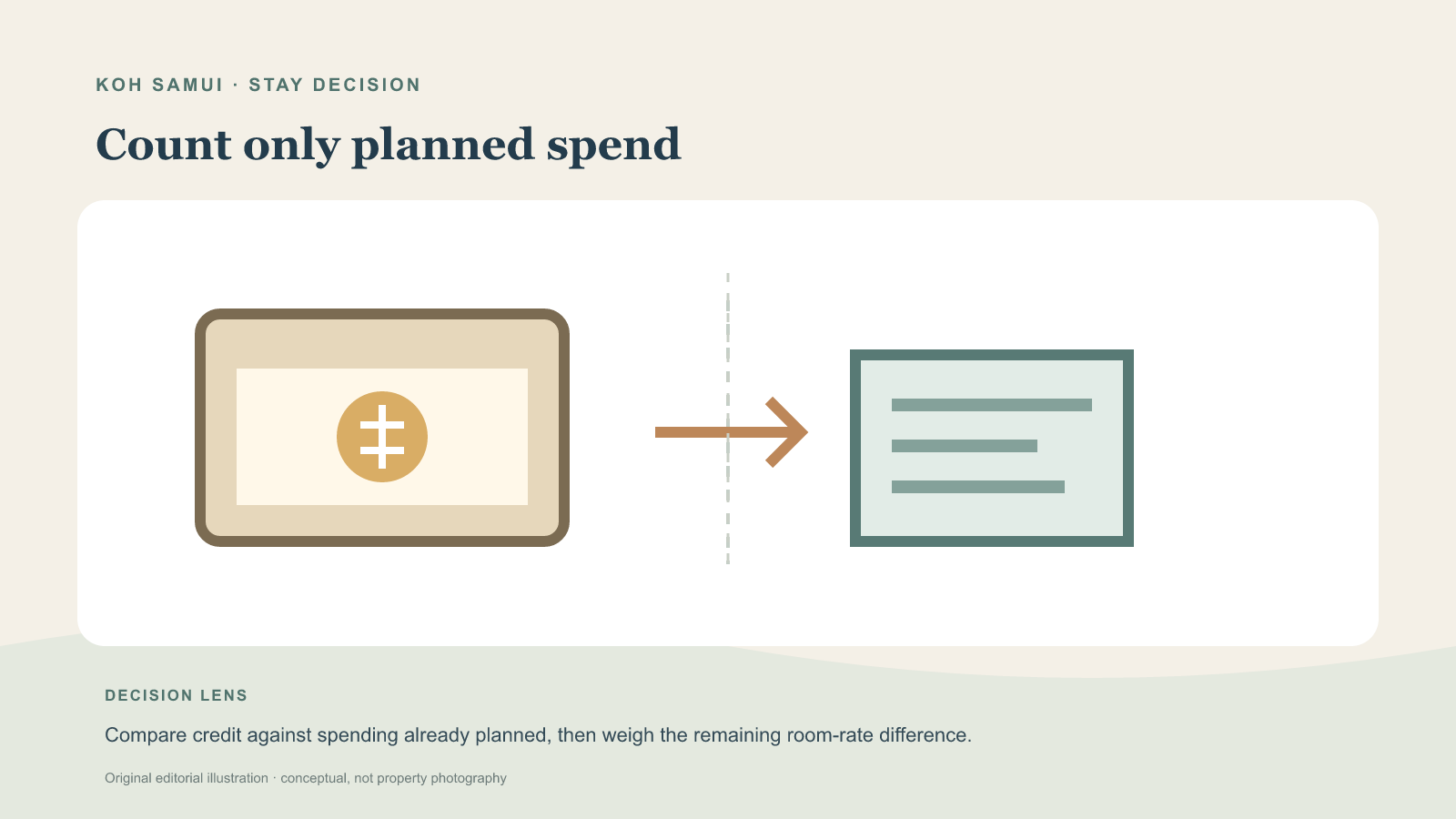
The natural-spend test matters more than the credit amount
A THB 5,000 resort credit is not automatically worth THB 5,000 to you. Its real value is the amount of eligible spending you would have made at that resort anyway. If your plan already includes one hotel dinner and one spa treatment, a credit can be close to cash-like. If you wanted to eat in Fisherman's Village every night and use a standalone spa, the same credit may be little more than a reason to change your holiday.
Before comparing rates, write down two or three exact on-property purchases you expect to make without looking at the package. If the credit naturally covers them, keep calculating. If the list stays blank, choose the simpler rate unless the package has other inclusions you independently value.
Stay planning
Find a place to stay
See available rooms around the property or neighborhood discussed here, with prices for your dates.
“Resort credit” can mean three different things
Credit bundled into the rate
You pay for a package or longer stay and receive a fixed amount usable at selected restaurants, bars or spa services. The key question is the package premium versus what you would naturally spend.
Credit earned after spending
Some promotions only issue credit after you hit a qualifying on-property spend. That is not the same as receiving a prepaid wallet on arrival.
Credit buried inside a larger bundle
Airport transfers, breakfast, dinner, laundry, spa treatments and late checkout may sit beside the credit. You have to value every component separately instead of attributing the whole rate difference to the credit.
Current Samui offers show why the label is not enough
Centara Reserve Samui currently sells several different package structures. Its Reserve Journey is built around a five-night stay with breakfast, resort credit and transfer benefits that vary by room type; the current terms say the credit can be used at Reserve Spa Cenvaree and resort food-and-beverage outlets but excludes in-room dining. Its Suite Reserve Experience currently combines a five-night suite stay with airport transfers, resort credit, a spa treatment, daily laundry and additional discounts. The Villa Reserve Experience adds half-board dining once per stay and a larger fixed credit alongside other inclusions. In other words, the credit is only one line in the package.
W Koh Samui currently illustrates two other mechanics. “Stay, Spend, Savor” awards THB 1,000 of resort credit for each THB 3,500 of qualifying spend, up to THB 2,000 per stay, with breakfast included. That credit is earned by spending; it is not a fixed wallet you receive simply for booking. W's current “Stay Longer, Why Not?” offer instead attaches different credit amounts to room categories and specifically limits the culinary credit to non-alcoholic spending and spa redemption to body treatments rather than facials. Its Romantic Escape goes further, combining resort credit with daily dinner, airport transfers and activities.
For a cleaner comparison, a straightforward rate can look more like Anantara Bophut's current Best Flexible Offer: accommodation plus daily breakfast, without a separate resort-credit bucket. That does not make it cheaper for every date. It simply makes the value equation easier to read.
Build a credit ledger before you book
- Match the same room and dates. A credit package attached to a higher room tier is not a like-for-like price comparison.
- Match the cancellation and payment terms. A credit does not compensate for a restriction you would not otherwise accept. Use our flexible vs non-refundable rate guide for that separate decision.
- List the eligible outlets and exclusions. In-room dining, alcohol, specific spa treatments or certain promotions may not qualify.
- Estimate natural spend only. Count dinner you already wanted, not dinner you add because money is trapped in the hotel.
- Value every other inclusion separately. Breakfast, transfer, laundry, spa and meal-plan benefits should each earn their own value.
- Compare the total premium with realistic value used. If the package costs more than the inclusions you would naturally consume, the “free credit” is not saving you money.
A four-night example: when the credit quietly changes your trip
That middle night is the trap. Resort credit can create a subtle sunk-cost feeling: “we should eat here because we still have credit.” If the hotel is intentionally the centre of your trip, that is fine. If your evenings were supposed to explore Samui, the credit can compete with the reason you chose the location in the first place. Our resort dining vs nearby restaurants guide is the better decision if dinner freedom matters more than the package arithmetic.
When resort credit is genuinely useful
The strongest case is a resort-heavy stay where on-property spending is already part of the plan. A couple staying mostly on the beach and pool, booking one spa treatment, and eating several dinners at the resort may consume credit without thinking about it. In that case the package can lower spending you would otherwise make anyway.
Credit can also work well when it sits inside a bundle whose other inclusions independently fit. If you already wanted the airport transfer, breakfast and spa treatment, you are not forcing value. Compare transfer economics separately in our airport transfer included vs lower room rate guide, and compare treatment commitment in spa package vs single treatment.
For a deliberately self-contained trip, also check whether your hotel choice itself supports that rhythm. Beach-first vs pool-first resort and activity-rich vs quiet resort matter more over several days than a one-time credit line.
When the straight room rate is the better buy
Choose simplicity when the island — not the resort — is the main event. If you expect boat days, restaurant nights, beach clubs, independent spas and lots of time away, your eligible hotel spending is naturally low. A smaller credit can still be useful, but it should not justify a materially higher rate or longer minimum stay.
This is especially true on a split stay. Credit tied to a five-night minimum can be the wrong shape if you actually want two bases. Use one resort vs split stay before allowing a long-stay package to design the whole trip for you.
It also matters for friends. Two friends may value separate beds, bathroom privacy and easy evening access more than a spa credit neither particularly wants. If your stay behaves more like an apartment week, resort vs residence-style suite may be the more useful comparison.
Do not confuse resort credit with a meal plan
Credit gives you a spending bucket subject to rules. Half board gives you a defined meal entitlement. They can overlap, but they solve different problems. If your real question is whether committing dinner to the hotel makes sense, read whether Koh Samui half board is worth it. A package that contains both credit and a meal inclusion should be valued line by line so you do not count the same dinner twice.
Which rate shape fits you?
| Your actual stay | Lean toward | Why |
|---|---|---|
| Four nights, two boat days, dinner out most evenings | Straight room rate | Too little natural resort spend for credit to drive the decision. |
| Five resort-heavy nights, planned spa + two hotel dinners | Credit package | The credit replaces spending already on your calendar. |
| Package requires a higher room category you did not want | Straight room rate | Do not spend hundreds to unlock a smaller credit. |
| You want alcohol at dinner but the culinary credit excludes it | Recalculate | Eligible spend may be much lower than the headline amount. |
| You planned a facial but spa credit covers body treatments only | Straight rate or different offer | The credit does not replace the treatment you actually want. |
| Couple celebrating, already wants dinner, spa and transfer | Bundle can work | Multiple inclusions may naturally substitute planned purchases. |
| You are choosing the resort mainly because the credit looks large | Stop and re-rank hotels | Room, location and stay rhythm matter every day. |
| Seven nights with lots of hotel time but uncertain spa plans | Value dining only | Assign zero or low value to inclusions you are not confident you will use. |
Eight questions to ask before paying more for resort credit
- What is the exact package premium for the same room, dates and guest count?
- Is the credit fixed at check-in, or earned only after qualifying spend?
- Which restaurants, bars and spa services are eligible?
- Are in-room dining, alcohol, facials or other categories excluded?
- Does unused credit expire at checkout, and can it be carried between days?
- Is the offer tied to a minimum stay or higher room category?
- Are taxes, service charge or gratuities covered by the credit, or charged separately?
- Which included benefits would you genuinely buy if the package did not exist?
The hotel still comes first
A resort-credit package should be a tie-breaker after the property already fits your trip. It should not rescue a hotel that is wrong for your location, room needs or daily rhythm. If the resort is sprawling enough that every meal or spa visit involves internal transport, read buggy-supported vs walkable resort. If your priority is how you spend the final morning, late checkout vs an extra night is a separate calculation.
And keep payment cash flow separate from value. Prepayment, incidental holds and deposits can exist even when a package looks generous. Our hotel deposit vs pay-at-checkout guide handles that side of the booking.
Final rule: credit only counts when it replaces planned spend
Imagine the resort credit disappears from the offer page. What would you still book at the hotel? Count those purchases. Everything else gets a heavy discount — or a value of zero.
That keeps the decision clean: choose the package when the credit naturally erases spending you were already going to make; choose the straight room rate when the credit needs you to redesign your holiday in order to feel valuable.
Continue with the Koh Samui destination guide if you are still choosing how much of the trip should happen inside the resort versus around the island.
Sources checked
Offer structures, eligible outlets, minimum stays and redemption rules can change. Re-check the exact rate terms for your dates before paying.
Stay planning
Find a place to stay
See available rooms around the property or neighborhood discussed here, with prices for your dates.