
The two-fixed-pool-block rule
Before comparing daybeds, mark the afternoons when pool time is part of your schedule. If you already have two blocks of roughly two hours or more when you want to settle beside the pool at a predictable time, seating certainty can be worth choosing for. If you are happy to swim before breakfast, wander down whenever a chair is free or move between pool, beach and room, first-come seating is rarely a deal-breaker.
This is narrower than choosing a shadier pool over a prettier infinity view. Shade asks whether the seat will be comfortable. This guide asks whether you can count on having the kind of seat you want at all.
Stay planning
Find a place to stay
See available rooms around the property or neighborhood discussed here, with prices for your dates.
“There are daybeds” tells you almost nothing
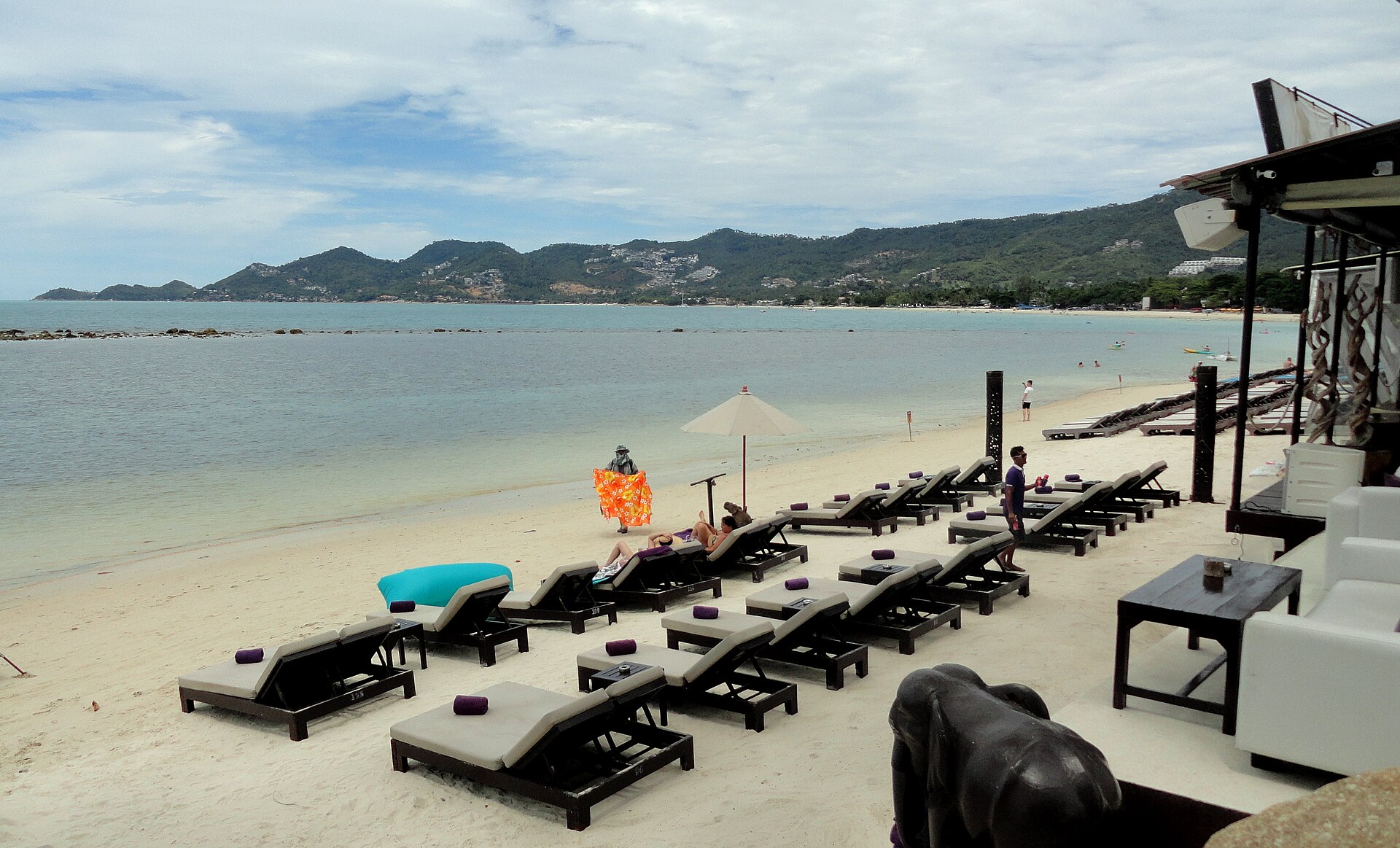
Hotel photography collapses several different systems into one attractive image. A large padded platform can be a complimentary lounger, a paid rental, a restaurant seat, a villa-only feature or an unreservable first-come sunbed. Until you know the access rule, the photograph is decoration rather than booking information.
That distinction matters more than the number of loungers. A smaller pool with a clear anti-reservation policy can feel less stressful than a huge pool where guests informally hold the best seats all morning.
What current Samui properties actually publish
Anantara Bophut Koh Samui Resort currently publishes a one-page Sunbed Policy for its pool area. It says sunbeds are not reserved, are available on a first-come, first-served basis, and that items left unattended for more than 30 minutes or before breakfast will be removed. That is unusually useful because it explains that seating is first-come and how the hotel handles seat-holding.
W Koh Samui currently describes daybeds at WET, its main pool. Its W Beach information separately lists day-beds and sun-beds around SIP among items or services available for rent, with fees and charges potentially applying. The public page does not publish a universal advance-reservation rule or current daybed price, so those details need direct confirmation before you build a hotel decision around them.
Sheraton Samui Resort currently describes daybed areas around its beachfront pool. Its public overview confirms the physical setup, but it does not state a current reservation or seat-holding policy. That is exactly why “daybed area” should never be read as “guaranteed daybed.”
Operating details checked 13 August 2026. The examples show how reservation rules differ. Check whether your hotel assigns daybeds or leaves them first-come before planning a pool day.
The real cost is not the daybed fee. It is seat uncertainty
A paid or reservable daybed can sound indulgent, but the useful way to value it is as uncertainty removal. If you are travelling as a couple or with friends and the whole point of the day is to settle in one shaded place, read, order lunch and stay until late afternoon, spending 40 minutes hunting for adjacent seats is a real cost even if no money changes hands.
But if you only want a 25-minute swim, uncertainty is cheap. You can leave your things on one available chair, swim, shower and move on. In that pattern, choosing a more expensive hotel because it appears to have premium pool seating would be poor optimisation.
If you are still deciding whether a pool-heavy hotel is right at all, compare beach-first vs pool-first resort. If several pool zones are competing for your attention, use one pool vs multiple pool zones first.
Replay four arrival times
Early swim
You arrive before breakfast, swim for 30 minutes and leave. First-come seating is almost always fine because your seat is storage, not your living room.
After a slow breakfast
This is where policy starts to matter. You are not first at the pool, but you still want two adjacent loungers, preferably with shade, for a long block.
Midday return
You come back from lunch or a short outing. A system that actively releases long-unattended seats can be more useful than one with prettier but informally “claimed” loungers.
Late-afternoon dip
Seat certainty matters less again. People begin moving toward rooms, showers and dinner, and your pool block is naturally shorter.
Choose the system that matches how fixed your day is
First-come is enough when…
- Your pool hours are flexible rather than scheduled.
- You are happy to arrive early or late instead of at peak midday.
- You mainly swim rather than sit for several hours.
- You can split between pool, beach, room terrace and restaurant.
- You do not need four adjacent seats for a group.
In this pattern, flexibility is an asset. You do not need to buy certainty you will barely use.
Seating certainty matters when…
- You have two or more long, fixed pool afternoons.
- You need adjacent seats for friends, children or a couple who will stay together.
- Shade is a hard requirement rather than a preference.
- One person plans to work, read or stay poolside while the other swims.
- A fixed pool setup is one of the main reasons you chose the resort.
Here the daybed is not a luxury prop. It is infrastructure for the day you already planned.
Room position can reduce the problem. A room close to the water lets you move between bed, bathroom and pool without treating one lounger as your only base; compare room near the main pool vs a quiet wing. If the resort itself is spread out, buggy-supported vs walkable resort may matter more than the seating policy.
Do not confuse an anti-reservation policy with poor service
“Sunbeds are not reserved” can sound less luxurious than “reserve your daybed,” but it can actually be a strong fairness signal when the hotel also has a clear rule for unattended belongings. A managed first-come system prevents one guest from informally turning a chair into all-day private property before breakfast.
The opposite mistake is assuming a paid seat is automatically better. Ask what you are actually buying. Is the daybed shaded? How many people does it fit? Is the fee a pure rental or a minimum food-and-beverage spend? Is it beside the pool you want, or at a beach bar? Can weather change the setup? Does the booking guarantee the exact location or only a seating category?
Do not transfer beach-club logic onto hotel pools. If you are deciding whether to leave the resort specifically for a social or dining atmosphere, that is a different decision: use beach club vs independent beach day.
For two friends, adjacent seats can matter more than a premium chair
Friends often want the pool to function as an easy regrouping point. One person swims, the other reads; one orders lunch, the other disappears to shower; both want bags and phones in one place. Two ordinary loungers side by side can be more practical than one impressive daybed that forces awkward sharing.
This is also where a “daybed for two” needs literal dimensions and access rules rather than romantic wording. If your room already gives you plenty of separate daytime space, a shared pool base matters less. If the room is small, the pool may be doing some of the work of a second living area.
When private daytime space is the real spend decision, compare private-pool villa vs beachfront room. A private pool or generous terrace can remove shared-lounger uncertainty altogether, but only if you will actually use it.
Eight trip patterns
| Trip pattern | Better default | Why |
|---|---|---|
| Two long resort afternoons, fixed timing | Seek seating certainty | Your day depends on being able to settle rather than improvise. |
| Excursion-heavy trip | First-come is fine | Your pool windows are short and movable. |
| Four friends who want to sit together | Verify the seating system | Adjacent availability matters more than individual lounger quality. |
| Solo traveler who swims, then leaves | First-come is fine | You need one temporary base; first-come loungers do not reserve a seat. |
| One swimmer + one poolside reader | Shade and seat certainty matter | The non-swimmer may occupy the seat for several hours. |
| Private-pool villa stay | Shared seating matters less | You already have a private water-and-lounger base. |
| Beach-first holiday | Do not overvalue pool seating | Your long stationary blocks may happen on sand instead. |
| Resort-heavy stay with lunch by the pool | Ask the policy before booking | The pool zone is part of your daily living and dining rhythm. |
Nine questions that are better than “Does the hotel have daybeds?”
- Are the main-pool loungers first-come, reservable or allocated by staff?
- Does the hotel remove belongings from unattended loungers after a stated period?
- Are any daybeds or sunbeds paid rentals, and if so, does paying guarantee a specific seat or only access to a seating category?
- Is there a minimum food-and-beverage spend, separate rental fee or other condition?
- Which pool or beach zone are the rentable or reservable seats actually beside?
- Are the shaded seats fixed, movable or limited to a small part of the pool?
- Can two or four people be guaranteed adjacent seating if that matters to your group?
- Do pool-seat rules change for hotel guests versus outside visitors?
- What happens if heavy rain, wind or maintenance makes the booked seating unusable?
The hotel with the clearest answers is often easier to use than the hotel with the longest amenity list. This is the same principle behind choosing covered vs open-air resort paths: operational details matter only when they affect journeys you repeat.
Put pool seating in the right place in the hotel hierarchy
I would still choose area, sleep, room layout, transport friction and the overall pool/beach fit before daybed policy for most Samui trips. A guaranteed lounger cannot rescue a hotel that is in the wrong area, has a room you dislike or makes every dinner and pickup inconvenient.
If you expect to spend most evenings inside the property, resort dining vs nearby restaurants may matter more. If your days depend on scheduled classes and activities, compare activity-rich vs quiet resort. And if you are splitting the trip between two very different hotel styles, read one resort vs split stay before optimising a single pool afternoon.
The final rule
If two fixed pool afternoons would feel spoiled by uncertain seating, verify the seating policy before you book. Otherwise, choose the better hotel and keep your pool time flexible. First-come is not automatically inferior, and a daybed is not automatically guaranteed, free or worth paying for.
For the wider hotel decision graph, continue with Koh Samui or go back one step to pool shade vs infinity view.
Sources checked
Stay planning
Find a place to stay
See available rooms around the property or neighborhood discussed here, with prices for your dates.