
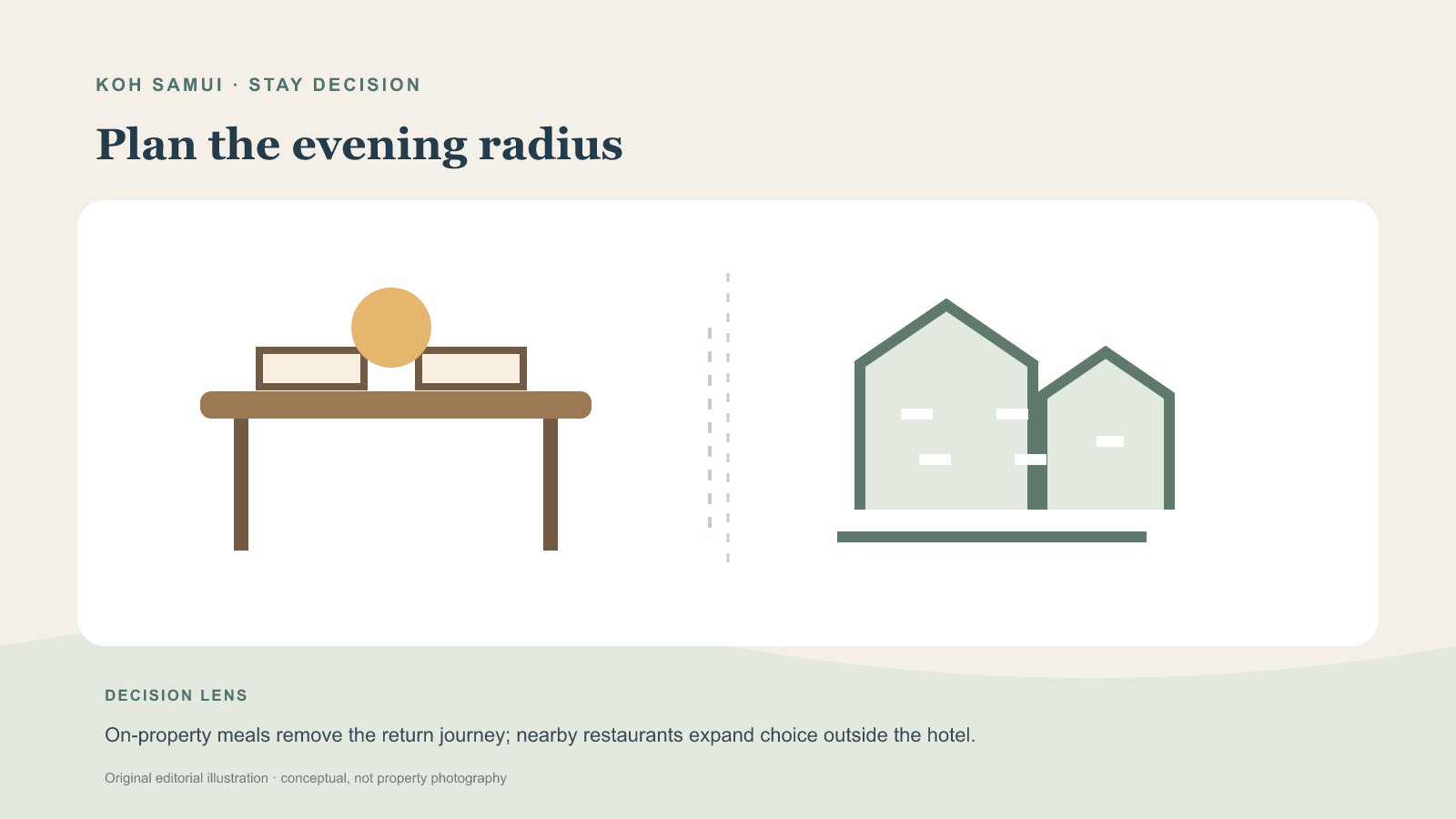
The decision is your evening radius, not the restaurant count
A resort can have excellent food and still be the wrong base if you keep wishing you could walk out after dinner. A hotel can sit beside dozens of restaurants and still be the wrong choice if your ideal evening is shower, sunset, dinner downstairs and bed.
Start with the radius you want after dark. Zero transport favors a self-contained resort. A short, comfortable walk favors a restaurant-rich base. A taxi every night is only a good compromise if you actually enjoy planning that ride.
This is different from asking whether Koh Samui half board is worth it. Half board is a rate-plan decision: how many meals should you prepay? This page comes one step earlier. It asks whether you should choose the hotel itself around on-property dining or around easy access to independent restaurants.
Stay planning
Find a place to stay
See available rooms around the property or neighborhood discussed here, with prices for your dates.
Map four evenings before you look at a hotel restaurant page
Arrival dinner
After luggage, check-in and a shower, the easiest meal often wins. A reliable on-site restaurant has unusually high value tonight.
Curiosity dinner
This is the night you are most likely to want a local restaurant, a walking street or a place that was not part of the booking decision.
Long-day dinner
After a boat or island day, you may want dinner without another transfer. That makes resort dining useful even if you normally like going out.
Last-evening choice
Some travelers want a final resort sunset; others want one more night out. Your answer is a better hotel filter than a raw restaurant count.
If you can already see yourself going out on two or three of those nights, a restaurant-rich location deserves real weight. If three nights naturally end at the hotel, on-property dining becomes part of the room decision rather than a backup plan.
Use a three-level evening radius
You want to finish the day inside the resort: pool, shower, sunset, dinner, room. This is coherent when the resort itself is the experience.
Best for resort-first staysYou want the freedom to leave without arranging a car. The exact pedestrian route matters more than the area label, especially after dark or in rain.
Best for flexible eveningsYou are happy to organize a taxi or driver for dinner. This can unlock more isolated resorts, but every spontaneous dessert, bar or late change now has a transport step.
Best when the hotel earns itThat last category is where the broader buggy-supported resort vs walkable resort decision becomes relevant. Internal movement and off-property movement are different problems, but they stack. A resort can be beautiful enough to justify both; just do not discover both frictions after check-in.
Current first-party pages show three genuinely different dining models
Translate hotel dining into an operating model
- InterContinental Koh Samui Resort currently lists two on-site restaurants, Amber and Flames, plus Air Bar, a pool bar and 24-hour in-room/villa dining. Its main hotel page describes a 22-acre west-coast resort. That is a clear example of a property designed to make staying in for meals workable.
- Kimpton Kitalay Samui currently lists five restaurants and bars—FishHouse, SHIO, Boho, SHADES and HOM—and publishes 24-hour in-room dining. The useful point is not that “five is better.” It is that several different food moods can exist without leaving the property.
- Anantara Bophut Koh Samui Resort currently promotes multiple on-site dining options while also stating that Fisherman’s Village is a short stroll away. Its leisure page says many family-friendly restaurants line the boardwalk there. This is the hybrid model: resort dining when you want it, independent restaurants without turning every dinner into a transport project.
- Conrad Koh Samui currently publishes distinct dining venues for different times and moods—JAHN for dinner, Azure by the pool, KO Lounge, Seakret Bar, destination dining and in-villa dining. Again, the editorial lesson is that a resort can intentionally supply enough internal variety to support a stay-in rhythm.
These properties are evidence, not a ranking or booking shortlist. Restaurant line-ups and hours can change. Check the exact hotel dining page for your dates, and check the real route to any outside dining you consider essential.
Tourism Authority of Thailand describes Bophut’s Fisherman’s Village walking street as an old fishing community now filled with seaside restaurants in both Western and Eastern styles. That is why “near restaurants” can be a real location feature in Samui rather than a vague OTA label. But it still needs a route check: “Bophut” on a listing is not the same as being able to stroll comfortably to the village.
Three hunger moments tell you more than a cuisine list
You are hungry in swimwear
Poolside or beach-side food has high value because changing, leaving and returning would break the day. If this is how you spend afternoons, on-property lunch coverage matters more than having a fashionable dinner restaurant.
That also connects to the one pool vs multiple pool zones decision: the best resort setup is often the one that keeps the water, shade and food in one easy orbit.
You are dressed and want options
This is the strongest case for a walk-out base. You can scan a few menus, change your mind and extend dinner into a drink or dessert without immediately thinking about the ride home.
If this sounds like the holiday, compare Bophut vs Choeng Mon or Chaweng vs Bophut before comparing room categories.
You are tired and done
This is where resort dining and room service stop looking boring and start looking intelligent. After a long excursion, avoiding one more pickup can be worth more than another restaurant choice.
For active trips, use the tour-pickup hotel location guide too; morning and evening transport friction can push the same hotel decision in opposite directions.
For women traveling solo, judge the return route rather than the restaurant itself
Solo dinner can be easy in both models. A resort restaurant removes the return journey. A genuinely walkable area gives you independent choice without needing to wait for a car after every meal.
The detail to inspect is the final route: lighting, traffic, steepness, road shoulder, rain cover and whether the hotel entrance sits directly on the active street or at the end of a quieter access road. Do not turn that into fear-based planning; just verify the exact route you would actually use at 9 or 10 pm. If you would prefer a car, the private driver vs taxis guide explains when pre-planning transport is worth the loss of spontaneity.
Friends usually need dining optionality more than couples do
Two friends can disagree about dinner without it becoming a trip problem if the hotel sits near several options. One wants seafood, one wants something casual, both are hungry now: a restaurant-rich base lowers the negotiation cost.
A resort-first group can prefer the opposite. If the plan is pool, spa, drinks and a long dinner together, the internal restaurant mix becomes part of the social space. In that case, choosing a villa vs resort for four friends may matter more than being near an external dining strip.
Do not confuse “food variety” with “going out”
A resort can offer Thai, seafood, Japanese, poolside snacks and a cocktail bar and still give you a stay-in evening. That can be perfect. But it does not replace the feeling of walking through Fisherman’s Village, choosing from unrelated restaurants, or pairing dinner with a market.
If the evening itself is the experience, the closed-loop is not a hotel decision anymore. Compare a guided food tour vs Nathon night market, or keep one night open for whatever looks good after you arrive.
Seven common four-night patterns
| Your real pattern | What usually works better | Why |
|---|---|---|
| Pool and beach on most days; early nights | Strong resort dining | You are buying the property as the destination. Leaving for dinner adds friction without adding much value. |
| First Samui trip; want two independent dinners | Hotel near restaurants | You preserve curiosity without needing a taxi for every change of mind. |
| Two full-day boat trips | Either, but protect easy late dinner | Return time and fatigue matter more than restaurant count. |
| Solo traveler who dislikes arranging late rides | Resort dining or truly walkable base | Both remove the least useful part of the night: transport uncertainty. |
| Friends who want bars, markets and separate tastes | Hotel near restaurants | Independent choice is part of the social value. |
| Honeymoon or anniversary; hotel itself is the splurge | Strong resort dining | The sunset, room and dinner can form one coherent evening rather than three separate bookings. |
| Seven nights split between active and slow phases | Use both models | A one-resort vs split-stay decision can intentionally put restaurant freedom first, then resort convenience. |
The most expensive mistake is paying twice for convenience
You can pay for a secluded luxury resort because you love its privacy, then spend every evening taking taxis to Bophut or Chaweng. Or you can pay for a prime restaurant-rich location and still eat every meal inside the hotel. Neither is automatically wrong, but both mean the location premium is not doing the job you bought it for.
The same principle applies to breakfast. If mornings are equally important, decide breakfast included vs room-only separately. A hotel can be perfect for dinner freedom and still make an included breakfast worthwhile.
Before booking, answer these seven questions
- How many dinners do I genuinely want outside the hotel? Write the number before looking at rates.
- What does “near restaurants” mean on foot? Check the exact entrance-to-dining route, not the neighborhood name.
- Does the resort cover more than one dinner mood? One all-day restaurant is different from a real mix of casual, special-occasion, poolside and late options.
- What are the current operating hours on my dates? Do not assume every listed outlet serves dinner every night.
- What happens after a late tour return? Check whether at least one practical food option remains when you get back.
- Would I still leave the hotel if a ride were required? If the answer is no, do not pay a location premium for restaurants you will not reach.
- Is independent dining part of the holiday or just a backup? That answer usually decides the hotel model.
If you are still torn, use one more filter: the room. A resort with perfect dining is not a good trade if you are giving up the room feature you will use every day. Our private-pool villa vs beachfront room guide is a useful reset when the hotel itself is becoming the destination.
The final rule: choose where you want to be hungry
Picture 7:30 pm on Night 3. You are showered, dressed and hungry. If your ideal next move is walk downstairs, choose the resort whose dining is strong enough to keep you happily on property. If your ideal next move is walk outside and decide then, choose the location that gives you that freedom.
Do not choose five hotel restaurants because five sounds luxurious. Do not choose “near Fisherman’s Village” because the area sounds convenient. Choose the evening radius you will actually use.
Sources checked
- Tourism Authority of Thailand — Ko Samui, for current destination context and Bophut as a distinct Samui base.
- TAT Contact Center — Koh Samui check-in guide, for Fisherman’s Village as a walking street with seaside restaurants.
- InterContinental Koh Samui Resort — current dining, for Amber, Flames, Air Bar, Pool Bar and 24-hour in-room/villa dining.
- Kimpton Kitalay Samui — current dining, for its five published restaurants/bars and 24-hour in-room dining.
- Anantara Bophut Koh Samui Resort — current resort overview and current leisure page, for on-site dining plus Fisherman’s Village walking access and independent restaurant context.
- Conrad Koh Samui — current dining, for its published venue mix and in-villa dining.
Restaurant line-ups, opening days, hours, menus and hotel access arrangements can change. Verify the exact operating details for your travel dates before relying on a particular outlet or late dinner option.
Stay planning
Find a place to stay
See available rooms around the property or neighborhood discussed here, with prices for your dates.