
Your resort room has two practical front doors
One front door faces the outside world: reception, car drop-off, tour pickup, airport transfer and the walk out to dinner. The other faces resort life: beach, pool, towels, showers, breakfast and the quick return for sunscreen or a forgotten phone.
Choose the side that serves the busier half of your holiday. A glamorous ocean-side room can become mildly annoying when every day starts with a long walk back to reception. A lobby-side room can feel equally wrong when every swim involves shoes, a cover-up and another trek across the property.
This is a different decision from ground floor vs upper floor. Floor changes vertical movement. Here the question is horizontal: which end of the resort should your room sit closer to?
Stay planning
Find a place to stay
See available rooms around the property or neighborhood discussed here, with prices for your dates.
Map one ordinary day from the room door
For a resort-focused stay, picture the sequence rather than the brochure view: leave the room for breakfast, go to the beach or pool, return to shower, head back out for lunch, rest during the hottest hours, then go out once more before dinner. Every return to the room is a separate trip. If the room is close to the water but far from breakfast and the entrance, that can still be the right choice when water breaks are the repeated journeys and meals are served nearby. Ask which restaurant is actually included with your rate; resorts can place breakfast away from the beach-facing rooms.
For an island-outing stay, draw the reverse pattern: room to reception or pickup point before breakfast, vehicle back to the resort, room to change, and perhaps out again for dinner. Beach access may be a single long visit between those trips. In that routine, a room near the lobby can remove repeated transitions with bags, wet clothes or a tired group. Count the return legs too. A tour that collects from the lobby still leaves you walking back to the room after you arrive, and that return may matter more than the morning departure.
Use a simple test for each planned day: write down where you expect to leave the room, where you will go, and whether you will come back before the next activity. Circle the route you will repeat most often. If the answer changes on only one excursion day, pick for the other days. If half the group will swim while the other half leaves for town, decide whether independent movement is important enough to split room locations or whether everyone should share the easier lobby route.
“Near the beach” can mean a view, a path or a usable shoreline
Ask what the hotel means by its room category wording. An ocean-view room may face the sea while sitting behind another building; a beachfront wing can still have rooms whose shortest exit points toward a pool deck or garden path. The relevant distance is from your room door to the access guests can actually use, by the route you are allowed to take. If you plan to swim, check whether the property describes a beach access point and whether the swimming area is usable at the times you expect. Tides, weather, flags, shoreline conditions and beach operations are date-specific; a map cannot promise that the nearest stretch will suit every swim.
At SALA Samui Chaweng, the official layout distinguishes Garden and Oceanfront wings; its current facilities listing places the Moon Pool by the oceanfront wing and a separate lap pool and spa in the Garden Wing. That is a concrete reason to ask which water facility you mean when requesting a beach-side room. A room nearer the shore may shorten beach trips but lengthen a routine built around the lap pool or spa. The example does not establish a standard layout for other Samui resorts; it shows why “closer to the beach” needs a named destination.
Translate your priority into a route request
Do not ask only for “a good location.” Give the reservations team the destination and the reason: “We have three early pickups; please prioritize the shortest practical route from our room category to the normal vehicle meeting point.” Or: “We expect several swims each day; please prioritize a short route to the guest beach access and main pool.” If the deciding facility is breakfast, name the breakfast restaurant. If the priority is accessibility, say what the route must allow and ask the property to confirm the exact room and step-free route. Hyatt Regency Koh Samui, for example, publishes accessible routes from its public entrance to registration, restaurants, guest rooms and the pool; that information is useful for framing the question, but it does not confirm that a particular booking category can be assigned beside each facility.
Then ask whether the requested position is guaranteed in writing or merely added as a preference. Request the likely wing or building, the route in minutes under normal walking conditions, and any stairs, slopes, lifts or exposed paths involved. For a late return, ask which entrance remains open and whether reception is staffed at that time. A map pin can show approximate distance but not a locked gate, a service corridor, a flight of steps or a path closed after pool hours. If the answer stays general, value only what the room category promises and decide whether the price still makes sense without the preferred location.
Let the resort’s real layout break a tie
Some properties distribute facilities between separate buildings or wings. Kimpton Kitalay Samui’s official room information lists 138 rooms, suites and villas, many with direct pool access or sea views. Those features describe what some room categories offer; they do not tell you how far every category sits from reception, restaurants or the beach. The same distinction applies across the island: room features, a named wing and a guaranteed walking route are three different kinds of information. Confirm the one that drives your choice.
If both directions appear equally useful, compare the specific room itself: bed configuration, connecting access, balcony exposure, bathroom layout, included meals and cancellation terms. A shorter walk is a modest benefit when used once a day; a room that fits the group or allows an easy late change may affect every night. Avoid paying a location supplement until the property tells you what that category secures. If there is no price difference, write the preferred route as a request, keep expectations flexible, and use the confirmed facilities and room features to make the booking decision.
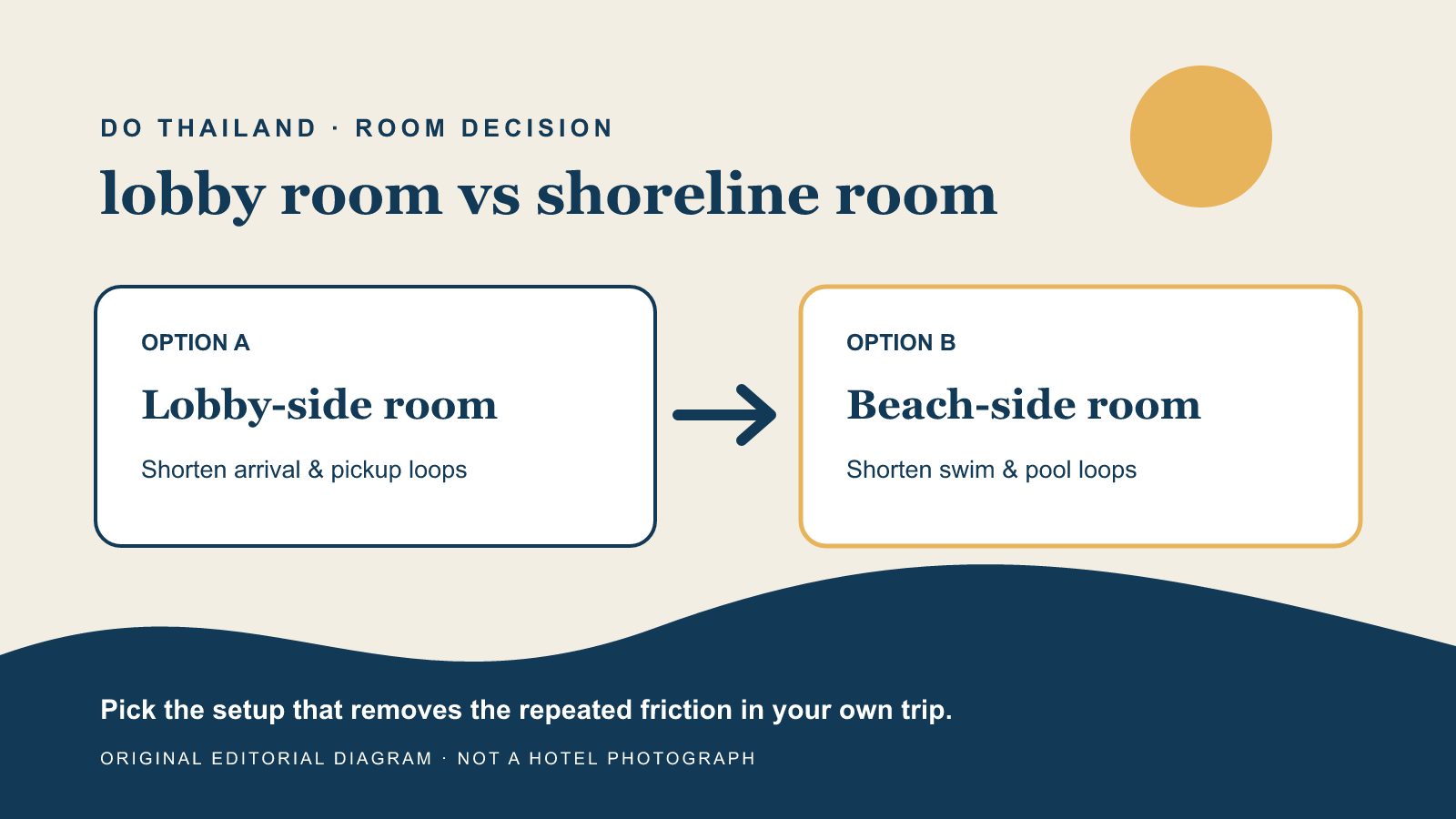
Lobby-side room
Best when you repeatedly use reception, cars, tour pickups, taxis, delivery handoffs or the main entrance. It can also make late returns simpler when reception is the place you naturally re-enter the property.
Beach-side room
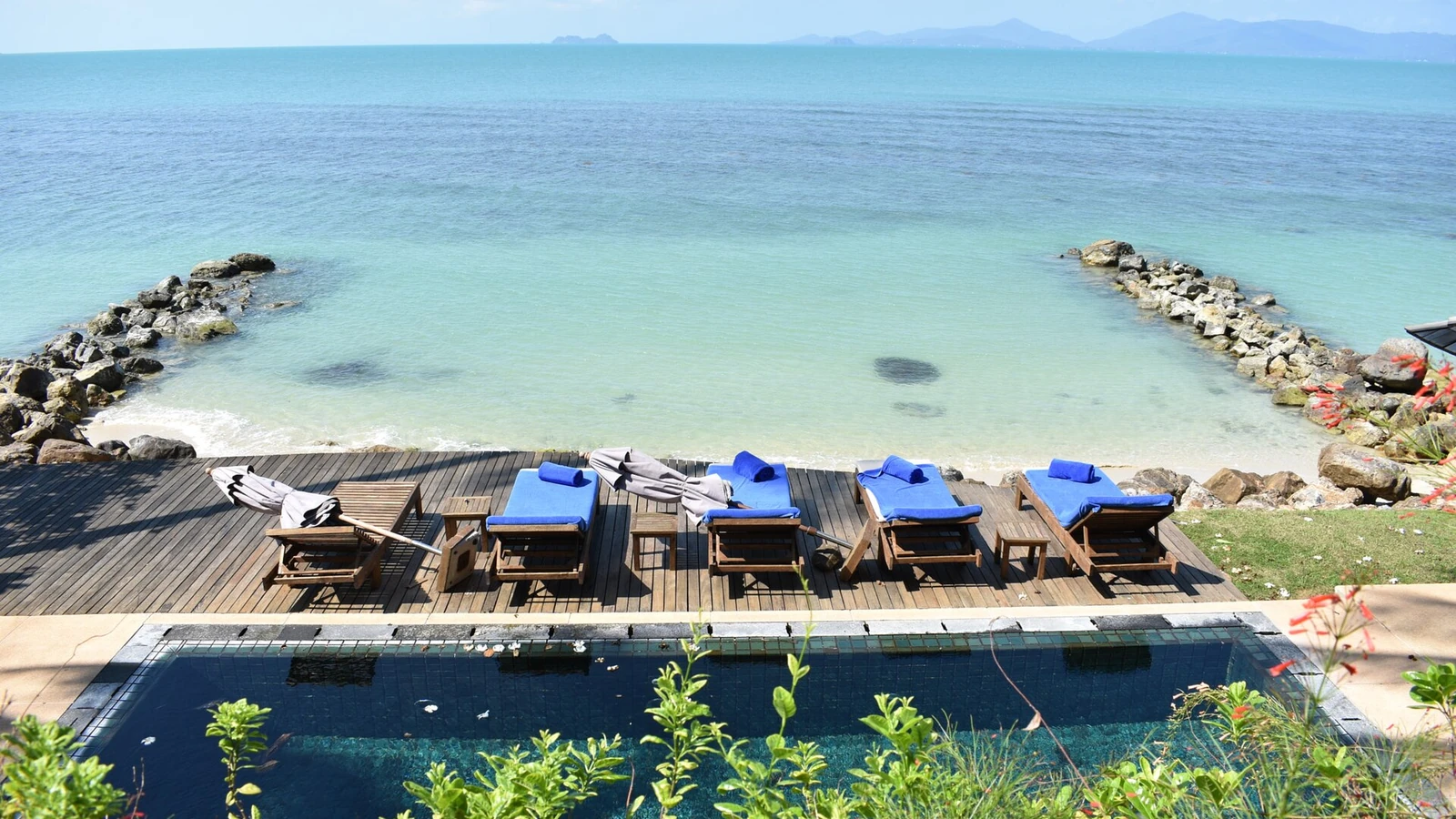
Best when your day repeatedly loops through room → beach → pool → room. It matters most when you actually use that proximity several times, not when you take one long beach session and leave for the rest of the day.
Do the five-departure count before you email the hotel
Count movements, not nights. A four-night stay with three tour mornings and three dinners outside can be more lobby-dependent than a seven-night resort holiday where you leave twice.
Put one mark beside every movement you genuinely expect
Samui resorts are exactly why room-position requests need context
Current first-party resort information shows how different the internal geography can be.
These hotels are evidence examples, not recommendations in this article. The point is that you should ask about the route, not infer it from a room name.
Beach-side rooms earn their position through repetition
The strongest beach-side case is not the view. It is the quick reset.
Imagine a day where you swim at 8:00, go back to shower, have breakfast, return to the beach, come back for sunscreen, swim again after lunch and then change before sunset drinks. Saving a few minutes each time can change the rhythm of the day. That is when a room closer to the beach behaves like a useful facility rather than a cosmetic preference.
This is closely related to the pool-access vs sea-view room decision. If you mainly want the water to be visually close, a sea view may satisfy you. If you want water access to be operationally close, room position matters much more.
Once you know the water-side route, decide whether you want to be near the resort’s social centre or away from its circulation. The companion guide to a room near the main pool vs a quieter wing compares that second choice, including pool traffic, balcony privacy and late-night paths. Lobby-versus-beach settles which end serves your routine; pool-versus-quiet-wing refines the room position within that routine.
It also explains why a true beachfront base can feel different from an inland one. If you are still choosing the neighborhood rather than the building, compare Chaweng beachfront vs inland or Chaweng Noi beachfront vs hillside first. There is little point optimizing the room’s last 100 metres before you solve the hotel’s last kilometre.
Lobby-side rooms win on movement days
Lobby proximity becomes disproportionately useful when your holiday is not resort-heavy. Three 07:00 pickups, several nights out and an early airport departure create a different stay from three lazy beach days.
If you book organised activities, read the Koh Samui tour-pickup hotel-location guide. Pickup coverage and the actual meeting point matter more than whether your room looks close to the driveway on a resort map. If you expect to use cars independently, the private driver vs taxis comparison helps you decide how much repeated front-desk and drop-off movement you are really creating.
A lobby-side request also has value on the last night when luggage, checkout and airport timing dominate. If that is your main concern, compare the broader last night near the airport vs beach hotel decision before you fine-tune the room location.
For women travelling solo or with friends, audit the final return route
I would not use a blanket rule that “near the lobby is safer” or “near the beach is more isolated.” Resorts are too different. Instead, ask what the last five minutes look like when you return alone at 10:30 p.m.
Rain can reverse the answer for one day, but should not decide the whole stay
A lobby-side room may be easier on a wet evening when you are repeatedly using cars, reception and indoor facilities. A beach-side room may lose some of its convenience if the beach day disappears entirely. But do not over-weight one rainy afternoon when your booking covers five nights.
Instead, look at the normal pattern. If you have breakfast included and plan to spend long stretches inside the resort, pair this decision with breakfast included vs room-only. If you are changing hotels during the trip, the one resort vs split stay guide matters even more because every move resets your room-position benefit.
Four friends should prioritise independence over perfect symmetry
For friends sharing two rooms, do not force both rooms into the same ideal location if that compromises the room setup. A guaranteed connecting pair or two well-placed separate rooms can matter more than getting everyone 30 metres nearer the beach.
Use the connecting rooms vs separate rooms guide first if privacy and different return times are the bigger issue. Room topology comes before room geography.
| Your actual stay pattern | Request near lobby | Request near beach | What to verify |
|---|---|---|---|
| Three early tour mornings | Usually yes | Only if pickups occur elsewhere | Exact pickup point and walking route from room |
| Two swims a day plus pool time | Less important | Usually yes | Actual path to main pool and usable beach |
| Solo traveller, nights out | Often practical | Can still work | Lighting, corridor vs outdoor path, late return route |
| Resort-only honeymoon | Usually secondary | Often better | Privacy as well as distance; avoid busy public paths |
| Airport night or one-night stay | Usually better | Rarely worth prioritising | Luggage route, checkout, vehicle access |
| Four friends with different schedules | Useful if returns split | Useful if everyone stays resort-side | Room independence, keys, internal route, room configuration |
| Accessible route is essential | Ignore the lobby-vs-beach label until the exact accessible route is confirmed. | Step-free route, lift, slopes, door widths where relevant, accessible room category | |
Six questions to send the hotel before you pay for a room-position request
- Is this room-location request guaranteed or only noted as a preference?
- How many minutes is the normal walking route from this room category to reception or the vehicle drop-off point?
- How many minutes is the route to the main pool and the beach guests actually use?
- Does that route involve stairs, slopes, outdoor paths or crossing between wings?
- Which restaurant or breakfast venue will we use, and is that closer to the lobby side or beach side?
- If we return late, what is the normal route from the drop-off point to the room?
Ask the hotel to prioritize the route you will use most: “shortest route to reception because we have three early pickups,” or “shortest practical route to the beach because we plan to swim several times a day.” That gives the reservations team more room to solve your actual problem.
The shortest answer
Choose near the beach when resort life creates more movements than the outside world. Choose near the lobby when pickups, dinners out, luggage and independent returns create more movements than swims.
If both sides look equally important, do not pay for the location request. Choose the better room itself, then use the hotel’s exact building and route as the tie-breaker.
Still deciding the wider base? Start from the Koh Samui destination guide rather than trying to solve an island-level location problem with a room request.
Sources checked
Stay planning
Find a place to stay
See available rooms around the property or neighborhood discussed here, with prices for your dates.