
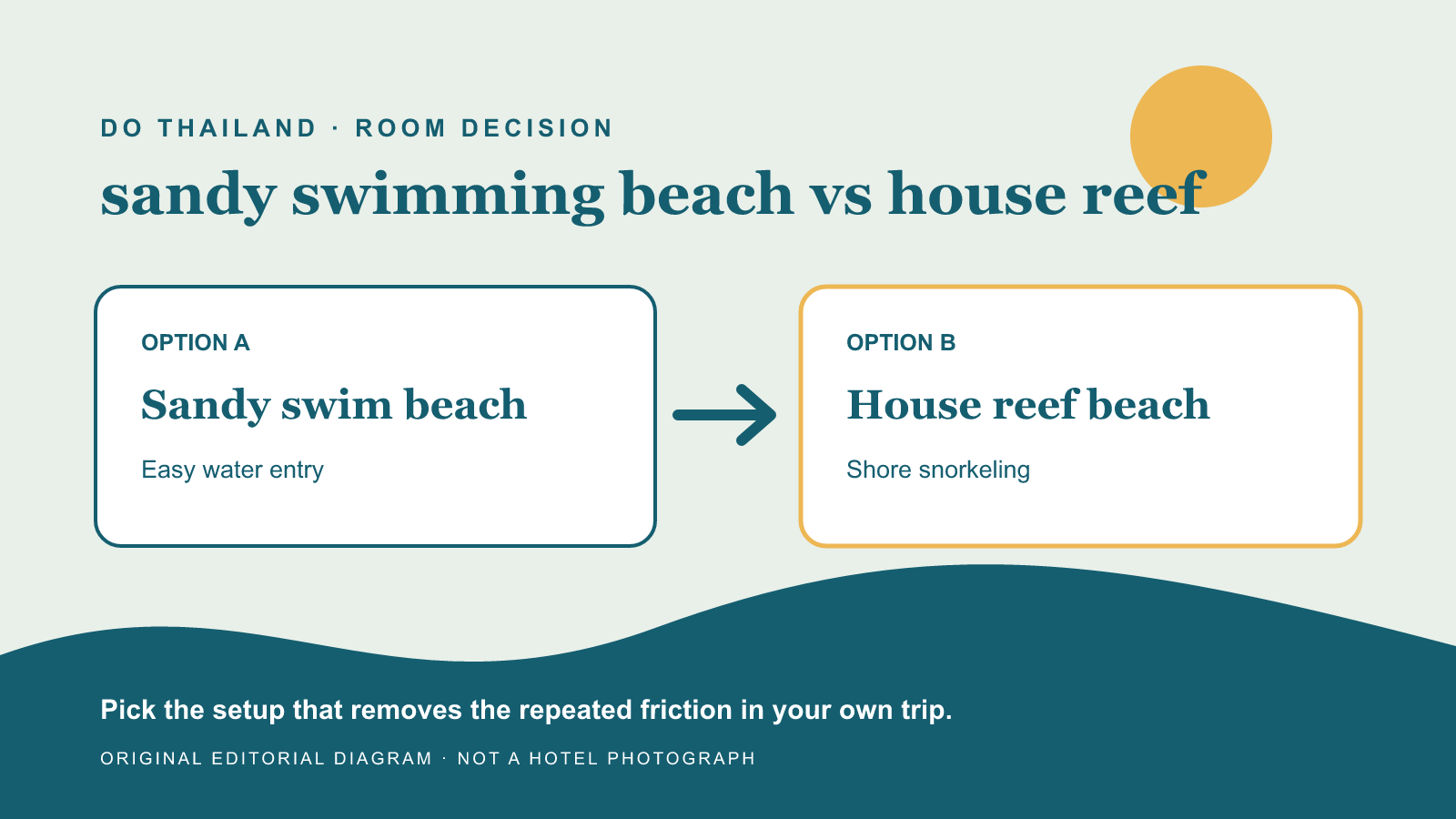
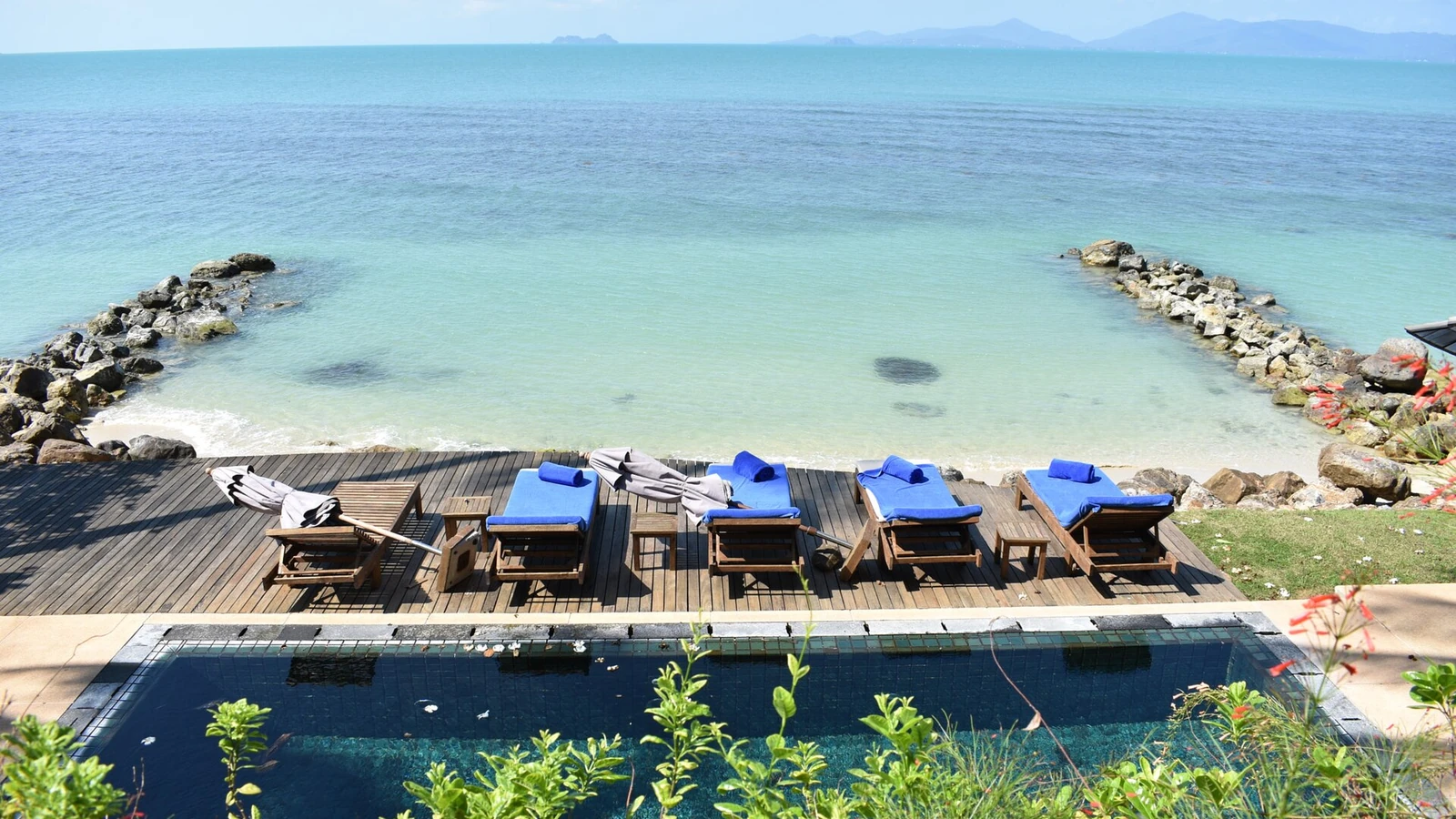
The recommendation: choose the water job, not the prettier label
“Beachfront” is too vague to make this decision. Two resorts can both sit directly on the sea and support completely different holidays. One beach may be the kind of place where you walk out barefoot, wade in for 20 minutes, float, cool down and return to your lounger. Another may earn its value because you repeatedly put on a mask, enter from the resort shore and spend your water time looking below the surface.
For a normal four- or five-night trip, easy repeated swimming is the safer default hotel criterion because it can serve more ordinary moments: pre-breakfast dip, post-tour cool-down, late-afternoon float and a quick swim while your travel companion is getting ready. A house reef should outrank that only when snorkeling itself is a repeated habit rather than a one-off idea.
This is deliberately different from our house reef resort vs snorkeling day trip guide. That page asks whether snorkeling should shape the hotel booking at all. This page assumes the beach already matters and asks what kind of hotel-beach relationship you actually want.
Stay planning
Find a place to stay
See available rooms around the property or neighborhood discussed here, with prices for your dates.
There are three useful hotel-beach models, not two
1. Easy-swim sandy beach
The value is low-friction water time: walk in, swim, cool off, get out. You do not need a mask, excursion, equipment desk or a 90-minute plan.
Best for: repeated casual swimming, couples who want flexible beach time, and travelers who dislike turning every water session into an activity.
2. House-reef beach
The value is repeated shore snorkeling. The underwater feature matters enough that you will deliberately gear up, enter the water and look for marine life more than once.
Best for: confident snorkelers, reef-curious travelers and people who prefer short independent water sessions to another organised boat day.
3. Verified hybrid
Some resorts can support both. Do not assume this from photos. You want current first-party wording that separately supports ordinary swimming conditions and reef/snorkeling access.
Best for: couples with different water preferences or anyone who genuinely expects both casual swims and repeat snorkeling.
What current Koh Samui resort pages actually prove
NH Collection Samui Peace Resort: the easy-swim model
The resort currently describes its Bophut Bay setting as a wide, sandy beach with calm waters to swim in. That is unusually useful first-party language because it states the swimming job directly instead of asking you to infer it from a beach photo.
It does not mean conditions are identical every day. It simply gives stronger evidence for an easy-swim hotel-beach proposition than a generic “beachfront” badge.
Banyan Tree Samui: the house-reef model
Banyan Tree currently states that its private beach gives access to a house reef just steps from the shoreline, with snorkeling among its complimentary beach activities. Its sustainability material also describes guided house-reef snorkeling in the private bay.
That is strong evidence for repeated shore-snorkeling access. It still does not tell you that every part of the shoreline behaves like a wide sandy wading beach.
Four Seasons Resort Koh Samui: a verified hybrid
Four Seasons currently describes a sheltered bay where water is typically calm and shallow close to shore, while the same current water-sports page also offers complimentary snorkeling gear and reef access directly from the beach.
This matters because the decision is a spectrum. A reef-oriented property can also work for ordinary swimming when the resort itself verifies both jobs.
Do the 30-minute water test before comparing room rates
Imagine the same ordinary 30-minute block at 10:45 in the morning. You have already eaten breakfast. You are not booking a tour. You have no intention of spending half the day at the beach. What do you naturally want to do?
“Shoes off. I just want to get in.”
You want the least ceremonial version of the sea: towel, swimsuit, water. You may swim for ten minutes, float for ten, stand and chat, then go back to the room. If this sounds like your default, an easy-swim sandy beach is more useful than a reef label you admire but rarely use.
This pairs naturally with our beach-first vs pool-first resort guide. If the beach is already your primary daily water environment, make sure it supports the way you actually enter the water.
“Mask on. I want to look underneath.”
You are happy to make the session more deliberate. You want to check conditions, use a mask, perhaps fins, and spend your 30 minutes observing rather than simply cooling down. If that urge repeats naturally, a genuine house reef can be a hotel feature rather than an activity-list decoration.
Read this alongside our included resort kayaks and SUP guide: both are about whether zero-transport water access creates behaviour you would otherwise skip.
Why a reef can be brilliant and still be the wrong beach for you
A reef gives you something a featureless swimming beach cannot: repeated underwater interest. But that does not make it universally more convenient. Reef-oriented snorkeling can involve a more intentional entry, equipment, awareness of coral and marine life, and more attention to current conditions. If your fantasy is “walk out in bare feet and float for fifteen minutes,” do not pay for an underwater feature you will experience mainly as a constraint.
This is especially relevant when two friends travel together. One person may want to snorkel; the other may want an easy swim and then a book under an umbrella. The best hotel is not necessarily the beach that maximises one person’s preferred activity. A verified hybrid can be more valuable than the strongest reef if it reduces daily negotiation.
If reef access is still a major priority, our house reef vs snorkeling day-trip guide helps you check whether repeated shore sessions actually justify changing hotels.
Why a sandy swimming beach can be brilliant and still be overrated
“Wide, sandy beach” is more useful wording than a glamour image, but it still does not create a permanent sea-condition guarantee. Water movement, weather and seasonal patterns can change how inviting a beach feels on a specific day.
Four Seasons’ current water-sports guidance is a good example of why you should treat conditions as dynamic: the resort says its sheltered bay is typically calm and shallow close to shore, while also noting that the calmest and clearest period is usually mid-December to April and that wetter periods can bring choppier water. This guidance applies to the named property; check sea conditions at the beach you plan to visit.
The correct booking logic is therefore: verify the beach model, then still check conditions locally. Do not turn “sandy” into a safety claim, and do not turn “house reef” into a visibility guarantee.
The condition gate matters more than the marketing adjective
Before swimming or snorkeling, use the resort’s current beach guidance, local staff advice and same-day sea conditions. If a property restricts water access, closes equipment operations or advises against entry, the hotel-beach label becomes irrelevant for that period.
For a water-heavy trip, also think about the whole wet-return chain. Our poolside vs room-issued towel guide, changing-room vs room-shower guide and drying-space guide cover what happens after you leave the water.
Which beach model is better for your actual trip?
| Your trip pattern | Lean sandy easy-swim | Lean house reef | What to verify |
|---|---|---|---|
| First Koh Samui trip, 4 nights, several outings | Yes | Only if snorkeling is a priority | How easy the ordinary beach swim feels relative to your room and pool routine |
| Resort-heavy couple, likes several short swims | Strong fit | Only if both enjoy snorkeling | Repeated entry comfort, shade, towel route, room-to-beach distance |
| Confident snorkeler who dislikes organised tours | Secondary | Strong fit | Verified shore reef, equipment model, operating hours, condition restrictions |
| Two friends with different water preferences | Good default | Only if hybrid conditions are verified | Whether both easy swimming and snorkeling are genuinely supported |
| Already doing Koh Tao / Koh Nang Yuan snorkeling | Usually stronger | May be redundant | Whether you still want repeated hotel snorkeling after the big water day |
| One resort stay with many beach afternoons | High value | High value if snorkeling repeats | Which water job you expect to do more often on ordinary afternoons |
| Mostly pool person who wants a pretty shoreline | Nice bonus | Low priority | Do not over-optimise the beach if the pool is where you will actually swim |
Choose a hotel that fits your beach routine
A fantastic beach does not repair a hotel that is wrong for the rest of your trip. If the property is spread out, ask whether room-to-beach movement is simple in heat and rain; our buggy resort vs walkable resort guide and covered vs open-air paths guide deal with that repeated internal friction.
If you expect long midday sessions, shade and pool backup still matter. Our pool shade vs infinity-view guide is useful because some days the sea will simply not be the place you want to spend two hours.
And if your hotel is also your evening base, do not sacrifice dinner logistics blindly for the beach. Compare the trade-off with our resort dining vs nearby restaurants guide. A beach you use for 30 minutes does not automatically outrank an evening setup you use every night.
Ask these eight questions before you let the beach decide the hotel
- Does the hotel currently describe the beach as suitable for ordinary swimming, or am I inferring that from photos?
- Does it explicitly describe a house reef accessible from the hotel shoreline?
- If snorkeling gear is complimentary, what are the current operating hours and where is it collected?
- Is the house reef reached directly from the hotel beach, or does the hotel simply arrange snorkeling excursions elsewhere?
- Does the property itself publish any seasonal or weather-related limitations for swimming, snorkeling or water sports?
- How long is the real route from my likely room category to the beach, towels and shower?
- If conditions are poor, is there a pool setup I would still enjoy enough to make the hotel work?
- Which will I do more often on an ordinary day: walk in barefoot for a swim, or deliberately put on a mask to explore?
The final rule: choose the water interaction you will repeat
If you keep picturing yourself walking straight in for an easy swim, prioritise the verified sandy-swim beach. If you keep picturing yourself putting on a mask and returning to the same underwater environment, prioritise the verified house reef. If a current resort page proves both, you may not need to choose at all.
But do not buy a beach adjective. Buy the routine. Then check the same-day conditions when you arrive.
For the wider accommodation plan, return to the Koh Samui destination hub or use our one resort vs split stay guide if you are tempted to move hotels purely to collect different beach features.
Sources checked
- NH Collection Samui Peace Resort — current official resort page (wide sandy Bophut beach and calm waters to swim in; checked 16 August 2026).
- Banyan Tree Samui — current official facilities page (private beach, house reef steps from the shoreline and complimentary snorkeling; checked 16 August 2026).
- Banyan Tree Samui — current sustainability material (house-reef snorkeling class and private-bay marine context; checked 16 August 2026).
- Four Seasons Resort Koh Samui — current official water-sports page (complimentary shore snorkeling, reef access, calm/shallow near-shore guidance and seasonal condition notes; checked 16 August 2026).
Stay planning
Find a place to stay
See available rooms around the property or neighborhood discussed here, with prices for your dates.