
The calendar-commitment test
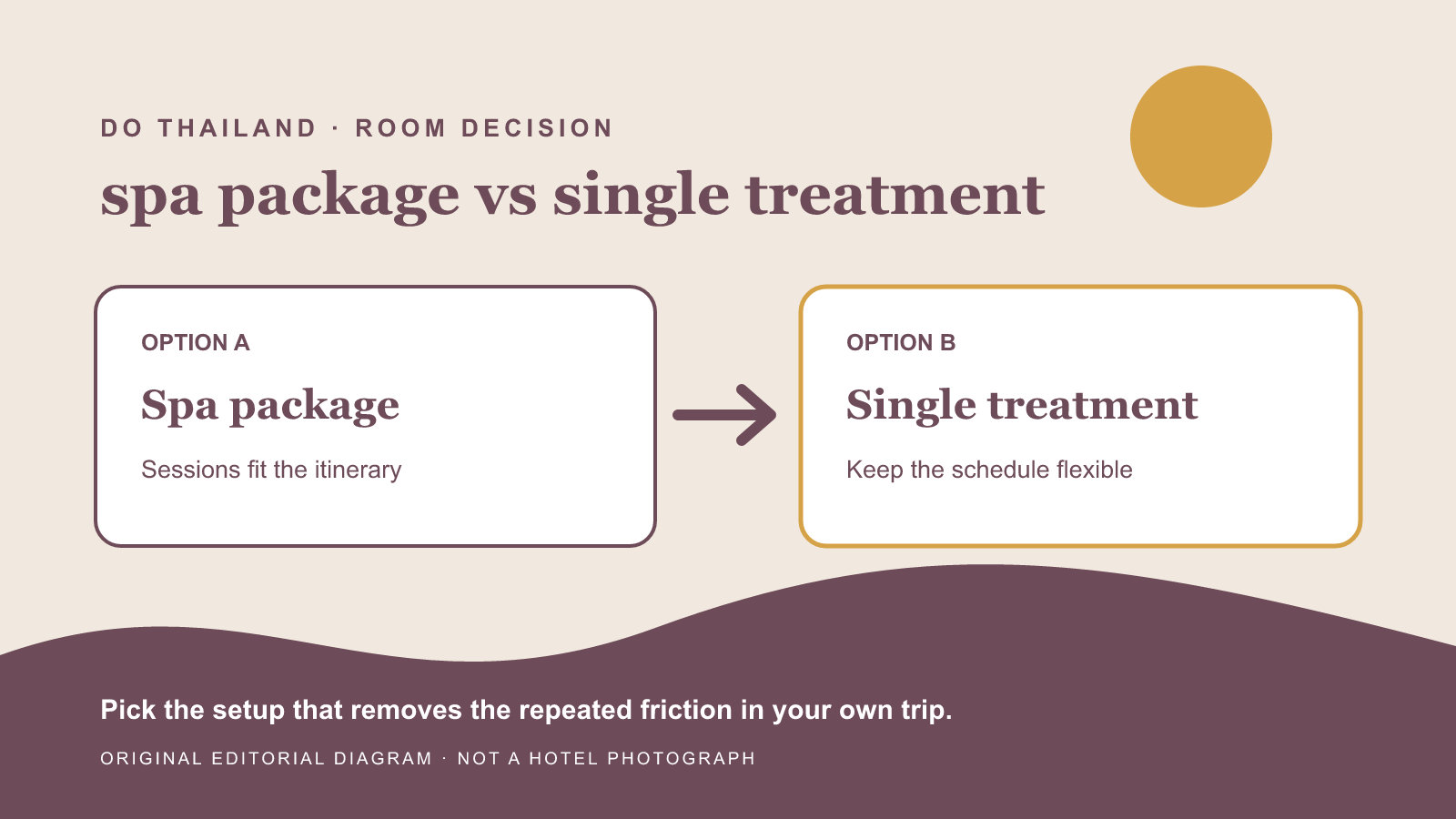
Before you compare package names, write down the exact sessions you would willingly schedule if they were sold separately.
My threshold: if you would independently choose at least two-thirds of the included sessions, and you can give them real time slots now, the package deserves a closer look. If you mainly like the idea of “doing wellness” but cannot say when you will use it, keep the trip flexible and book one treatment.
Stay planning
Find a place to stay
See available rooms around the property or neighborhood discussed here, with prices for your dates.
First, separate three very different things that hotels call a spa package
1. One treatment
A 60-to-105-minute massage, facial or recovery session booked on its own. This is the cleanest option when you want one deliberate reset without letting wellness dictate the rest of the stay.
If you are still deciding whether you want a quick treatment or a longer ritual, use our massage vs spa-day guide first.
2. One-day programme
This can combine movement, steam, scrub, massage, facial and food into a large block. The value is not “more treatments”; it is that you genuinely want a structured wellness day more than a beach, island tour or free afternoon.
On a weather-sensitive day, compare that commitment with our rainy-day cooking class vs spa decision.
3. Multi-day or hotel-rate bundle
Some programmes spread sessions across several days. Other hotel offers simply attach one spa treatment, credit or spa benefit to a longer accommodation package. Those are not the same product and should never be evaluated with the same mental shortcut.
If the package is changing where or how long you stay, check our one resort vs split-stay guide before letting spa inclusions choose the hotel.
Current Koh Samui programmes show why the label is not enough
Anantara Bophut Koh Samui Resort currently publishes individual 90- and 105-minute recovery treatments alongside a much larger one-day wellness programme, plus three-day and five-day wellness programmes. The one-day format currently combines movement, herbal steam, body treatment, massage, facial and a wellness meal; the multi-day formats spread movement and treatment sessions across consecutive days.
Six Senses Samui currently presents its wellness programmes around assessment and personalisation: wellness experts use health, movement and lifestyle information to recommend treatments, activities and nutrition rather than simply selling a long fixed massage list. Its spa remains separately available for individual treatments.
Centara Reserve Samui currently has accommodation offers in which a spa treatment or spa credit sits inside a longer room package alongside items such as breakfast, transfers, dining credit or laundry. That is a hotel-rate bundle, not automatically a reason to build the holiday around spa time.
The practical lesson is simple: ask whether you are buying a treatment, a wellness schedule, or a hotel rate with a spa perk. Current inclusions, advance-purchase terms and operating details can change, so re-check the exact offer before booking.
Build the five-night calendar before you buy the wellness calendar
A package feels generous when you read it in one block. It feels different when each session has to occupy a real part of a real holiday.
If your trip is deliberately resort-heavy, this calendar changes. The more hours you already plan to spend on property, the easier it is for repeated wellness to become useful rather than intrusive. That is exactly the trade-off behind our activity-rich vs quiet resort guide and beach-first vs pool-first resort guide.
The package wins when the sessions replace things you were going to do anyway
Pre-commitment makes sense when wellness is already part of the trip architecture. If you planned two massages, one yoga session, one facial and a quiet resort day before seeing the package, bundling those things can simplify decisions rather than create new ones.
This is especially true on a training-focused stay. If you are already using hotel fitness facilities or a specialist studio repeatedly, a coherent recovery programme may slot naturally around training. Compare that hotel decision in our resort fitness vs specialist studio guide.
Likewise, if sauna, steam or recovery facilities are genuinely part of your routine, the infrastructure itself may carry hotel-selection value. That is a separate question from buying treatments, covered in our recovery facilities vs ordinary pool-and-spa guide.
Pay-as-you-go wins when the package depends on your future self being more organised
If you would not independently buy the facial, scrub or movement session, it does not become useful merely because it sits inside a programme.
Boat plans, sea conditions and rain already create enough calendar movement. Flexible spa booking lets wellness absorb the gap instead of competing with the plan.
One person may love a structured wellness block while the other wants open beach time. A package should not become relationship admin.
Do not downgrade beach access, room position, pool fit or evening convenience just because another resort has a more impressive programme page.
The same hierarchy applies to food. A resort package that pushes you to spend every afternoon in the spa and every evening on property can quietly remove the restaurant freedom you thought you were buying with the holiday. Use our resort dining vs nearby restaurants guide if that is part of the trade-off.
For two friends, schedule ownership matters more than matching treatment menus
Friends often book wellness together because it looks easy on the itinerary. The friction appears later: one wants a massage after breakfast, the other wants the pool; one likes facials, the other would rather spend the money on dinner; one is happy to lose a full afternoon, the other gets restless after ninety minutes.
A single shared treatment is easy to coordinate. A three-day programme is a shared calendar contract. If you are travelling with a friend, I would only pre-book the larger programme if both of you independently want the same amount of structure. Otherwise, let each person book what she actually wants.
If the hotel itself is being chosen around friendship logistics, keep the room and movement basics ahead of spa perks. A beautiful spa does not compensate for poor daily circulation; our buggy resort vs walkable resort guide is useful when the property is large or hillside.
For solo women, flexibility can be a luxury in its own right
Solo travel makes it easier to follow your own wellness rhythm, but it also makes over-programming unnecessary. You do not need to coordinate with anyone, so one free afternoon can become a massage at 3 p.m., a long lunch, another swim or absolutely nothing.
If the spa is outside your hotel, transport and return timing become part of the decision. We separate that location question in our resort spa vs external day spa guide. If you do leave the property, make the return route explicit rather than relying on a late, isolated walk; our private driver vs taxis guide covers the wider transport trade-off.
Use this decision table instead of counting inclusions
| Your trip pattern | Better default | Why |
|---|---|---|
| 3 nights, first visit, one massage sounds nice | Single treatment | Too little time to let a multi-session programme dictate the stay. |
| 5 nights, two boat/activity days, one resort day | Single treatment | Keep the wellness slot flexible around weather and fatigue. |
| 5 nights, resort-heavy, already want 3+ sessions | Package can work | The programme is replacing planned wellness, not inventing extra obligations. |
| Training or recovery is a main trip goal | Programme more likely | Repeated treatment can support an existing routine. |
| Couple or friends want different wellness intensity | Pay as you go | Each person keeps schedule ownership. |
| Hotel rate includes one spa treatment anyway | Use the inclusion, then reassess | A bundled perk is not proof that more prepaid spa time is needed. |
| Multi-day wellness is the reason for coming to Samui | Programme | At that point the wellness schedule is the trip, not an add-on. |
Seven questions to ask before paying for a spa package
- Exactly which sessions are fixed, and which can be swapped?
- Do you choose the appointment times now, or only after arrival?
- What happens if a boat day, flight delay or illness collides with a prepaid session?
- Is the programme available to hotel guests only, or can non-guests book it too?
- Does a room-rate package change the cancellation or prepayment conditions of the hotel stay?
- Are meals, movement classes, steam/sauna access or consultations genuinely included, or just described elsewhere on the spa page?
- If you removed one-third of the included sessions, would you still want the package?
The final rule: buy the programme only if you want the schedule
A spa package is not automatically better value because it contains more. The real cost is calendar ownership.
If you already want repeated wellness, a coherent programme can make a Koh Samui resort stay feel intentional. If you mainly want one beautiful massage somewhere between swimming, dinners and island days, a single treatment protects the part of the holiday that is hardest to price: the freedom to decide later.
Choose the hotel around the repeated parts of your trip first — beach, pool, room, movement and evenings — then let wellness take exactly as much space as you genuinely want. For the broader Samui planning graph, start at the Koh Samui destination hub or compare how much resort infrastructure matters in our one pool vs multiple pool zones guide.
Sources checked
Stay planning
Find a place to stay
See available rooms around the property or neighborhood discussed here, with prices for your dates.