
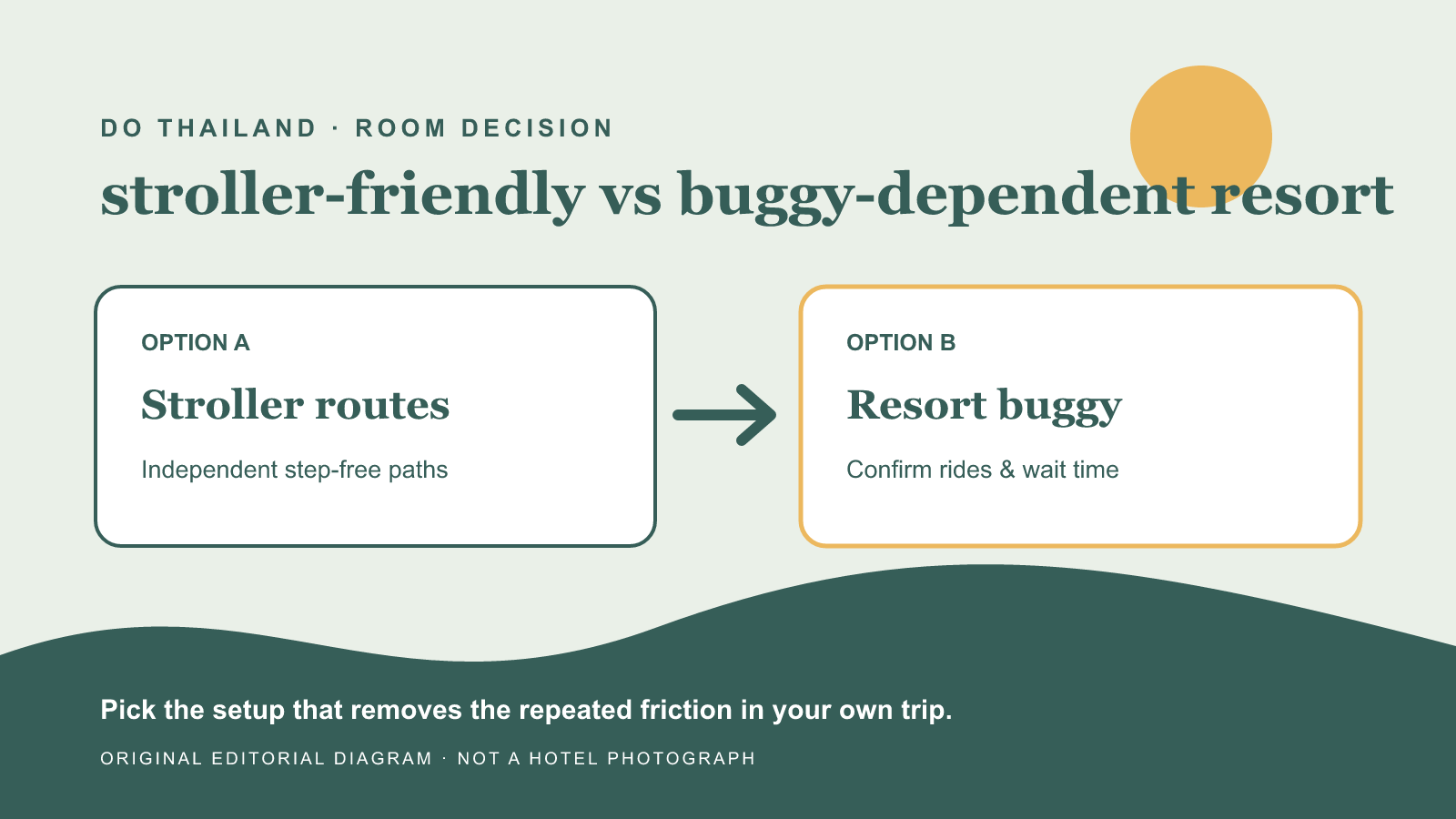
The recommendation: buy route independence, not a “family-friendly” label
A stroller changes a resort in a way a map does not show. Fifty metres of level paving can feel easier than a beautiful 200-metre path with one flight of steps, a buggy handoff and a second short walk. The useful question is not whether the hotel welcomes children. It is whether you can move through the parts of the hotel you will use without repeatedly waking, lifting or transferring the child.
For a baby or toddler family, my default is a hotel where the important journeys can be completed continuously with the stroller. That does not mean every path has to be flat, or that a buggy-dependent resort is unsuitable. It means the family should know which routes are step-free, where a buggy becomes necessary, whether the stroller must be folded, and what happens when the child is asleep.
This is a more specific problem than our buggy resort vs walkable resort guide. That article asks how much internal transport friction an adult traveller should accept. Here the issue is stroller continuity: how many times per day you have to convert a settled child and loaded stroller into a separate transport problem.
Stay planning
Find a place to stay
See available rooms around the property or neighborhood discussed here, with prices for your dates.
Run four routes before you compare pools, views or villa size
Room → breakfast
This is the highest-frequency morning route. You may carry a diaper bag, sun hat, bottle and a child who is not fully awake. A “small” staircase matters more here than it did on the hotel tour.
Room → pool or beach
Now add towels, swimwear, sunscreen and possibly a sleeping child on the way back. Repeated water days magnify every lift, kerb and buggy transfer.
Room → lobby or pickup
Airport mornings and tour pickups are clock-bound. If this route depends on calling a buggy, include that coordination step in the real departure time.
Room → dinner
This is the route most likely to happen after dark with a tired child. The easiest restaurant is often the one you can reach without dismantling the family’s bedtime setup.
If even one of those routes is complicated by a building change or lift dependency, compare it with our elevator vs elevator-free resort guide. If the issue is exposure rather than steps, use the covered walkways vs open-air paths guide as a second filter.
What current Koh Samui accessibility pages actually prove—and what they do not
Kimpton Kitalay Samui: useful route disclosures
IHG currently publishes flat terrain between parking and entrance, ramp access to the property, bar/lounge, leisure facilities and restaurant, plus elevator access to all levels. Those are useful route facts. They do not automatically prove that every room-to-pool, room-to-beach or exact assigned-room route is effortless with a stroller. Treat the accessibility page as a strong starting map, then confirm the route for the room category you are actually booking.
Holiday Inn Resort Samui Bophut Beach: ramps to major public areas
IHG currently publishes ramp access to the property, hotel bar/lounge, leisure facilities and restaurant, a drop-off point adjacent to the entrance and elevator access to all levels. Again, that is better evidence than a generic “family-friendly” badge—but it is still not a stroller-specific promise for every room block or every playground/pool route.
Hyatt Regency Koh Samui: accessible routes to several major areas
Hyatt currently lists accessible routes from the accessible public entrance to restaurants, registration, concierge, spa and meeting areas, and identifies the swimming pool and guest rooms among accessible hotel areas. The page does not publish a stroller route from every room category to every family facility, so exact-room placement can still matter.
Four Seasons Resort Koh Samui: buggy service is part of the accommodation system
Four Seasons currently lists buggy service across its accommodation amenities, while several villa and residence categories are explicitly described as hillside. That makes buggy support a real operating feature rather than an inference. But the public pages reviewed for this guide do not promise that a particular stroller can ride unfolded, that a child can remain in it during the buggy trip, or that buggy arrival is instantaneous. Those are direct-confirmation questions.
The important distinction is this: wheelchair-accessibility disclosures are evidence about ramps, lifts and accessible routes; they are not a universal “stroller-friendly” certification. A stroller can be wider or more awkward to fold than you expect, and a family may deliberately choose a non-accessible room category. Use published route facts as evidence, not as a shortcut.
The four-route stroller test
Score each of the four routes—breakfast, water, lobby/pickup and dinner—from 0 to 2.
0 = continuous: you can push the stroller from start to finish without lifting it or waiting for transport. 1 = one manageable interruption: a lift, short ramp detour or predictable doorway that does not require removing the child. 2 = transfer-dependent: steps, repeated lifting, buggy handoff or a route where you would normally fold the stroller.
If your total is 0–2, route friction is low enough that it probably should not dominate the hotel choice. At 3–4, room placement and exact facility routes deserve written confirmation. At 5+, I would treat internal circulation as a primary hotel criterion for a stroller-heavy trip.
This is not an accessibility score and it is not a safety rating. It is a family-effort score. Its only purpose is to reveal how often a beautiful resort will ask you to stop, lift, wait or re-pack.
The hidden cost of a buggy is not the ride—it is the handoff
Before the buggy
You may have a child strapped in, a bag under the stroller, drinks in a holder and a rain cover or sun shade fitted. If the stroller must fold, the whole setup becomes loose objects.
During the buggy
You need a clear answer about where the stroller goes. Do not assume the buggy can carry your specific model, that it can remain unfolded or that there is a child restraint suitable for your child. Ask.
After the buggy
You may rebuild the stroller only to walk another three minutes. Doing that once on arrival is trivial. Doing it before breakfast, pool time and dinner becomes a defining part of the stay.
This is why a buggy-dependent resort can be wonderful for a couple and unexpectedly tiring for the same travellers one year later with a stroller. The architecture did not change; the number of handoffs per day did. If heavy luggage is part of the same arrival problem, our luggage assistance vs self-service arrival guide solves the bag side separately.
The nap test is more revealing than the arrival test
Imagine the child falls asleep in the stroller at 12:40 after lunch. You are at the restaurant and want to return to the room without waking them.
At a route-continuous hotel, you can often keep moving: restaurant → ramp or lift → corridor or garden path → room. At a transfer-dependent resort, the family may need to stop, lift the child, fold the stroller, call or board a buggy, then rebuild the stroller at the other end.
That does not make the second resort “bad for families.” It means the hotel is asking you to trade route independence for setting. If the hillside view, villa privacy or destination-resort experience is central to the trip, you may happily make that trade. If you mainly want easy family days, the route itself is the amenity.
When I would choose the step-free, independently navigable resort
You expect four or more stroller journeys every day. Breakfast, pool, nap return, dinner and lobby errands make small obstacles repetitive. A route you can operate yourself reduces coordination.
The stroller is your mobile base. If the basket carries diapers, changes of clothes, water, sun protection and a sleeping child, folding it is not a one-second action. In that case, continuous routes have much higher value.
You have different adult schedules. One parent may go to the gym while the other takes the child for breakfast. A hotel where one adult can move independently with the stroller prevents the resort’s transport system from becoming a household scheduling system.
You plan short pool trips. Families often do not spend one six-hour block at the pool. They do 45 minutes, go back for a nap, then return later. That makes room position and easy circulation more important than a dramatic pool photo. Compare the route with our room near main pool vs quiet wing guide and kids pool slide vs calm family pool guide.
When a buggy-dependent hillside resort can still be the better choice
You will use the stroller lightly. If the child is mostly carried, walking confidently, or the stroller is a compact backup rather than the family’s moving storage unit, one or two buggy transfers may be inconsequential.
You are choosing the resort as a destination. A secluded villa, view or private-pool routine can be worth more than route independence if you spend long blocks in the room and make fewer internal journeys. That is the same logic behind our private-entrance villa vs hotel-room route guide.
The hotel confirms the stroller handoff. If the resort tells you exactly how your stroller travels, where the buggy stops, how long the walk is at each end and what happens late at night, the uncertainty disappears. You are no longer buying “buggy service”; you are buying a known operating system.
You are not changing hotels repeatedly. On a one-resort stay, you learn the routes once. If you are considering multiple bases, compare the benefits with the extra packing and transfer work in our one resort vs split stay guide.
Three things parents often overvalue
“Elevator access to all levels.” Useful, but it does not prove the path from the elevator to the beach, pool or your exact room is step-free. Route continuity matters more than the lift icon.
“Buggy service.” Useful, but it does not answer whether a stroller rides folded, where it is stored, whether a sleepy child has to be removed or how long you may wait at peak times.
“Family resort.” This can describe kids’ clubs, pools, meals or room occupancy. It says almost nothing about the route between them. If the family’s real priority is childcare, use our kids club vs babysitting guide. If the priority is sleeping arrangements, start with connecting vs separate rooms.
Rain and heat make route quality more visible
Stroller friction rises when you are trying to keep a child shaded, dry or asleep. A short uncovered path may be completely acceptable; a long route with multiple transfers may feel much less appealing during a shower or in strong midday sun. This is why “stroller-friendly” should not be reduced to step count. Shade, shelter, surface, distance and independence all belong in the route audit.
If the resort is mostly open-air, read the covered walkways guide alongside this one. If you will drive, do not assume a car solves the internal resort problem; our hotel parking vs walk-out location guide addresses a different layer.
| Your family pattern | Better default | Why |
|---|---|---|
| Baby naps in stroller most days | Continuous step-free route | Fewer forced transfers between sleep and room. |
| Compact stroller, toddler mostly walks | Either | Buggy handoffs are less costly when the stroller is genuinely a backup. |
| Two resort-heavy pool blocks daily | Step-free or room-near-pool layout | Repeated short water trips magnify route friction. |
| Private villa is the main holiday experience | Buggy-supported can win | Fewer internal journeys make the setting more valuable than circulation. |
| Frequent tours and timed pickups | Independent lobby route | Clock-bound departures benefit from fewer handoffs and less waiting. |
| Rental car used most days | Verify parking → room route | Easy property parking does not automatically mean easy stroller circulation after drop-off. |
| Parents split up during the day | Independent route | One adult should be able to manage child + stroller without waiting for an internal transport system. |
| Older toddler, no daytime stroller naps | Hotel quality first | Route friction may be too low to justify rejecting the better resort. |
Arrival logistics deserve their own check. If you land early, a secure bag drop plus an easy first few hours may be more useful than paying for a guaranteed room; see early check-in vs luggage drop. And if your family regularly buys water, snacks or forgotten baby supplies, hotel near shops vs self-contained resort is a separate convenience decision.
Ask these eight questions before booking a stroller-heavy stay
- From the exact room category or building, is there a step-free route to breakfast?
- Is there a step-free route to the main pool, children’s pool and beach, or does any part require stairs?
- If a buggy is normally used, does my stroller need to be folded, and where is it placed during the ride?
- Can a sleeping child remain in the stroller for the whole room-to-restaurant or room-to-lobby route?
- Are elevators or ramps available along the route to my assigned room?
- Which parts of the four core routes are uncovered outdoors?
- Where exactly does a taxi or airport transfer drop us, and can we roll the stroller from there to reception and the room?
- If a route is not step-free, what is the practical alternative after dinner or for an early pickup?
If a late arrival makes any of those handoffs uncertain, also compare 24-hour front desk vs limited reception. Ask for the answer in writing when a route is a real requirement.
What I would not do
I would not reject a resort because it has a hill. I would not call a hotel stroller-friendly because it has one ramp. I would not assume a wheelchair-accessibility statement covers every room category or every family route. And I would not assume a buggy service solves a stroller problem until I know the handoff.
The most useful family-hotel question is rarely “does the hotel have this amenity?” It is “can we complete the routine we will repeat without turning it into a small project?” That is the same principle running through our broader Koh Samui decision guides: design the stay around repeated behaviour, not isolated feature labels.
Final rule: count stroller handoffs, not resort stars
Choose the step-free, independently navigable resort when the stroller is part of four or more daily journeys and you want to preserve naps, storage and one-adult independence. Choose the buggy-supported resort when the stroller is light-use, the route is fully explained, and the hillside or villa experience is important enough to justify the transfer.
The tie-breaker is simple: imagine a sleeping toddler at 12:40. Pick the hotel whose route back to the room you would rather operate yourself.
Sources checked
- Kimpton Kitalay Samui — current IHG accessibility information, checked 17 August 2026.
- Holiday Inn Resort Samui Bophut Beach — current IHG accessibility information, checked 17 August 2026.
- Hyatt Regency Koh Samui — current hotel accessibility information, checked 17 August 2026.
- Four Seasons Resort Koh Samui — current accommodation services and buggy-service disclosure, checked 17 August 2026.
Operational details can change. This guide deliberately does not infer stroller carriage rules, buggy child restraints, wait times or exact assigned-room routes from generic amenity labels. Confirm any route that is essential to your family before paying.
Stay planning
Find a place to stay
See available rooms around the property or neighborhood discussed here, with prices for your dates.