
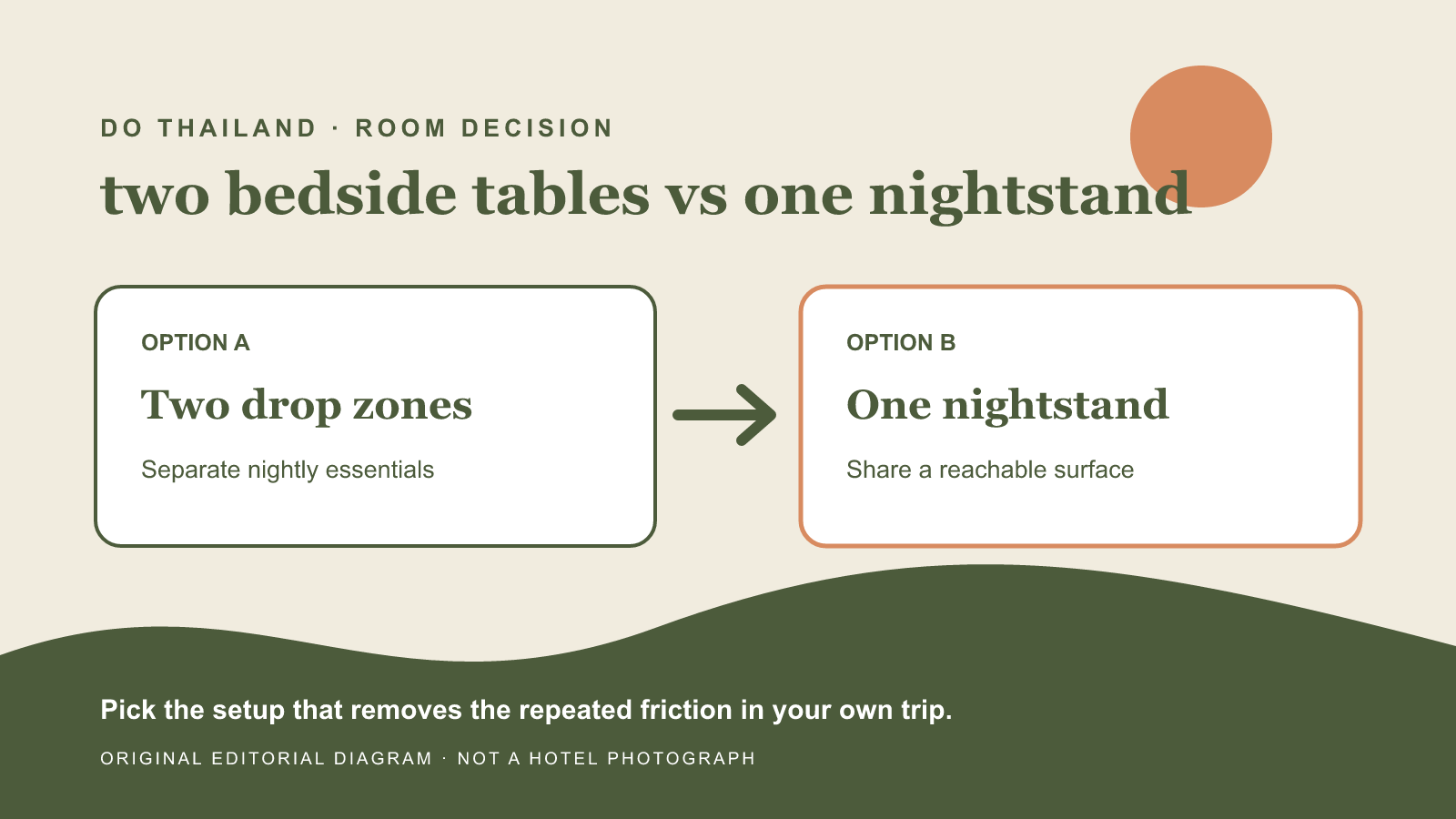

The recommendation: pay for two usable drop zones, not matching furniture
A room can look beautifully symmetrical in a photo and still be annoying at 11:45 p.m. if one nightstand is decorative, tiny or blocked by a lamp. Another room can have only one obvious table yet work perfectly because a built-in ledge runs behind the headboard and both people have somewhere to put a phone and a glass of water.
So this is not really a furniture-style question. It is a bedside ownership question.
For two friends, independent surfaces matter sooner because each person usually has a separate phone, charger, water bottle and bedtime routine. For couples, one generous shared surface can be perfectly fine if both people genuinely use it comfortably. For a solo traveler, a second table is almost never worth sacrificing a better room just for visual balance.
Stay planning
Find a place to stay
See available rooms around the property or neighborhood discussed here, with prices for your dates.
Do the 30-second bedtime drop test
Before comparing room photos, picture the final 30 seconds before sleep. What actually has to leave your hands?
Alarm, pickup messages, transport contact and tomorrow's booking details often make the phone the one item people want closest.
One bottle can be shared. Two open glasses squeezed behind a lamp are a different story.
Small items become irritating when one traveler has a proper surface and the other uses the floor or headboard edge.
The second bedside zone becomes more useful as soon as both sides of the bed develop a nightly pile.
If each traveler has two or more small items that need to stay within easy reach on most nights, two usable bedside zones are worth checking. If the entire room has one phone, one water bottle and no one cares which side they use, do not create a hotel problem that does not exist.
Power is a separate decision. Our bedside power vs desk-only charging guide covers outlet placement, while the bedside light-controls guide covers switches and different sleep times. A table can exist without a socket, and a socket can exist without enough surface to put anything down.
Current room photos show why the hotel name is not enough
The current exact Booking.com listing shows one twin-room image with a bedside table and wall outlet between the beds. The same property listing also shows a different double-bed room image with two round bedside tables. That is exactly why “this hotel has bedside tables” is too broad a conclusion: furniture geometry can vary inside one property.
The current Hotels.com Superior Double Room image is captioned as a bedroom with two bedside tables with lamps. A Deluxe Double Room image on the same current listing is described with a bedside table and lamp. Public imagery is useful evidence, but it is still category-level visual evidence rather than a guarantee that every assigned unit will be identical.
The current Hotels.com Deluxe Double Room photo is described with two bedside tables, while a Deluxe Double or Twin Room with Balcony photo is described with a nightstand and lamp. Again, the useful lesson is not that one category is better. It is that the exact room category matters more than the property-level amenity list.
Room photos can help you spot an obvious one-sided setup, but they are not a contract for furniture placement. If two separate surfaces are a real requirement, ask the hotel to confirm the exact booked category.
For two friends, the second bedside table is often about independence
The roommate test: can both people finish the night without borrowing the other side?
Two friends can share a room very happily and still have completely separate nighttime habits. One may set three alarms, the other may read. One keeps a water bottle beside the bed; the other has glasses, earbuds and a watch. The friction is rarely dramatic. It is the repeated low-level stuff: “Can I put this there?” “Can you move your phone?” “Which side has the charger?”
If you are already choosing between bed configurations, solve the bigger sleep decision first with our king vs twin beds for friends guide. A perfect pair of nightstands does not rescue a sleeping arrangement neither person actually wanted.
The same priority logic applies to bathrooms. If mornings are the difficult part, one sink vs double vanity and separate toilet vs shared bathroom will usually matter more than bedside furniture.
One-sided bedside setup is fine when the room gives you another usable surface
Two bedside tables win when both sides are genuinely occupied
This is the stronger setup when both travelers keep their phones beside them, both drink water overnight, both wear glasses or watches, or both want a book or small personal item within reach. It is especially useful on a five-to-seven-night stay because the tiny arrangement gets repeated every night.
It also pairs well with a room that already works for storage. If luggage keeps creeping into the bedside area, the more important issue may be room storage vs suitcase living.
One nightstand is fine when the room has a headboard ledge, console or easy desk
A single obvious nightstand can be enough if the second person has a stable built-in shelf, nearby console or another reachable surface that does not block the walkway. The requirement is functional, not decorative.
This is also why a larger room is not automatically better. A room can have a sofa, desk and more square metres yet still give only one person a convenient bedtime drop zone. Our lounge area vs separate living room guide deals with usable zones at a much larger scale.
Do not let a nightstand outrank sleep
The most common mistake is noticing a small room-detail preference and letting it climb above everything that happens for eight hours a night.
If you are sensitive to noise, a better room position should beat prettier bedside furniture. Use the quiet room vs best view guide first. If dawn light wakes you, blackout curtains vs sunrise-facing room is a more important filter. If pillow firmness genuinely changes your sleep, the pillow-menu guide sits above nightstand symmetry too.
A sensible room-priority order
- Sleep setup: bed type, quiet, light control.
- Room layout: can two people move, unpack and get ready without constantly crossing paths?
- Bathroom practicality: privacy, toilet/shower overlap and mirror access.
- Nightly convenience: bedside surface, charging and lighting controls.
- Decorative symmetry: nice when it happens, not a booking reason by itself.
If getting ready is the bigger pain point, see full-length mirror vs bathroom mirror. If downtime is the issue, Smart TV vs standard TV is a different room-tech decision.
When two tables are worth actively checking
| Traveler pattern | How much it matters | Reason |
|---|---|---|
| Solo traveler | Low | One good bedside surface is normally enough; prioritise the better room and location. |
| Couple sharing one charger | Low to medium | A generous shared table can work if both people naturally use the same side. |
| Couple with separate phones, glasses and water | Medium | Two zones remove a small but repeated nightly pile-up. |
| Two friends sharing one room | Medium to high | Independent surfaces reduce borrowing, reaching across the bed and device confusion. |
| Early-tour stay | Medium | Phone, alarm, water and pickup messages make reachable bedside organisation more useful. |
| Five-to-seven-night stay | Medium | Minor room friction compounds when repeated every night. |
| Room has a headboard shelf on both sides | Low | The functional problem may already be solved even without two conventional tables. |
For couples, ask whether you want symmetry or independence
Couples often assume matching bedside tables are automatically better, but the real question is whether both people have separate habits. If one person always charges the phones on the desk and the other keeps only water beside the bed, one larger table may be completely fine. If both people use their phones as alarms and both keep glasses, water and a watch nearby, two surfaces feel less like luxury and more like simple organisation.
Different bedtimes raise the importance slightly, but then lighting controls may be the bigger issue. Different wake-up times raise it again, but blackout curtains and a quiet room still matter more. The useful approach is to identify the repeated friction rather than collect amenity badges.
Eight questions to verify if bedside layout really matters to you
- Does the exact booked room category show two bedside surfaces for phones, glasses or water?
- If there is only one conventional table, is there a stable headboard shelf or console on the other side?
- Can both travelers reach a surface without leaning across the other person?
- Is a lamp, telephone or control panel taking up most of the tabletop?
- Are power outlets on both sides, or is power a separate limitation?
- For twin rooms, is the table shared between the beds or does each bed have its own drop zone?
- Are room photos representative only, or can the hotel confirm this layout for the exact category?
- If the layout varies, can the hotel note a preference for two bedside tables without presenting it as a guarantee?
Do not upgrade a whole hotel just to fix a tiny surface problem
If Hotel A has the better beach, quieter room, easier breakfast route and a layout you otherwise prefer, do not abandon it because Hotel B has two photogenic nightstands. Small items can often be solved with a nearby console or organised charging station. Bad sleep, poor location and awkward bathroom privacy are harder to repair.
The same logic applies when you are comparing more than one hotel during the trip. Our one resort vs split stay guide should be decided by trip structure, not furniture details. And if you are still choosing the base itself, start from the Koh Samui destination hub before narrowing down room micro-features.
Final rule: count two people's bedside items, not two matching tables
Choose a room with two independent bedside drop zones when both travelers repeatedly need their own reachable surface at night. That may mean two nightstands, two shelves or another equally practical setup.
If only one person cares, or a shared table genuinely works, keep this as a tie-breaker. The useful hotel room is the one that reduces repeated friction—not the one that looks most symmetrical in a listing photo.
Sources checked
- Booking.com — Stay Inn Nathon Samui current exact listing and room-image captions, checked 15 August 2026.
- Hotels.com — Sans Souci Samui current room inventory and image captions, checked 15 August 2026.
- Hotels.com — Amarin Samui Hotel current room inventory and image captions, checked 15 August 2026.
Furniture can vary by room category and assigned unit. The article uses current exact-listing photo disclosures as practical evidence, not as a guarantee of the furniture in every room.
Stay planning
Find a place to stay
See available rooms around the property or neighborhood discussed here, with prices for your dates.