
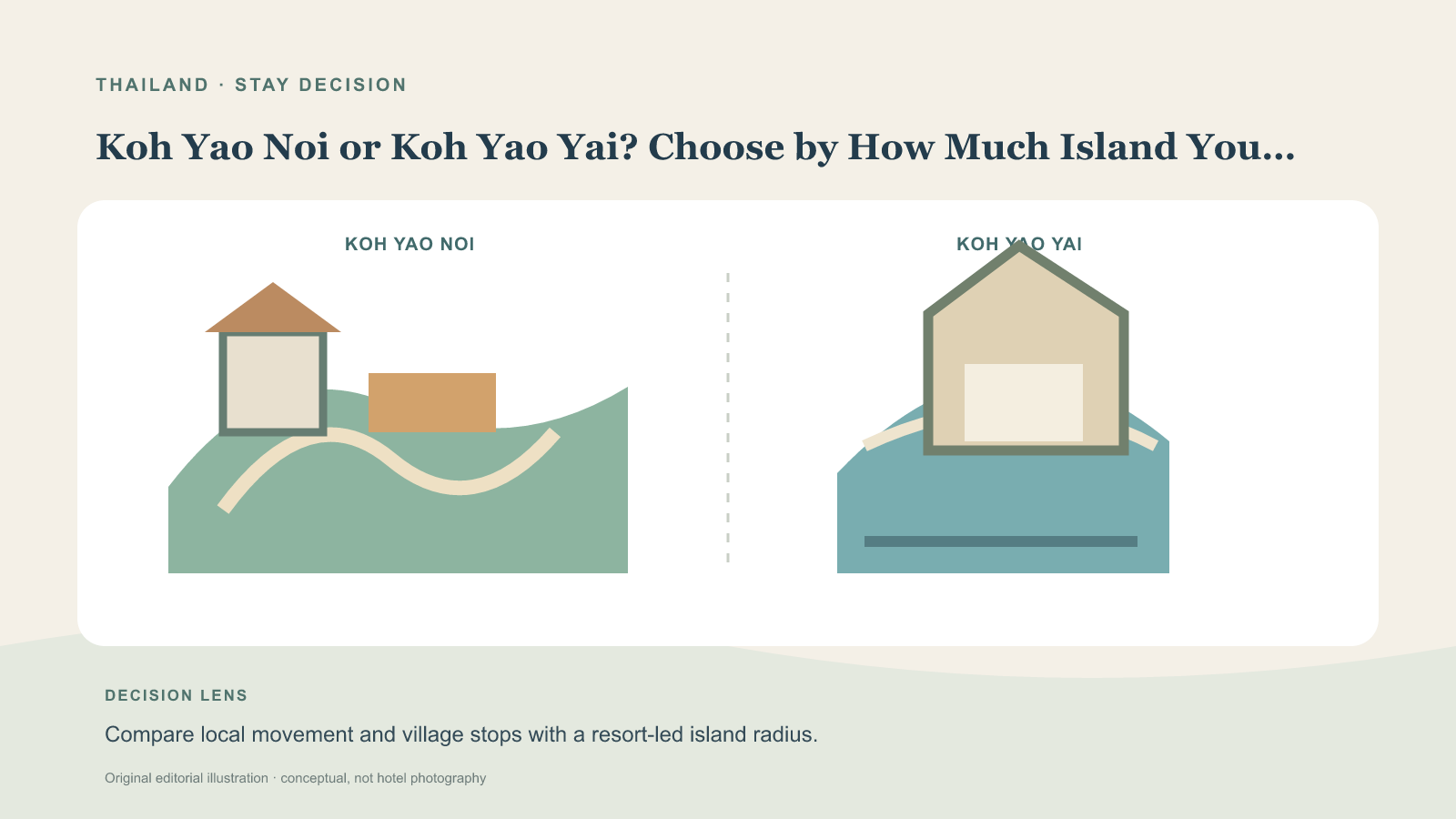
Tourism Authority of Thailand material describes Koh Yao Noi as the smaller of the pair and Koh Yao Yai as the larger. Both sit between Phuket and Krabi, and TAT currently lists access from both sides of Phang Nga Bay. So this is not a simple “easy island versus hard island” choice. The money decision starts after the boat: how often will you want the island outside your hotel to do something for you?
Koh Yao Noi: quiet with more choices kept alive
TAT’s current Koh Yao Noi material describes a fishing community and hotels along the eastern coastal hills. A current Phuket-based guide, updated July 2026, also describes Noi as the smaller island with more of the accommodation, restaurants and activities visitors commonly use.
Book Noi when the hotel should be one node in the trip, not the whole system.
Stay planning
Find a place to stay
See available rooms around the property or neighborhood discussed here, with prices for your dates.
Koh Yao Yai: quiet with more value concentrated in the property
TAT describes Yai as the larger island, with quiet beaches, coastal hotels and resorts, fishing, homestays and nature activities. Its larger scale makes the exact resort and beach radius more consequential.
Book Yai when staying in is a feature, not a failure of planning.
Do not let the headline ferry time choose every hotel night
TAT’s current island pages list both islands as reachable from Phuket’s Bang Rong Pier, with roughly 40-minute speedboat or longtail crossings, and both also have Krabi-side access. Operators, departure times and sea conditions can change, so verify the exact service for your date.
The real comparison is door to door: prior hotel or airport → mainland pier → island pier → exact hotel. A longer last island road segment, uncertain pickup or late arrival can erase a small difference in boat time.
Count repeated exits, not attractions
Noi gains value when you expect several ordinary non-tour exits: breakfast away from the hotel, a café, a community stop, a second dinner choice or a short island loop. Yai gains value when the opposite is true: beach, pool, room reset and resort dining are meant to replace those movements. On a three-night stay, ask where you want to spend the unplanned afternoon, not which island has the longer list of things to do.
No scooter? Change the decision before you change the hotel
Neither island should be treated as a walk-everywhere destination. Current practical reporting on Koh Yao Noi describes motorbike taxis, songthaews around the pier and hotel pickups, but also limited shared transport for general exploring. Do not convert that into a guaranteed timetable. If you do not ride, write down how you will do one off-property lunch, one dinner and one non-tour activity before booking.
That usually makes Noi the safer starting shortlist for an independent first stay because more visitor infrastructure sits on the smaller island. Yai can still be the better choice, but the hotel needs to earn it with a clear pier transfer, useful dining, a beach you actually want and a practical plan for any evening you leave.
The cancelled-plan test is the cleanest tie-breaker
Imagine the Phang Nga Bay boat day disappears because of weather or operator changes. Where would you rather spend the resulting six hours?
If the answer is “I want coffee, a local meal, a short ride, a small activity and room to improvise,” Noi gets stronger. If the answer is “I want the hotel, its beach, pool, lunch and a slow room block to carry the day,” Yai gets stronger. This test prices what the base does when the itinerary is imperfect—the moment location value becomes easiest to see.
Do not buy either island from one high-tide photograph
Phang Nga Bay beaches are tide-sensitive. A July 2026 Koh Yao Noi guide notes that some Noi beaches become much less useful for swimming at low tide. On Koh Yao Yai, Laem Had’s famous sandbar is itself a low-tide feature. Once you shortlist a property, ask the hotel what the beach directly outside it is like during your dates and when swimming is normally practical. The exact beach can reverse an island-level verdict.
Solo women and two friends should inspect different friction
Solo travelers should ask how guests normally return after an off-property dinner, whether reception can arrange transport and whether the final path from drop-off to room is lit and straightforward. Two friends should pair mobility with room function: a twin-bed room in a more flexible location can beat a larger king-only room that makes every meal a coordinated ride.
Do not split two or three nights just to prove you saw both islands
A short split adds another checkout, pier handoff and luggage cycle. Pick the island that matches the dominant trip rhythm. A split starts to make more sense around five nights only if the halves have different jobs—for example, resort-led Yai time followed by more independent Noi time. Even then, compare the transfer against simply choosing a better hotel pin on one island.
Eight checks before the cheaper island is allowed to win
- Mainland side: confirm whether Phuket or Krabi is your real upstream handoff.
- Exact mainland pier: verify departure pier, check-in time and road transfer.
- Island arrival: identify the arrival pier and final hotel pickup.
- No-scooter plan: map one lunch, one dinner and one independent activity.
- Beach reality: ask about low tide and normal swimming conditions at the exact property.
- Weak-day fallback: decide whether the hotel or the surrounding island network should rescue a blank day.
- Evening return: check the route home after dark as well as the walk to dinner.
- Same rate conditions: compare identical dates, occupancy, room category, bedding, breakfast and cancellation terms.
My booking order
First choose how much of the holiday should happen outside the resort. Second choose the island. Third choose the exact hotel pin and transfer. Fourth choose the room. Only then compare live prices. For a first mixed Koh Yao stay, Noi is my default. Yai becomes more compelling when you can already name the property or beach experience that will replace the extra island movement.
Koh Yao Noi · Flexible quiet-island base
Compare exact Koh Yao Noi hotel pins
Match the same dates and room terms, then check the pier handoff, evening return and beach directly outside the property.
Koh Yao Yai · Resort-led island base
Compare the exact Yai resort radius
Compare the same conditions, then ask whether this resort, beach, dining setup and transfer can carry the quieter stay you are buying.
My final rule
Koh Yao Noi is for keeping a quiet island usable. Koh Yao Yai is for letting the exact resort matter more.
Pay for the version of peace that removes movements you genuinely do not want to make.