
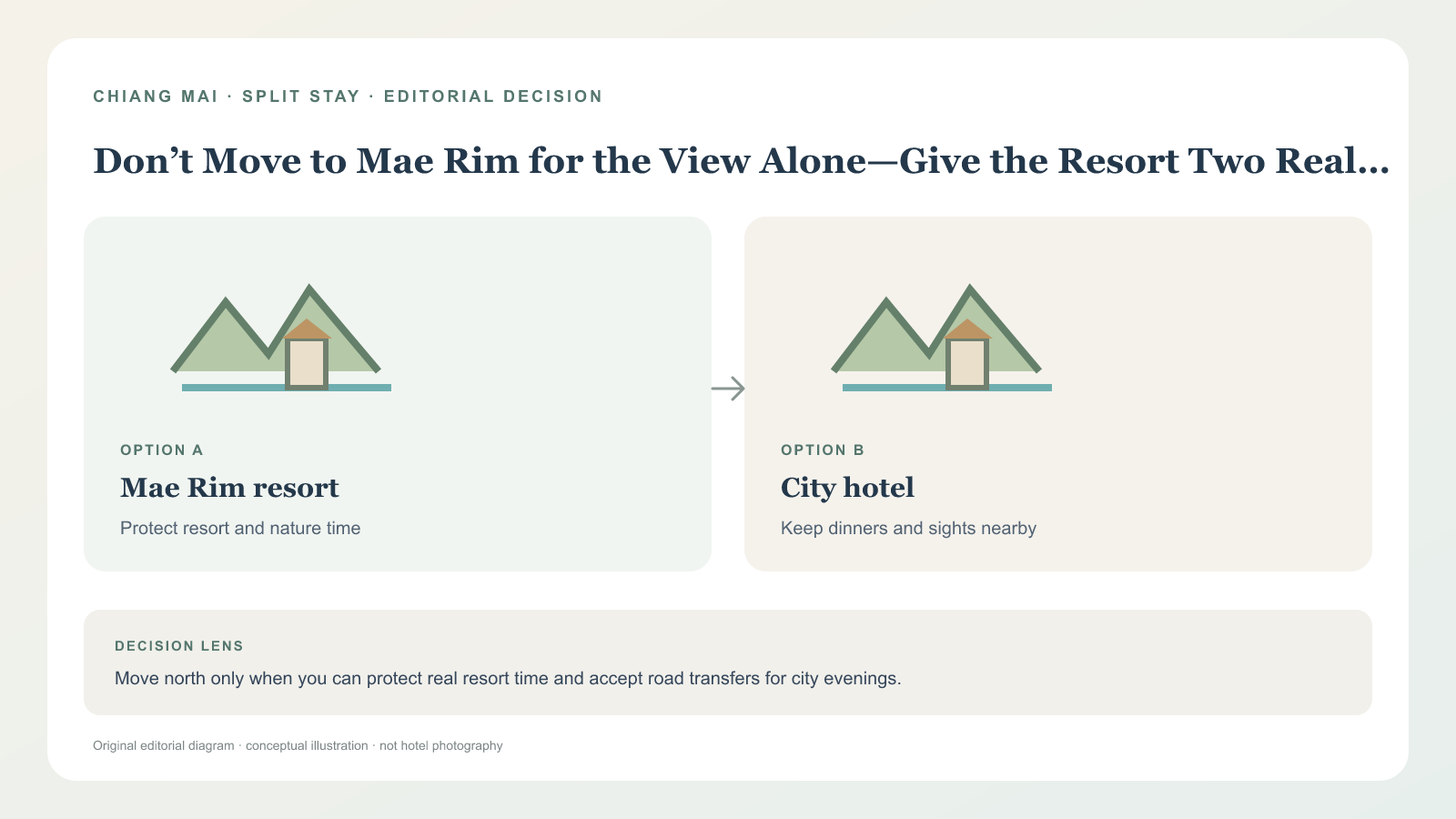
This is not the same decision as riverside resort vs central Chiang Mai hotel. A riverside stay can still behave like part of the city. Mae Rim is a more deliberate move outward. Tourism Authority of Thailand currently places Queen Sirikit Botanic Garden in Mae Rim and describes it as about a 30-minute drive from Chiang Mai city; its current self-driving Chiang Mai itinerary also treats the botanical garden and other northern sights as a road-based block rather than a walk-out city day. That matters because the accommodation decision changes both your transport needs and the scenery around you.
The 30-second answer: use the two-block gate
Choose a Chiang Mai city hotel when most days begin or end in the Old City, Nimman, Tha Phae, Night Bazaar or other urban areas; when dinners are spontaneous; when you dislike arranging rides; or when the trip is only three to four nights.
Choose a Mae Rim resort when the resort itself is one of the reasons for the trip: pool, spa, gardens, quiet breakfast, on-site dinner, villa time, or simply a slower countryside rhythm. It becomes much easier to justify when at least one nearby Mae Rim-area day is also part of the plan.
Use a split stay only if you can protect two real blocks for Mae Rim: for example, arrival afternoon + evening and the following morning; or a full resort afternoon plus a countryside day. If every Mae Rim hour is interrupted by rides back into the city, the split is working against itself.
Stay planning
Find a place to stay
See available rooms around the property or neighborhood discussed here, with prices for your dates.
Choose Mae Rim when resort time adds something to the itinerary
The strongest reason to move out is not that the resort looks more peaceful online. It is that your behavior changes after check-in.
Property time
You arrive early enough to swim, use the spa, sit in the garden, have dinner on-site, or simply spend an unhurried evening without immediately ordering another car into town. If the hotel is only used after 9 p.m., this block does not exist.
Mae Rim / countryside time
You are already planning Queen Sirikit Botanic Garden, Mon Cham direction, countryside cafés, gardens or another north-of-city day. In that case the overnight move can reduce the feeling that every rural activity is an out-and-back excursion from the city.
Slow morning
You wake without needing to cross town. Breakfast, pool time or a quiet first hour becomes part of the reason you moved. This is also where the breakfast-included vs room-only decision can flip: breakfast is more useful when the property genuinely owns the morning.
City return
You still want dinner in Nimman, a night market, a late bar, an evening cooking class or repeated city stops. This is the block that weakens the Mae Rim case because the resort no longer removes friction; it adds another ride.
You do not need all four. In fact, Block D is the warning sign. Mae Rim works best when A, B and C dominate and the city return becomes optional.
The one-night Mae Rim move is usually the trap
A single night sounds efficient: see the countryside, sleep somewhere beautiful, return to the city. In practice, it can compress the very calm you were trying to buy.
You check out of the city, move luggage, arrive before the new room is ready or after the most useful pool hours, unpack enough to function, repack the next morning, then coordinate another transfer. One night can work when the resort itself is the main event and you are happy to do almost nothing else. Otherwise, two nights is the cleaner threshold because it creates one middle day or at least one unhurried morning that is not dominated by hotel logistics.
If you only want one Mae Rim attraction, keep the city hotel
Queen Sirikit Botanic Garden is the clearest test. TAT's current eco-tourism material places the garden in Mae Rim, about a 30-minute drive from the city, and highlights its glasshouses, nature trails and canopy walkway. The official Botanical Garden Organization site is also actively publishing 2026 updates, confirming that it remains a current Mae Rim anchor.
That is enough to justify a Mae Rim day. It is not automatically enough to justify moving hotels. If your plan is simply “go to the garden, spend several hours, return,” keeping one city hotel can be easier than turning a single outing into a luggage transfer.
The same logic applies to a first Chiang Mai trip. Our four-day Chiang Mai itinerary deliberately protects one mountain or countryside block while keeping the urban base stable. If the trip is short, the cleaner move is often to protect a road day rather than introduce a second hotel.
Mae Rim gets stronger when the city has already had its turn
A split stay works best in phases. Spend the first part of the trip in the city, then move outward after you have already done the walk-out things you would otherwise miss.
If this is your first visit, start by choosing the urban side correctly. Old City vs Nimman is the basic morning-versus-evening decision; Old City vs Night Bazaar is more useful if your biggest concern is the final walk after dinner or a market night. Once those city decisions are satisfied, Mae Rim can feel like a genuine second chapter rather than an inconvenient detour.
3 nights
Stay in the city. A resort move consumes too much of a short trip unless the resort is the entire reason you came.
4 nights
Usually stay in the city. Consider Mae Rim only if you are comfortable giving it two nights and reducing the number of city neighborhoods you try to cover.
5–6 nights
This is the sweet spot for a 2-night split. You can do the city first, then move outward without making every day a compromise.
The airport does not automatically make Mae Rim convenient
Chiang Mai International Airport currently has official Grab service and designated pickup arrangements. That makes the initial handoff workable, but it does not prove that a car will always be immediately available for the return from every Mae Rim resort at every hour. Airport availability and remote-resort pickup availability are different questions.
If you are arriving late, use our Chiang Mai Airport late-arrival guide first. For many travelers, the better sequence is still one easy city night, then a daytime move to Mae Rim after breakfast. A late flight followed by a long resort transfer gives you the transport cost without giving you any resort time that evening.
The real transport risk is the return side
Do not ask only “Can I get to the resort?” Ask how you will leave it after dinner, after rain, with two suitcases, or for a morning flight. Official airport Grab service is useful, but it should not be treated as a guarantee of on-demand pickup from an exact Mae Rim pin.
Before booking, confirm the resort’s own transfer options, whether advance booking is required, what happens for early airport departures, and whether on-site dining is available on the nights you plan to stay in. A remote-feeling resort is much easier to enjoy when you are not checking your phone every hour to see whether a ride will appear.
For solo women, the last 500 metres matter more than the district label
Mae Rim is not one single walkable neighborhood. Two resorts with the same district name can have completely different practical access. One may have a visible staffed entrance and restaurant; another may sit behind a quiet approach road with little reason to walk out after dark.
That does not make the quieter resort inherently worse. It changes the booking questions. For a solo woman, especially on a first visit, check whether you expect to walk outside the property after dinner at all. If the honest answer is no, then on-site dining, a reliable transfer plan and a staffed arrival become more important than being “near” a road on the map.
The same logic applies to two friends with luggage. If two full-size suitcases have to move twice during the trip, the split should buy something meaningful in return: a better pool, quieter mornings, countryside access or a resort experience you would actually use. Otherwise, keep the luggage still and spend the transport budget on a day trip.
Rain changes the cost of every resort transition
Rain does not automatically rule out Mae Rim. It makes small frictions more expensive. Covered pickup, a clear drop-off point, a lobby close to the vehicle entrance, on-site food and a room you are happy to spend time in all become more valuable.
This is different from choosing a central hotel, where a wet afternoon can often be rescued by moving between cafés, malls, restaurants or short rides. At a resort, the stronger fallback is often the property itself. If you would be disappointed to spend a rainy half-day there, that is a sign the resort may not be strong enough to justify the move.
| Your actual trip | City hotel | Mae Rim resort | Better lean |
|---|---|---|---|
| 3 nights, first visit, temples + Nimman + one countryside day | Keeps every urban day recoverable | Adds a hotel move for very little protected resort time | City |
| 4 nights, one botanical-garden day, dinners still in town | Easy day-trip structure | Likely creates a ride back to the city at the exact time you wanted less transport | City |
| 5 nights, 3 city + 2 resort, pool/spa and countryside planned | Strong first phase | Creates a distinct second phase with enough time to settle | Split stay |
| 6 nights, couple, resort dining and quiet mornings are part of the trip | Useful but not essential for every night | The property itself can justify the road dependence | Mae Rim for 2–3 nights |
| Solo traveler, wants spontaneous dinners and late city evenings | More flexible after dark | Requires stronger transport and on-site-dining planning | City |
Do not confuse Mae Rim with the Doi Suthep decision
Doi Suthep is a separate transport problem west of the city, not a reason by itself to move to Mae Rim. If your main out-of-center goal is Wat Phra That Doi Suthep, use our songthaew vs private car guide and keep the accommodation decision separate.
This matters because “mountain trip” can sound like one geographic cluster when it is not. Choose a Mae Rim resort because the Mae Rim/countryside phase works for your itinerary and because the hotel is worth using.
Before you book any Mae Rim resort, check these eight things on the exact pin
- What will you do between check-in and dinner? Name the actual resort time, not the marketing promise.
- What will you do the next morning? If the answer is “leave immediately for the city,” the move is weak.
- How many nights? One night needs a very strong reason; two nights is easier to justify.
- How will you get dinner? On-site, walkable nearby, resort shuttle or arranged car?
- How will you leave? Confirm airport, city and early-morning transfer options instead of assuming an app ride.
- How far is the room from drop-off? This matters with rain, luggage and late arrivals.
- Does the property still work in bad weather? If the pool closes and the view disappears, is there still a reason to stay?
- What city plan are you giving up? If you still want Nimman dinner, Sunday Walking Street and Night Bazaar on the same resort nights, keep the city base.
Who should choose Mae Rim — and who should not
Mae Rim is strongest for: couples who want a distinct slow phase; travelers with five or more nights; people who will use the pool/spa/gardens rather than merely photograph them; travelers pairing the stay with Mae Rim-area nature; and anyone happy to eat at the resort or arrange transport in advance.
Stay in Chiang Mai city if: it is your first short trip; you expect to decide dinner at 7 p.m.; you want several evening neighborhoods; you dislike moving luggage; you have an early flight after the stay; or the resort is mainly attractive because the room photo looks calmer.
If the city is still the better answer, do not treat that as settling for less. The Stay hub has the current Chiang Mai base decisions, and the Chiang Mai destination hub keeps transport, experience and itinerary choices connected so you can spend resort money only when the resort actually changes the trip.
The final rule: move only when Mae Rim becomes a phase, not a detour
If you can describe the Mae Rim part of your trip as “two nights where we slow down, use the property and spend one day in the countryside,” the split has a job.
If you describe it as “one night because the resort looks nice, then back to Nimman for dinner and into the city again tomorrow,” keep one Chiang Mai hotel and make Mae Rim a day trip.
Sources checked
Sources checked 10 August 2026: Tourism Authority of Thailand, Chiang Mai destination; Tourism Authority of Thailand, Queen Sirikit Botanic Garden / eco-tourism feature; Tourism Authority of Thailand, current self-driving Chiang Mai itinerary; Botanical Garden Organization, Queen Sirikit Botanic Garden current site; Airports of Thailand / Chiang Mai International Airport, official Grab service information. The approximate city-to-garden drive is a starting point; actual time depends on the exact property, traffic and weather. No individual hotel, resort, tour or bookable activity is named or evaluated on this page, so the exact-property OTA/official image gate is not triggered; no generic or misleading hotel image has been used.
Stay planning
Find a place to stay
See available rooms around the property or neighborhood discussed here, with prices for your dates.