
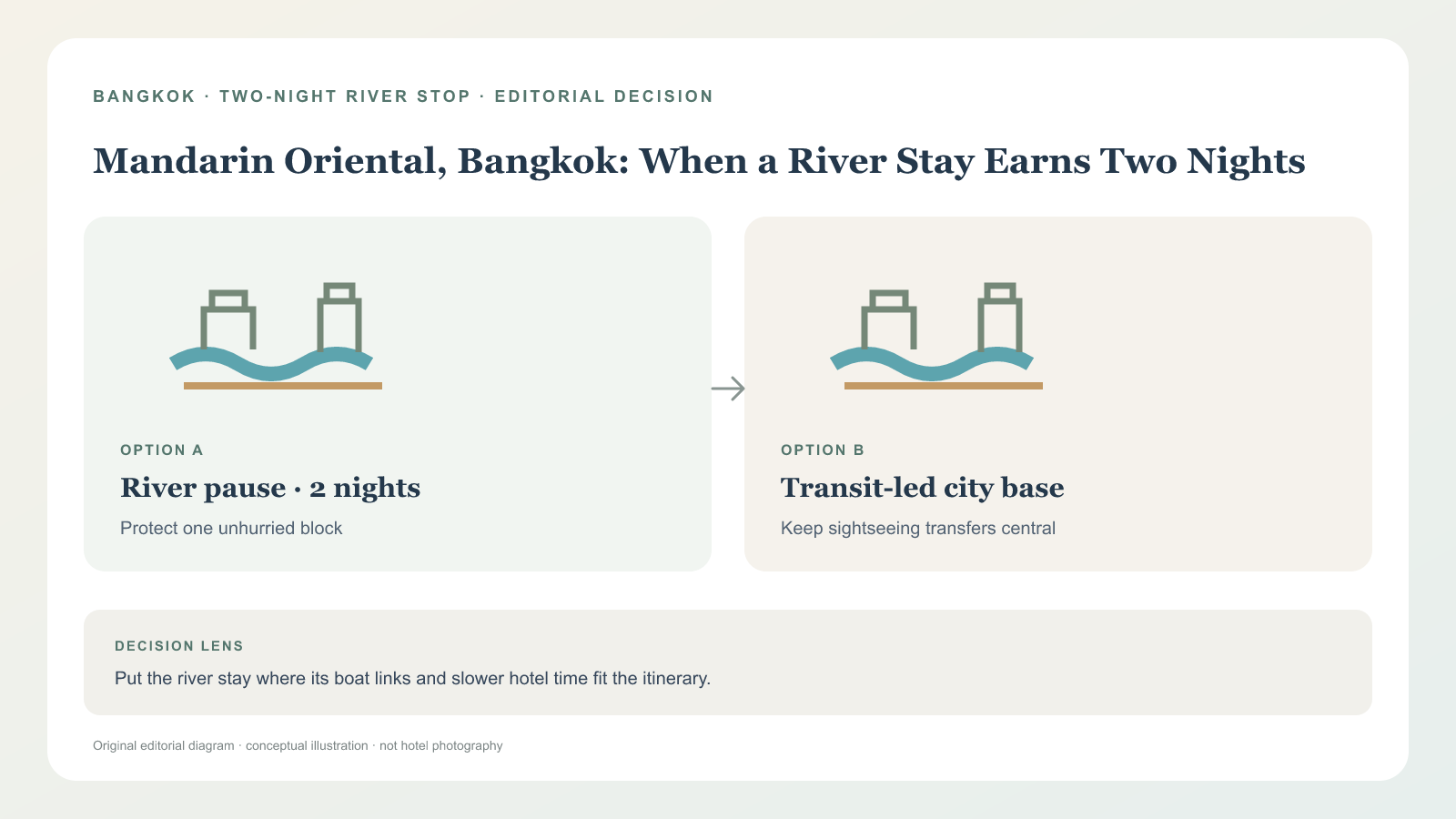
The short answer: two nights, with one open half-day
At Search places to stay, the useful upgrade is time around the hotel, not simply a more elaborate room. One night can feel compressed by arrival, a dinner reservation and the next morning’s checkout. Two nights create a full day when the pool, breakfast, river and neighborhood can shape the plan. If your only available window is a late arrival followed by a dawn departure, keep the river hotel for another trip and compare the city zones in our Bangkok stay-area guide.
This is a question of itinerary placement more than hotel ranking. The property sits at 48 Oriental Avenue in Bang Rak, on the Chao Phraya’s east bank. That position makes the river part of the hotel’s daily rhythm, while many of Bangkok’s headline sights still require a planned boat, train or road leg. If you want every transfer to begin outside a central rail station, the river address will ask more of you. If you want a hotel that can hold an afternoon without sending you out to find another activity, it has a clearer role.
Stay planning
Find a place to stay
See available rooms around the property or neighborhood discussed here, with prices for your dates.
Why the middle of a trip is often the better slot
Put the stay after your first run of temples, markets and neighborhood wandering. A two- or three-night central stretch gives you room to learn Bangkok’s scale before switching pace. On arrival, the hotel can be a calm landing; in the middle, it can be a reset; on the final night, it can become a polished send-off. The middle option is the most forgiving because you are less likely to spend its best hours recovering from a long-haul flight or watching the clock before an airport transfer.
For a first visit, I would not build every night around this one address. Start with the practical differences in riverside Bangkok versus Sukhumvit and Siam versus the river. Then assign the Mandarin Oriental nights to the part of the trip where returning to the hotel is a feature, not a detour. That might mean spending a morning in the old city, returning for a swim and a slower lunch, then making dinner the evening’s main plan.
A one-night stay can still make sense for a celebration or a deliberate hotel night. Treat it as a contained experience: arrive early enough to use the public spaces, book the room category that matters to you, and avoid stacking a far-flung excursion on either side. For a multi-night Bangkok visit with temples, shopping and food stops spread across town, a second night reduces the feeling that you paid for a setting you barely saw.
Read the river as a route, not as a view
A river-facing room can make the Chao Phraya visible from your own space, but the larger benefit is how the water changes the options around your stay. The hotel operates a complimentary shuttle boat to ICONSIAM, a useful link for a meal or a few hours across the river. It does not turn every Bangkok destination into a water-side arrival. Before you set the day, decide whether each stop is best reached by boat, BTS, taxi or a mix, and account for the walk between the pier and the actual destination.
The connection that matters most depends on the day. For river attractions, boats can make the journey part of the outing. For a BTS-led day, the property is not the same as sleeping beside an elevated station; the transfer to a station or pier still takes time and coordination. This is where a quick map glance can mislead. A point may look close across water yet need a bridge, a pier change or a road ride. Build the movement around actual boarding points rather than straight-line distance.
Use our Bangkok river and canal boat comparison when the boat is part of the sightseeing plan, and keep the hotel-near-transit trade-off in view for nights when a train connection matters more than river atmosphere. If the itinerary is dominated by repeated cross-town trips, a less expensive central base may return more usable time.
Let the hotel carry one part of the day
The property’s own dining range is substantial: the current hotel directory lists options from all-day dining at The Verandah to Thai meals at Baan Phraya and Sala Rim Naam, plus the Bamboo Bar and other venues. That variety is useful when weather, energy or a late return makes another cross-city dinner feel like work. It is not a reason to eat every meal on-site. A Bangkok trip loses local texture if the hotel’s convenience replaces neighborhood food by default.
Make the choice in sequence. Keep one evening for an on-property meal or drink, especially if you have a reservation you care about. Use the other night to explore Bang Rak or connect the hotel with another area. The BACC versus Jim Thompson House guide helps with a different, more central art-and-house day; it also illustrates why this hotel is best treated as a distinct chapter rather than a launch point for every activity.
Breakfast timing can also affect the morning. The hotel currently lists à la carte breakfast at The Verandah from 6 a.m. to 11 a.m., with buffet hours that vary by weekday and weekend. If you have a timed temple visit or a long-tail boat departure, check the meal plan and opening window attached to your booking rather than assuming breakfast fits around any start. A leisurely meal is a genuine part of the stay only when it does not make the rest of the day rushed.
Editorial fit scores
These are trip-fit judgments based on the hotel’s published location, room and dining details—not guest-review averages. Higher means this feature is especially useful for the two-night river-stay decision.
Choose the room for the hours you will use it
The hotel’s current room mix includes 43-square-meter Deluxe Premier Rooms in the River Wing, with king or twin beds, a sitting sofa, floor-to-ceiling windows and river or city views. Other categories add a balcony, a separate living area, or more suite space. That gives you a practical decision ladder: pay for a feature that changes how you spend the day, not for a longer room name.
If the room is mostly a base between outings, prioritize bed configuration, view direction and the bathroom setup that matter to your group. A balcony becomes more valuable when you expect to spend quiet time in the room; a separate sitting or dining area matters more for a longer stay or a work break. The largest suite is not automatically the best use of the budget if you will leave after breakfast and return near bedtime.
Traveling with friends or relatives? The hotel already has dedicated guides for connecting rooms versus Garden Wing rooms and the Oriental Two-Bedroom Suite for six. Those pages handle who sleeps where. This decision is earlier in the chain: whether to put this property into the itinerary at all, and how many nights its setting can realistically shape.
These two licensed interiors are archival images from 2009, so use them to understand the property’s photographed room history, not as a promise of today’s finishes or an exact representation of a current bookable category. Current room names, layouts and inclusions should be matched to the room attached to your dates. The hotel’s room pages and virtual tours are more useful for the final category check than a single image detached from its date.
Build a two-day rhythm that survives Bangkok traffic
Arrival day
Keep the first plan close to the hotel: settle in, take a short river outing if timing allows, and reserve dinner only after you know your arrival window. Do not schedule a cross-city attraction against an uncertain transfer.
Full day
Choose one main area, not a chain of distant stops. The river can carry one leg; use road or rail for the rest. Return to the hotel early enough to use the room, pool or an unhurried meal.
Departure day
Keep checkout and the airport transfer realistic for your flight. If your departure is very early, compare the cost and sleep benefit of moving closer to the airport the night before.
This rhythm works for couples who want a slower hotel interlude, travelers celebrating a milestone, and repeat visitors who have already seen the central landmarks. It can also suit a short stay after a more transit-heavy first leg. It is a weaker match for a family trying to cover several child-led attractions each day or a first-time visitor with a tightly packed list. In either case, the river hotel may be more satisfying as a single celebratory night than as the trip’s only base.
For a classic old-city day, use the Bangkok experiences index to choose one anchor and build around it; the Bangkok stay collection can then help you decide whether the remaining nights should sit closer to transit. If your flight makes airport timing the main constraint, begin with the Thailand transport guides and leave a separate buffer for road conditions. A river view does not shorten a departure transfer.
When another Bangkok base is the better call
Choose a more central or rail-oriented hotel if most of your plans begin far from the river, you want to return to your room between several short outings, or your group prefers to decide dinner at the last minute in a dense restaurant district. That is not a verdict against the hotel; it is a mismatch between the itinerary’s movement pattern and the river address. A premium location only earns its role when you make use of what that location changes.
Also consider splitting the stay only if the move has a real purpose. One central night followed by two river nights can work when the first day is arrival-heavy and the later days are slower. Two or three short hotel hops across Bangkok usually create extra packing, checkout and car waits without solving a meaningful problem. Keep the number of bases low unless an early flight, event or change in trip pace makes the switch worthwhile.
Families who need adjacent sleeping spaces can compare the property’s room configurations before splitting rooms; our Bangkok family-stay decisions are a useful starting point. For a broader neighborhood reset, return to where to stay in Bangkok and choose one base that reduces the journeys you repeat most often.
Before you commit the two nights
Match the exact room name and bed setup to your travelers, then confirm whether breakfast is included and which dining venues are open on your dates. The hotel currently lists seasonal closures for some restaurants, so an attractive on-site choice may not operate during every visit. Check the shuttle boat’s current destination and operating hours against the day you want to use it; service details can change.
Next, put your likely sights on a map with their actual piers and rail stations. If this reveals a string of road transfers, reserve the river hotel for the part of the trip when you can slow down. If one of your two days already includes a river excursion, an open afternoon at the hotel may be enough to make the location coherent. For a first trip with little flexibility, choose the area that cuts your repeat journeys instead.
For exact dates and occupancy, Search places to stay, then compare the named room, bed type, breakfast, cancellation terms and transfer details as a single package. The river stay earns two nights when you can name the hours it will give back: one unhurried morning, an evening that stays on the river, or a full day with no pressure to keep crossing the city.
Sources and image credits
- Mandarin Oriental, Bangkok official room page: Deluxe Premier Room (room area, wing, views, bed types and amenities).
- Mandarin Oriental, Bangkok official dining directory (venues, meal windows and current seasonal closures); official hotel overview (address, room count and shuttle-boat service to ICONSIAM).
- Mandarin Oriental, Bangkok official rooms and suites for current room-category descriptions. No guest-review averages are used in the editorial scores above.
- Guest-room image: Executive Suite interior, Mandarin Oriental Hotel Group, 2009, CC BY-SA 3.0; permission confirmed via Wikimedia VRT ticket 2010052710032299. Guest-room image: Somerset Suite interior, Mandarin Oriental Hotel Group, 2009, CC BY-SA 3.0; same permission archive ticket. Both are archival depictions; changes: resized for display.
- Context image: Mandarin Oriental, Bangkok exterior, Mandarin Oriental Hotel Group, 2009, CC BY-SA 3.0; permission confirmed via Wikimedia VRT. Context image: Chao Phraya river view, Supanut Arunoprayote, CC BY 4.0; hotel is identified within the panorama. Images resized for display; no other edits.
- License links: CC BY-SA 3.0 and CC BY 4.0.


Sources checked
Last verified: October 6, 2026. Commercial accommodation links may earn a commission.
Stay planning
Find a place to stay
See available rooms around the property or neighborhood discussed here, with prices for your dates.