
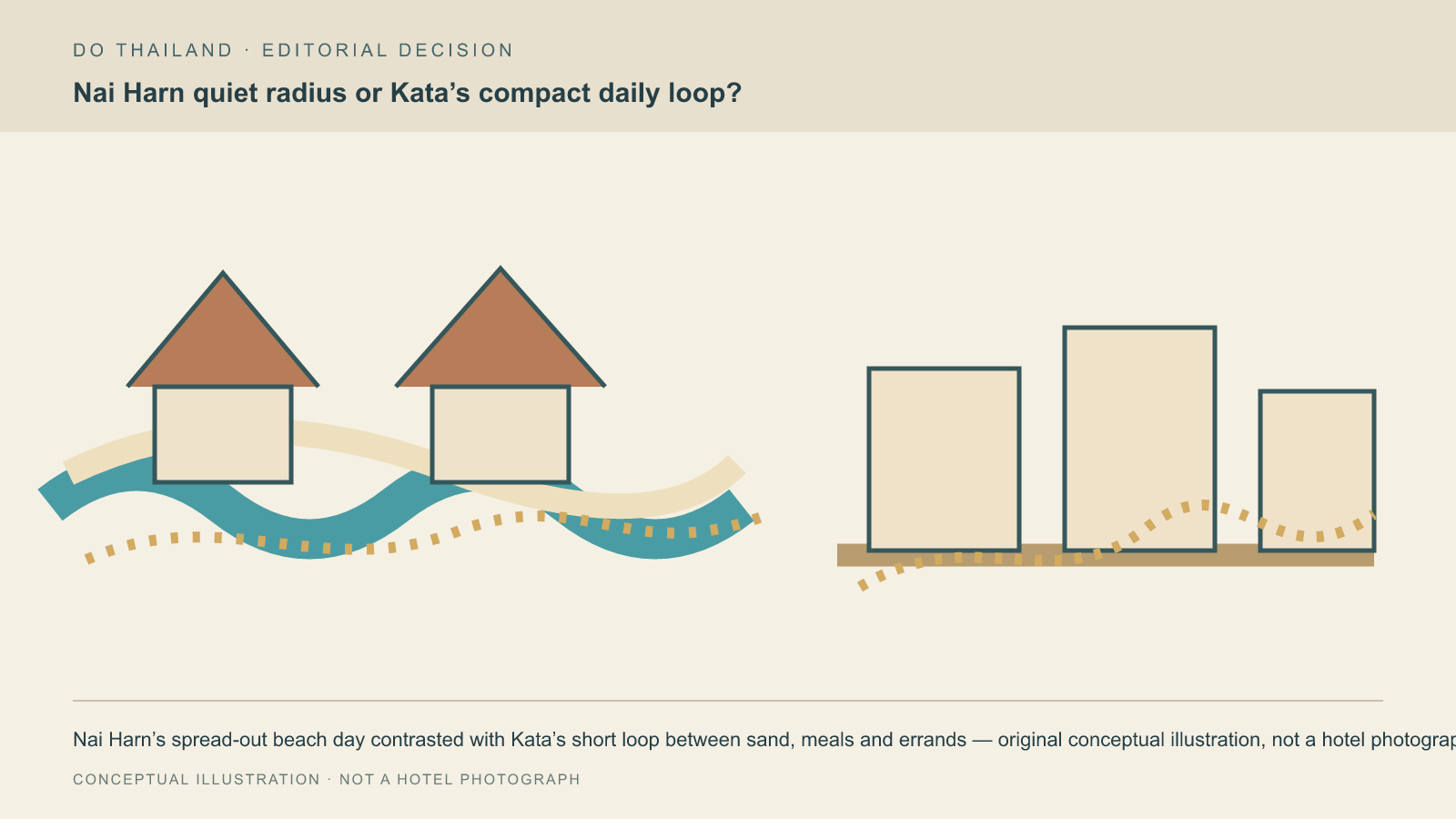
If your Phuket shortlist has reached Nai Harn versus Kata, you have already moved beyond the usual Patong-or-not debate. Both put you on the island's south-west side, both can deliver serious beach time, and both can work without renting a scooter. But they solve different versions of the holiday. Kata is a beach town that is designed to keep many small visitor decisions nearby. Nai Harn is stronger when you actively want fewer small decisions and are happy to make the occasional ride count.
If you are still comparing Phuket at a broader level, start with where to stay in Phuket. If Kata is already the likely answer, the narrower Kata vs Karon guide solves a different problem: compactness versus Karon's longer beach geography. And if you are deciding between the two Kata beaches, use Kata Yai vs Kata Noi rather than treating all of Kata as one hotel zone.
Use a movement budget, not a beach ranking
Before you open hotel filters, count how many independent exits you expect on a normal non-tour day. Do not count the big excursion you planned weeks ago. Count the tiny movements that decide whether a base feels easy.
Nai Harn starts to make sense
You are happy with a long beach block, hotel time, one planned meal or outing elsewhere, then a quiet return. Transport is something you choose once, not something you renegotiate every two hours.
Kata is usually the safer choice
You expect coffee, beach, room reset, a shop, a spontaneous dinner and maybe a massage or drink afterwards. A base that keeps more of those decisions local usually ages better.
That is the real split. Phuket Province's visitor information describes Kata as a center for shopping, accommodation, entertainment and tour companies. Nai Harn is described around the beach itself, its freshwater lagoon and nearby bays, with Rawai about three kilometres away. Neither description makes one place objectively better. They reveal what each area is good at carrying without additional planning.
Stay planning
Find a place to stay
See available rooms around the property or neighborhood discussed here, with prices for your dates.
Nai Harn works when quiet is allowed to reduce the itinerary
Nai Harn sits north of Promthep Cape with a large freshwater lagoon behind the beach. The provincial visitor page also places Rawai roughly three kilometres away and identifies Ao Sane as a tiny bay next to Nai Harn. Ya Nui is another small cove on the south-coast road between the Windmill viewpoint and Promthep Cape. Those places make the wider south feel interesting, but they are better understood as deliberate little outings, not proof that everything will be outside your room on foot.
This is why Nai Harn can be excellent for a couple finishing a busy Thailand trip, a solo traveler who genuinely wants two slow mornings, or anyone who gets tired of turning every beach stay into a checklist. The beach, the room and perhaps the pool do more work. A lunch can remain a lunch rather than becoming a reason to cross the island. One planned ride to Rawai can feel like a change of scene rather than transport failure.
Nai Harn has a useful south-Phuket radius — but it is still a ride-out radius
Rawai, Ao Sane, Ya Nui and Promthep Cape can all broaden a Nai Harn stay. The mistake is using their proximity as a substitute for checking the exact hotel pin. A place can be “near Nai Harn” and still create a final road segment, hill or entrance that you would not want to repeat casually in heat or rain.
Book Nai Harn because you are comfortable planning those movements.
If that sounds a little too hotel-dependent, compare the northern quiet-beach decisions too. Nai Thon vs Surin asks how much backup radius you want when the sea is rough, while Nai Thon vs Nai Yang separates retreat-style quiet from a quieter base that preserves more airport-side flexibility.
Kata is easier when you like changing your mind after check-in
Kata's advantage is not simply that it is busier. It is that more of the ordinary visitor infrastructure is already part of the area. Phuket Province explicitly lists shopping, accommodation, entertainment and tour companies around Kata. That makes it a more forgiving first-trip base when you do not yet know which two restaurants, which massage shop or which departure-day errand will end up mattering.
A self-contained base becomes valuable in small moments: your tour is back earlier than expected; it rains just as you planned to walk to the beach; one person wants dinner and the other only wants fruit and water; you decide at 9 p.m. that tomorrow's boat day needs sunscreen, cash or a different pickup plan. None of those events is dramatic. Together, they determine whether you keep arranging rides for trivial reasons.
Kata also has a stronger case for travelers who are nervous about making a scooter rental part of the holiday. If your hotel choice seems to work only after adding “we can just rent a scooter,” stop and read Phuket scooter vs Grab. Transport should support your preferred base, not rescue a hotel whose geography does not fit your actual comfort level.
Public transport gives Kata a cleaner headline, not a door-to-door guarantee
The current Phuket Smart Bus Airport–Rawai route names Kata as a major stop and continues south through Sai Yuan to Rawai. Its published timetable likewise runs Airport → Patong → Karon → Kata → Rawai. That gives Kata a straightforward place on the west-coast public-bus corridor.
For Nai Harn, separate the corridor from the final hotel leg
The current Smart Bus route does not list “Nai Harn” as one of its headline major stops. That does not mean public transport can never form part of a Nai Harn trip. It means the final transfer from the corridor to your exact hotel deserves its own check rather than being assumed away.
If you expect to use Smart Bus repeatedly around Kata, compare it with app-based rides in our Patong to Karon or Kata: Smart Bus vs Grab guide. Timetables and traffic can change, so check the operator again close to travel.
Airport convenience alone should not decide this beach choice. If Phuket is one half of a wider Andaman route, solve the gateway question first with Krabi or Phuket Airport. There is little value optimizing the last kilometre of a hotel stay if the larger arrival route is still wrong.
When the sea is rough, the base starts doing more work
Phuket's provincial guidance specifically warns that swimming at Nai Harn is not recommended from May to October because of strong currents. Tourism Authority of Thailand also tells Phuket visitors to notice red flags before swimming at major beaches. Local beach flags and on-the-day conditions always outrank a hotel plan.
This matters to the Nai Harn-versus-Kata decision because bad weather changes what you need from the area. If the beach is temporarily off the table, Kata's visitor infrastructure can absorb more of the day without requiring a full rethink. Nai Harn can still be satisfying, but only if the hotel, immediate surroundings and your willingness to make one deliberate ride are enough.
Do not turn that into “Kata is better in rain.” A good Nai Harn property with comfortable common areas, covered drop-off, food you actually want to eat and a room you enjoy using can outperform a badly located Kata hotel. The point is to judge the whole day rather than the sunny hero image.
For women traveling alone, test the return before the beach
Quiet can be a feature without becoming accidental isolation. Before paying, zoom in on the final approach to the exact hotel and ask four practical questions:
- Where will a Grab, taxi or hotel car actually drop me and collect me?
- Would I be comfortable waiting at that point after dark or in heavy rain?
- Does the last stretch involve a hill, road shoulder, poorly lit bend or set-back entrance?
- If dinner changes at 9 p.m., am I happy arranging one more ride — or did I expect to walk out?
Kata does not automatically pass this test and Nai Harn does not automatically fail it. The hotel pin is more important than the neighborhood label.
Which traveler should choose which beach?
| Trip shape | Better default | Why |
|---|---|---|
| First Phuket trip, 3–4 nights, no scooter | Kata | More ordinary visitor needs can remain local, so fewer small decisions become rides. |
| Couple finishing a busy Thailand itinerary | Nai Harn | A smaller rhythm can feel intentional when beach, hotel and one planned outing are enough. |
| Solo traveler who wants editable evenings | Kata | The base is generally better aligned with browsing, errands and changing dinner plans, subject to the exact hotel approach. |
| Beach-and-hotel reset with one south-coast outing | Nai Harn | Rawai, Ao Sane, Ya Nui or Promthep can work as deliberate additions rather than constant escape routes. |
| Several tours plus independent dinners | Kata | When the hotel is mainly a launchpad, a self-contained visitor base usually earns more of its location. |
| You have found a dramatically better room in Nai Harn | Maybe Nai Harn | Only if the room or property advantage is large enough to repay the repeated transport you will actually use. |
Do not compare room prices until you price the movement
A cheaper Nai Harn room can be poor value if your real trip needs two extra rides every day. A more expensive Kata room can also be poor value if you intend to spend the whole stay beside the pool and leave once for sunset. The correct comparison is not nightly rate versus nightly rate. It is room + repeated movement + the time and attention that movement consumes.
Before booking either area, open the exact property map and make a one-day route with real pins: breakfast, beach access, one midday need, dinner, final return. Then count the transitions. If the Nai Harn version still looks calm, you are buying the right kind of quiet. If the Kata version keeps most of the day compact without feeling too busy, you are buying useful flexibility.
If you are still deciding how much quiet you want across Phuket, Nai Yang vs Mai Khao is the north-coast version of a related problem: independent beach-base flexibility versus a more resort-led radius. Use the Phuket destination hub to see the rest of the live beach and transport comparisons.
Book in this order
- Choose your movement budget: one deliberate ride or several small exits?
- Choose the area: Nai Harn for intentional quiet, Kata for more self-contained flexibility.
- Audit the exact hotel pin: entrance, road, hill, drop-off point, dinner and beach route.
- Check the weather-season fallback: what will you do if swimming is not sensible that day?
- Only then compare room categories and live OTA availability.
The final deciding question is simple: on an ordinary day, do you want to leave your beach-and-hotel radius once on purpose, or do you want to step out two or three times without arranging another ride? If it is once, Nai Harn can be exactly the reset you want. If it is two or three times, Kata is usually the more forgiving base.
Sources checked
Stay planning
Find a place to stay
See available rooms around the property or neighborhood discussed here, with prices for your dates.