
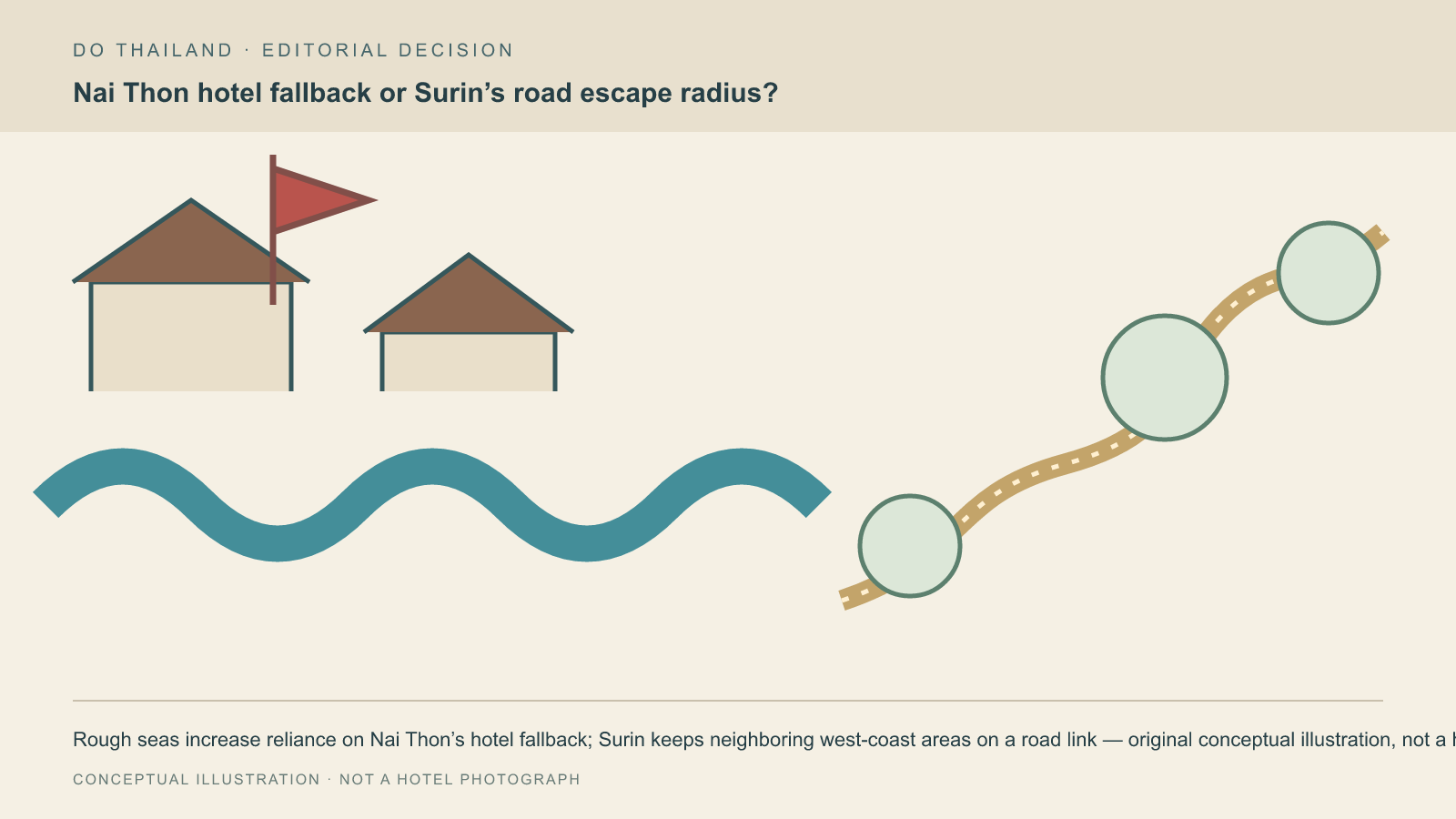
If your shortlist is already down to these two beaches, you are not choosing between “busy Phuket” and “quiet Phuket.” You are choosing between two different ways of being quiet. Nai Thon sits inside the Sirinat National Park coastline in Phuket's north-west. Surin sits farther south, between the Bang Tao and Kamala side of the west coast. The decisive question is not which sand looks better in a sunny photograph. It is what happens to your day when swimming, sunbathing or a long beach session stops being the obvious plan.
That question matters because the official Phuket visitor pages warn against monsoon-season swimming at both beaches: Nai Thon because of strong currents, and Surin because of strong waves and stormy conditions. A red flag or rough sea can therefore erase the activity that made both places look simple on paper. Your backup radius suddenly becomes part of the accommodation decision.
The one test that separates Nai Thon from Surin
Imagine you wake up to rough water, intermittent rain and no appetite for a long transfer. Which version of the day sounds less disappointing?
Nai Thon: stay small on purpose
Breakfast, room, pool or spa if your hotel has them, a slow lunch, a short local walk, reading, another meal nearby or on property. The hotel carries more of the value because you chose the area to reduce movement.
Surin: keep an escape radius
Use the beach when it works, but retain a more connected west-coast position for a deliberate ride toward Bang Tao or Kamala when you want a larger dinner, shopping or a different evening.
If the Nai Thon version sounds restful rather than restrictive, it is probably the better fit. If the Surin version sounds reassuring rather than unnecessarily busy, Surin is more likely to age well across three or four nights.
Stay planning
Find a place to stay
See available rooms around the property or neighborhood discussed here, with prices for your dates.
Nai Thon is better when “nothing much” is part of the purchase
Phuket Province describes Nai Thon as a curved bay suited to relaxing and swimming when conditions are safe. The same official page routes access through the airport-side road network and then down to the beach. That geography tells you how to use the place: Nai Thon is strongest when you are not planning to make repeated cross-island or south-coast movements just because you became bored after sunset.
This is why Nai Thon can suit a couple taking a deliberate reset, somebody finishing a busy Thailand itinerary, or a traveler who values two genuinely slow mornings more than a large choice of evening venues. A smaller radius is not automatically inconvenient. It becomes inconvenient only when your actual behavior keeps asking it to function like a town.
The hotel therefore matters more here than it would in a denser beach base. Before paying, inspect the things you would normally dismiss as secondary: covered common space, whether you would actually use the pool, a room you can comfortably spend an hour in during rain, meal options you would not resent using twice, and a straightforward vehicle pickup point.
If that sounds too hotel-dependent, compare Nai Thon vs Nai Yang. Nai Yang answers a different northern-Phuket question: how to keep a quiet beach while preserving easier airport-side flexibility.
Surin is better when quiet still needs an exit door
Surin is also officially described as a quiet beach, with clear water and white sand, but its road context is different. Phuket Province's Bang Tao directions place Bang Tao about two kilometres from Surin by road, while the Surin directions also describe access via Kamala. That does not make Surin a walkable lifestyle district, and it does not promise a fixed transfer time. It does mean your quiet beach is positioned between other established west-coast areas rather than at the end of a deliberately smaller northern beach rhythm.
For a traveler without a scooter, that distinction is useful. You may still use Grab, a taxi or hotel transport, but a backup dinner or change of scene can remain a local west-coast decision instead of becoming a larger island move. If you already know that two of your evenings will involve a different restaurant area, or that a rainy afternoon will make you want shops and cafés rather than another hotel hour, Surin gives the itinerary more places to bend.
Do not exaggerate that advantage. Surin itself is not Kamala or Bang Tao. Our Kamala vs Surin guide explains why Kamala remains the safer choice if you want more everyday walk-out independence. And if you actually want the larger resort-and-lifestyle ecosystem farther north, use Bang Tao vs Kamala rather than asking Surin to imitate Bang Tao.
The wrong question is “which beach has more nearby restaurants?”
Restaurant counts age badly and do not solve the decision anyway. The useful issue is how many times you expect to need a different radius. One excellent dinner next to your hotel can be enough on a two-night retreat. Ten places on a map are irrelevant if you plan to eat on property. Conversely, a beautiful hotel can start to feel confining if you discover at 19:00 every night that you actually like choosing where to go.
Before booking, open the exact hotel pin and test three moments: the walk or vehicle handoff after dark, the route you would use in rain, and the nearest realistic fallback meal. Do not measure only straight-line distance to the beach. In Phuket, an entrance on the wrong side of a road, a hillside drive or a property set back from the useful part of the area can change how the stay behaves.
If your plan relies on renting a scooter simply to make the hotel location workable, read Phuket scooter vs Grab before you finalize the room. Transport should support a good base choice, not rescue a base that does not match your comfort or riding experience.
Bad weather does not make either beach a bad choice — but it exposes a bad match
The official monsoon warnings are not an argument against staying at Nai Thon or Surin. They are a reason to stop treating the sea as guaranteed inventory. Conditions change day by day, and local red flags always outrank a travel plan.
For women traveling alone, this is also when small practical details become more important: where a ride actually collects you, whether you are comfortable waiting there after dark, whether the entrance is visible from the road, and whether your fallback dinner requires a poorly lit walk. “Quiet” should not be shorthand for “isolated in a way you did not choose.”
Choose Nai Thon if your hotel is part of the destination
Nai Thon is the more coherent answer when you want to wake up and repeatedly use the same small set of places without feeling that you are missing Phuket. It particularly suits a stay where one or more of these statements are true:
- You are deliberately taking two or three slower days after a busier city or island sequence.
- You care more about repeating the beach and hotel than adding restaurants every night.
- You would still like the property if the sea were too rough to swim for part of the stay.
- You are comfortable planning the occasional ride rather than expecting every evening to remain editable on foot.
If airport proximity and a little more evening flexibility matter more than the retreat feeling, Nai Yang vs Mai Khao and Nai Yang vs Bang Tao for a first or last night are more useful comparisons than forcing Nai Thon into that role.
Choose Surin if you want calm without shrinking the whole trip
Surin is the more forgiving choice when the beach matters a lot but you do not want every non-beach decision to become a major event. It works especially well when you plan to spend mornings and late afternoons near the sea but expect at least a few deliberate rides for dinner, shopping or another west-coast area.
That makes Surin a useful bridge between smaller-beach calm and the more connected choices farther south and north. It is still not the answer for travelers who want a dense walk-out town every night. If that is your real preference, look at Kata vs Karon without a scooter. If you want an integrated resort district rather than a smaller beach zone, compare Laguna Phuket vs Cherng Talay.
You want the holiday to contract
The beach and hotel are the destination, repeated rides feel like noise, and a rough-sea day would still feel restorative if the property itself is somewhere you want to spend time.
You want the holiday to stay editable
You still want a quiet beach, but a changed weather day or spontaneous dinner should be able to expand into another west-coast area without feeling like you have abandoned the logic of your base.
What to check before you open the OTA tabs
First decide which failure mode bothers you more. In Nai Thon, the risk is discovering that you wanted more external choice than the small radius gives you. In Surin, the risk is assuming “more connected” means everything you want will be walkable from the hotel door. Neither beach name can solve an inconvenient property pin.
Then check the booking map at the actual entrance; area labels can cover a wide radius. Look for the road you would use at 21:00, the pickup point in heavy rain, how you would reach a fallback meal, and whether the hotel has enough indoor or covered value for a weather-disrupted afternoon. Only after those questions are answered should you compare room categories and rates.
Choose the beach radius first, then compare exact hotel pins within it. The better area is the one that still fits your plans when the sea is rough and swimming is off the table.
Stay planning · compare the beach bases
Search stays near Nai Thon and Surin
Check the exact hotel pin against the beach, bad-weather alternatives and the routes you expect to repeat.
The final call
Nai Thon wins when the smaller world is the product. Choose it when you want a deliberate retreat and your hotel can carry the day if beach conditions turn. Surin wins when you want quiet without giving up a practical escape radius. Choose it when a few weather-driven or dinner-driven rides toward neighboring west-coast areas sound useful rather than annoying.
If neither sounds right because you want to walk out to more choices most evenings, return to Where to Stay in Phuket and widen the shortlist before you book.
Keep the Phuket decision chain moving
For another quiet-beach comparison, use Nai Thon vs Nai Yang. To move south, compare Kamala vs Surin. To test whether you actually want a larger beach ecosystem, read Bang Tao Beach vs Boat Avenue. And if transport is starting to dictate the accommodation choice, use Phuket scooter vs Grab before making the hotel do work your transport plan should have solved.