
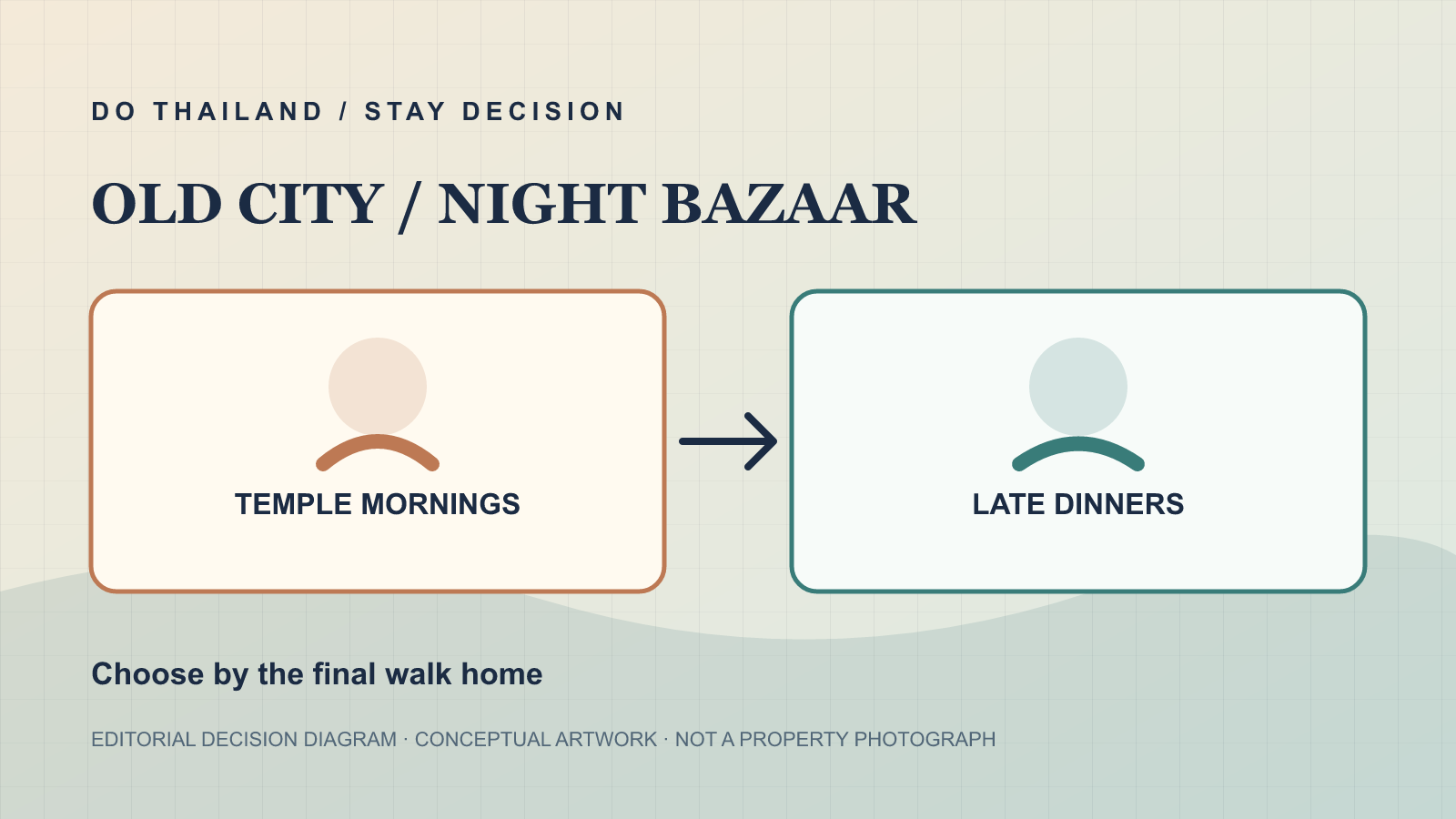
This is not a repeat of our Old City vs Nimman comparison. Nimman is a contemporary west-side lifestyle choice. Night Bazaar / Chang Khlan is an east-side evening-and-handoff choice. The overlap is small enough that a first-time traveler can make a genuinely different decision: heritage-core mornings versus a base that keeps more night-market, Chang Khlan and airport-route logistics on the same side of town.
If you are still mapping the whole trip, open the Chiang Mai four-day itinerary beside this page. Mark each day with the place where you expect to finish after dinner. Your hotel decision becomes much clearer once you stop counting attractions and start counting late returns.
The final-15-minutes test
Ignore hotel star ratings for one minute. Imagine both rooms are equally good. Now picture yourself at 9:45 p.m., a little tired, carrying a small shopping bag and deciding whether to walk, call a ride or cross one more busy road before bed.
Lean Old City. You are accepting that some evenings may end with a ride back because the payoff arrives every morning: temples, gates, old streets and short reset walks around the moat-side core.
Lean Night Bazaar / Chang Khlan. You are accepting that temple mornings may start with a walk or ride because the payoff arrives later: a more evening-oriented hotel radius and a direct connection to a corridor the airport itself uses in its transport guidance.
Stay planning
Find a place to stay
See available rooms around the property or neighborhood discussed here, with prices for your dates.
The Old City wins when you want the first half-day to require no setup
Tourism Authority of Thailand identifies Tha Phae Gate on the eastern wall as an entrance to Chiang Mai's old walled city and a gateway toward nearby temples and the Sunday Walking Street. That matters because a first visit is usually front-loaded with heritage: Wat Chedi Luang, Wat Phra Singh, smaller temples, old streets, cafés between stops and the simple pleasure of seeing the moat repeatedly rather than treating it as a destination.
The Old City advantage is cumulative rather than dramatic. You may only save one small ride in the morning, one short detour after lunch and one decision about where to stop for coffee. But on a two- or three-night trip, removing those little pieces of friction makes the city feel easier to learn.
It is also the stronger default if you enjoy returning to the hotel during the day. Heat, rain and temple-heavy mornings can make a midday reset useful. A well-placed Old City hotel lets you break the day into two walking blocks without turning the hotel return into a separate transport event.
The catch is that “Old City” is not one hotel pin. The east side near Tha Phae Gate behaves differently from the west side near Suan Dok Gate, and deep interior sois behave differently from moat-edge roads. If evening access matters, the exact pin can narrow the practical gap between Old City and Night Bazaar far more than the neighborhood label suggests.
Night Bazaar / Chang Khlan wins when evenings create more decisions than mornings
Chiang Mai International Airport's current transport pages repeatedly use Night Bazaar and Chang Khlan as route reference points. Its city-bus guidance lists Night Bazaar and Tha Phae Gate on the central loop, while the airport-shuttle guidance lists an A2 route through Night Bazaar and hotels on Chang Khlan Road. That does not mean every service will suit every arrival or that schedules cannot change. It does confirm something useful for hotel selection: Night Bazaar / Chang Khlan is an established visitor and transport corridor, not an invented hotel-booking label.
This is why the area can suit travelers who keep ending the day east or southeast of the moat. If your repeated evening is dinner, market browsing, a drink, a river-side stop or simply returning from somewhere by car, the value is not “nightlife.” The value is having more of the last leg happen in the same urban zone as your hotel.
That can be especially attractive for two friends. One person can finish shopping while the other heads back. A late dessert does not necessarily require moving the whole group again. And if the exact hotel entrance sits on a straightforward road with a visible lobby and reliable ride pickup, the end of the night can feel mechanically simple.
But do not assume every Chang Khlan pin is equally convenient. Some hotels sit directly on larger roads; others are recessed behind drives or side streets. A Night Bazaar label can still hide a weak final 300 meters. Inspect the final approach; the district name can hide a difficult last stretch.
The smartest hybrid is often the east edge, not the middle
If you want the Old City but keep worrying about Night Bazaar access, do not immediately abandon the historic core. First check hotels near the eastern moat and Tha Phae side. TAT identifies Tha Phae Gate as the eastern entrance to the old walled city, and AOT's route guidance places both Tha Phae Gate and Night Bazaar on the same central transport loop.
That does not make every east-side Old City hotel “walkable to Night Bazaar,” and we would not use a fixed walking-time claim without the exact hotel pin. It does mean the east edge deserves its own shortlist before you make a binary neighborhood decision.
Sunday is the one evening that can flip the answer
TAT's current Chiang Mai material identifies Tha Phae Walking Street as a signature Chiang Mai experience, and its Sunday-market coverage places the market from Tha Phae Gate along Ratchadamnoen Road into the Old City from around 5 p.m. If Sunday Walking Street is one of your non-negotiable plans, an Old City or east-moat base can turn that evening into a simple hotel-to-market movement instead of another out-and-back ride.
The same event can also complicate vehicle access. Streets that are perfect for walking are not always perfect for a car reaching your hotel entrance at the same time. If you check in on Sunday evening with luggage, ask the property how vehicle access changes during Walking Street hours. The best Old City pin for a pedestrian can be a worse pin for a suitcase arrival.
Use a four-block ledger instead of a generic pros-and-cons list
Old City
Better if your first block is temples, gates and wandering before the day gets hot or crowded.
Old City
Stronger when you expect to return to the room between heritage sights and a later plan.
Night Bazaar
Stronger when dinner, shopping or a Chang Khlan / east-side finish happens repeatedly.
Exact pin wins
At this point the lobby entrance, side street, pickup point and final walk matter more than the district name.
If your Chiang Mai trip is actually built around pool time, spa time or a hotel you plan to enjoy for hours, this is the wrong comparison. Read riverside resort vs central hotel instead. That decision is about whether the property itself should absorb part of the itinerary, not which urban block is easier.
Airport arrival is useful context, but it should not choose the hotel for you
Chiang Mai International Airport currently lists Grab, airport taxi, metered taxi and other ground-transport options. Its current Grab page identifies a service counter at the domestic terminal and publishes designated pickup information. So both Old City and Night Bazaar are practical arrival targets when you want a direct ride rather than improvising with luggage.
Late-arrival rule: solve reception + curb access first
If you land late, open our Chiang Mai airport late-arrival guide. The critical questions are whether reception will still be staffed, where the driver can stop, how obvious the hotel entrance is and whether you need to carry luggage down a poorly surfaced or dim side street.
Do not book Night Bazaar solely because the airport's route guidance mentions it. Likewise, do not reject the Old City because it sounds older or less vehicle-friendly. The exact hotel entrance determines the real arrival friction.
Solo women should audit the final 150 meters, not “safety” by neighborhood
It is too crude to declare either Old City or Night Bazaar universally “safer.” Both contain hotels on larger roads, hotels on quiet side streets, visible entrances and less obvious ones. What you can evaluate before booking is the repeated route you will actually use.
Run this exact-pin audit before you pay
- Open the hotel entrance in map and street imagery. Is the lobby obvious from the road, or hidden behind a driveway or side lane?
- Trace the last 150–300 meters from your likely dinner or drop-off point. Check road crossings, pavement continuity, lighting and whether you would want to repeat that approach tired or in rain.
- Check the ride pickup point. Can a Grab or taxi stop at the entrance, or will you need to walk to a larger road?
- Look at the Sunday scenario separately. If you stay near Tha Phae or Ratchadamnoen, ask how Walking Street affects vehicle access.
- For two friends, inspect room practicality too. Twin-bed configuration, bathroom privacy, mirror placement and whether two suitcases can stay open may matter more than moving the hotel 500 meters.
Do not move neighborhoods to solve Doi Suthep or Chiang Rai
A mountain day already requires transport. If Doi Suthep and Wat Pha Lat are fixed plans, use our Doi Suthep songthaew vs private-car comparison to choose the day transport. Do not choose a three-night hotel base around a journey that happens once.
The same logic applies if you continue north. Our Chiang Mai to Chiang Rai bus vs private-transfer guide handles that handoff. A one-time terminal or pickup requirement should not overrule the neighborhood you will use morning and night for the rest of the stay.
If you are still deciding how to arrive from Bangkok, solve that upstream with Bangkok to Chiang Mai sleeper train vs flight. Arrival mode changes the first few hours. Your hotel area should be chosen for the repeated hours after that.
Who should choose which base?
Choose Old City if…
You are on a short first visit, temples and historic streets dominate your list, you like starting sightseeing before breakfast turns into lunch, or Sunday Walking Street is a fixed plan. It is also the better fit if you expect to return to the room between daytime sights.
Choose Night Bazaar / Chang Khlan if…
Your evenings repeatedly finish east of the moat, you care more about dinner-and-shopping flow than temple-first mornings, you prefer a hotel corridor that airport transport guidance already recognises, or your trip works better when the final return is the simplest part of the day.
If neither description feels right, you may be solving the wrong pair. Café-heavy contemporary trips should revisit Old City vs Nimman. Property-led slow stays should revisit riverside resort vs central hotel. And if you are still unsure how many city blocks you actually have, go back to the Chiang Mai destination hub or the broader Thailand stay guides before opening OTA filters.
The booking rule
Old City is the stronger first-trip default. It puts the historical reason for visiting Chiang Mai closest to your room and makes mornings easier.
Night Bazaar / Chang Khlan becomes the better decision when your repeated friction happens after dinner, not before sightseeing. If most nights end around the market corridor or east side, making the final hotel return simpler can be more valuable than shaving friction from a temple morning.
Whichever area wins, book by the exact hotel pin — entrance visibility, final walk, pickup point and Sunday access — not by the neighborhood label alone.
Sources checked
Transport routes, pickup arrangements and market access can change. Recheck the official airport and local sources close to travel, and verify the exact hotel pin rather than relying on a neighborhood label.
Stay planning
Find a place to stay
See available rooms around the property or neighborhood discussed here, with prices for your dates.