
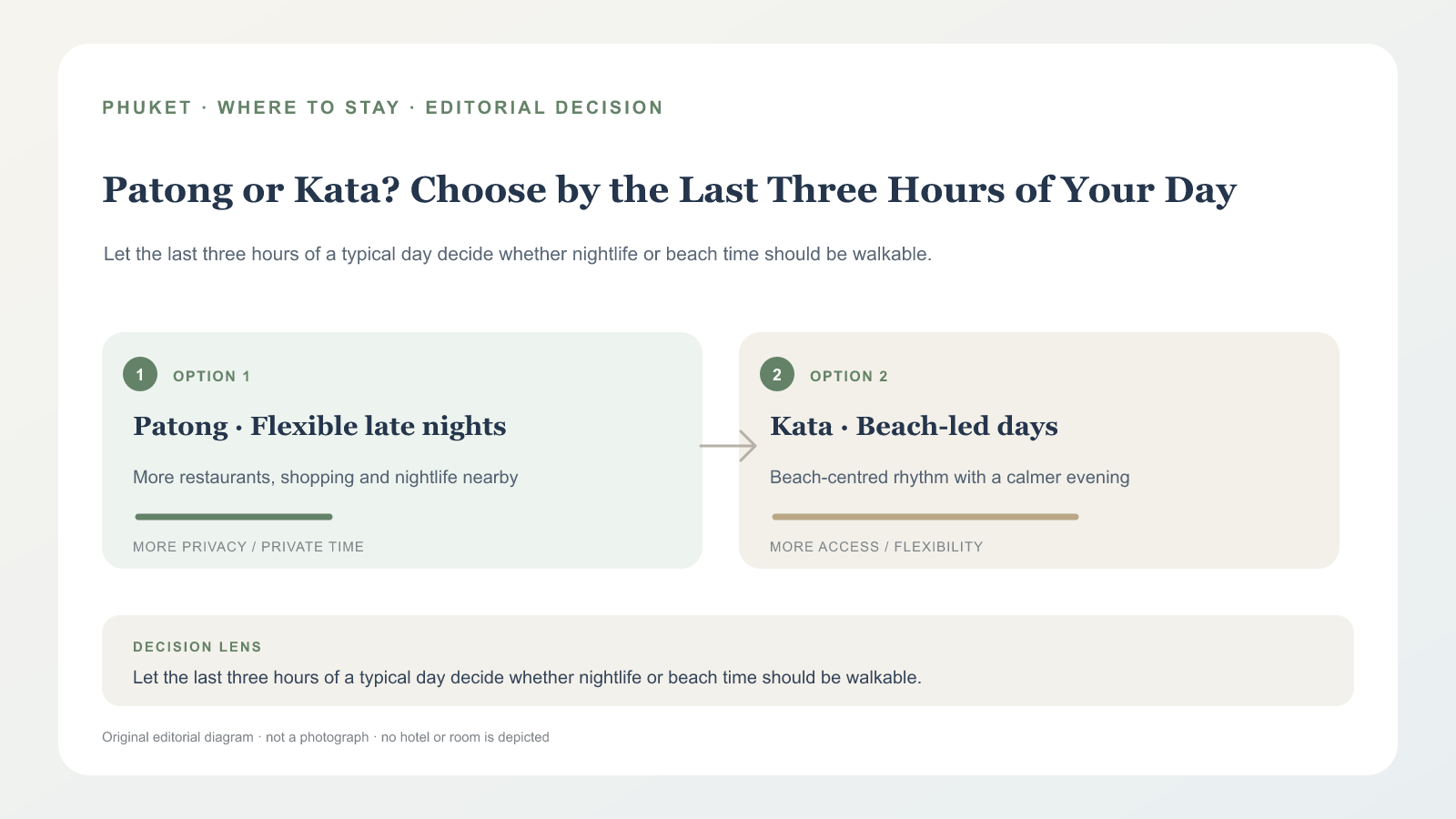
If you are still choosing among more than two Phuket areas, start with our broader Patong, Kata or Kamala where-to-stay guide. Patong versus Kata is the sharper decision once your shortlist has narrowed to the island's busiest tourist centre and a more beach-led south-west base.
Tourism Authority of Thailand currently describes Patong as a major tourist centre with a wide range of accommodation, shopping and restaurants, and Phuket's nightlife remains one of the island's defining visitor draws. Kata is also one of Phuket's established major beaches rather than an isolated resort enclave. The real difference is not “busy place versus empty place.” It is how much activity you want immediately outside the hotel after the beach day is over.
The 30-second answer: decide at 10 p.m., not 10 a.m.
Patong wins if 10 p.m. often means “one more drink, dessert, shopping, live music or somewhere else before bed.” Its commercial density makes the last part of the night easier to extend without turning every change of plan into a transport decision.
Kata wins if 10 p.m. usually means “walk back after dinner, shower, sleep, then have a better beach morning.” You still have restaurants and visitor services, but the base does not need to function as your nightlife district.
Do not choose either area by the beach photo alone. The exact hotel pin can still put you uphill, deep inland or farther from the part of the neighborhood you expect to use.
Stay planning
Find a place to stay
See available rooms around the property or neighborhood discussed here, with prices for your dates.
Run your trip through the last-three-hours test
Most Phuket accommodation comparisons begin with the beach. That is logical, but it overweights the easiest part of the day. At 11 a.m., both Patong and Kata can give you beach time, cafés and tourist infrastructure. The more revealing test is what you want after dinner, when heat, rain, tired feet and the desire to stop planning start to matter.
Patong
You can let dinner stay undecided for longer. A busy commercial base is useful when nobody wants to commit to one venue before leaving the hotel.
Kata
You can still walk out for dinner if the hotel pin is sensible, but the evening is more likely to stay inside one beach-town radius rather than keep expanding.
Patong
This is where the convenience premium becomes real if you enjoy late activity. The night can continue without a separate “how do we get back?” discussion.
Kata
If you are already satisfied after dinner, Kata's quieter rhythm stops feeling like a compromise. You are not paying for nightlife choice you never intended to use.
Patong
Choose the exact hotel carefully. Being close to the action is useful only if the sound, traffic and pedestrian intensity still fit the kind of room you want to return to.
Kata
A late return from elsewhere on Phuket is more deliberate. If you expect several nights outside Kata, the ride dependence starts to erase the reason you chose a calmer base.
Patong buys optionality; the cost is that the neighborhood rarely disappears
Patong is easy to recommend for the wrong reason. “It is convenient” is true in a broad sense, but convenience is not neutral. You are buying a place where accommodation, restaurants, shopping and entertainment sit close together, which is valuable when your plans keep changing. You are also choosing Phuket's most internationally recognised tourist centre, so a quieter hotel experience depends much more on the exact property location and how well it separates itself from the surrounding energy.
For a first Phuket trip of two or three nights, Patong can make practical sense when the schedule is already full. If one day is an island excursion, one is a beach-and-shopping day and both evenings remain open, a base that keeps food and late options nearby can prevent the trip from becoming a series of short car rides.
I would not choose Patong simply because you are afraid Kata is “too quiet.” Kata is not a remote beach. The better question is whether you actively want Patong's extra evening choice. If you do not, the extra density is not a free benefit.
Kata buys a softer daily rhythm; the cost is that late plans need more intention
Kata is the stronger default when the beach matters more than nightlife but you still want a tourist base with enough food and services to avoid feeling stranded. It is especially convincing for couples and two friends who like an evening to have a natural end rather than a second and third venue.
The trap is assuming every Kata hotel gives the same walk-out experience. If your shortlist is inside Kata itself, read our Kata Yai vs Kata Noi guide. Kata Yai behaves more like the editable beach-town base; Kata Noi is smaller and more resort-led. If you are comparing Kata with the neighboring longer beach instead, Kata vs Karon without a scooter is the better next decision.
For travelers who are considering going quieter still, our Nai Harn vs Kata guide makes the trade more explicit: a smaller movement radius and planned rides versus a more self-contained base that tolerates multiple small daily exits.
More external energy
The location works best when you want to use the commercial density. If your ideal evening is early dinner, quiet pool time and sleep, the neighborhood's biggest advantage is not doing much for you.
More deliberate late returns
Kata works best when most evenings finish locally. If you repeatedly leave for Patong or another nightlife area, you have turned a calmer base into a recurring ride home.
The Smart Bus connects the areas, but it does not make them interchangeable
Phuket Smart Bus currently operates its Airport–Rawai route through Patong, Karon and Kata in that order southbound, with the sequence reversing northbound. That is useful because you can move between Patong and Kata without routing through Phuket Town. Choose the base where you expect to spend most evenings; use the bus for occasional trips rather than a nightly commute.
The operator also warns that timetable times are approximate and traffic can affect them. A public connection is excellent for a planned daylight beach hop; it is a weaker substitute for choosing the base whose evenings you actually want. Our Patong to Karon or Kata: Smart Bus vs Grab guide handles that local transport decision in detail.
If you are considering a scooter because you want freedom between beaches, read scooter vs Grab in Phuket before turning the accommodation problem into a self-drive problem. A cheaper or prettier hotel is not a saving if its location forces you into a transport mode you are uncomfortable using.
Before paying, audit the exact hotel pin with five questions
- What is the final walk after dinner? Check the actual entrance, not the centre point of Patong or Kata on a booking map.
- Is there a hill, large road or awkward crossing? A short distance can behave very differently in rain, humidity or sandals.
- Where will a Grab actually collect you? A resort driveway or side road can add friction even when the neighborhood itself is convenient.
- Can you reach one dinner, one convenience store and the beach without a vehicle? If yes, the hotel has a workable everyday radius.
- Will you still like the location after 10 p.m.? In Patong, check whether the activity level is too much; in Kata, check whether the street becomes quieter than you are comfortable with for the final walk.
For a solo woman, choose the easier final 500 metres
I would not reduce this to “Patong is safer because it is busier” or “Kata is safer because it is calmer.” Those labels are too crude. A busy street can be noisy and tiring; a quiet street can feel perfectly comfortable or uncomfortably empty depending on the exact route, lighting and hour.
For a solo stay, I would prioritize a visible hotel entrance, a final walk on streets you expect to use naturally, and a location where you are not repeatedly waiting alone for a ride just to reach dinner. Patong often gives you more people and businesses around late; Kata can give you a calmer return if the hotel sits on a useful, lived-in route rather than deep up a side road.
Also think about how you arrive. If you land late and Patong is the choice, our Phuket Airport to Patong guide separates the arrival options. If your first or last night is mainly about the flight rather than the beach area, Nai Yang vs Bang Tao for a flight night may solve a different problem more cleanly than either Patong or Kata.
Rain makes the hotel pin more important than the beach name
Tourism Authority of Thailand currently reminds Phuket visitors to follow beach red flags, and the Smart Bus operator notes that road timings can move with traffic. In wet weather, the practical value of a base shifts from “which beach looks better?” to “how exposed is the repeated walk between room, dinner, pickup point and shelter?”
Kata remains my lean for a beach-led trip, but only with a sensible exact pin. Patong remains the more flexible late-evening base, but a quieter property location becomes more valuable when bad weather keeps you around the hotel for longer stretches.
If island tours are a major part of the trip, do not over-optimize the beach base for one pickup
One excursion should not decide the hotel unless its departure creates a genuinely difficult handoff. If you are choosing your main Phuket boat day now, our Phi Phi vs Phang Nga Bay comparison decides by swimming, snorkeling, kayaking and the shape of the day rather than by which card has the prettier island photo.
If Phi Phi is part of a ferry connection rather than a day tour, the logistics are different again. Use the Phuket Airport to Rassada Pier guide to protect the airport-to-boat buffer instead of assuming a west-coast hotel location solves the connection.
2–3 nights, nightlife matters
Patong. The short stay gives you fewer evenings, so keeping late options close has more value.
4–5 nights, beach + dinners
Kata. You have enough time for excursions without making every evening a nightlife decision.
Resort-first holiday
Neither automatically. If the property is meant to carry the trip, compare Kamala, Bang Tao or quieter resort areas before assuming Patong or Kata is the right shortlist. Start with Bang Tao vs Kamala.
Choose the area first, then make the hotel earn the premium
Once Patong or Kata has won, stop comparing hotels across both areas as if location were a minor feature. The room should be judged inside the base you have already chosen. If a more expensive hotel gives you a materially better final walk, quieter room position, usable pool, better drop-off or a beach setup you will use every day, the premium may improve the trip. If the upgrade is mainly decorative while the location becomes worse, I would keep the cheaper, better-placed option.
This is the same reason our Phuket stay network starts with where to stay in Phuket before room categories. A good hotel in the wrong daily rhythm is still the wrong booking.
My final pick
Pick Kata for the more balanced Phuket holiday. I would choose it for most couples, two-friend trips and first visits where the beach, dinner and a comfortable return to the room matter more than having the island's biggest nightlife choice outside the door.
Pick Patong when late flexibility is a real priority. If you already know you will stay out late, shop after dinner or change venues more than once, accepting the busier environment can remove repeated transport friction.
Whichever wins, check the exact hotel entrance before paying. The neighborhood decision gets you 80% of the way there; the final pin decides whether the remaining 20% feels easy every day.
Sources checked
Stay planning
Find a place to stay
See available rooms around the property or neighborhood discussed here, with prices for your dates.