
If you are still deciding among broad parts of the city, start with where to stay in Bangkok. If you already know you want Chit Lom but are comparing it with a more self-contained Sukhumvit neighborhood, read Chit Lom vs Phrom Phong. This page answers a narrower question: two premium central micro-bases that can both work beautifully, but reward different repeated routes.
The fast answer: do not compare the neighborhoods by distance alone
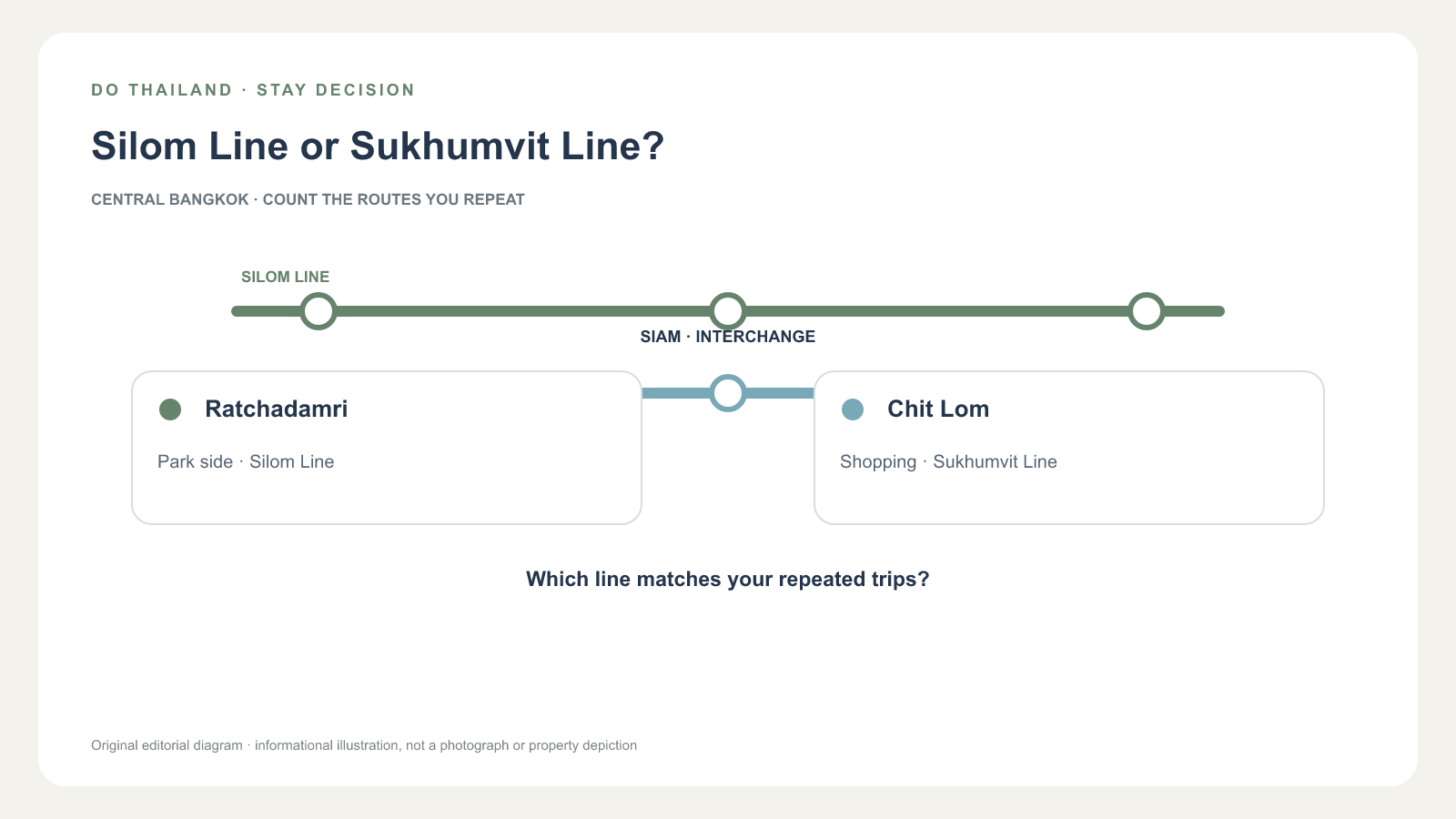
Ratchadamri is on the BTS Silom Line; Chit Lom is on the BTS Sukhumvit Line. BTS currently identifies Siam as the interchange between those two lines. That makes the decision less about whether either area is “central” and more about which line your repeated plans already use.
If two or three of your most repeated journeys naturally sit on the Silom-Line side of the network, Ratchadamri can quietly remove friction. If your days repeatedly run east-west through Chit Lom, Siam, Phloen Chit, Asok or Phrom Phong, Chit Lom usually keeps the everyday map simpler.
Stay planning
Find a place to stay
See available rooms around the property or neighborhood discussed here, with prices for your dates.
What Ratchadamri actually buys
Ratchadamri works when you plan to spend time near the hotel as well as travel around the city. The Silom Line runs along Rajdamri Road and passes the Lumpini side of central Bangkok before reaching Siam, according to BTS's current system description. Bangkok Metropolitan Administration currently lists Lumphini Park as open daily from 04:30 to 22:00. That does not mean every Ratchadamri hotel is “next to the park”; the exact entrance still matters. It does mean that park-led mornings and a more hotel-centred central rhythm fit this side of the city naturally.
This is the base I would prefer when the trip includes substantial hotel time, a morning walk or run matters, and I do not need every dinner to emerge from the densest shopping district. It also makes more sense when your central-Bangkok plans lean toward the Silom side often enough that changing lines at Siam would otherwise become a repeated habit.
If your alternative is the more energetic commercial side of Silom rather than Ratchadamri, step sideways to Siam vs Silom. For nightlife and MRT access, compare the Silom options separately; Ratchadamri answers a different hotel-base question.
What Chit Lom actually buys
Chit Lom's strength is a denser everyday retail-and-dining orbit around Ratchaprasong and Ploenchit. Central Chidlom currently opens daily from 10:00 to 22:00, and Central's own information says the store connects directly to BTS Chit Lom via Exit 5. The Ratchaprasong district's current visitor information also describes an elevated R-Walk network linking major shopping, hotel and entertainment nodes in the district.
That infrastructure matters most in ordinary moments: a storm starts before dinner, you want to shop after returning to the hotel, or you have ninety minutes between plans and would rather not create another taxi ride. Chit Lom is not automatically the better Bangkok base because it has more shopping. It is better when those indoor, walk-out options repeatedly replace extra movement.
If you are really comparing Chit Lom with Bangkok's main BTS interchange, use Siam vs Chit Lom. Siam wins more often when changing lines itself is the daily job; Chit Lom wins more often when the Ratchaprasong/Ploenchit orbit is part of the trip.
Your trip leans south and your hotel matters
Choose it when park time, hotel downtime and repeated Silom-Line journeys are real parts of the itinerary rather than decorative ideas you may never use.
Your trip keeps returning to Ratchaprasong
Choose it when shopping, indoor dining, Ploenchit and the Sukhumvit Line will absorb multiple small decisions every day.
Use a three-journey test, not a neighborhood reputation
Before you compare room categories, write down the three journeys you are most likely to repeat. Not the three biggest attractions—your repeated journeys. They might be hotel to dinner, hotel to a friend's hotel, hotel to a work event, or hotel to a station before a day trip.
Journey 1: your most common morning departure
If it naturally sits on the Silom Line or the Lumpini/Silom side, Ratchadamri gains a point. If it runs east along the Sukhumvit Line, Chit Lom gains a point.
Journey 2: your most common post-hotel-reset evening
If you want the evening to stay inside Ratchaprasong, Chit Lom gains a point. If you expect a quieter hotel evening or a deliberate ride elsewhere, Ratchadamri does not need to imitate that retail density.
Journey 3: your least glamorous logistics day
Airport arrival, luggage, an early rail day or rain should break ties. Read BKK to Sukhumvit by rail vs taxi and BKK vs DMK before pretending the first and last day are identical to the middle of the trip.
The Siam-interchange rule
BTS currently describes Siam as the interchange between the Sukhumvit and Silom lines. One interchange is not a travel crisis. The problem is repetition. If your chosen base creates the same change at Siam two or three times a day, every day, that is the kind of tiny friction a hotel map rarely prices in.
This is why I would not pay a premium for a prettier Ratchadamri room if almost every meaningful plan lies east on the Sukhumvit Line. I also would not pay more for Chit Lom simply because it is familiar if my trip is mostly hotel time, park mornings and Silom-side plans.
Rain changes the answer more than heat does
Bangkok heat makes the last few hundred metres important in both areas. Rain makes covered movement and easy indoor fallbacks more valuable. Chit Lom has the clearer advantage when you specifically want Ratchaprasong's elevated and mall-connected pedestrian network to absorb wet-weather transitions.
Ratchadamri can still work very well in rain, but you should inspect the exact hotel entrance rather than assuming the station name guarantees a sheltered final walk. This is the same reason the broader near-BTS vs deep-soi hotel decision remains important after you have chosen a neighborhood.
For a short trip, Chit Lom is easier to justify
On a two- or three-night city break, dense optionality is valuable because there is less time to recover from a badly placed hotel. Chit Lom often wins that short-trip version of the comparison, especially if shopping and central dining are already on the plan.
On a four- or five-night stay with deliberate hotel time, the answer can flip. Ratchadamri becomes more attractive if you are actually using the room, pool, spa or park-side morning rhythm rather than treating the hotel as a bed between twelve-hour sightseeing days.
If your short trip is driven by an early airport handoff instead, compare Siam vs Phaya Thai. If the question is whether moving one BTS stop away buys a better room, Siam vs Ratchathewi is the more useful decision.
For solo women and two friends, inspect the final 300 metres
A famous central neighborhood does not make every hotel entrance equally comfortable at 11 p.m. For a solo traveler, I would inspect the exact route from the BTS exit to the lobby, lighting, crossings and whether the final section requires a quiet side street. That is a route-specific comfort check, not a claim that one district is universally safer.
For two friends, the biggest booking mistake can be more basic: choosing the “better area” and then discovering the preferred room does not have the bed layout you need. Finish the area decision first, then verify the exact room category and cancellation terms before paying.
Pick Ratchadamri if...
You want a calmer central hotel rhythm, you will actually use Lumphini-side mornings or hotel facilities, and repeated Silom-Line movement is part of the real itinerary.
Pick Chit Lom if...
You want Ratchaprasong shopping and dining to function as an everyday fallback, you expect frequent Sukhumvit-Line movement, or you value covered central-city options when plans change.
Now compare the winning area, not all of Bangkok
The editorial decision comes first. Once you know which side fits your repeated routes, compare actual hotels around that station. Check the exact entrance, bed type, cancellation terms, breakfast and room category before treating the headline rate as comparable.
Five checks before you book
- Map the hotel entrance, not the neighborhood label. The station pin is not the lobby.
- Count your repeated line changes. One Siam interchange is trivial; the same interchange six times in two days is a pattern.
- Inspect uncovered walking. Heat and rain turn a small map distance into a repeated cost.
- Check your likely 9 p.m. plan. Choose the base that makes the tired version of you happier, not the ambitious itinerary version.
- Verify the exact room. Bed layout, usable floor area and cancellation rules can outweigh a micro-location win.
Where should you stay: Ratchadamri or Chit Lom?
For a first short Bangkok stay with shopping and varied central plans, I would usually choose Chit Lom. Its Sukhumvit-Line position and Ratchaprasong indoor network are easy to use even when the itinerary changes.
For a slower premium stay where the hotel and park-side rhythm are part of the holiday, I would choose Ratchadamri. But I would only pay that premium after confirming that the exact hotel pin genuinely reduces the routes I plan to repeat.
For the next layer of the decision, use Bangkok stay decisions, or step back to the Bangkok destination hub. If you are planning a day outside the city, Ayutthaya DIY train vs guided tour is a good example of why your base should support the handoffs you actually make.
My final rule
Choose the line you will repeat, then let the hotel earn the rest of the premium. Chit Lom wins when Ratchaprasong and Sukhumvit-Line optionality keep replacing extra trips. Ratchadamri wins when park-side mornings, hotel time and Silom-Line movement are genuinely used rather than merely attractive on paper.