
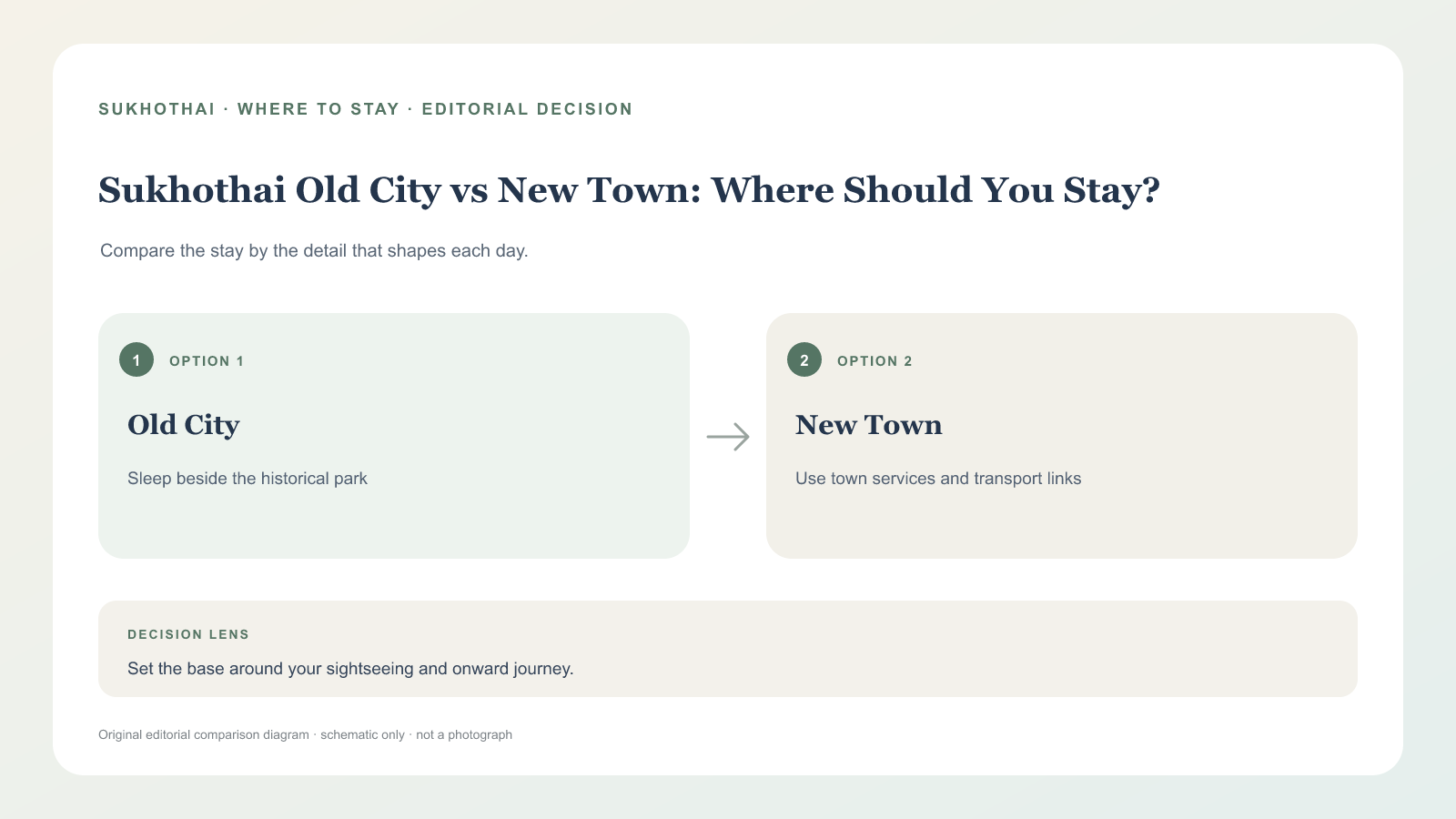
Sukhothai is unusually easy to misunderstand on a booking map because the name belongs to both a modern provincial city and the historic area around Sukhothai Historical Park. UNESCO's World Heritage listing protects the Historic Town of Sukhothai and its associated towns; the Tourism Authority of Thailand still describes the Historical Park as the province's central heritage draw. The Fine Arts Department places the park in Tambon Mueang Kao, not in the modern riverside city centre.
Recent independent destination reporting puts the practical gap at about 12 kilometres between Old Sukhothai and New Sukhothai. That is short enough to cross, but long enough to become a repeated tax if you choose the wrong base for the shape of your stay.
Sukhothai runs on two clocks
Choose the clock you cannot afford to keep resetting.
The park clock · Old City
Old City earns its room rate when you want to be close to the Historical Park at more than one moment: opening time, a mid-day room reset, a second cycling block, or Saturday evening.
The Fine Arts Department currently lists the main Historical Park hours as 06:30–19:30 Monday–Friday and Sunday, and 06:30–21:00 on Saturday. Wat Si Chum / Wat Phra Phai Luang and the Aranyik area have different, shorter schedules, so “the park is open” does not mean every zone runs to the same clock.
The transfer clock · New Town
New Town earns its room rate when the stay is shaped more by buses, an onward route, luggage or a short urban evening than by repeated park entries. A current Travelfish update describes New Sukhothai as closer to the main bus station, with a broader budget-accommodation, food and nightlife base.
That does not make New Town the better sightseeing base. It makes it the more useful handoff base when transport is the thing most likely to break the itinerary.
Stay planning
Find a place to stay
See available rooms around the property or neighborhood discussed here, with prices for your dates.
Count crossings, not kilometres
A 12-kilometre gap is harmless once. It becomes a hotel-location problem when it appears four times in thirty-six hours. The cheapest way to think about this is to count door-to-park crossings and luggage handoffs separately.
The four-movement score
Before you compare hotel rates, write down which of these movements actually exists in your itinerary.
If movements 2 and 3 repeat, Old City usually wins. If movements 1 and 4 are the parts you are most worried about and the park is one clean block, New Town can win.
Old City puts you close to the ruins and lets you split park visits
The better reason to stay near Mueang Kao is that proximity lets you divide the park into the hours when you actually enjoy being outside. That matters in Sukhothai because a heritage day can involve cycling, exposed paths, temple interiors, sunscreen, water and repeated transitions between moving and stopping.
Old City therefore buys schedule elasticity around the reason you came. If you would never use an early start, never return to the room and never re-enter the park, much of that premium disappears.
New Town is strongest when your park day is already compressed
New Sukhothai should not be treated as a consolation prize. It is a different operating system. A June 2026 Travelfish update describes it as the modern provincial capital with stronger budget accommodation depth, closer access to the main bus station and a larger food/nightlife scene. TAT has also documented a Saturday walking-street market in the modern riverside city around Wat Ratchathani.
That matters most when you have decided the park will be one deliberate block: go out, see it properly, return once, and spend the remaining evening in the city. In that version of Sukhothai, paying to sleep beside the park may solve a problem you do not actually have.
The 5 p.m. return test
You still want another temple block
Old City is doing real work. You can reset, eat, cool down or wait for softer light without turning the second outing into another cross-city decision.
You are done with heritage for the day
New Town becomes more competitive. If dinner, a riverside walk or an ordinary city evening is what you want next, returning there is not “wasted travel”; it is returning to the part of Sukhothai you deliberately chose to use.
You are wet, hot or carrying more than planned
This is where the exact hotel pin matters more than a romantic area label. A shorter last kilometre, a simple reception handoff and a room you can reach without another improvised ride can be worth more than a better-looking lobby.
For solo women and two friends, test the return plan rather than asking which area is “safer”
I would not turn Old City and New Town into a blanket safety ranking. Instead, check whether your exact hotel lets you complete the ordinary parts of the day independently and without unnecessary negotiation.
For a solo traveler, look at the route from the hotel to dinner after dark, how reception helps with an early transfer, and what happens if rain or heat changes your park plan. For two friends, ask whether one person can return early while the other stays out without forcing both people into the same tuk-tuk, songthaew or room-key schedule.
The better base is the one that makes the unglamorous return predictable.
Three trip shapes, three different winners
Do not split a two-night stay just because both bases exist
Old City and New Town are close enough that a split stay usually creates more friction than value on a short trip. Two checkouts, two luggage handoffs and two exact hotel pins are a lot of administration to solve a 12-kilometre decision.
I would split only when the trip genuinely changes job—for example, a late transport arrival where the first night is purely a handoff, followed by a protected Historical Park block. If both nights are ordinary sightseeing nights, pick one base and use the saved move for actual Sukhothai time.
Eight checks before you book the exact hotel
Old City shortlist
- Is the property actually in Mueang Kao / Historical Park radius, or merely marketed as “Sukhothai”?
- How will you reach the park entrance at 06:30 if that early window is part of the value?
- Can you reach dinner the way you prefer after your final park block?
- Will the hotel store luggage if your bus or onward transfer does not match checkout?
New Town shortlist
- How will you get to and from the Historical Park, and what is the fallback if the expected local transport is not running when you need it?
- Does the exact room pin improve the bus-station / city handoff enough to justify another park crossing?
- Are you comparing the same dates, occupancy, room category, breakfast and cancellation terms?
- On departure morning, which movement is actually fragile: room → terminal, or room → one last park visit?
After the base wins, compare hotels inside the correct radius
The editorial verdict comes first: Old City for repeated Historical Park access; New Town for a transport-led stay with one concentrated park block. Use the area links below to compare current availability, total price and cancellation terms for the same dates.
Old City · Compare stays
Shortlist the Historical Park radius
Check the exact entrance distance, evening return, room category, breakfast and luggage plan before paying for a “Sukhothai” label.
New Town · Compare stays
Shortlist the modern city base
Compare the exact terminal/city handoff, park-transfer plan, evening radius and cancellation terms for the dates you will actually stay.
Where this decision sends you next
- Use the Sukhothai Stay Decisions hub as the exact-hotel and room chain grows.
- Use the Sukhothai destination hub for the wider city graph.
- If Sukhothai follows Bangkok, settle where to stay in Bangkok before adding another luggage handoff.
- If airport choice is still unresolved, compare BKK vs DMK before booking the first intercity leg.
- Use Thailand Transport Guides for the Bangkok–Sukhothai and onward-route problem rather than making the hotel solve it by accident.
- Use Thailand Experience Guides when the next decision becomes a specific cycling, heritage or day-trip product.
- Set up Thailand eSIM vs airport SIM only if connectivity is still an unresolved arrival task.
- If Sukhothai itself is not final, return to all Thailand destinations, all Stay Guides or All Guides.
My final rule
Stay near the clock you want to touch twice. If the Historical Park appears in two or more separate blocks of your stay, Old City usually earns the room. If the park is one clean block and the fragile moments are luggage, bus timing and an onward connection, New Town can be the smarter purchase. Do not pay to remove a crossing you were only going to make once.
Sources checked
Sources checked 13 August 2026: Thailand Fine Arts Department's current Sukhothai Historical Park map/contact page for Mueang Kao location, current main-zone hours and the different schedules for Wat Si Chum / Wat Phra Phai Luang and Aranyik; Tourism Authority of Thailand Sukhothai destination page for current destination framing; UNESCO World Heritage Centre for the Historic Town of Sukhothai and Associated Historic Towns; and Travelfish's 20 June 2026 Sukhothai accommodation update for the current Old/New accommodation split, approximate 12 km gap, bus-station proximity and modern-city food/accommodation context. Opening hours, local transport and hotel inventory can change; verify the exact date and route before relying on them.