
A cheap Bangkok–Hua Hin ticket can come with an expensive morning: a taxi across Bangkok, time finding the right departure point, and another ride after arrival. For this route, I would start with a map of the two hotel entrances. The train becomes attractive when a suitable station is easy to reach and the chosen carriage offers the comfort you want. A minivan earns its place when the booked pickup and drop-off reduce the work at either end.
That leaves room for different answers within the same group. Someone traveling with a backpack may happily take a small road vehicle, while a friend with a large suitcase may prefer a reserved train seat. For a short beach break, the useful question is how much of the first afternoon survives the journey. Saving on the intercity fare matters less if the arrival leaves everyone too tired for the evening they planned.
The Bangkok station name belongs on the ticket
“Bangkok” is not enough information to send a taxi driver to the railway. Southern-line services use different starting points; Krung Thep Aphiwat, Thon Buri, and Bangkok Hua Lamphong appear in the rail network's departure information. A train number ties the station to a particular service. The ticket's named origin takes precedence over a familiar station photo or directions saved for an earlier trip.
Krung Thep Aphiwat is the large northern Bangkok rail terminal, while Thon Buri puts the departure on the west side of the river. Hua Lamphong is a separate station again. A hotel location that makes one easy can make another a substantial transfer. Comparing two train results without comparing their origins can hide that difference. I would favor a departure with a manageable first leg over an earlier train that requires a stressful cross-city start.
The same principle applies to minivans. A booking result may name a terminal, a counter, or a private pickup point rather than a rail-connected stop. The name “Mo Chit” can appear in travel directions without identifying the actual boarding area. A BTS station pin is not proof that the vehicle boards there. The confirmation needs a usable address or map pin and instructions for finding the counter; that is what goes into the taxi destination.
Buy the carriage you want, not an idea of rail travel
The train's biggest advantage for me is the possibility of a less confined journey. A suitable seated carriage lets the ride become part of the beach break rather than several hours squeezed into a small vehicle. But the word “train” alone promises neither air-conditioning nor a reserved seat. Ordinary services and faster services can offer different accommodation, and a low fare can reflect a very different carriage from the one imagined while browsing station pictures.
For a traveler who wants cool air and a confirmed place to sit, the booking comparison should use a train with those features explicitly listed. A fan-cooled option may suit someone who enjoys open-window travel and accepts the heat; it is a poor substitute for an air-conditioned ticket when comfort is the reason for choosing rail. Seat class, available accommodation, and the actual arrival hour deserve a closer look than the train's name.
A suitcase also has to get through the station and into the carriage. Rail can offer more scope to move around once aboard, but it does not remove lifting, boarding steps, or finding storage. For someone with limited mobility, the relevant questions concern the particular station access and carriage entrance. A friend carrying the bags can help, but that does not turn every service into an accessible journey.
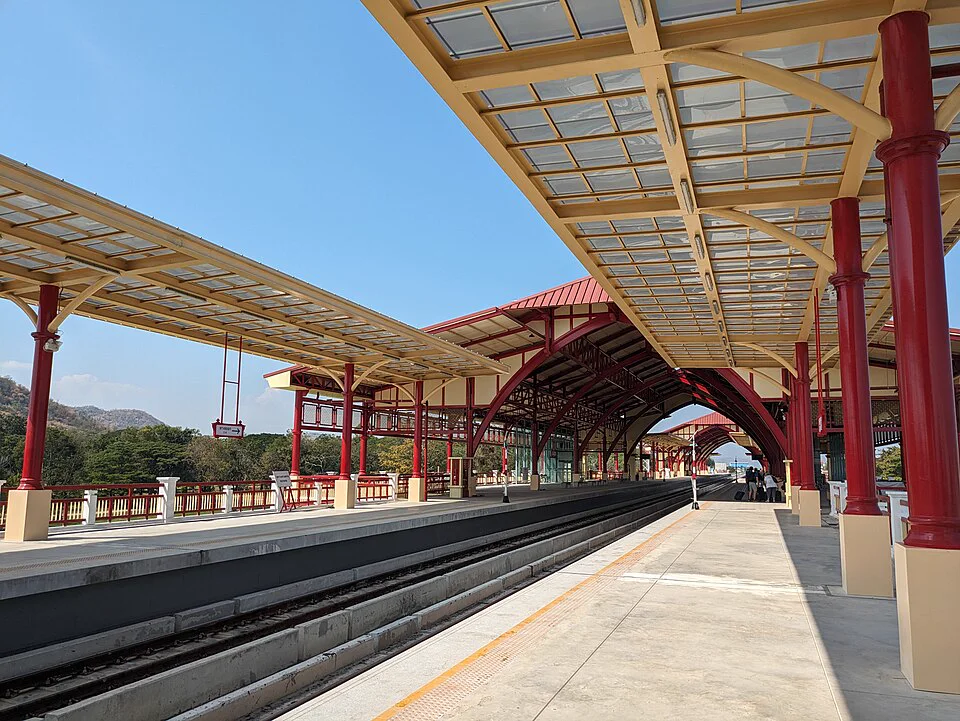
Hua Hin's elevated platforms are distinct from the historic station building often shown in travel features. The photograph here shows those newer platforms in January 2024. On arrival, the operational exit and pickup point matter more than reaching the familiar landmark for a picture. A hotel driver should have the train number and the agreed meeting location, especially when several people are traveling together.
When a small road vehicle is the better fit
A minivan is most persuasive when its departure fits the day and its stops fit the hotels. A couple checking out of Bangkok after breakfast may prefer an available road departure to waiting for a train that arrives much later. Conversely, a convenient train is hard to beat if the road booking requires reaching a terminal across the city. The road option needs to solve a real problem in the itinerary; flexibility on a route listing is not useful if the desired departure is full.
Small vehicles have a more intimate cabin, which can be fine with light bags and a comfortable seat. The uncertainty is where luggage goes when the vehicle is loaded. A fare for one passenger does not automatically settle the arrangements for a large hard-shell case. Bag dimensions and any additional charge belong in the prebooking conversation, along with whether the booking is for a van or a larger minibus. Those labels are sometimes treated loosely in search results.
I would compare the passenger total only after the carrier has explained baggage. Four friends with cabin bags and four friends with full-size cases are different loads. Buying an extra seat is useful only when the operator permits that arrangement and explains how the bag is secured. A loose case in an aisle is not a comfortable solution, and a group should not have to negotiate storage while the other passengers wait.
Road arrival estimates also move with traffic and intermediate stops. A quicker advertised run can lose its advantage before leaving Bangkok. For an arrival afternoon, a beach walk or an unreserved meal is easier to accommodate than a prepaid appointment. If the trip begins with a fixed event in Hua Hin, I would compare an earlier departure or travel the previous day rather than relying on the shortest estimate.
A base near the arrival
Compare central Hua Hin stays
Locate the hotel entrance against your confirmed arrival point before choosing the ticket.
Cha-am and the southern resorts change the last leg
A resort marketed as a Hua Hin stay may be in Cha-am, north of town, or farther down the coast. Traveling into central Hua Hin first can then create a ride back in the direction you came from. Cha-am appears on the southern railway line, but an express train passing through the district is not a guarantee of a stop. The selected service needs to show the destination you intend to use.
For a minivan, an intermediate drop-off also needs explicit agreement. A road running through Cha-am does not mean every departure offers a ticket to the same curbside point. I would ask the property which arrival point works for pickup, then compare only services that actually serve it. That avoids choosing a town name from a map and discovering that the booked vehicle ends somewhere else.
South of central Hua Hin, a resort transfer may still be the best last leg after either mode. An attractive beachfront room can be quite separate from the transport corridor. The pickup quote should identify where the car meets you and whether a delayed train or road service changes the charge. For a group, having one vehicle ready for everyone can be more useful than sending friends out in separate taxis.
A central hotel gives a different tradeoff. Staying near restaurants can make the first evening easy after the journey, although that does not guarantee direct beach access. A resort outside town may offer the setting the group wants, with more dependence on arranged rides. The Hua Hin destination guide helps with the area choice; the beach-resort comparison considers the stay itself.
Use the complete fare for a group decision
Train and minivan prices become meaningful when everyone compares the same journey. The total includes getting out of Bangkok and reaching the hotel at the other end. For road travel, any accepted baggage charge belongs in that figure. Rail comparisons need the chosen carriage rather than the cheapest class on the route. Dividing a transfer car among four friends can change the result even when individual public-transport tickets look inexpensive.
There is a sensible point at which a private car deserves a quote. It can be attractive for several travelers with bulky bags or an outlying resort, provided the vehicle genuinely has space for the party and luggage. The quote needs to cover tolls and the hotel address. A small sedan advertised for four passengers may not fit four large cases, so the passenger count alone is an incomplete specification.
A full-size coach can be another option, but it is a separate product from a minivan. For someone arriving at Suvarnabhumi, there is an airport–Hua Hin coach with its own terminal and baggage arrangements. Its Hua Hin terminal is near Hua Hin Airport, not a promise of central-hotel delivery. That route can avoid entering Bangkok first, while being an unnecessary detour for someone already settled in a downtown hotel.
For a quieter coastal base
Check the Cha-am hotel address
Compare beach stays in Cha-am if your preferred resort would otherwise mean backtracking from Hua Hin.
The return can decide a two-night break
For a short stay, I would look at the journey back while choosing the outward ticket. A pleasing arrival is only half the calculation if the return cuts the last morning short or ends far from the next Bangkok hotel. The return pickup can differ from the outward drop-off, particularly for road services. Saving its actual location makes the final checkout easier than trying to reconstruct it from the first ticket.
A same-day flight connection needs a more conservative plan than a return to a Bangkok room. Neither a train arrival nor a road estimate guarantees that the airport leg will run on time. With an expensive onward flight, a Bangkok night before departure can be worth the extra room cost. For a relaxed hotel return, a later service may preserve time for breakfast and a final swim without making the evening depend on punctuality.
My preference for a friends' weekend would be a reserved, comfortable train when its station and arrival hour work, with a modest first evening rather than a packed arrival program. I would choose the minivan if the confirmed departure gives us more useful time at the coast and the baggage arrangements fit. The deciding result is a workable ticket for the people traveling, not a universal winner between road and rail.
Route evidence and booking limits · checked October 12, 2026
State Railway of Thailand southern-line reference supports the station network, including the different Bangkok stations, Cha-am, and Hua Hin. It is a legacy timetable endpoint; its displayed times are not reproduced as a date-specific offer. SRT's newer timetable search could not be retrieved reliably during this check. The official D-Ticket page was retrieved directly, but no travel-date inventory or fare was verified. Carriage descriptions and booked station names therefore remain ticket-specific.
Roong Reuang Coach's airport–Hua Hin route identifies the separate Suvarnabhumi service and its Hua Hin terminal near Hua Hin Airport. It is not evidence for a downtown minivan's stops or luggage rules. No directly controlled minivan-operator source was established for the previous JKP schedule claims; fixed departure intervals, guaranteed intermediate stops, fares, and blanket luggage allowances have been removed. Those details require confirmation for the selected carrier and departure.
Practical safety details: baggage needs a secure place that leaves the aisle clear; boarding steps and station access need checking for mobility limitations. Hotel pickup availability, last-mile prices, and flight-connection margins were not tested. Photographs are dated location evidence, not proof of present-day carriage interiors, station accessibility, or vehicle condition. Individual image credits and adaptations are expandable beneath the photographs.