
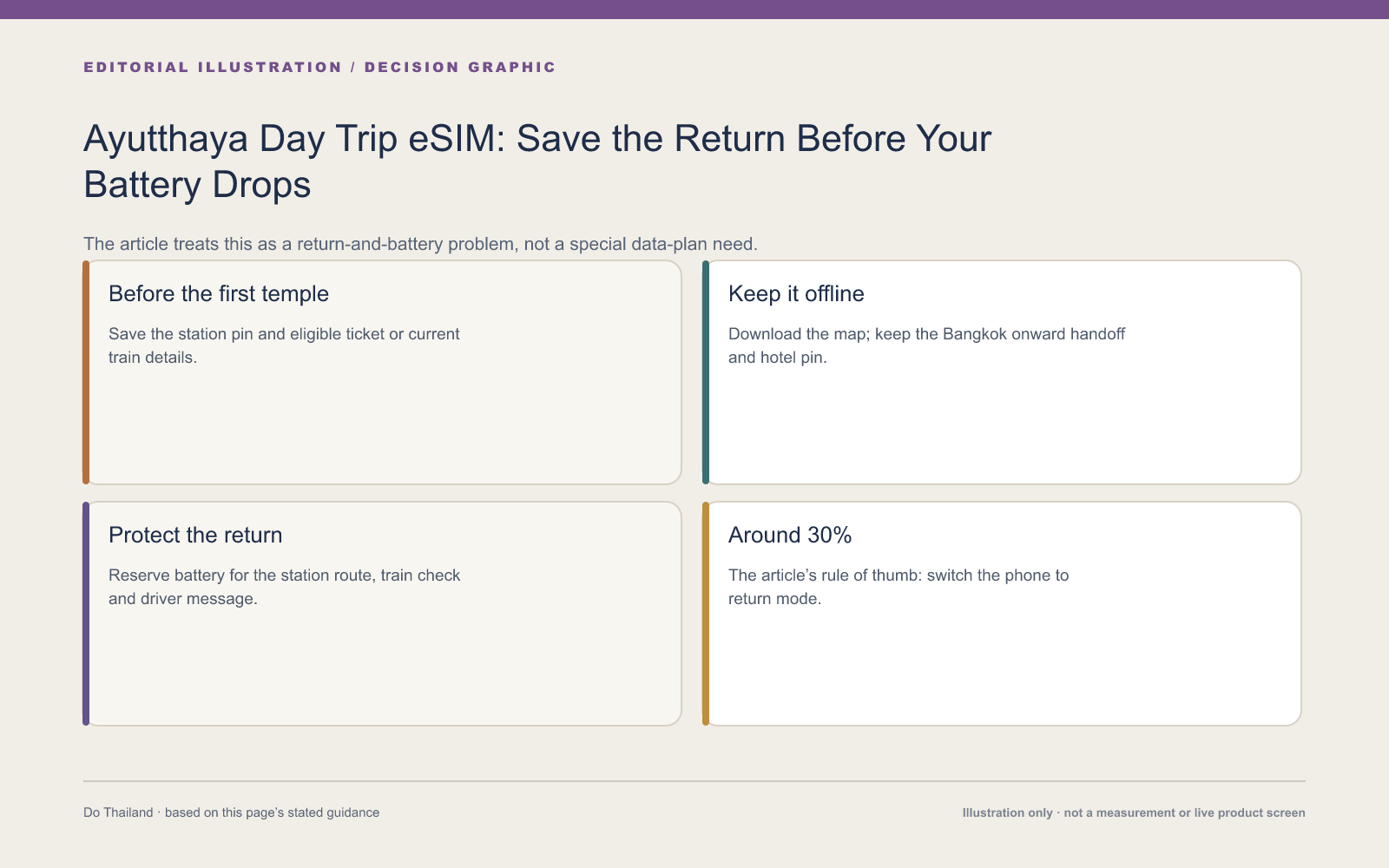
The recommendation first: protect the return, not the data allowance
An Ayutthaya day trip is rarely a reason to change a working eSIM. Maps, messages and a few live timetable checks do not require a special “Ayutthaya plan.” The fragile part is that a phone can be at 80% when you arrive, then quietly drop through photos, navigation, heat, video and screen time until the return to Bangkok depends on a device with almost no margin.
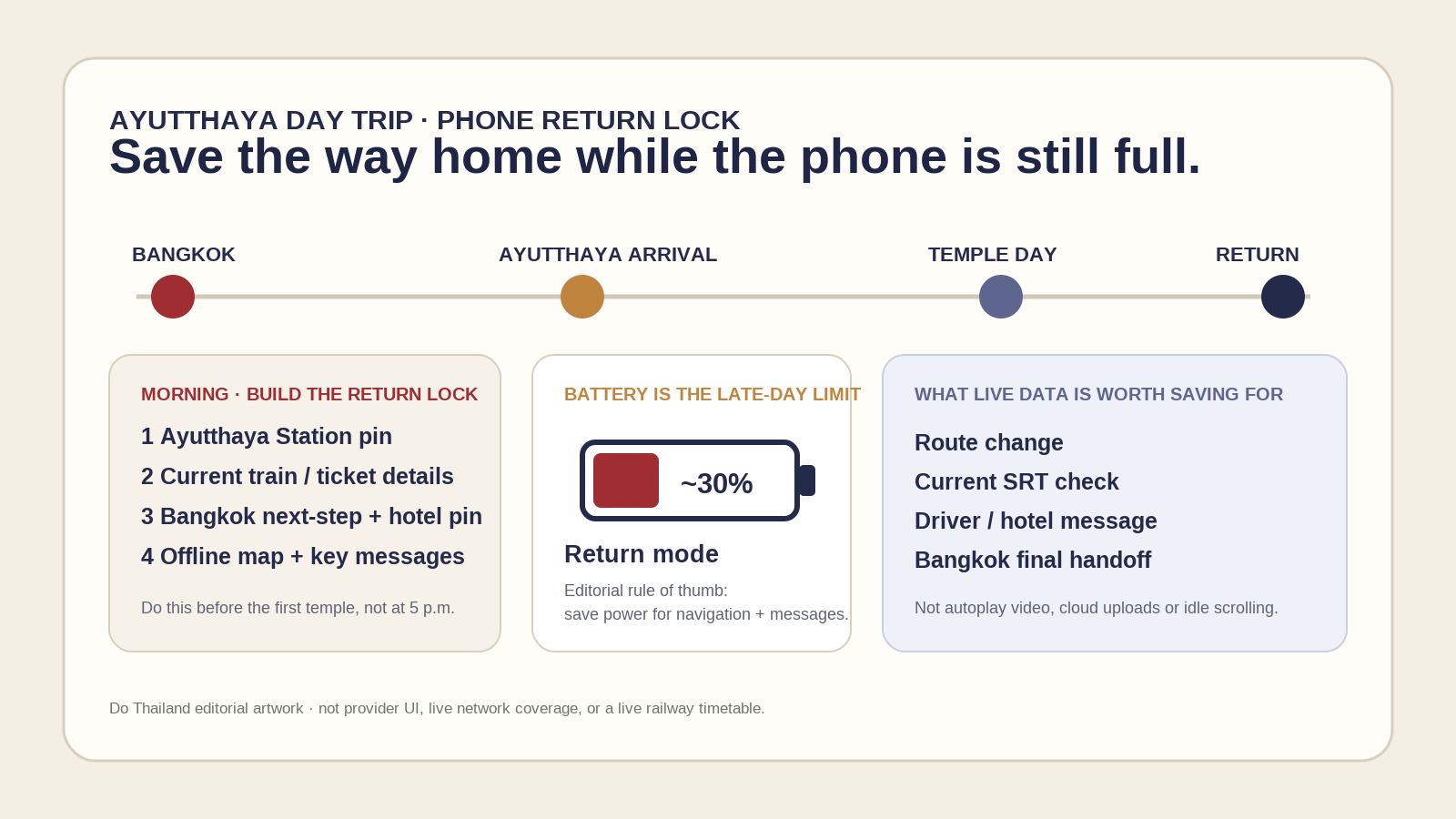
My rule is simple: build a four-item return lock before the first temple, then treat roughly 30% battery as the point where the phone stops being an entertainment device and becomes a transport tool. That 30% figure is an editorial rule of thumb, not a device-maker specification.
Ayutthaya is close enough to Bangkok to feel like an easy add-on: the Tourism Authority of Thailand currently places the historic city about 86 kilometres north of Bangkok. But the day itself is spread across ruins, roads and small transport handoffs. That makes the phone useful in short, important bursts rather than continuously.
This guide starts after you have already decided to travel independently. If you are still choosing between doing the day yourself and handing the coordination to somebody else, read Ayutthaya from Bangkok: DIY train or guided tour? first. The connectivity plan below is most valuable when you are managing the return yourself.
Think in three phone phases, not one giant data allowance
Prove the basics
Confirm the travel eSIM is the data line, save the return station, and check the current railway information before you are moving between ruins. If your Bangkok departure begins at Krung Thep Aphiwat, our hotel-to-Krung Thep Aphiwat guide solves that earlier handoff.
Spend data where it changes the day
Maps, translation, opening-detail checks and messages are useful. Continuous video uploads and idle scrolling are optional. A normal leisure eSIM does not need to become a streaming connection simply because the phone is in your hand more often.
Reserve the working margin
Late afternoon is when you may need the station route, a current train check, a driver message and the Bangkok final mile in quick succession. That is the wrong time to discover that your only copy of the return details lives behind a dying battery or a weak connection.
If you are unsure whether your whole Thailand trip has enough data, use the broader Thailand data allowance guide. Do not size the entire plan around one day trip. Ayutthaya is much more likely to expose a battery-and-handoff problem than a data-capacity problem.
Build this four-item “return lock” before the first temple
The aim is not to make the phone offline forever. It is to make the way home legible even if live data becomes inconvenient for an hour.
Save the exact railway-station pin and, ideally, a screenshot showing the name. Do not rely on typing a vague station search when you are tired and watching the clock.
If you hold an eligible D-Ticket, keep the ticket or emailed ticket file accessible. If you are travelling flexibly, save the current train numbers/times you are considering and recheck them before the last temple.
Know what happens after the train: which Bangkok station you expect, how you plan to continue, and your hotel pin. The return is not finished just because the train reaches Bangkok.
Download the relevant map area while connected and keep the hotel or travel-companion contact thread easy to find. If you use WhatsApp, LINE or iMessage, preserve the identity people already use to reach you.
Do not assume every useful Ayutthaya train can be booked online
The current State Railway of Thailand D-Ticket system lets you search by origin, destination, date and passenger count, then choose from eligible trains and times. But SRT's current D-Ticket terms explicitly say that ordinary, suburban, local and special-rate trains are not bookable through the internet system. That distinction matters on a flexible day trip.
So there are two different phone jobs. If you booked an eligible service, protect the ticket file and its train details. If you are planning to use an ordinary, suburban or local option, protect the decision information: the current official timetable, the station pin and enough time to deal with the station rather than assuming the phone can complete every transaction.
SRT's own FAQ points travelers to its current timetable system, and the timetable matrix presently contains multiple services calling at Ayutthaya. Treat that official system—not a screenshot from an old blog—as the source to recheck on your actual date.
| Your return setup | What to save before sightseeing | What still needs a live check | What not to assume |
|---|---|---|---|
| Eligible D-Ticket already booked | Ticket/email file, train number, departure time, Ayutthaya Station pin. | Any service notice or platform/station information you need on the day. | That a screenshot of a random timetable is more authoritative than your current ticket and SRT information. |
| Flexible ordinary / suburban / local return | Station pin plus two plausible current official services, written down or screenshotted for reference. | Recheck the current SRT timetable and station information before your final sightseeing stop. | That every useful train can be bought online. |
| Return followed by MRT / ride / hotel walk | Bangkok arrival point, hotel pin, next transport step and essential contact details. | Traffic, ride pickup or any last-minute route change. | That “back in Bangkok” means the final mile is solved. |
At about 30% battery, put the phone into “return mode”
This is not a universal battery-health threshold. It is a travel operating rule: once you reach the point where a few hours of sightseeing could consume the remaining margin, give the phone fewer jobs.
Keep: navigation when needed, railway checks, essential translation, hotel/driver messages, OTP access and the Bangkok final-mile plan.
Pause: autoplay video, social scrolling, background cloud uploads, unnecessary hotspot sessions and repeated photo reviewing. Turn on your device's power-saving mode if it suits your phone, reduce unnecessary screen use, and keep the return details available without opening five apps.
If you are sharing data with another traveler, remember that the person carrying the hotspot is also carrying the group’s battery dependency. For couples, our one hotspot vs two eSIMs guide explains when that single point of failure becomes annoying.
Offline maps are useful, but Google and Apple do not behave the same way
Google Maps offline
Google currently lets you download an area and navigate offline when the route stays inside that downloaded map. But Google explicitly says that transit, cycling and walking directions are unavailable offline; offline driving also loses traffic information and alternate routes.
For an Ayutthaya day on foot, that means an offline Google map is still valuable for orientation, pins and road context, but it should not be treated as a full replacement for live walking or transit routing.
Apple Maps offline
Apple currently documents offline maps that can provide turn-by-turn driving, walking, cycling and transit directions, plus ETA, where offline maps are available. Feature availability varies by country and region, so download and test the area before the trip rather than assuming it will appear at the last minute.
Whichever app you use, save the station as a named destination rather than expecting memory to do the work after a long hot day.
Your home SIM still has a separate job
A day trip is not a good reason to dismantle the dual-SIM setup that already works. If your bank or account codes arrive on your home number, keep that number available while routing mobile data through the Thailand line. Our home-SIM-for-OTP guide shows the job split, and which line should have data roaming enabled covers the settings logic.
If you are still preparing the phone before Thailand, confirm eSIM compatibility and carrier unlock status first. If the profile is not yet installed, use the installation and activation timing guide instead of trying to solve setup on the train.
If data dies at 4 p.m., fix only what blocks the return
Late in the day is a bad moment for destructive troubleshooting. First confirm that the intended travel eSIM is still the mobile-data line and that the provider-required roaming setting has not changed. A short airplane-mode cycle can force a fresh connection. Leave network selection automatic unless your provider specifically instructs otherwise.
Do not start inventing APN values. Our Thailand eSIM APN guide explains why manual APN changes belong only where the exact provider instructions require them. And do not delete the profile as a reflex: deleting and reinstalling an eSIM can create a harder recovery problem.
If the connection still fails, use the ordered checks in Thailand eSIM not working. The goal at this point is not to perfect the phone. It is to restore enough connectivity—or use the offline packet—to get to the station and complete the Bangkok handoff.
Three travelers who need different versions of this plan
Solo traveler returning after sunset: save the station, Bangkok arrival and hotel entrance early. Live data is most valuable for the changing parts—an unexpected route, ride pickup or message—not for information you could have stored at breakfast.
Two friends who split up for an hour: each person should have the hotel/station details, not one shared screenshot on one phone. If one person has the only working line, the group has a coordination problem disguised as a connectivity plan.
Traveler who photographs everything: the problem may be battery rather than gigabytes. Delay cloud backup and long uploads until hotel Wi-Fi. Keep the phone capable of doing the boring but important jobs at 5 p.m.
When to buy nothing
If your current Thailand eSIM has enough validity, some data remaining and a stable connection, keep it. Ayutthaya does not require its own eSIM. A new profile can add activation, routing and troubleshooting work without solving the real day-trip risk.
If you are deciding between the travel eSIM and a home-carrier pass for the whole trip, solve that at the trip level with Thailand eSIM vs roaming. Do not make the decision because of one afternoon outside Bangkok.
The operating rule I would keep
Save the return while your phone is still full, then spend live data only where it can change the day. Ayutthaya is a much better trip when the phone quietly supports the ruins instead of becoming the final attraction you have to manage.
Before the first temple, lock four things: Ayutthaya Station, current return-train information, the Bangkok next step, and an offline map/contact packet. If the battery reaches roughly 30%, switch priorities. The remaining power belongs to the way home.