
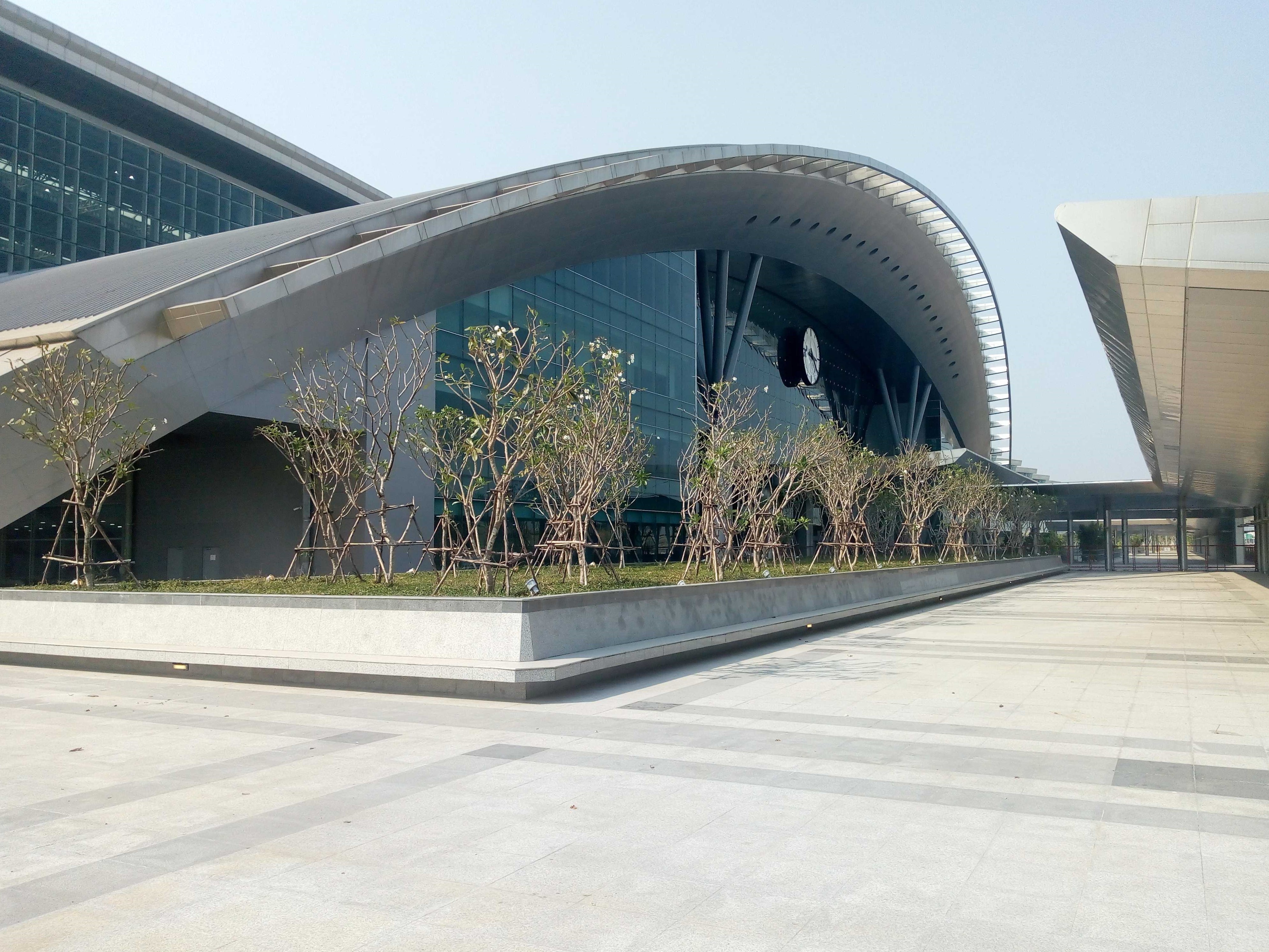
Bang Sue MRT connects to Krung Thep Aphiwat, but the MRT exit is only the start of the SRT leg. You still need to find your gate and boarding area, so plan around the time on your train ticket rather than the city-crossing estimate alone.
Check the actual departure times
Compare your first MRT with the train on your ticket
First check the origin station and direction. Then confirm your SRT train and terminal status for the travel date; these times change, so a general opening-hour estimate is not a route plan.
If you are choosing between rail and flying to northern Thailand, first read Bangkok to Chiang Mai: sleeper train or flight. This page assumes the train is already the plan and answers the smaller but surprisingly important question: how should you leave the hotel?
Start with the first train from your hotel-side station
The Blue Line has no single first-train time that works for every hotel. Check the departure from your actual station and direction; the timetable can show trains before 06:00. Then compare the ride to Bang Sue with the departure and boarding instructions on your SRT ticket.
Before the first train from your station
If the first train from your station leaves too little time for the ride, terminal walk and ticket checks, ask your hotel to confirm a car pickup. A route that only works if every handoff is immediate is too tight.
When the connection leaves too little margin
Count the hotel-door walk, wait, rail journey, Exit 3 connection and the walk to your SRT gate. If a missed train or slow interchange would put the departure at risk, the direct car is the more robust option.
Blue Line hotel with room to spare
If the hotel is genuinely close to a Blue Line entrance and the live timetable gives you a workable arrival, rail avoids Bangkok road traffic and drops you at Bang Sue MRT for the terminal connection.
Use the published schedule for the travel date, not a saved screenshot or a remembered first-train time. Leave room for one ordinary delay instead of planning a chain with no recovery option.
First check whether your hotel actually touches the Blue Line
Bangkok hotel names often advertise “near BTS” or “near MRT” as if the two systems are interchangeable. Before an early train, they are not. A hotel beside the Blue Line gives you a direct urban-rail path to Bang Sue. A hotel beside only the BTS may require a walk, an interchange and another station entrance before the useful part of the journey even begins.
Sukhumvit is directly on the Blue Line, so this is one of the cleanest hotel-to-station rail cases. If you are still choosing within the area, the Asok vs Phrom Phong decision matters because Asok gives you the MRT without needing a BTS hop first.
Both sit on the Blue Line. When the first-train schedule leaves a workable margin and luggage is manageable, rail avoids a cross-city road trip. The broader Siam vs Silom guide explains why this dual-rail geography can matter beyond the train day.
These are excellent Bangkok bases, but they are primarily BTS-led. For a normal daytime trip you can interchange. Before an early train, I would not add an unnecessary transfer simply to prove that public transport is possible. See Sukhumvit vs Siam if this is still a hotel-location decision.
Some Old Town hotels are genuinely walkable to the Blue Line; others are not. If your hotel requires a dark pre-dawn walk through small streets before you even reach MRT, a door-to-door car may be the more sensible transport choice. The Siam vs Old Town comparison is useful before booking.
Riverfront hotels vary widely in road and rail access. When the first move is already a shuttle boat, taxi or long walk, a single car to Krung Thep Aphiwat is usually the cleaner early-morning chain. See Riverside vs Sukhumvit for the bigger stay trade-off.
This is why “hotel near BTS” is not enough. A property can be excellent for sightseeing and still be awkward for an early long-distance train. If you are comparing two otherwise similar rooms, the near BTS vs deep-soi hotel guide shows how the final walk changes transport value.
Count the whole MRT handoff to the terminal
Hotel room → MRT entrance
Count the actual door-to-platform walk with luggage. A five-minute daytime stroll can feel different at 05:40 in rain, with a roller bag and a quiet side street.
Check the first train from your station
Check the train for your exact station, direction and travel date. The useful service is the one that gets you to Bang Sue with enough time to reach your SRT gate.
Ride to Bang Sue (BL11)
Bang Sue (BL11) is the Blue Line stop for the terminal connection. Check the journey from your own station in a current route planner, then allow for the walk after you leave the MRT platform.
Use Exit 3 for the main station connection
Follow signs to Exit 3 for Krung Thep Aphiwat; some MRT signs still use the former name, “Bang Sue Grand Station.” Exit 3 has an elevator. Exit 1 also has one, but leads toward Bang Sue Railway Station, so check the signs if you need a step-free route.
Find the correct long-distance gate and platform
Follow the departure time, ticket instructions and live station signs for your specific service. The walk from the MRT connection is only one part of reaching the correct gate and platform.
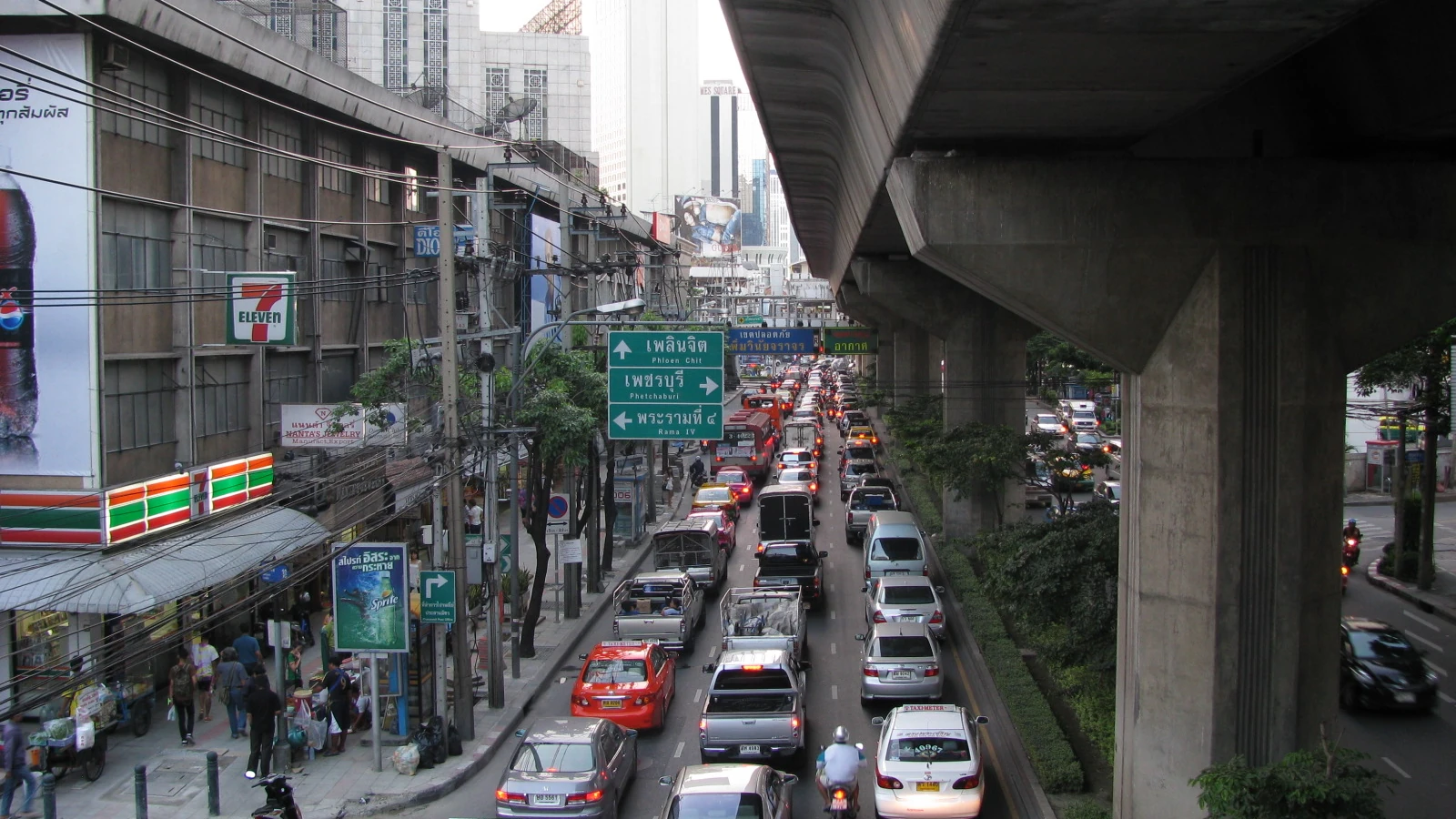
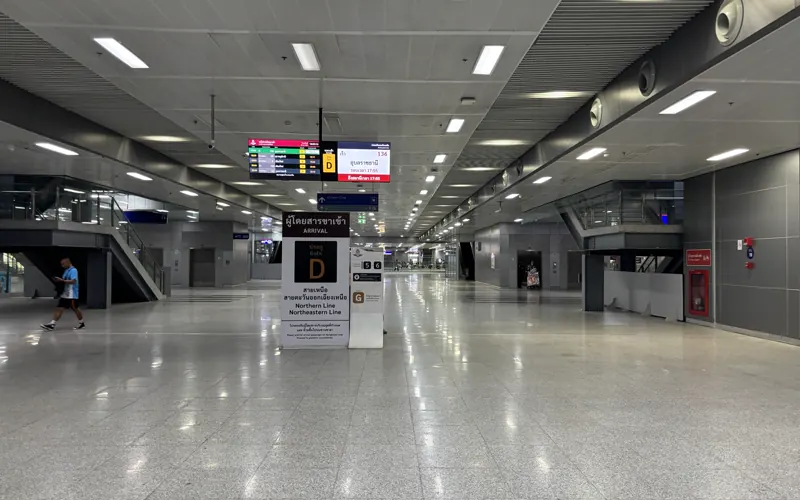
Swipe to compare the MRT handoff and the terminal interior.
Keep your actual ticket ready before you leave the hotel
Keep the ticket in the format provided when you booked and make it available offline. A gallery photo may not preserve the scannable ticket details, and a weak signal is a poor moment to sign back into a booking account. Check the current instructions attached to your own SRT ticket.
Build the station buffer backward from the gate, not from the curb
At Krung Thep Aphiwat, boarding calls begin about 20 minutes before departure, and staff close access to the second-floor boarding area three minutes before. Aim to be inside before the call; the MRT exit or car drop-off is not your boarding point. Leave time to check the departure board and find your gate and carriage.
Work backward from the departure on your ticket. Allow for the terminal walk and ticket checks, then add the transfer time and a margin for a missed train or a slow vehicle pickup. Do not treat a map's travel-time estimate as your arrival target.
If you have not bought the ticket yet, use SRT's booking service before departure day and read the ticket's station instructions. Queuing for a counter adds another step that a hotel-to-terminal estimate will not include.
Do not assume the Red Line solves a Blue Line hotel journey
Krung Thep Aphiwat serves more than one rail network, but the line that matters is the one you can actually reach from the hotel at that hour. A Red Line connection does not replace the Blue Line's station-specific first-train check or remove the transfer from a Sukhumvit or Silom hotel.
The network distinction matters around Don Mueang too. The DMK to Sukhumvit via the Red Line guide covers the airport-arrival route, which is a separate decision from reaching a long-distance train from your hotel.
Luggage changes the winner before it changes the timetable
One cabin-sized roller and a familiar MRT entrance are a very different task from two large suitcases, a deep-soi walk and an elevator search. Check the hotel-side station for a step-free route too; lifts at the terminal do not help if stairs block the way to your first platform.
Travelling with children or several bags adds time at lifts, ticket gates and platform changes. A solo traveller using a booked car can wait inside the hotel lobby and check the vehicle details before walking out; that is often more useful than trying to save a few minutes on the route.
When a direct car is the better fit
A direct car buys you one continuous handoff: hotel lobby to Krung Thep Aphiwat. Traffic still affects the drive, but at very early hours it removes the station-opening question, ticketing at the MRT and the luggage transfer through Bang Sue.
For a train you cannot afford to miss, confirm the pickup with the hotel or car provider the night before and agree on the exact terminal entrance. A ride request made at the last minute is not a backup plan if no car is available.
Give the driver the full destination name Krung Thep Aphiwat Central Terminal. Do not casually ask for “Bang Sue station” because the area includes Bang Sue Junction and the MRT station as separate transport references. The main long-distance terminal was formerly called Bang Sue Grand Station, which is why that older wording still appears on BEM’s Exit 3 signage.
For solo travelers, the hotel exit can matter more than the vehicle
An early start makes the hotel-side walk part of the decision. If your route to the MRT runs through a quiet or poorly lit soi, that first stretch may feel less comfortable than the train ride itself.
If you are travelling alone with luggage, a confirmed car lets you wait inside the staffed lobby until it arrives. I would use that option when the walk to the station feels exposed or the first-train margin is tight. With a close station entrance and enough timetable slack, the MRT avoids road uncertainty.
Rain is another tie-breaker. A covered lobby pickup can be worth more than a modest fare saving when you have a large suitcase, travel clothes you want to keep dry and a long train day ahead.
Do not move hotels just for one train unless the base is already wrong
It is easy to over-correct after seeing Krung Thep Aphiwat on a map and decide you should spend the last night near Bang Sue. For most visitors, one confirmed car solves the problem more cleanly than another checkout, another check-in and giving up a hotel area you actually wanted.
If you are still choosing a first-trip Bangkok base, use Where to Stay in Bangkok rather than optimising the whole trip around one station departure. If the train is only one piece of a wider airport-heavy itinerary, compare BKK vs DMK and the separate BKK to DMK airport-transfer guide before locking the sequence.
Sources and timetable checks · updated 5 October 2026
I checked current operator timetables, station details and ticket guidance. Times can change; use the timetable for your travel date and follow the instructions on your ticket.
- BEM first and last train times by station for the Blue Line origin and direction.
- BEM Bang Sue (BL11) station information for Exit 3, the terminal connection and elevator locations.
- SRT 2026 timetable search and Krung Thep Aphiwat live train board for the booked train and station status.
- SRT D-Ticket for booking details and the ticket issued for your journey.
- SRT Krung Thep Aphiwat station FAQ for station access and boarding cut-off guidance.