
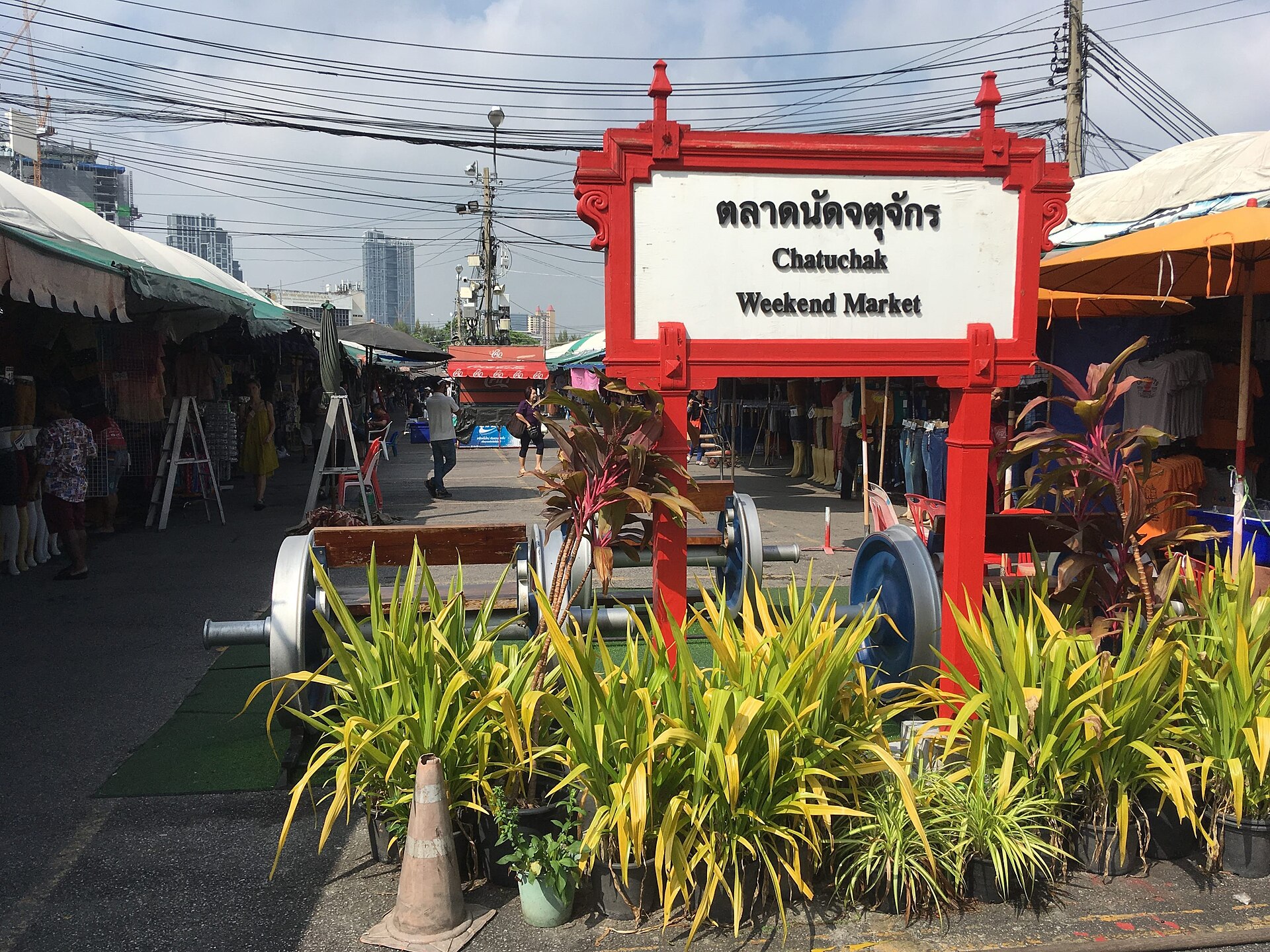

The mistake is treating Chatuchak like a mall where 10 a.m. and 4 p.m. are simply two interchangeable arrival times. The Bangkok Metropolitan Administration currently describes the market site as an outdoor public space and lists general market service through 6 p.m. The current Chatuchak Market website lists the full market on Saturday and Sunday from 9 a.m. to 6 p.m. That closing time changes the decision: every hour you delay the visit removes browsing runway from the far end of the day.
If you genuinely want to shop, arrive around the start of the full weekend trading window and leave when your interest, heat tolerance or bags say you are done. If you mainly want to see the market, buy a few things and move on to dinner, a later visit can work precisely because it forces you to be selective.
Maximum browsing runway, easier break timing and no need to decide in advance exactly how long the market deserves.
A compact browse when the market is a supporting stop rather than the centrepiece of your weekend day.
You give up the calmer start without gaining the clear time boundary that makes a late-afternoon visit efficient.
Morning is better when shopping is actually the point
Chatuchak rewards wandering. You turn down one lane for ceramics, another for clothing, another because a stall looks more interesting than the one you originally came to find. That is exactly why a morning start works: the market can expand or contract around your interest instead of forcing you to compress every decision into the remaining hours.
The current market website recommends allowing at least half a day for a proper look and says even a brief sweep can take several hours. You do not need to accept that as a target—there is no prize for “completing” Chatuchak—but it is useful evidence that this is not designed as a 45-minute attraction.
A morning start also gives you the cleanest exit strategy. If you are finished at noon, leave. If you find a section you love, stay longer. If you discover that shopping is less important to you than expected, you have not lost the rest of the day.
That flexibility is especially useful on a first Bangkok trip where the rest of your itinerary is still competing for time. If your base is not settled, start with where to stay in Bangkok rather than choosing a hotel around one weekend market. Chatuchak is easy enough to reach by rail that it should usually fit your base—not dictate it.
Late afternoon works when you want Chatuchak to have a hard stop
There is a different kind of traveller for whom less time is an advantage. Maybe you do not enjoy open-ended shopping. Maybe your goal is one or two categories rather than a full-market browse. Maybe you would rather reserve your morning for sleep, brunch or a neighbourhood you care about more.
In that case, arrive later with a narrow brief: see the market, browse a few sections, buy only what earns space in your luggage, then leave for dinner. The 6 p.m. close becomes a useful boundary rather than a threat.
What late afternoon does not do well is rescue an overstuffed sightseeing day. A temple-heavy morning in the Old Town followed by a rushed Chatuchak run is still two substantial urban blocks. If you are deciding between a central rail base and a temple-first location, the existing Siam vs Old Town guide is the better place to solve that larger itinerary trade-off.
Window A · Shopping-first day
Arrive in the morning, then let the market decide your departure
Use the first part of the visit for the categories you care about most. Break when you actually need food or air-conditioning rather than because a rigid itinerary says “lunch now.” When purchases become hard to carry, end your visit instead of starting another lap.
Window B · Market-as-one-stop day
Arrive in the later afternoon with a specific mission
Choose this only if you are comfortable leaving without seeing most of the market. Decide your exit before you enter: dinner near your hotel, a straightforward rail ride back or one nearby evening plan. The visit succeeds because it is deliberately incomplete.
Use the MRT entrance to reduce the least interesting part of the visit
For many visitors, the best timing decision is improved by a better entrance. Bangkok Expressway and Metro’s current station information lists Kamphaeng Phet (BL12) Exits 1 and 2 directly for Chatuchak Weekend Market. It also lists Chatuchak Park (BL13) Exit 1 for the market and connects other exits with Mo Chit BTS.
If your hotel already sits naturally on the MRT, Kamphaeng Phet is the cleaner market-first choice because the official exit information points directly into the market zone. If you are coming on the BTS Sukhumvit Line, Mo Chit remains the obvious rail approach; do not add a transfer simply to optimise one entrance.
This is why hotel micro-location matters more than abstract neighbourhood rankings. A hotel that is technically “central” but requires a long walk before and after every rail journey can make a shopping day feel heavier. Our near-BTS vs deep-soi guide deals with exactly that repeated friction.
Do not build a perfect route through the market.
Choose the rail line that already fits your hotel, enter, orient yourself once, and keep enough phone battery for the trip home. Chatuchak is large enough that a theoretically optimal entrance can save less time than you lose trying to execute an over-engineered shopping map.
Where you stay changes what “morning” costs
If you stay around Siam or Ratchathewi, a morning market does not require moving hotels or giving up your central evenings. The trade-off is simply whether you want to start the day with a rail trip north. Compare Siam vs Ratchathewi if you are deciding how much centrality to pay for, or Siam vs Phaya Thai if airport-rail access matters as much as weekend sightseeing.
If shopping is the theme of the whole trip, Siam vs Chit Lom is a more useful hotel question than “should I stay near Chatuchak?” Both central areas keep department stores and dinner options close after you return, while Chatuchak remains a purposeful weekend excursion.
And if you landed on a red-eye, do not force a 9 a.m. market start purely because this guide says morning is the better market window. The Bangkok red-eye arrival guide makes the opposite priority clear: protect sleep, luggage and room-access uncertainty first. A good Chatuchak morning assumes you are capable of enjoying it.
Carrying purchases is part of the timing decision
If you start early
You may buy more simply because you have more browsing time. Keep the rest of the day flexible so you can return to the hotel once carrying bags starts reducing enjoyment. Do not turn “we still have the afternoon” into an obligation to drag purchases across Bangkok.
If you start late
Your shopping window is shorter, but the onward plan matters more. If you want dinner after the market, choose somewhere that does not require a complicated chain of rides while you are carrying bags and watching your phone battery.
For solo women and friend trips, the practical rule is simple rather than alarmist: keep your phone, wallet and passport in a secure bag you can control in a crowded lane; avoid carrying so many loose shopping bags that you lose awareness of them; and decide how you will get back before your battery is low. The market is a shopping environment, not a test of how much you can physically carry.
Do not stack Chatuchak with another full decision-heavy day
A market and a day trip both look like “one line” on an itinerary, but they use attention differently. Chatuchak is thousands of tiny decisions: turn left or right, buy or wait, compare or move on, eat now or later. If the following morning is an early train from Krung Thep Aphiwat, keep the evening simple and use the MRT vs Grab departure guide to protect that handoff.
Likewise, if your weekend also contains an Ayutthaya day trip, let those be two distinct days rather than trying to make Chatuchak the “quick shopping stop” after a historical excursion. The value of the market comes from enough slack to browse without watching every minute.
The decision rule
Choose morning if you would be disappointed to leave Chatuchak unfinished; choose late afternoon if being forced to leave unfinished is exactly what you want.
For most first visits, that makes morning the better answer. Start with real shopping runway, stop when the market stops being fun, and give yourself permission to leave early. Late afternoon is not the secret “better” time—it is the better tool for travellers who want Chatuchak contained inside the day rather than allowed to take it over.
Continue with the Bangkok experience hub, the broader Bangkok destination guide, or browse all Thailand experience decisions.